Category: Black and White

  • Bristol – Home of artists. Part 3

    Bristol – Home of artists. Part 3

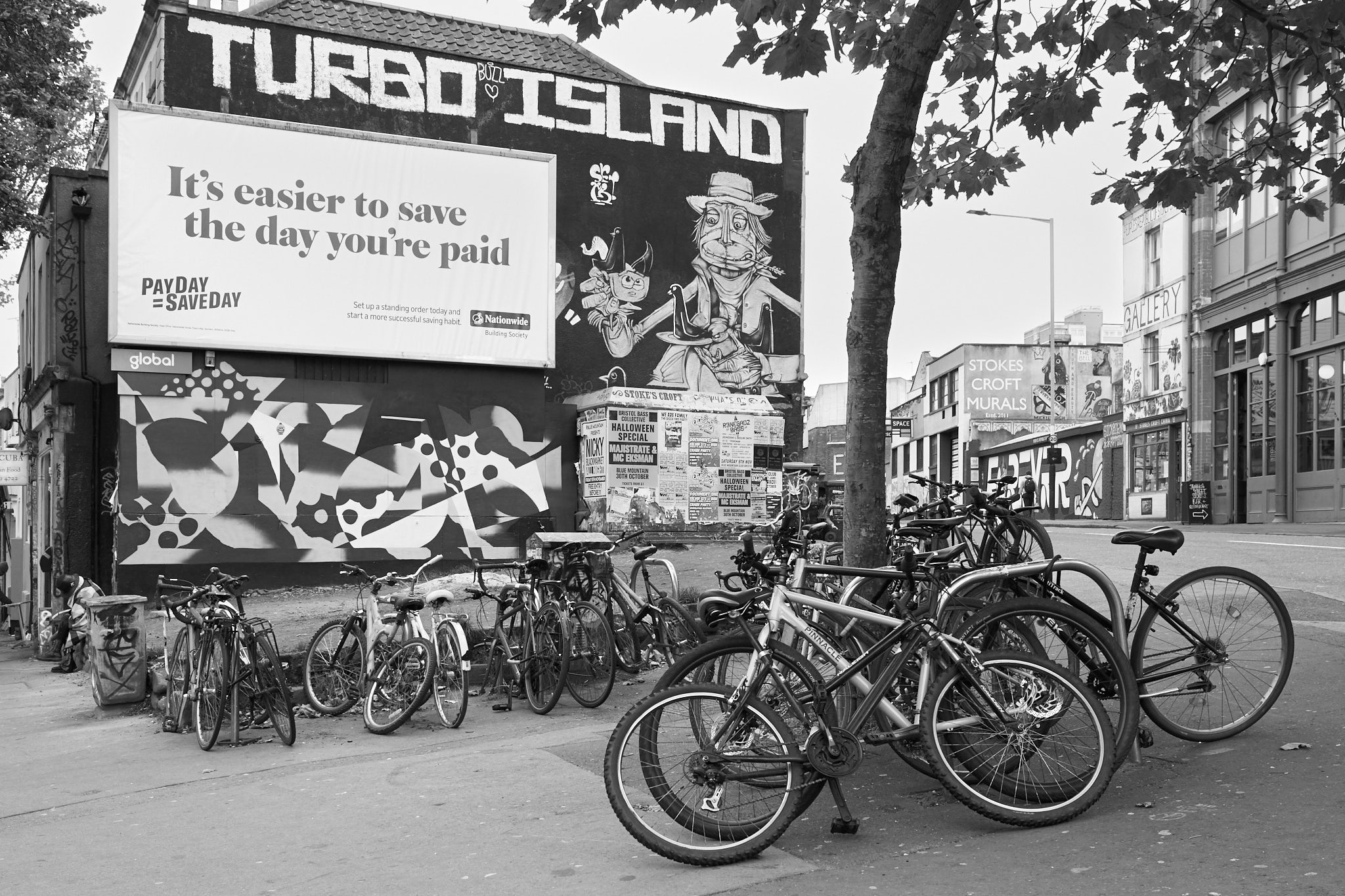
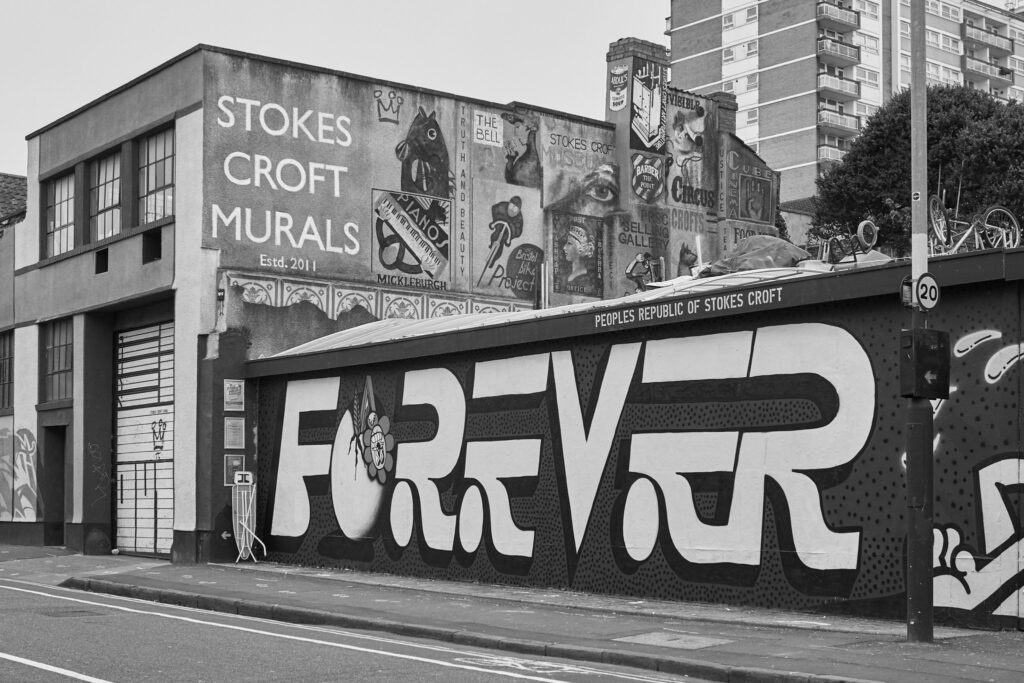
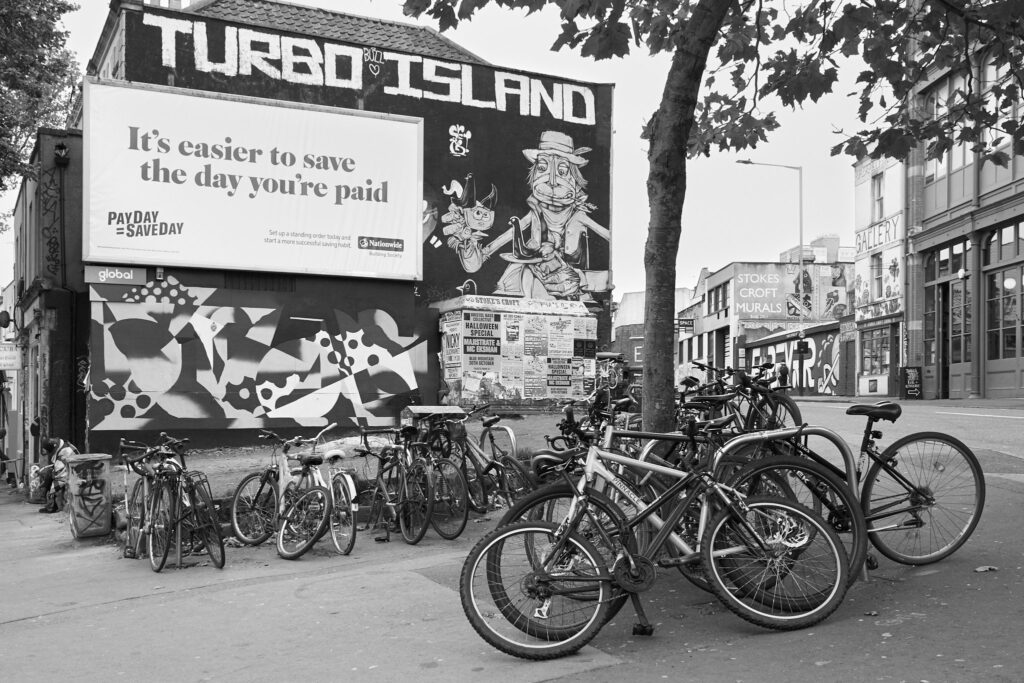
    The Mild Mild West is, of course, the Banksy on the side wall of the Canteen. Walk along the road from the city and it’s easy to miss. Walk towards the city and it’s impossible to miss! So what did I do? Yup, you guessed it! First I got distracted by the collection of bicycles under a tree at Turbo Island and then by a big stylised ‘Forever’ painted on the Peoples Republic of Stokes Croft (PRSC) Outdoor Gallery wall.  The paintings on this wall change frequently so its always worth a look when passing. The artwork is always of a very high standard.
    Stokes Croft mural
    Stokes Croft mural

    But above and to the left of the wall are my personal mural favorites. They are much smaller than others but very, very good. Click on the image to the left for a larger version were they are easier to see. Approximately fourteen small paintings, all designed to look like vintage 20th Century posters, decorate the outer wall of a building. My particular favourites are the Stamp, Abduls soup – a play on Campbells soup, Crofts – a play on Crufts, the Invisible Circus and the Bristol bike Project. It’s such a shame that one day we will loose these; photography will record them but photography won’t capture the emotional reaction to seeing them in-place and where they belong. The PRSC, an organisation that promotes street art in Bristol is located here and I urge readers to take a look at their website.
    Tsunami of Roses
    Tsunami of Roses

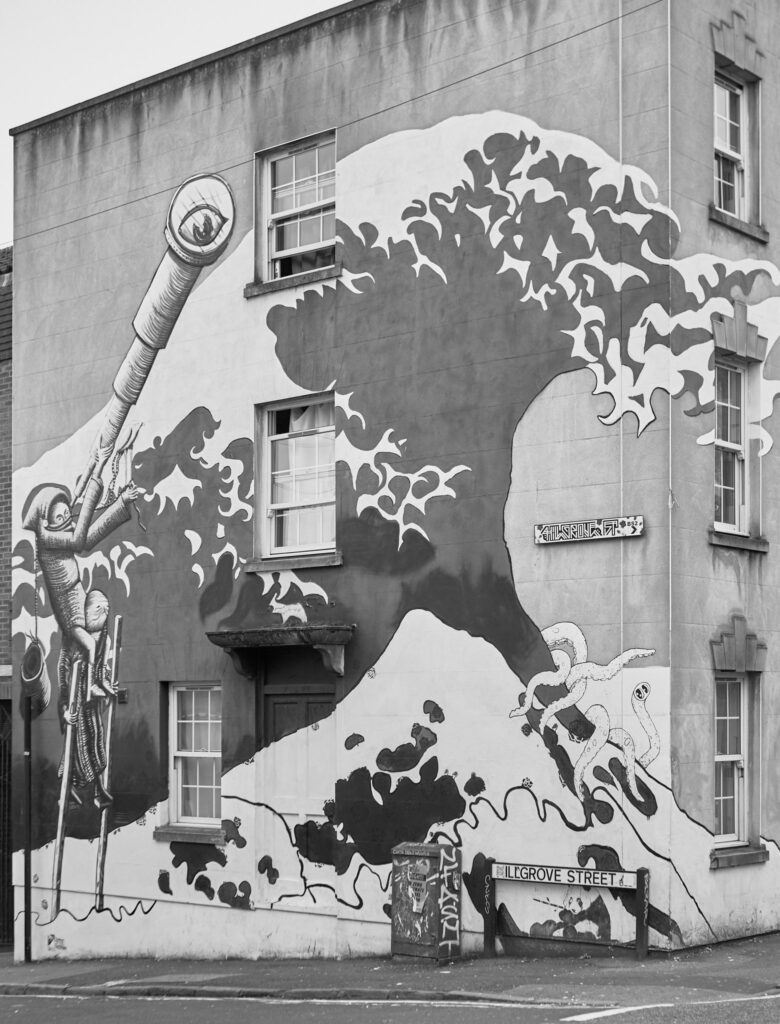
    Just opposite the PRSC wall is another great mural, the Tsunami of Roses. Now, to be honest, I’m not sure what this is about! Yes, there is a large red and white wave but why the stilts and men with a telescope? What am I missing here?

    Paintings are tucked away throughout Bristol not just in Stokes Croft, but at this point in the afternoon I wanted to get off the beaten track and explore some of the back-streets in Stokes Croft, places I hadn’t ventured before and to hopefully find something new. I can’t remember now where I went; I just meandered the streets knowing that sooner or later I’d find something I recognised and thus a way back. All this was during the light of day, had it been dark I would not have been so keen. It would most probably have been just fine, but safety first…

    Just off one of the streets, in what was probably the grounds of a building long since demolished and behind a chain to stop vehicles using it as a parking area was a lovely painting of a girl (See the first image in Part 1 of this series). Now, I’m not sure if it was just coincidence or perhaps the artists intention, but just in front of her was a 45 Gallon oil drum painted with big eyes looking back at the girl. Clever as it added a 3rd dimension to the painting extending it out of the wall.
    Bird mural
    Bird mural

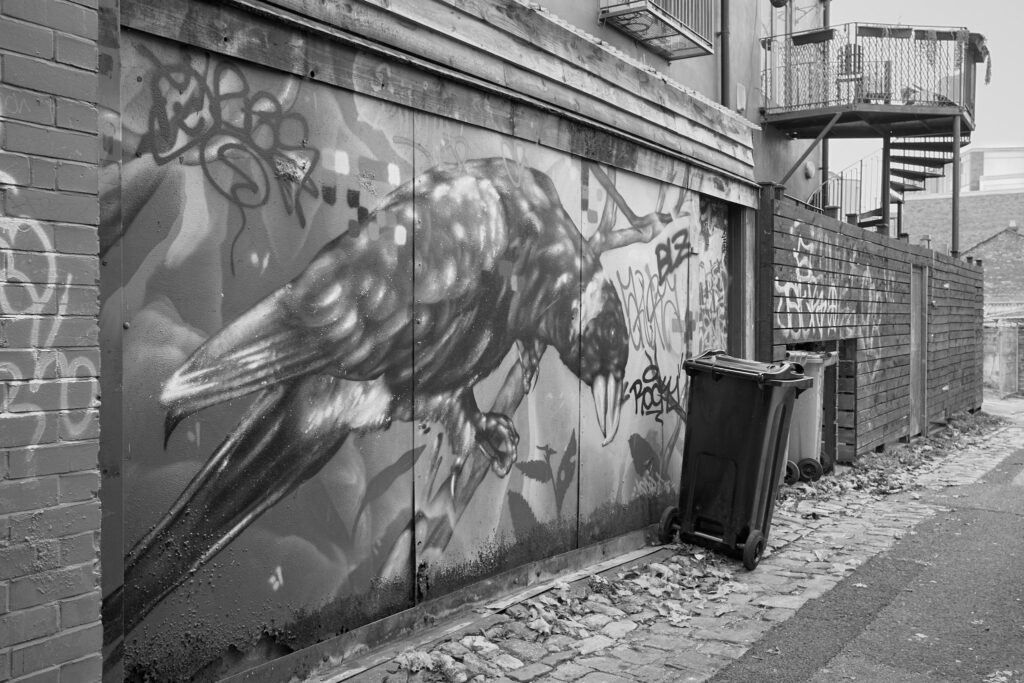
    Exploring further I ventured down a small, run-down, road and was rewarded to find the painting of a lovely bird perched on a branch. I don’t know my birds but it doesn’t look native to the UK, perhaps from someplace a lot warmer and somewhere exotic. What do readers think? It was also nice to see that although the painting had some graffiti, the graffiti had mostly avoided the bird.

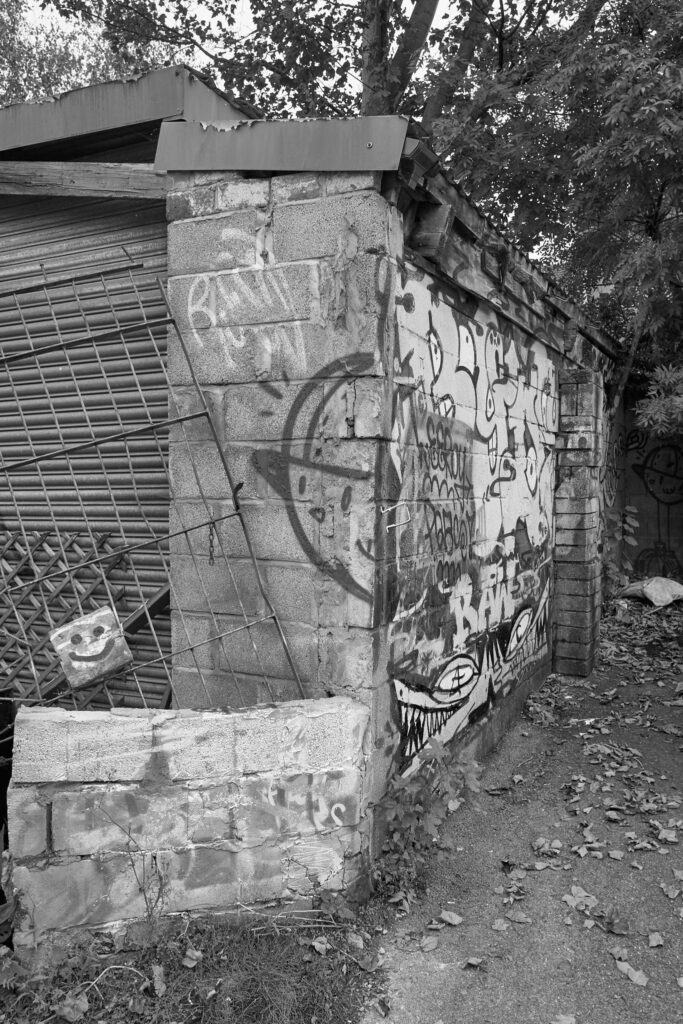
    A little further along was a run-down garage whose side wall was covered in brightly coloured graffiti. It looked abandoned and I cannot imagine anyone using it to shelter a car. Leaning against the garage door was a piece of steel that looked like it was once a gate or grill. What made me smile was that someone had painted a smiley on a square and attached it to the steel. It seemed so incongruous. A happy, smiley face attached to old steelwork leaning against a decaying garage covered in graffiti. πŸ™‚

    Yet further along the road were some very rundown, but sound looking buildings whose ground floor was covered in graffiti. But on the end-wall was a painted face wearing a green peak cap with a single star. I’m not sure of the symbolism and thus meaning but the design of the hat reminded me of the sort commonly worn by Fidel Castro so I wonder if the painting is a political statement about the suppression of the workers and fighting for freedoms.
    Smiley
    Smiley
    Alligator
    Alligator

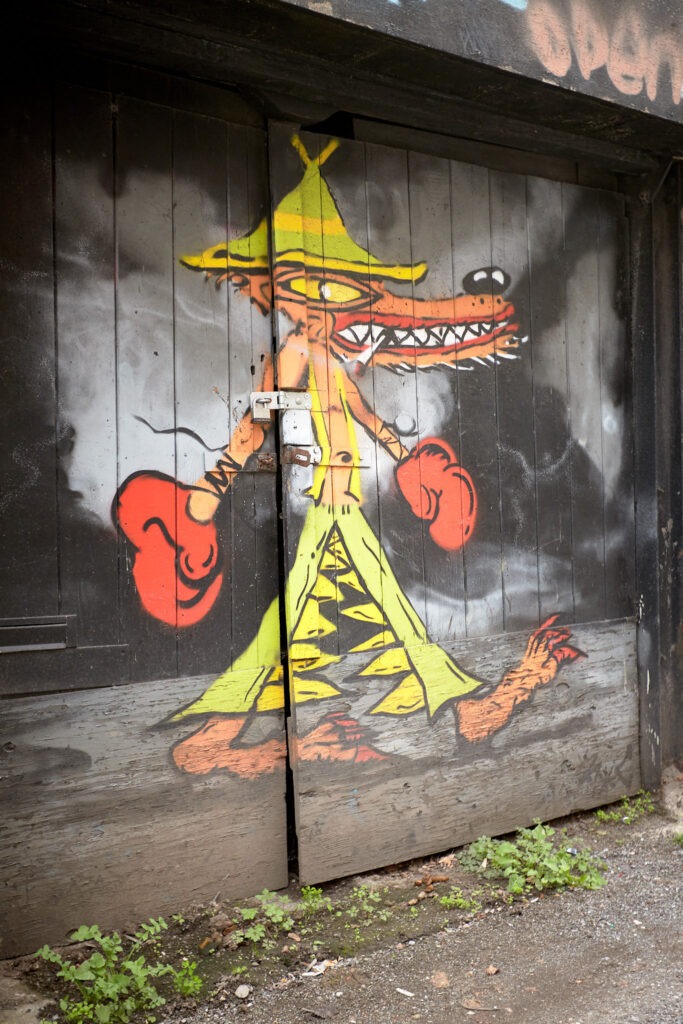
    This little street was proving to be quite a gem as just around the next corner were a couple more paintings again adorning the side of garage walls. One of these – to the right – is in colour as the character painted didn’t render well in black and white. Like other paintings, the symbolism and message of this one is lost to me but, for that, I like it non the less. In fact, shortly after taking the photograph a car arrived and parked in the garage. The driver didn’t look like the sort of person who would have created the painting tho.

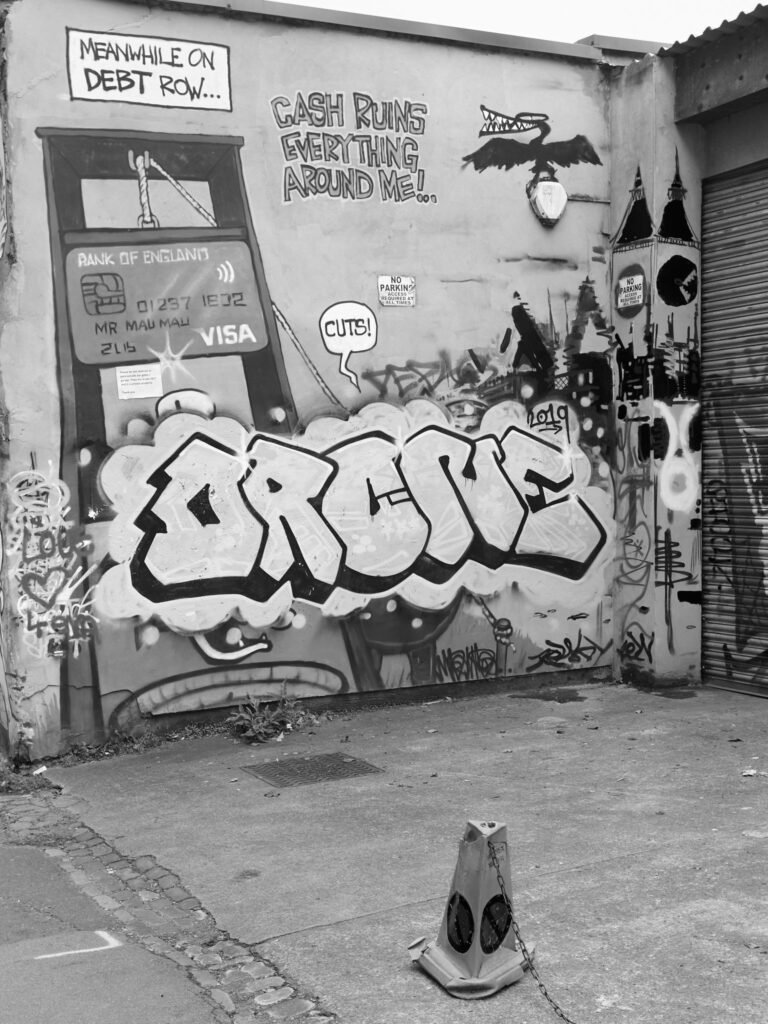
    Just next door was something I found easier to understand. The image of a guillotine with the blade being a Bank of England Visa card plus the message ‘Meanwhile on debt row…’ makes for a very striking message. It is a shame that some large graffiti has been placed over who/whatever was in the guillotine and who was holding its rope so some of its message is now lost. Higher on the wall a large bird with a similar beak and eye to that in the colour photograph is perched atop an alarm.
    Bristol street art.
    Bristol street art.

    It would be interesting to better understand a lot of these paintings so their full meaning could be appreciated. Perhaps that hidden meaning is important tho – the message is only decernable to those with the knowledge…

    What I’ve presented in this series is just a tiny, tiny fraction of the painting and graffiti in Bristol. The photographs are the result of an afternoon walk around some streets in Stokes Croft. There is so much more to explore and as paintings change often there is always something new too see. I fully expect to spend some more time in the city soon.

    In Bristol, graffiti can be found in many places, the murals/paintings are less common and, in my simple uneducated opinion, of a high quality. Is Bristol different from any other city? I don’t know. But what I do know is it’s a great city, that Stokes Croft is an artistic area with independent, free thinking people who are making Bristol a colourful and better place.

    Andy


    All images are Copyright Andy Gawthrope Photography
  • Glyder Fach

    Glyder Fach

    On this trip I planned to stay in the Ogwen valley at the Gwern Gof Isaf campsite but on arrival it was full with large trailer vans, generators and a catering / bar tent.  All the fluorescent yellow clad security guards would say is that it was for a film…  But they probably didn’t know more either!  Clearly, it was no small film crew as there must have been facilities for several tens of people.  A short distance away was a temporary stables full of horses.  So, a large budget film requiring mountain scenery and horses.  In 2015 King Arthur was filmed in just this part of Wales…Could this be a sequel?  Who knows πŸ™‚  Anyway, to avoid all the noise I went a little further down the road and stayed at Gwern Gof Uchaf – a small, basic, farm campsite.  This turned out to be a better choice as there was an excellent path from the site past Tryfan into the mountains.

    In the Northern hemisphere June 21st is the longest day and with a little over a month before the longest day the sun rose early and set late.  At the campsite, in valley, the sun was obscured by the mountains for some time at sunrise and sunset so, some height really helped catch the morning and evening light.  Sunrise/sunset times were at about 05:20/21:10 according to the apps PhotoPills and The Photographers Ephemeris.  Whilst the timings seemed correct in the valley, at altitude these times seemed somewhat off.  At the top of Glyder Fach (994m ASL) sunset seemed almost 50 minutes later.  Hopefully it’s possible to configure an elevation in the apps.  Some investigatory work required!

    Being high in the mountains for sunrise/sunset I knew would be impossible from a valley base due to, what would be, very late descents and early ascents.  So, a plan was hatched to carry everything needed for an overnight stay including camera gear into the mountains during the late afternoon, photograph in the golden and blue hours, sleep then awake already on location for sunrise.  After that the plan was to return to the valley, rest and repeat the next evening.  As it turned out the plan was pretty solid πŸ™‚

    Glyder Fach
    Glyder Fach

    Two things were a problem tho.  My fitness and the sunny, warm, cloudless sky.  I knew hauling gear was going to be hard and it was!  My legs, hips and back ached afterwards πŸ™‚ The fully loaded rucksack wasn’t actually that bad tho.  It was never weighed but it could be lifted one-handed onto the shoulder without straining.  Note to self: More fitness required!  After a full day’s rest the body seemed to recover which was good πŸ™‚  The bigger problem was the cloudless sky caused by a high pressure system sat over the country πŸ™  That meant there were no interesting clouds in the sky to add colour, interest or detail.

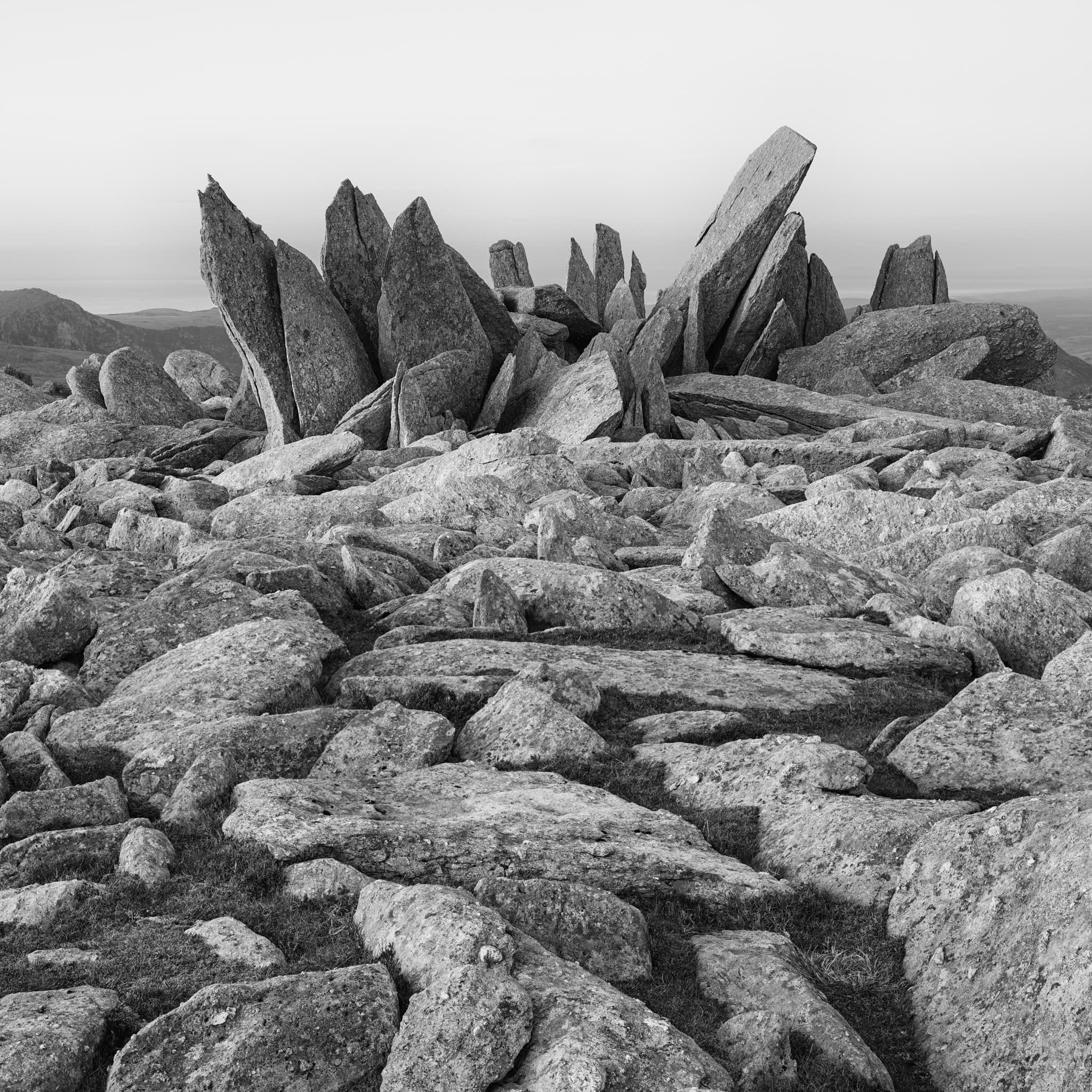
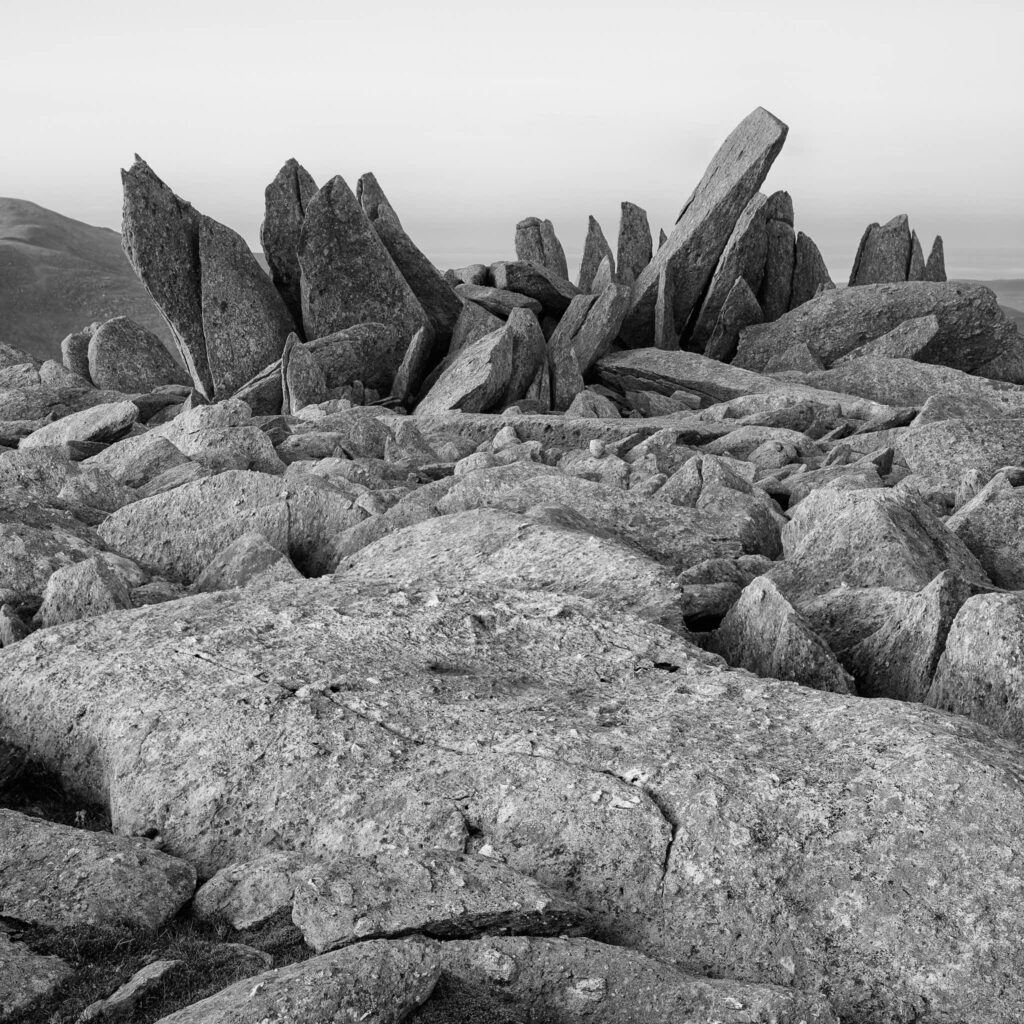
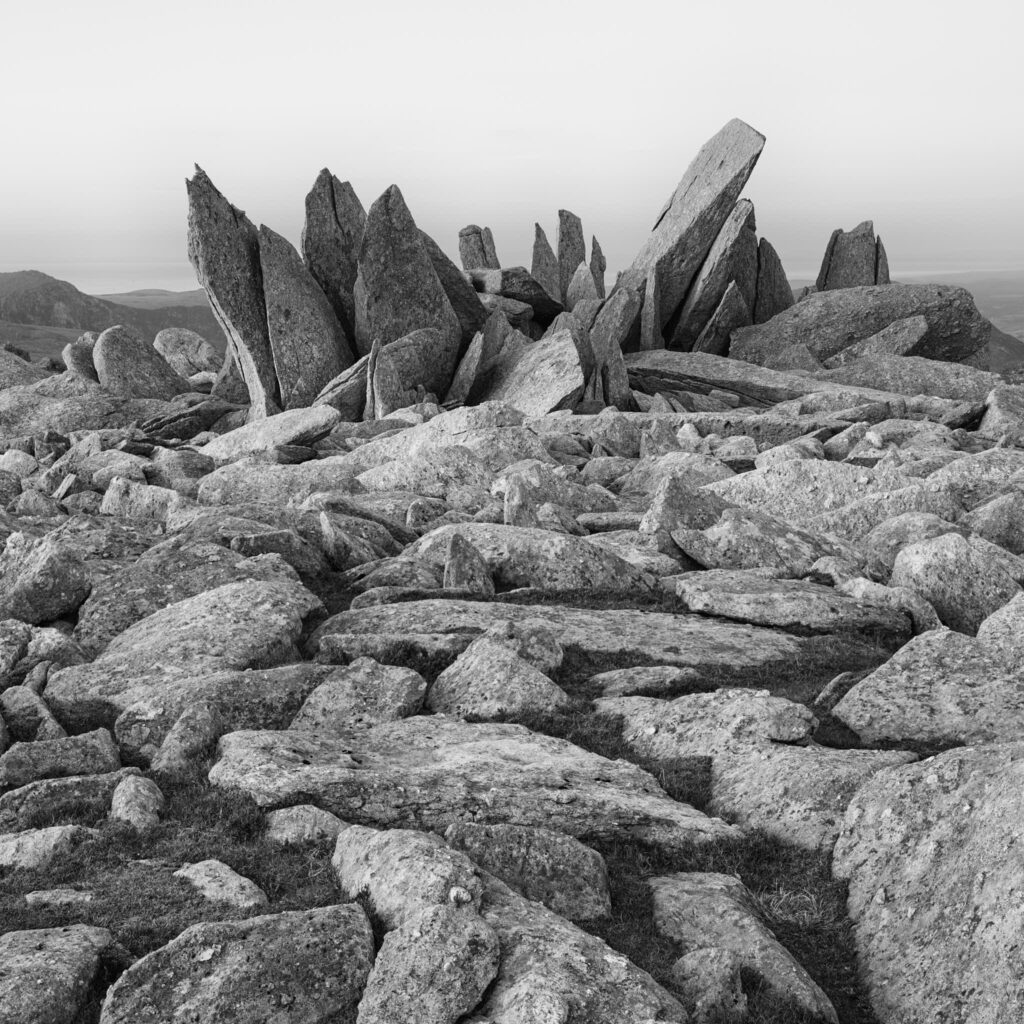
    The photographs in this post were from the top of Glyder Fach.  Both are the result of a 3-image focus stack with each component image exposed at F8 to achieve excellent overall depth of focus.

    With only a little colour in the sky and some subtle yellows and greens of lichen clinging to the rocks any wow factor seemed to be lacking for a colour photograph.  But the strong shapes and excellent rock textures lent themselves towards a monochrome photograph.  Some dramatic sky and light would really have helped tho. πŸ™‚

    Despite the temperature being about 18/19 degrees Celsius in the valley during the afternoon, after sunset on top of the mountain the temperature quickly dropped and with the rise of a slight breeze it became cold quickly.  Having hauled a small stove, a hot drink was nicely warming before crawling into a cozy sleeping bag for the night.  By that time it was pretty late, about 2300hrs, and sunrise was only a few hours away!

    Next morning I awoke whilst it was still dark, put my head outside the tent to check the sky for cloud and was greeted by a sky full of bright starts.  It looked fantastic. πŸ™‚ Probably the sort of light astro-photographers would crave πŸ™‚

    Sunrise the following morning was through a cloudless sky.  It will be the topic of the next post.

    If you have enjoyed this post or just like the photographs, please like on social media.

    Thanks πŸ™‚

    Andy


    All images are Copyright Andy Gawthrope Photography.

  • Porlock Weir II

    Porlock Weir II

    Seizing an opportunity between the incessant wind and rain over the Christmas 2018 period, I headed down to the small village of Porlock Weir. It’s situated just under the Exmoor hills on the North coast of Somerset.  It’s not only a pretty little village with a nice harbour but it also has a couple of minor claims to fame.  It’s owners like to advertise it as a film location.  Indeed, part of the 1995 movie β€˜Feast of July’ was shot in the harbour and it also made an appearance in the more recent BBC, β€˜A Very English Scandal’ television series.

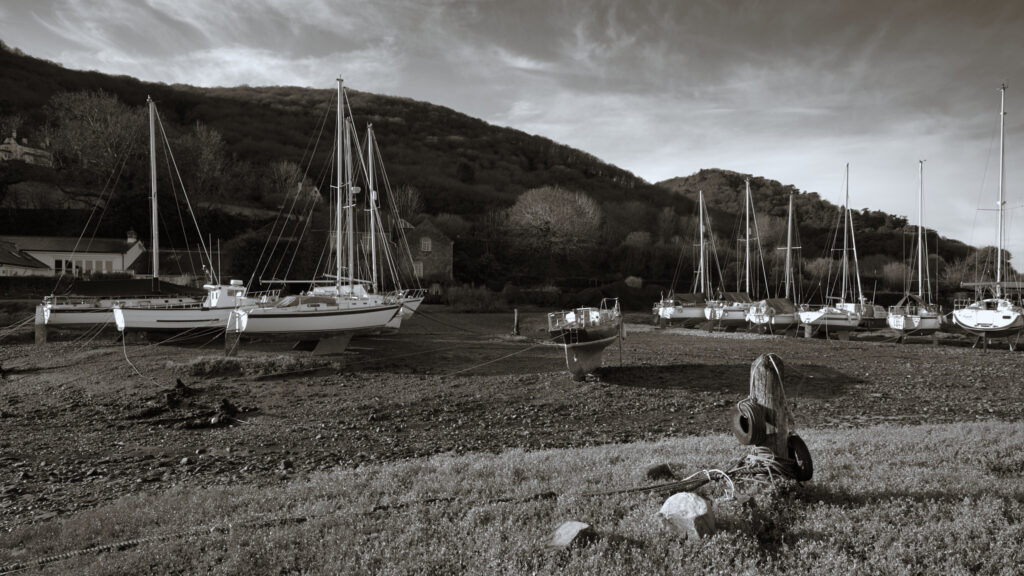
    Porlock means place of the port and Porlock Weir, situated a few kilometres West of Porlock, is its harbour.  The harbour is shallow, controlled at one end by lock gates and used mainly by small pleasure boats so it’s always a bit of a surprise what’s there.  Previously I’ve seen β€˜older’ looking wooden sailing boats but on this occasion it was mostly modern β€˜plastic’ yachts presumably avoiding the winter weather.

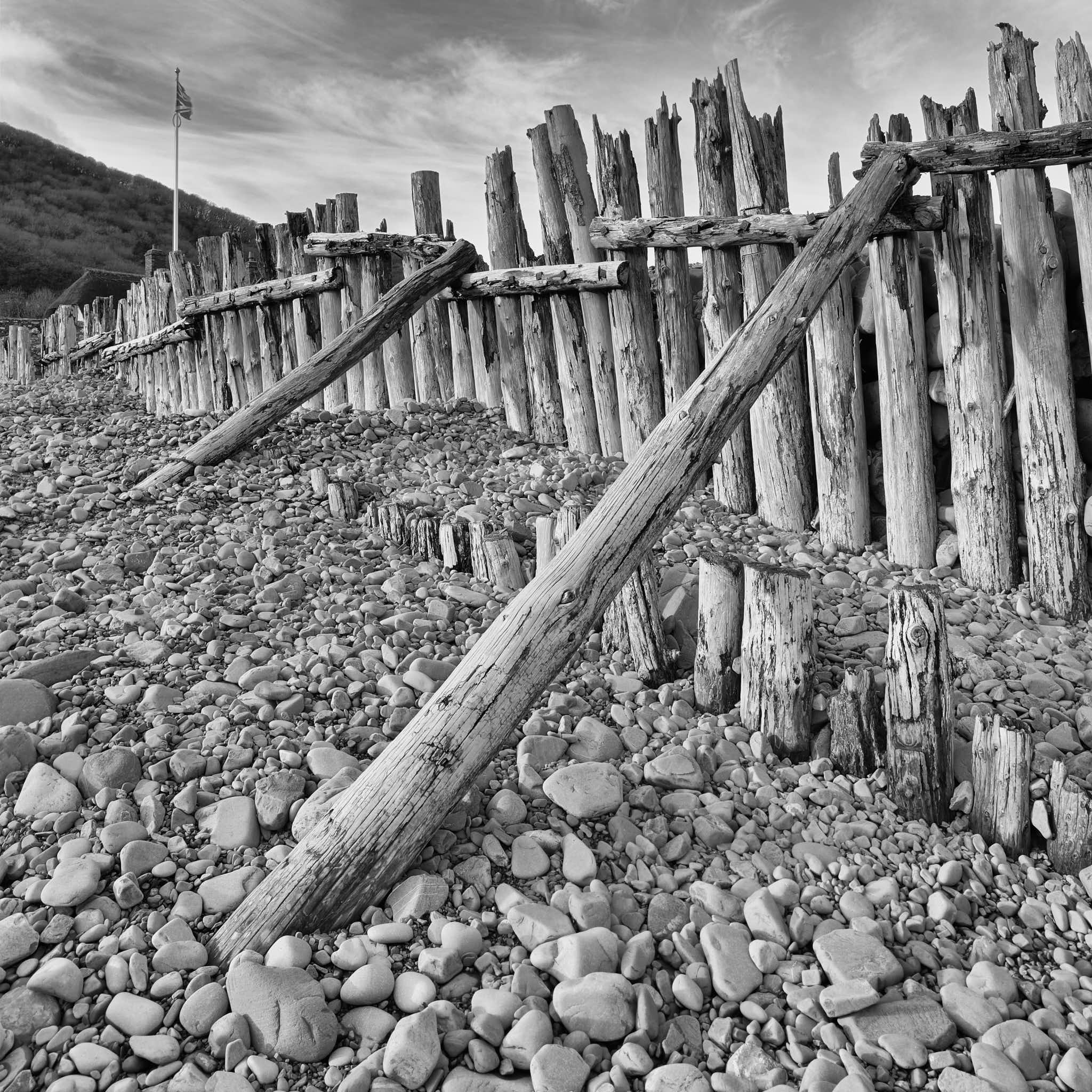
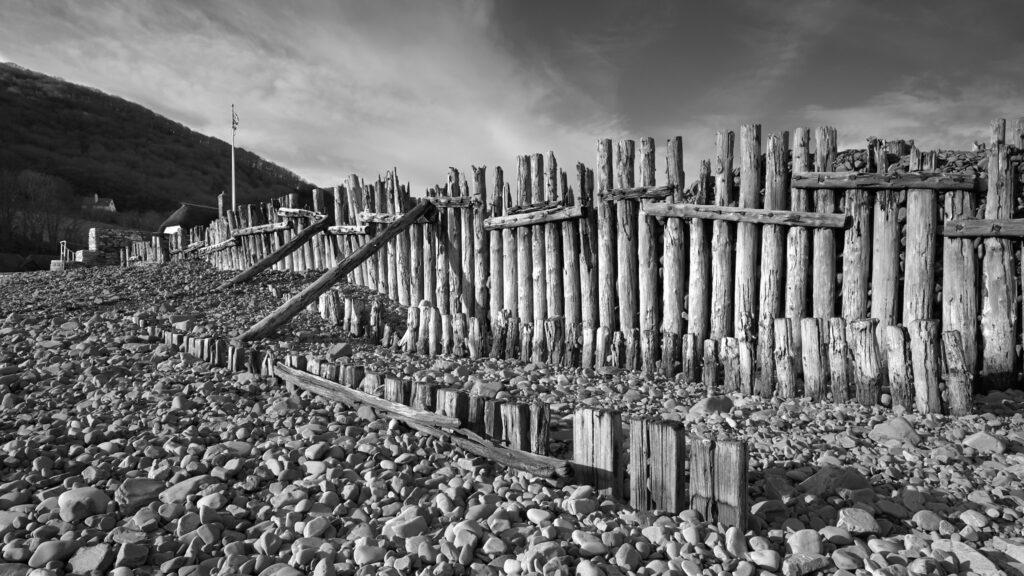
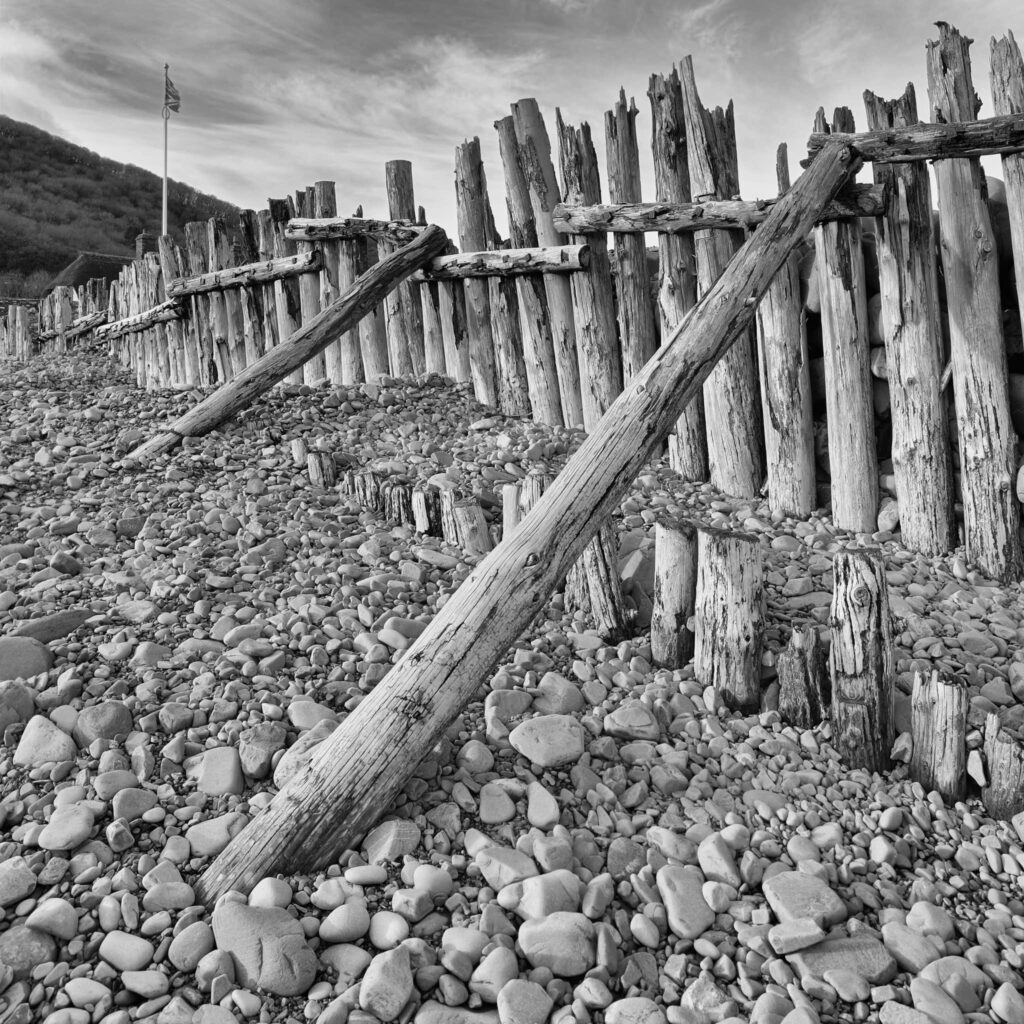
    In addition to the harbour there is a fine groyne constructed from wooden poles each of which must be at least 12-14 inches in diameter.  Probably just as well as it’s holding back a beach of many thousand large, heavy stones which must exert tons of pressure.  The groyne has been there for years and each of the poles is now showing signs of age and exposure to the elements of nature.  It’s a striking structure with exposed natural knots, cracks and textures held together with massive rusting steel bolts.  I’ve photographed the groyne before but always had the idea of returning to capture the wood in greater detail.  The above photograph was captured with a 50mp camera using a 21mm lens so seen at 100% there is a huge amount of detail.  During post-production I opted for a monochrome square crop to remove the whispy clouds and the distractions of colour.

    Porlock Weir Groyne No. 1
    Porlock Weir Groyne No. 1

    Flying at the shoreward end was a Union Jack flag but rather annoyingly it never flew side-on to the camera, but viewed at 100% there is just enough to identify the flag. πŸ˜‰  Shortly after the photographs were made the whispy cloud thickened signalling the approach of the next weather front and band of wet, windy weather.

    Porlock Weir Harbour
    Porlock Weir Harbour

    Slightly earlier I’d been walking around the harbour searching for something photogenic and found the above wooden post festooned with ropes and a couple of old tyres presumably being used as buoys.  It was almost midday when photographed but being so close to mid-winter the sun was low in the sky and only just peeking above the Exmoor hills.  Half an hour later and it had dropped behind them.  It’s a strangely basic harbour; one side is formed by the land, two sides by the stones that form the beach and the forth by a high set of old and rusting lock gates.  Part of the reason it seems so strange is it’s just a short and easy walk from the harbour floor over a small stony rise to find oneself on the beach facing the sea.  More so when that sea is the Bristol Channel, an expanse of water with one of highest tidal ranges (15m) on the planet!Just a reminder to readers that clicking on the photographs will generate larger versions πŸ™‚

    Andy


    All images are Copyright Andy Gawthrope Photography.

  • Dubs hut and Hay Stacks

    Dubs hut and Hay Stacks

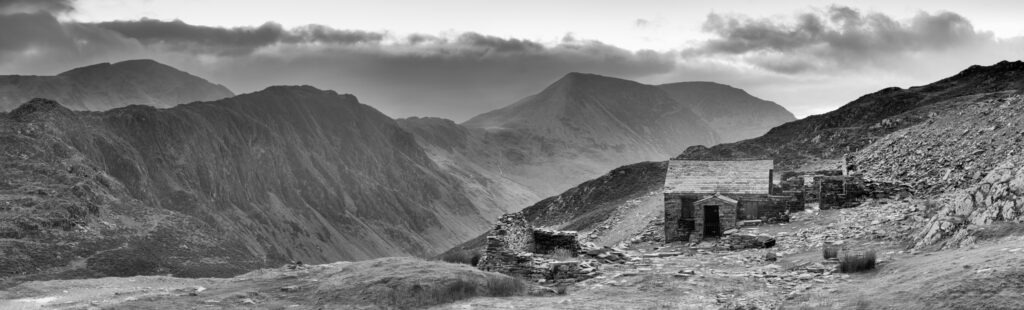
    On my recent visit to the Lake District, one of the aims was to do a little mountain photography.  Unfortunately the cloudy weather put the stops on that, but the day I arrived the weather looked promising.  The plan was to arrive earlier in the day to leave more time for an evening outing, but thanks to hideous roadworks – Birmingham through to Manchester – the journey took much longer than it should have.  So when I had arrived there was only about 1.5hrs before sunset.  Not enough time for much….

    This time of year the sun sets further to the South and behind the mountains in the photograph so, down in the valley, the sun was already perilously close to disappearing behind the mountains.  The only other option was to head to the tops – no easy thing with such little time…  I was staying at the Bridge Hotel in Buttermere so, the quickest access to the tops was a 20 minute drive to the Honister mine car park followed by a mad dash up the track in the hope of getting somewhere nice by sunset!

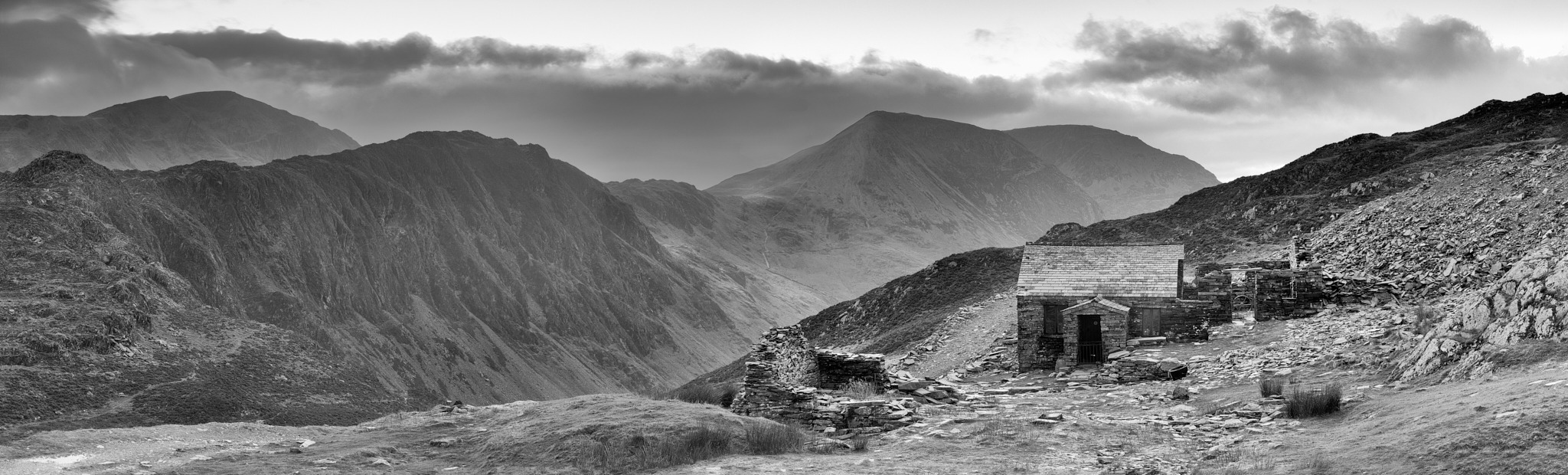
    So that’s what I did and it almost worked.  I got to the Dubs hut just as the sun set with no time to go further.  In fact, I would have needed to be there about an 1.5hrs earlier to allow a little exploration and setup time.  But that’s how it went πŸ™  The result was a very quick hunt for a composition in the fading light.  Anyhow, for what was, essentially, a grab shot I’m pretty pleased with the result. πŸ™‚

    The photograph is the result of stitching three individual images so, like all my panoramic photographs its pretty wide and computer screens don’t them justice.  At full size, the detail in the hut, surrounding stones and distant screes is impressive but this is lost when displayed small-size on computers.

    The plan is to do much more mountain photography over the coming year.  I’ve asked Santa Claus for a carbon fibre tripod πŸ™‚

    Andy


    All images are Copyright Andy Gawthrope Photography.

  • Avebury in snow

    Avebury in snow

    I’m writing this sat outside under the shade of a pear tree, its 26 degrees Celsius, cloudless and the hottest day so far this year.  What really makes it unusual is that it’s a Bank Holiday Monday also known as a public holiday here in the UK.  Its tradition that Bank Holidays are always wet and windy.  Something is very wrong!

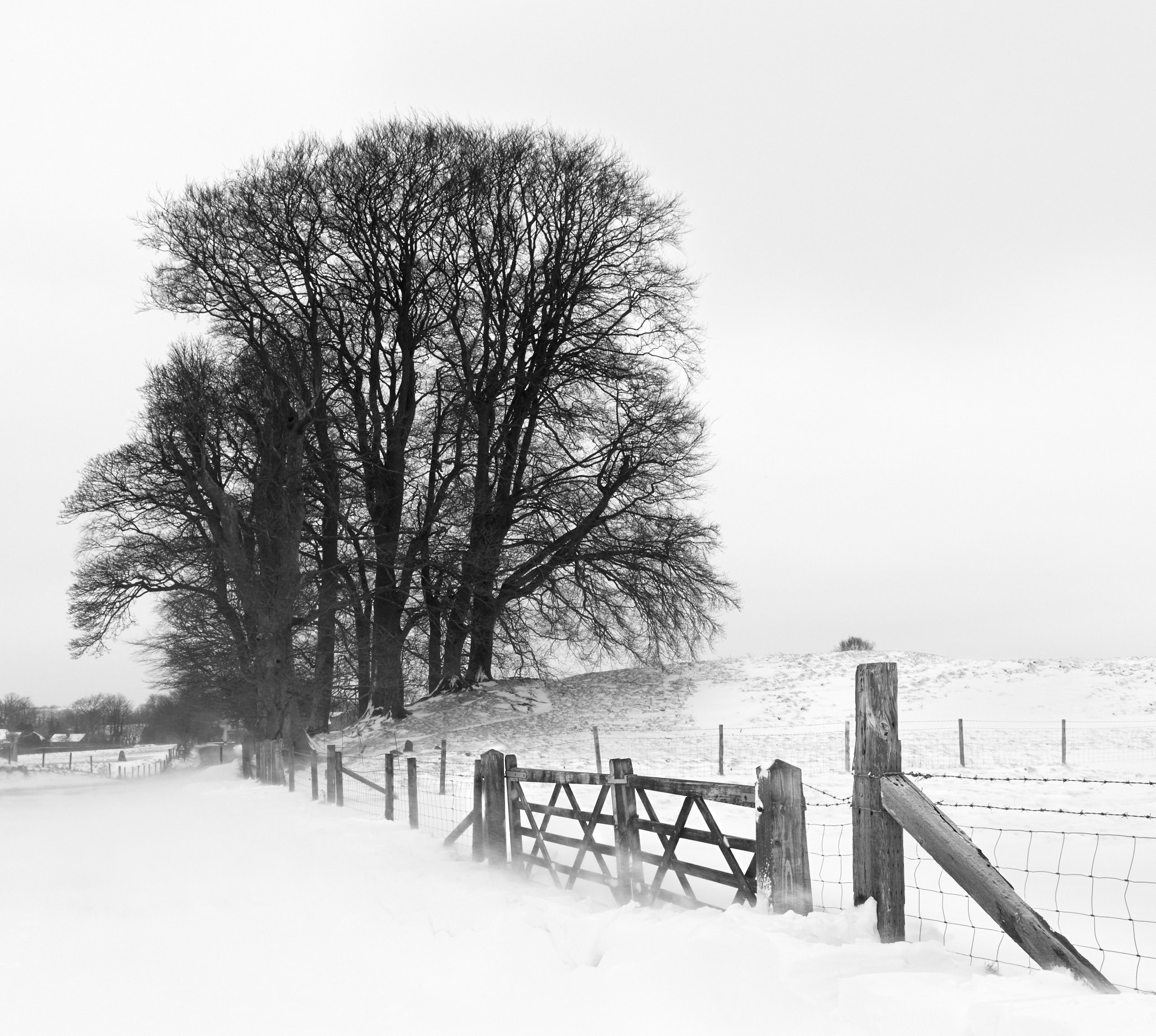
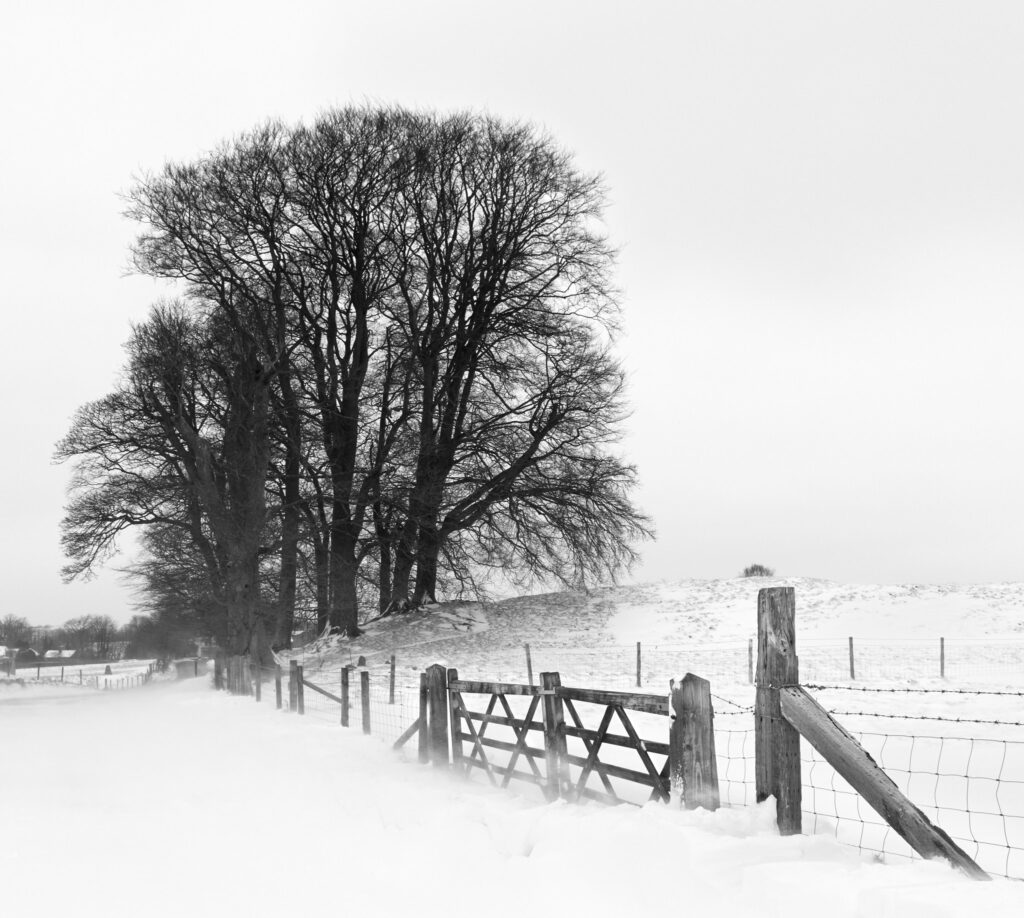
    Not so very long ago the weather was very different. Sub-zero temperatures, snow and wind!  Ah, the British weather πŸ™‚  On one morning the sky was white, the ground white and little colour.  Perfect photography day!  A day for black and white πŸ™‚

    Avebury stone circle is a Neolithic (stone age) bank, ditch and stone ring enclosing a further two rings.  The outer ring is a little under 350m in diameter.  On such a monochrome day big dark stones set against a carpet of white seemed like the perfect shoot and a nice place to spend a few hours.

    Avebury stone circle
    Avebury stone circle

    It was obvious tho, that it was going to be cold, bloody cold, standing around in those conditions as we photographers do.  Suitably clothed and equipped with a thermos of hot coffee I headed off.  The major roads had been cleared, but the smaller ones in Wiltshire were still covered in their snowy blanket.  A few cars had been brave or foolhardy enough and ventured out, but thankfully, the roads were quiet and, this time, I didn’t get myself stuck in the snow!

    Avebury is managed by the National Trust and they have a little car park just beyond the outer ring.  When I arrived the gate was open, I drove in and parked.  The National Trust don’t usually miss an opportunity to collect visitor fees and I was mildly amused that, on this occasion, the weather had got the better of them. πŸ™‚  From the car park its a short walk to the rings and I cut fresh tracks down the little footpath linking the car park and village centre.

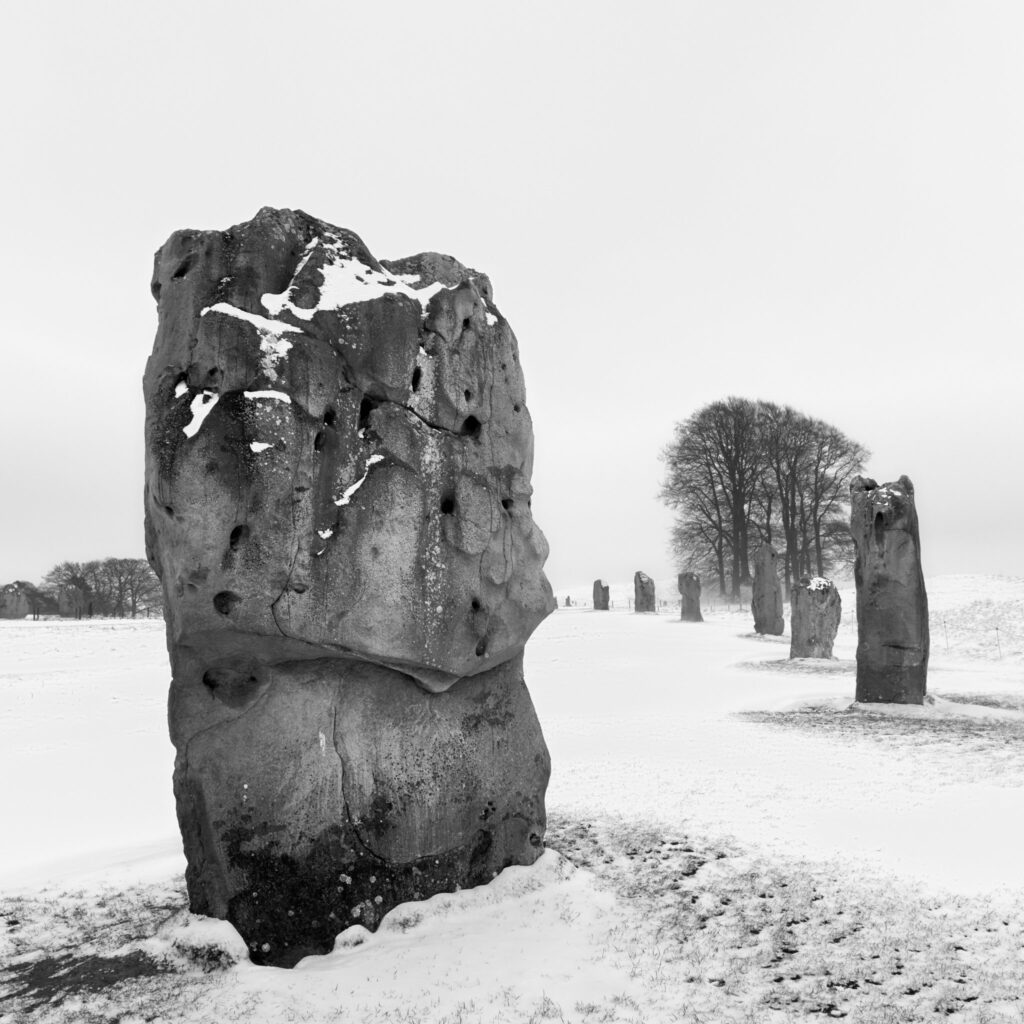
    Two small roads bisect the outer ring dividing it into quadrants.  The South-Eastern quadrant retains some nice stones and its to there I went.  I envisioned a photograph that captured the stark detailed shapes of the stones set against the white of a snowy day; something eternal as the stones have been there for thousands of years and seen many a cold, wintery day.

    Red Lion pub, Avebury
    Red Lion pub, Avebury

    Its not my first visit to Avebury and knowing a location, any location, greatly helps as available time can be spent concentrating on photography rather than hunting photographs.  I knew of this stone, with its glorious pock-marked surface and bands of weathered stone.  It made the perfect subject and I chose to contrast its wonderful surface and bold features against the drifting, snowy background.  It a stone I’ve photographed before and will probably photograph again!

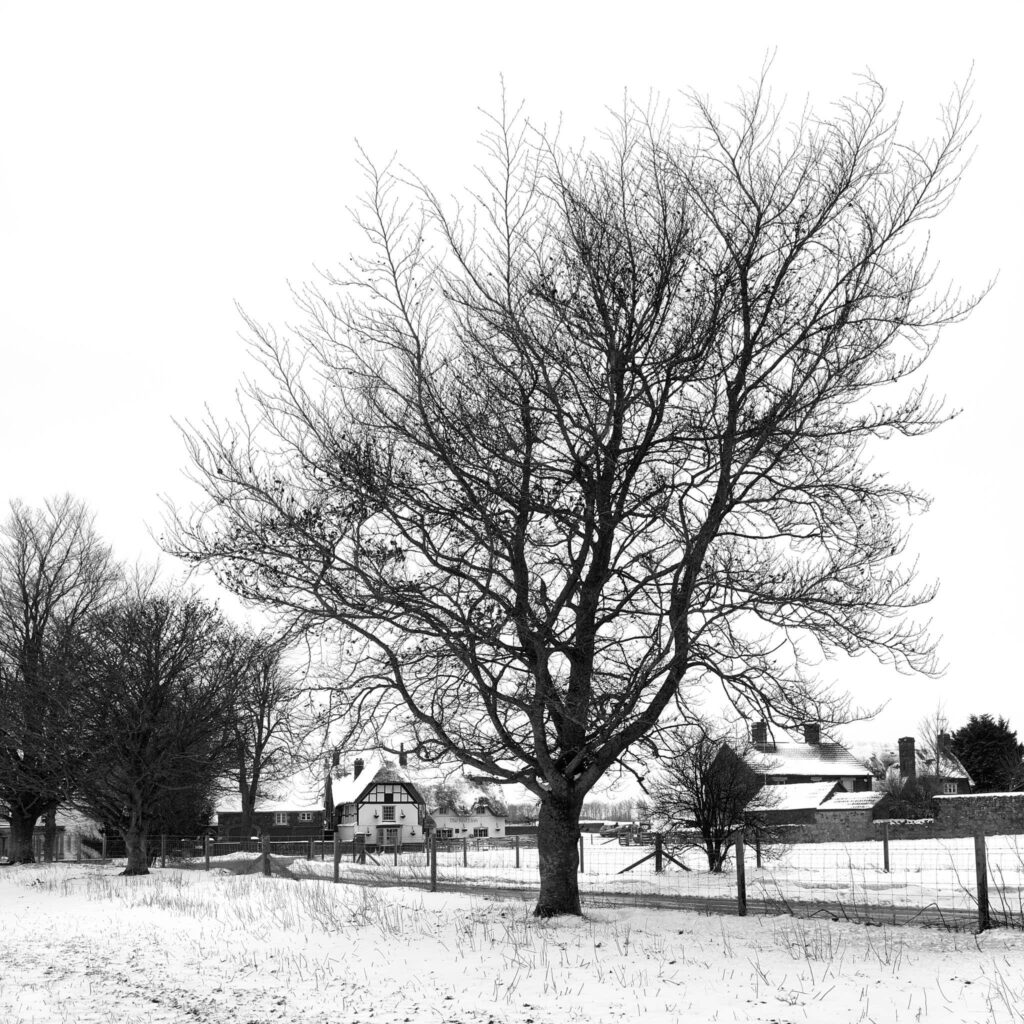
    Almost as famous as the stone ring is the Red Lion Public House which lies at its centre.  The building was constructed around the year 1600 and thus postdates the Neolithic site by about  4500 years!  First licensed in 1850, it has a lovely straw thatched roof and a 26m deep well; its definitely worth a visit πŸ™‚  That morning it looked very olde-worldly covered with snow so I couldn’t resist a photograph.

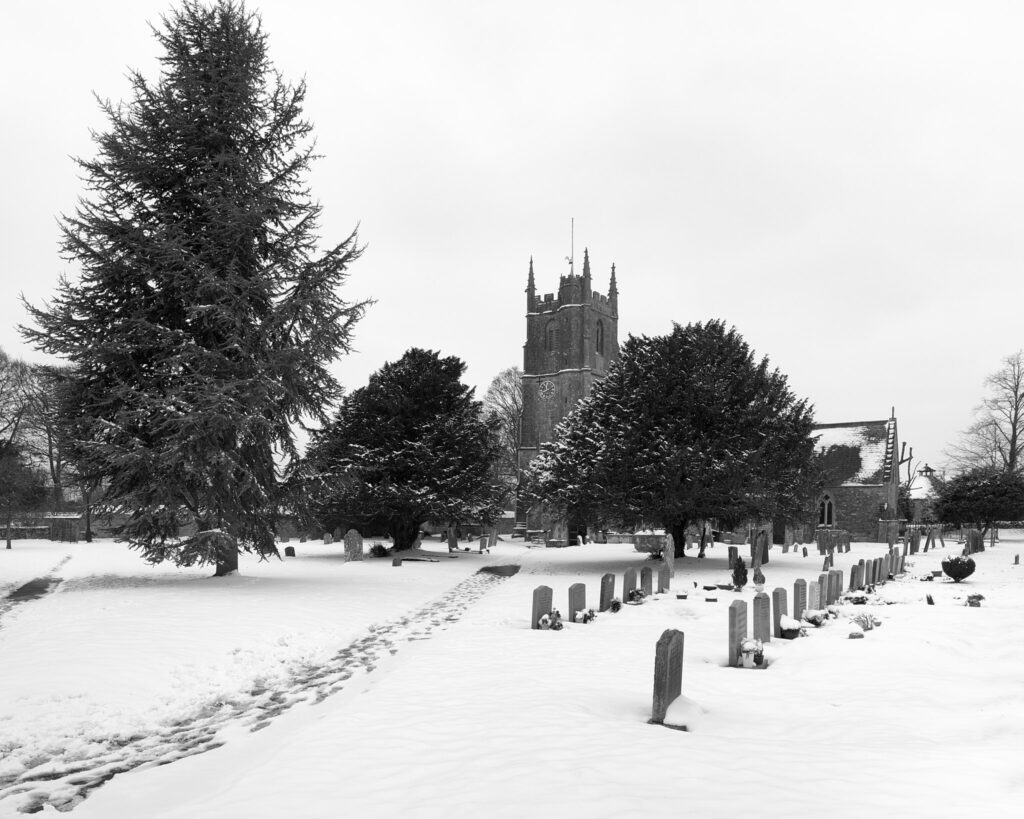
    Tucked away a little to the West of the Red Lion is the little church of Avebury.  It predates the pub by several hundred years!  Thought to have been constructed around the year 1000 it has seen much alteration over the subsequent centuries.  However, it still retains its Anglo-Saxon nave although later altered by the Normans.

    Avebury Church
    Avebury Church

    My visit to Avebury was on a Sunday and it was late-morning before I strolled into to the church grounds.  The Avebury parishioners had obviously been there before me and left their mark.  But I think the footprints on the path bring a reminder of life to what could be a deathly photograph of church and gravestones.

    Before leaving home I decided that the objective of the day was to concentrate on shape, contrast and to convey a sense of winter, of cold or Brrr if you like.  I like to think I achieved that.

    Andy Gawthrope Photography is based in North Bristol, UK.  Readers are reminded that the copyright to each image in this post is held by Andy Gawthrope Photography.
    Andy


    All images are Copyright Andy Gawthrope Photography.

  • Dunraven Bay

    Dunraven Bay

    For some the onset of Winter will be a perfect excuse to hunker down beside a nice warm fire but to the landscape photographer, well, let’s just say we are made of different stuff. Those long, boring blue sky days are gone, replaced with far more dramatic weather that can bring our photography to life. There is nothing like crashing seas, dark threatening clouds, snow or the dramatic lighting that comes from Wintery weather.

    A recent Sunday was forecast to be cloudy in the morning followed by a period of clear sky before wind and heavy rain swept up the Bristol channel arriving around sunset. This forecast sounded promising not due to the period of blue sky and thus sunshine but because of the approaching windy and wet weather! So, just before lunch I set out for a part of the Welsh coast just South of Bridgend as it’s somewhere not too far from home and easily accessible. Leaving home the sky was a thick grey, water laden mass of cloud but on crossing the Prince of Wales bridge from England into Wales it miraculously cleared and I had to reach for the sun glasses! This is rare! It’s normally just the opposite!

    At the coast the sky was still almost entirely clear, the light extremely harsh with strong reflections from the sea, rock pools and every wet rock recently uncovered by the receding tide. The level of glare and contrast was huge. πŸ™

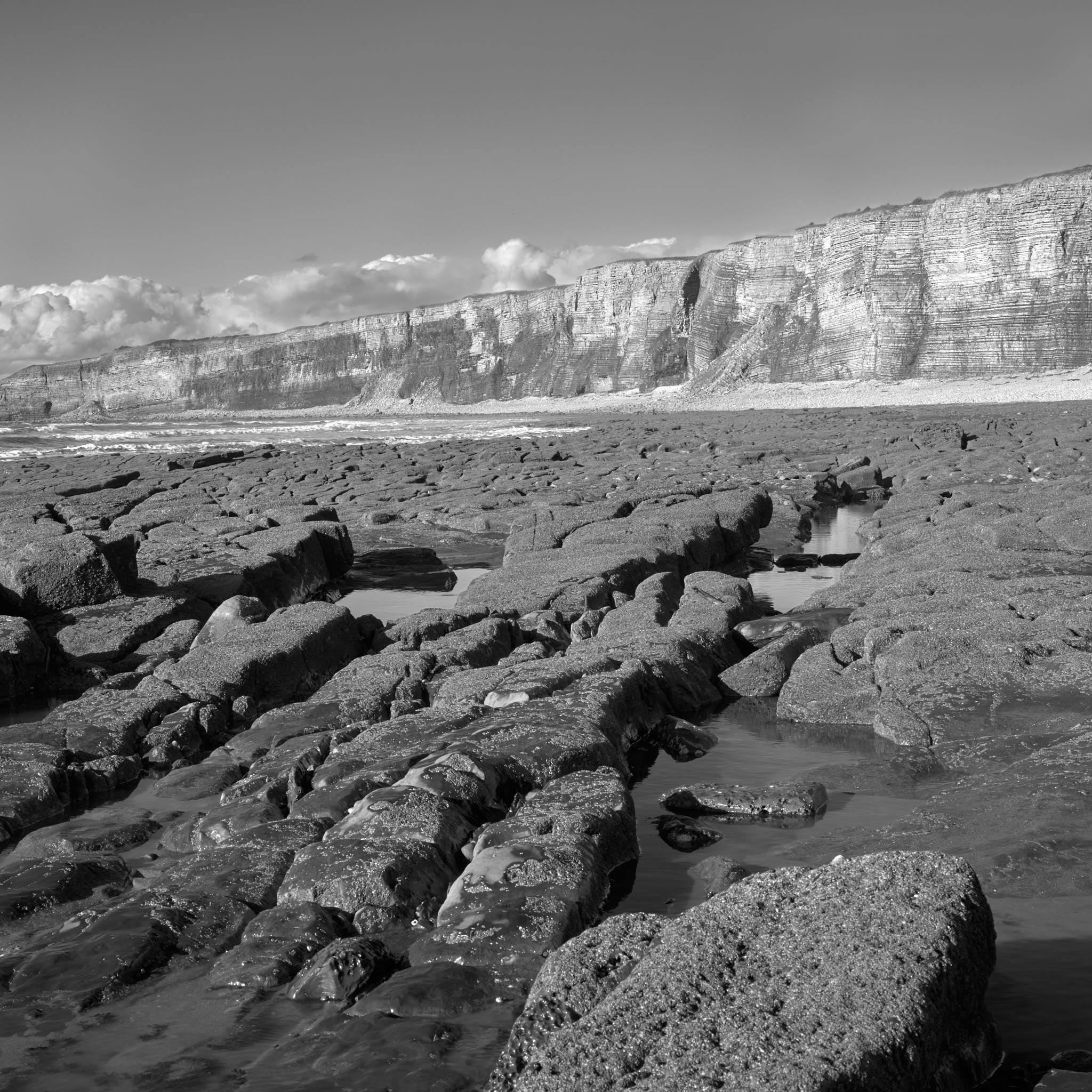
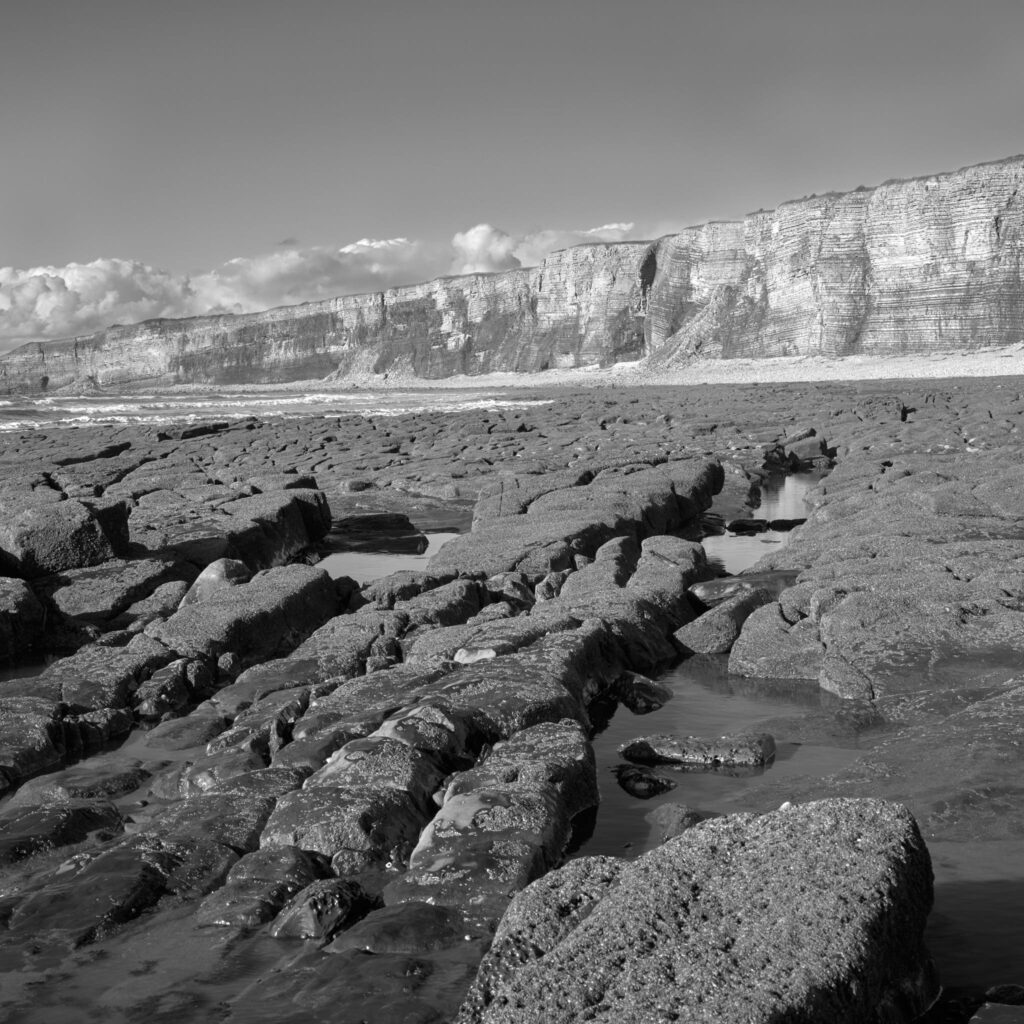
    That part of the Welsh coast isn’t sandy nor does it have pretty rocks. The land appears to be formed in layers of rock – see the cliffs in the first photograph – and where the sea has eroded the land it’s left a pock-marked pavement which extends out under the sea at high tide. I’m sure there will be a geological name for this type of feature. Perhaps a reader can let me know? At low tide, as on that day, the pavement presents a grippy surface that’s easy to walk on as its covered in barnacles. This makes moving around with camera gear really easy.

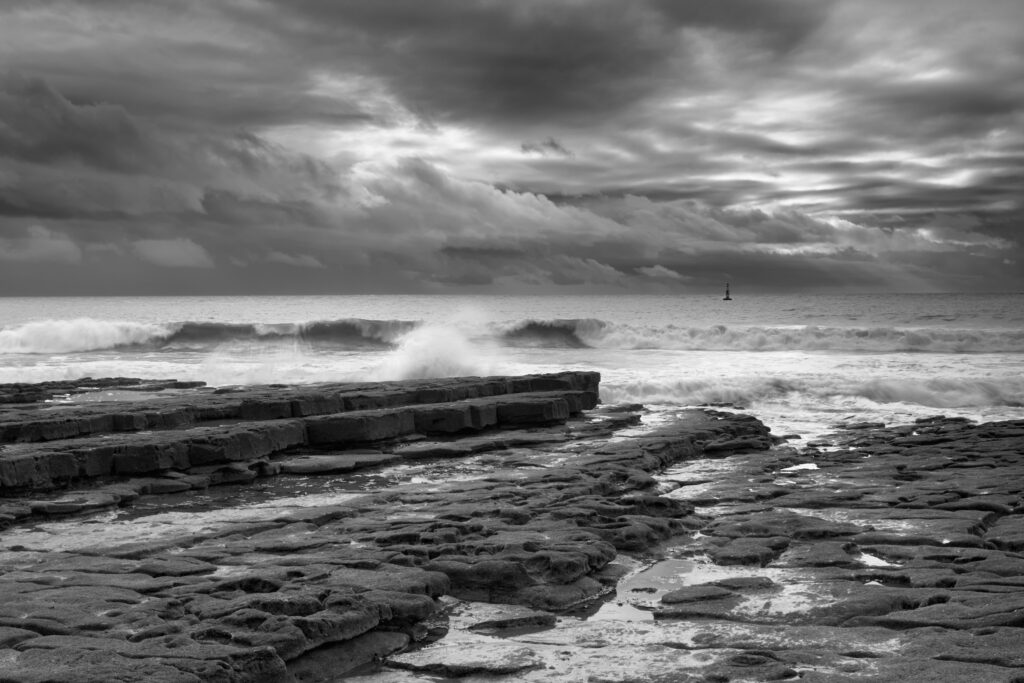
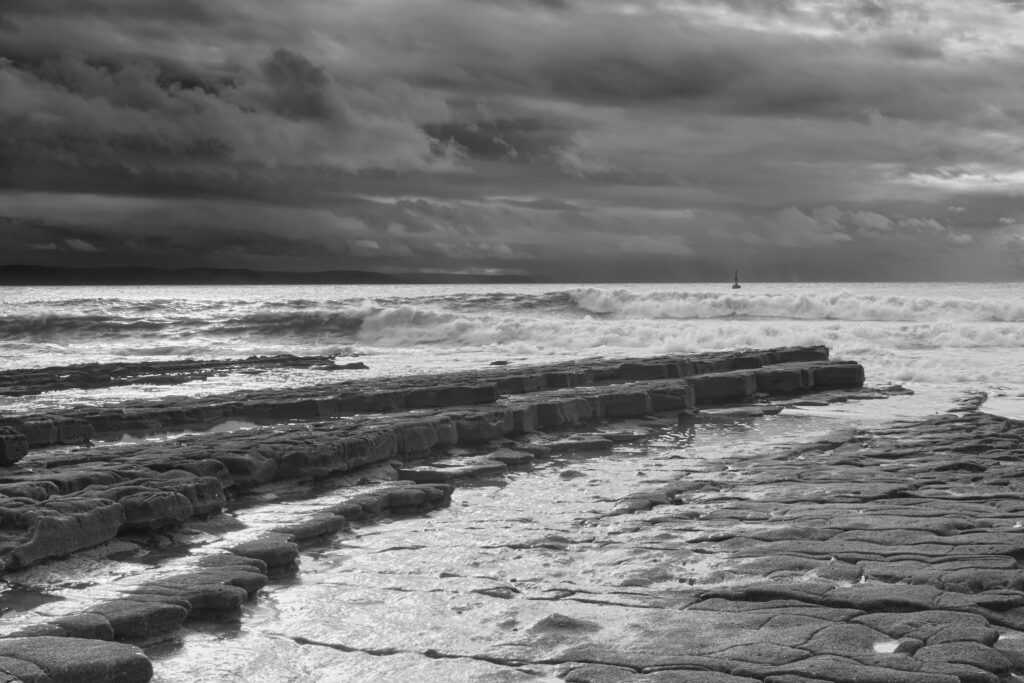
    I pottered around the beach for some time searching for compositions. The obvious ones included the long straight lines formed by the edges between different layers of the pavement. Colour was scarce. In fact it was either the dark brown of the pavement rock or the mid-tone grey of small, round boulders. There was no coloured seaweed, no coloured rocks, actually very little of interest. The sea and tide must carry everything away that can move. In the end it wasn’t my eye that found something but my ears. I became aware of a bell ringing and noticed a navigation buoy about 50m off-shore bobbing around in the swell. I felt this when composed with the pavement lines and the sky worked well.

    Stood there on the beach in bright sunshine I could see the distant English coast as a black stripe on the horizon covered by dark stormy clouds. That part of England was getting hammered! I was there for some time watching the clouds and it became obvious that the main interest lay the clouds. Sure enough it wasn’t long before those clouds started to get closer but then they faded away just when it looked like it may get interesting. Fortunately they soon returned, building much as before. The weather forecast wasn’t going to be wrong and I didn’t want to be on the beach when the rain and wind finally arrived.

    Sure enough about 45 minutes before sunset the cloud made it across the water and it started to spit with rain. That was my cue to retreat back up the cliff to my vehicle. Just after the camera gear was stowed and I had jumped in, the skies opened and it started raining – heavily!

    With a big smug smile,

    Andy


    All images are Copyright Andy Gawthrope Photography.