Tag: Borrowdale

  • Borrowdale rock photography

    Borrowdale rock photography

    Introduction

    The long, often blue sky days of summer are a photographically challenging time but this year I wanted to make the most of them by doing something different and pushing my photography into an area not previously explored. My photographs are typically of the classic landscape / grand vista style and include land, sky and if possible, water. I needed a project concentrating on much smaller, simpler subjects that would, hopefully, lend themselves to summer conditions.

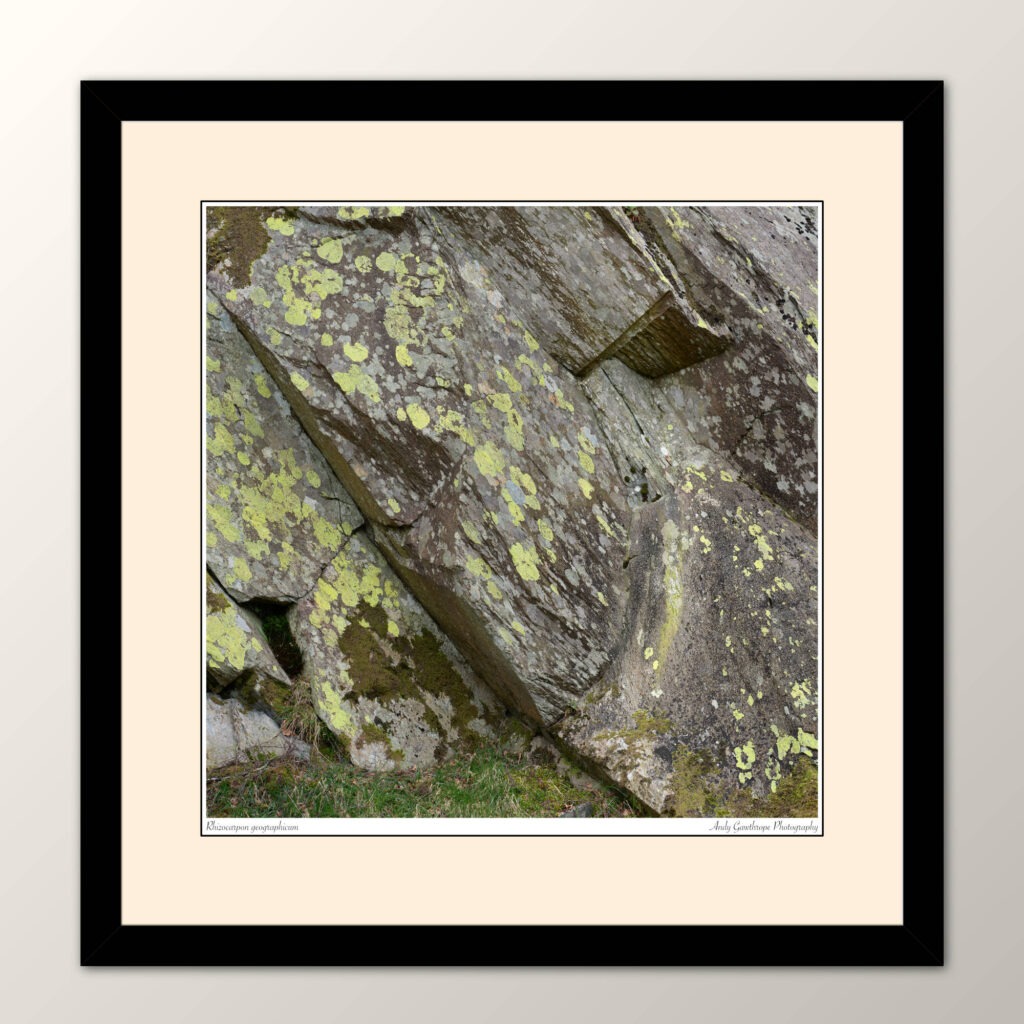
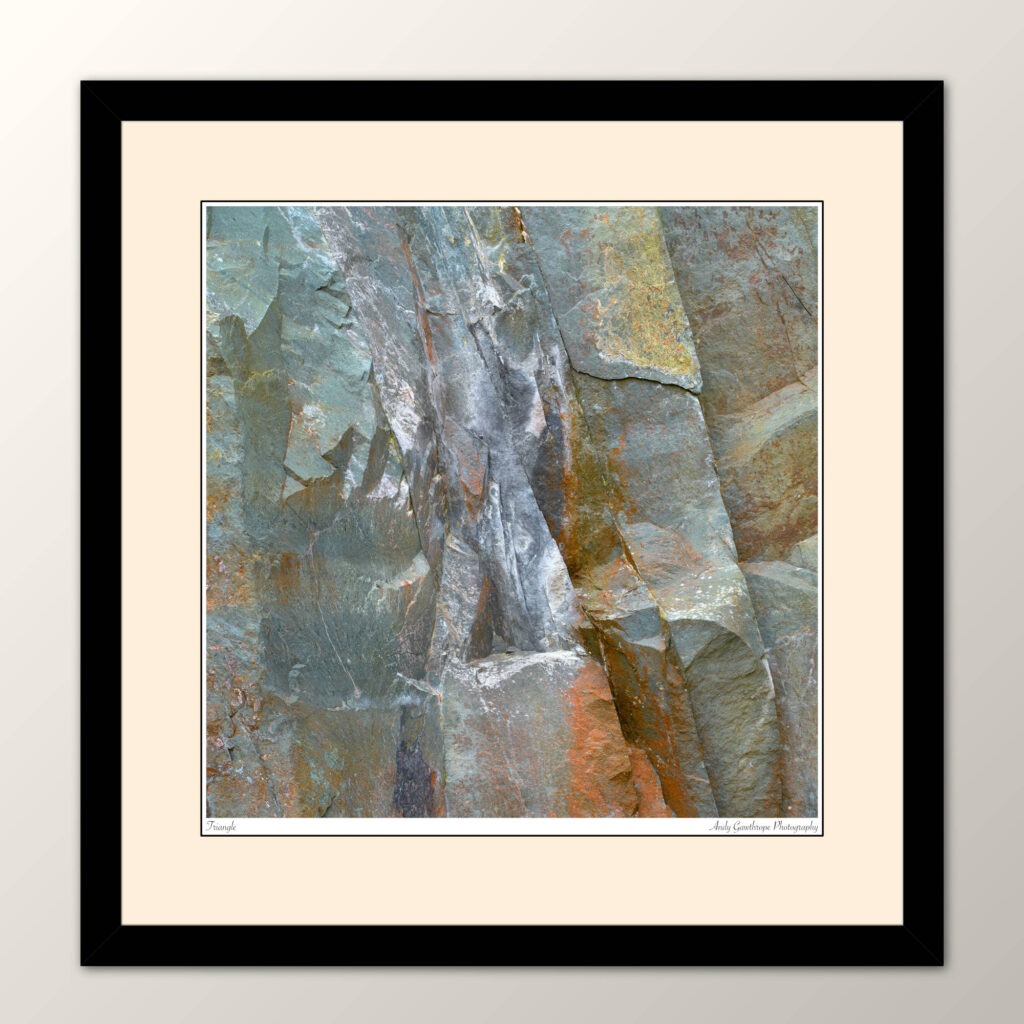
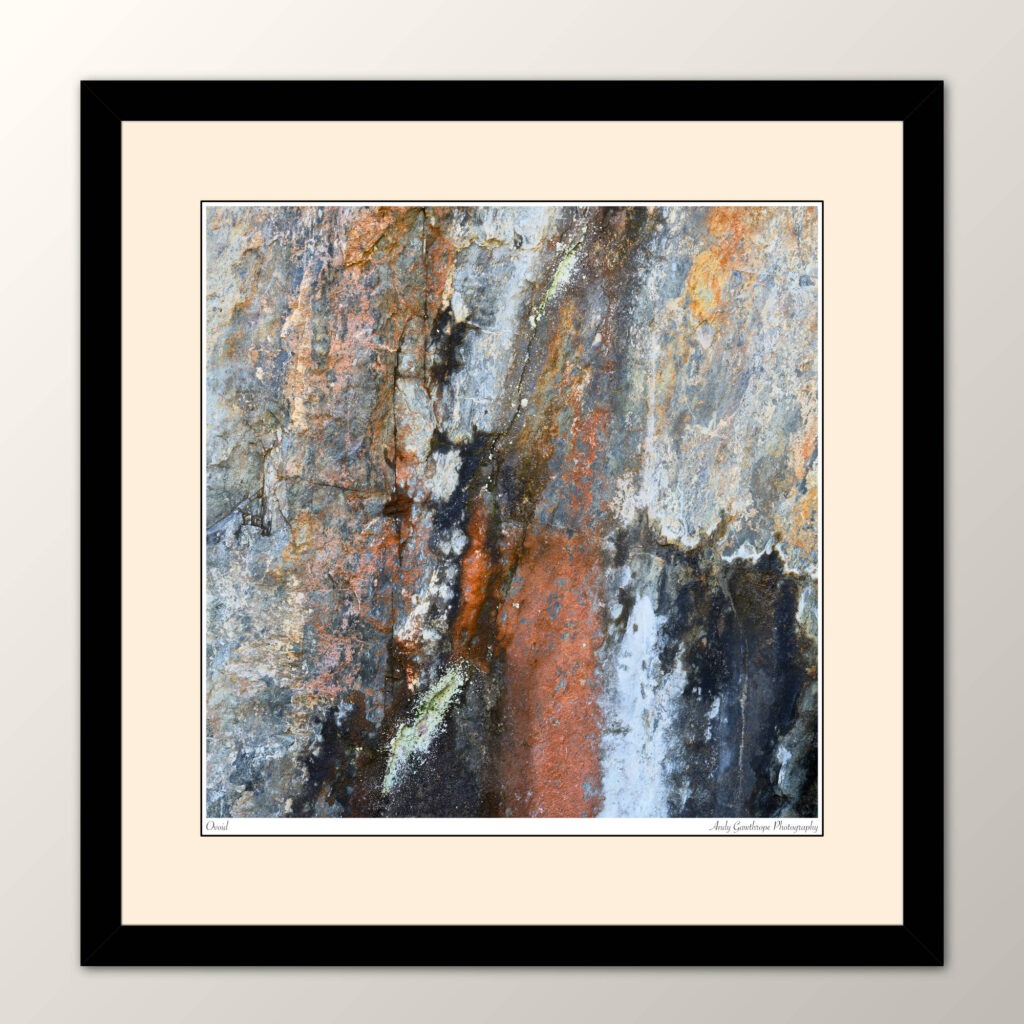
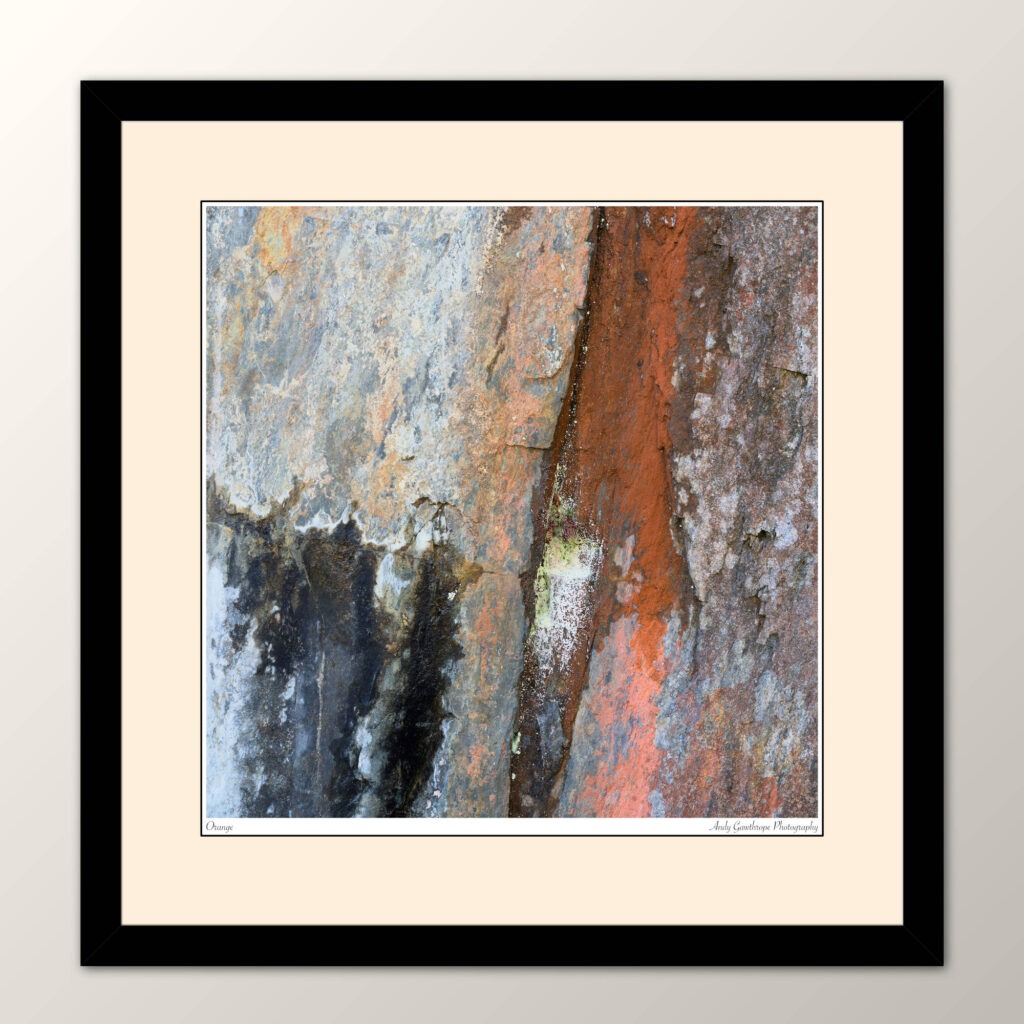
    Please see the gallery at the bottom of this post for the full collection of photographs. Each may be enlarged by its selection.

    After much deliberation two ideas remained. The use of colour, patterns, shapes and textures as a primary subject with images bias towards simplicity and the second idea was to photograph people rock climbing. I like the idea of photographing people in seemingly gravity defying positions high above the ground surrounded by hard unforgiving rock. There is a certain sense of tension and of drama.

    At some point I realised that photographing climbers was going to be hard, very hard in fact, despite having over a decade of climbing experience myself but the idea of rock somehow stuck and fused with the first idea. So I had a project, but where to go?

    Location

    The English Lake District has a long history of rock climbing but also of quarrying for stone. That is no different from many other areas of the UK such as Snowdonia but I hadn’t been to the β€˜lakes’ for a few years and felt it was time for another visit. Borrowdale is my favourite Lake District valley. It’s a wide crescent shape with Keswick at the top and Seatoller at the bottom. It’s green and a beautiful mix of small farms, trees and water surrounded by hills and sheep. And, of course, no description of Borrowdale can omit the magnificent Castle Crag which sits in the middle of the valley just below the Southern end of Derwent water. Seen from the North its imposing shape can’t be mistaken. Borrowdale also makes a great location as it has the friendly campsite of Hollows Farm at Grange. This nestles just below the Northern slopes of Castle Crag and thus most locations are within walking distance. It was, therefore, the easy choice as I knew the area had several quarries from previous climbing and photography trips.
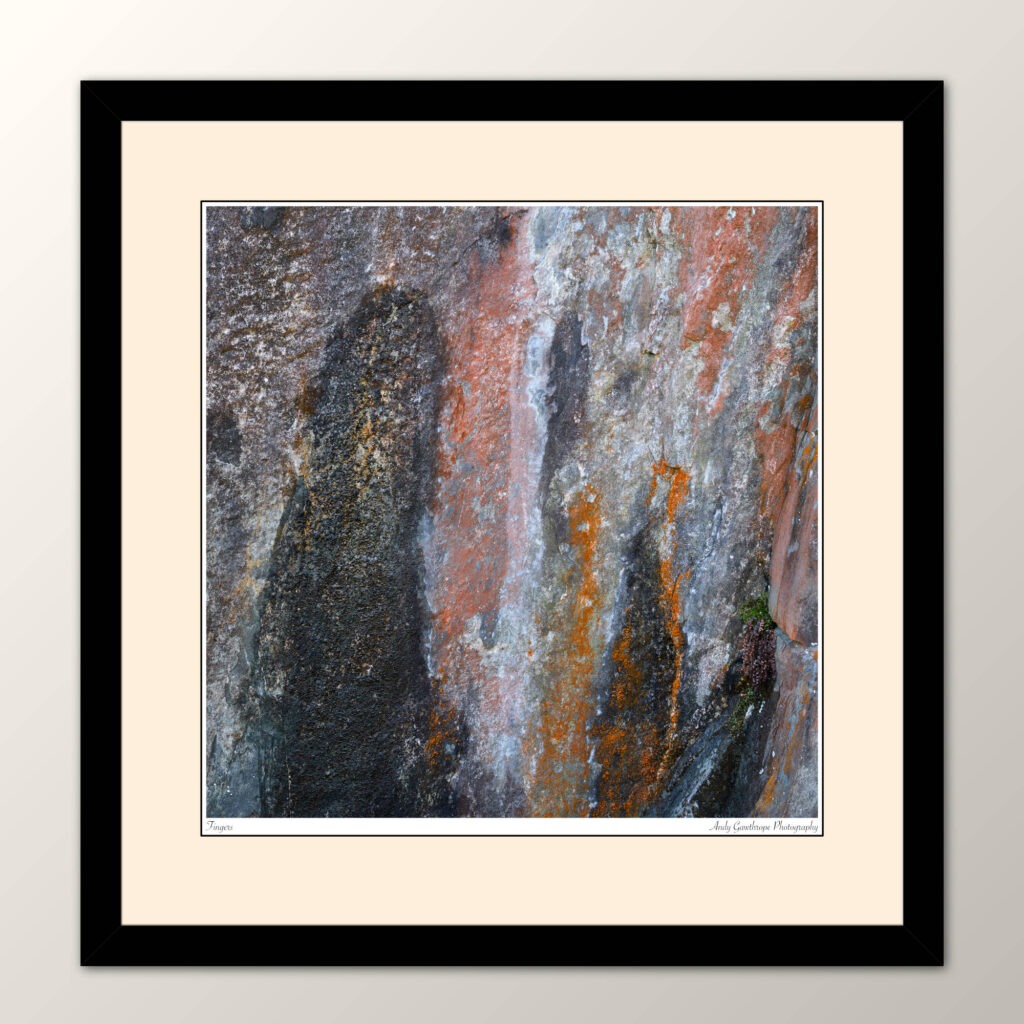
    Fingers
    Fingers

    I must stress that it’s necessary to be very, very careful when photographing in quarries. Rocks can and do fall from above unexpectedly; They don’t have to be large to cause serious injury to body or equipment. They are dislodged by many factors not just humans.

    Before visiting, rooting through the Internet and my book collection identified that others had photographed in some of the area’s I was considering before. But the English Lake District is one of the most popular destinations in the UK and it’s almost impossible to photograph something completely original. In particular I was inspired by photographs in Landscape of the imagination by Angie and David Unsworth, ISBN 978-0-9565798-0-5, Greenburn Publishing 2010. Sadly, this excellent collection of work appears to be now out of print.

    Equipment

    The equipment used for the project was the medium format GFX100s from Fujifilm with either a GF32-64mm, GF45-100mm or GF100-200mm lens and it was usually necessary to work close-up to subjects using longer focal lengths to fill the frame. Focus, sharpness and depth of field were paramount so many of the images were made using wider apertures for later focus-stacking. The Fujinon lenses are very sharp especially at F8 but diffraction does start to soften from somewhere between F11 and F14 and is definitely noticeable by F16. For all photographs the camera was tripod mounted to ensure sharpness but positioning was often complicated as the ground was strewn with boulders and slippery, damp vegetation.

    Photography
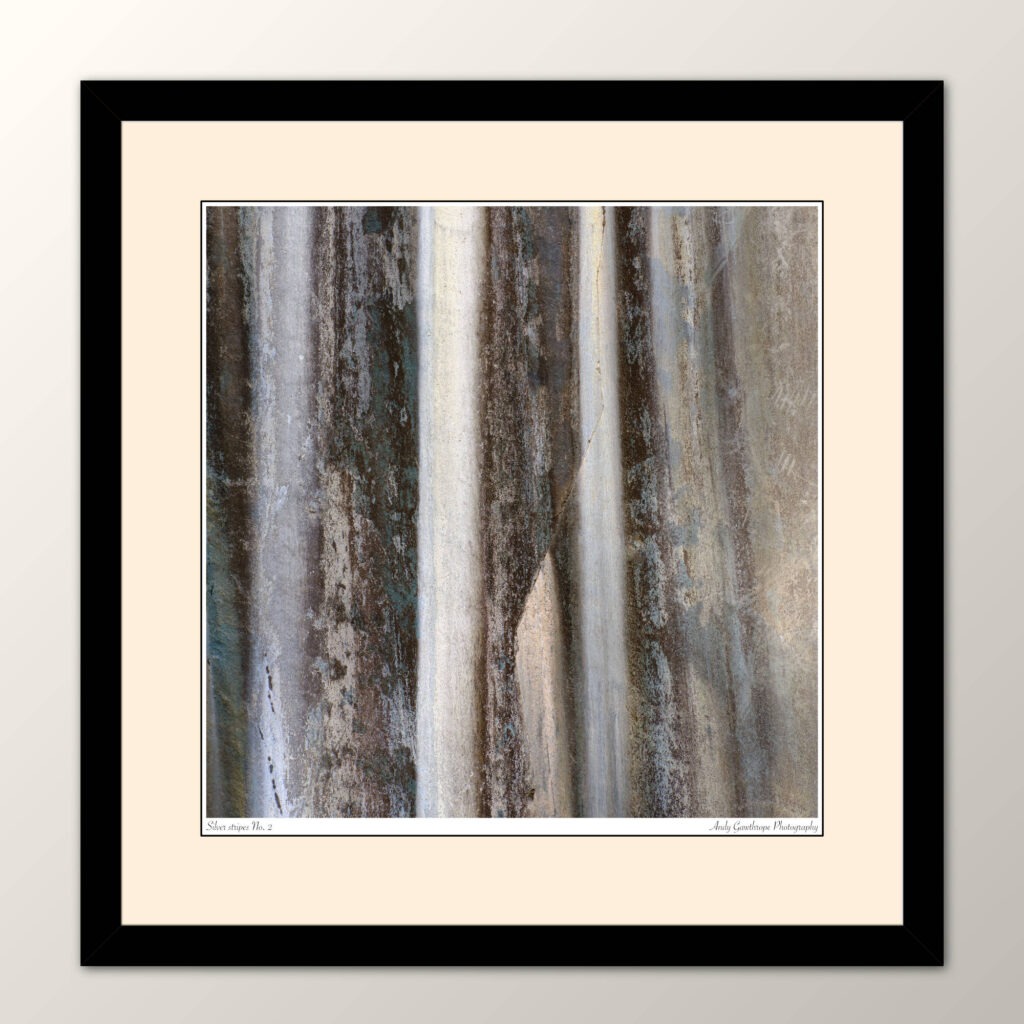
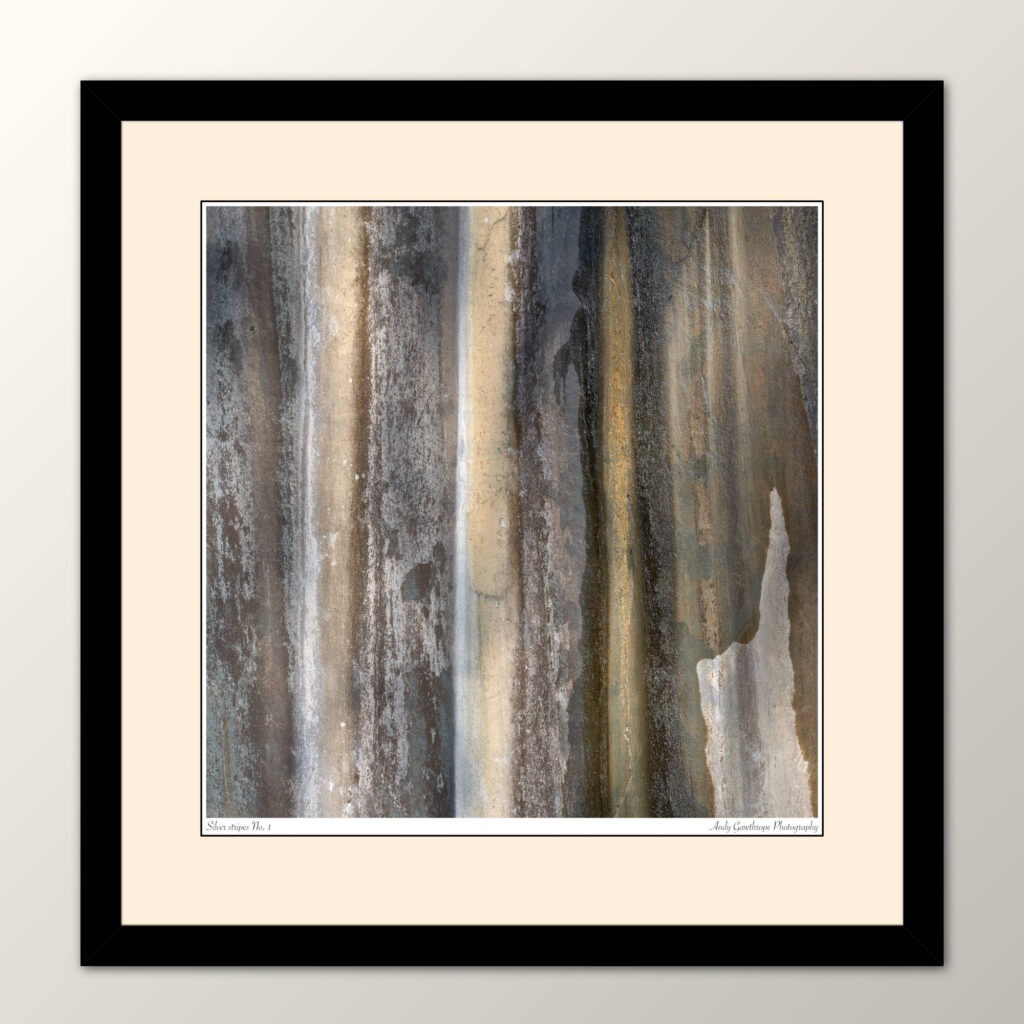
    Silver stripes No. 2
    Silver stripes No. 2

    Typically my photographs are made to stand alone being intended for wall display either in a domestic or commercial environment. I felt from the outset that the photographs intended for this project would probably work best as a collection and should therefore share, for the most part, a common aspect ratio. The GFX100s has a native 4:3 aspect ratio but in the field I often found myself using the 1:1 (square) preview so it wasn’t a surprise that on returning that I quickly settled on a 1:1 aspect ratio for all photographs.

    I was fortunate that on each visit to the Lakes the weather was dry and bright, perhaps sometimes a little too bright but at least not dull and wet. Overcast but bright days were best, deep shadows were avoided and there remained sufficient, softer light to bring-out the colours. Although clear-sky days or days with direct light gave well saturated colours and shorter exposures there was also a tendency for shadows from surrounding trees and their leaves to be deeper and more noticeable. When these shadows moved between images focus-stacking became problematic and required extra work to ensue specific area’s were selected from one image over that in another. The best tool I’ve found for focus stacking is Helicon Focus because of the manual interventions and editing it supports during the stacking process.

    Whilst making the photographs but more so after returning I became aware that there were two clear groupings; The close-up, abstract ones and those including features more identifiable such as the ground or grasses and thus non-abstract. Initially this was a concern as I couldn’t decide whether I liked the unbalance, the contradiction within the same collection. However, ultimately I feel more comfortable with both being together as they contrast and the non-abstract photographs help set the context of the others.

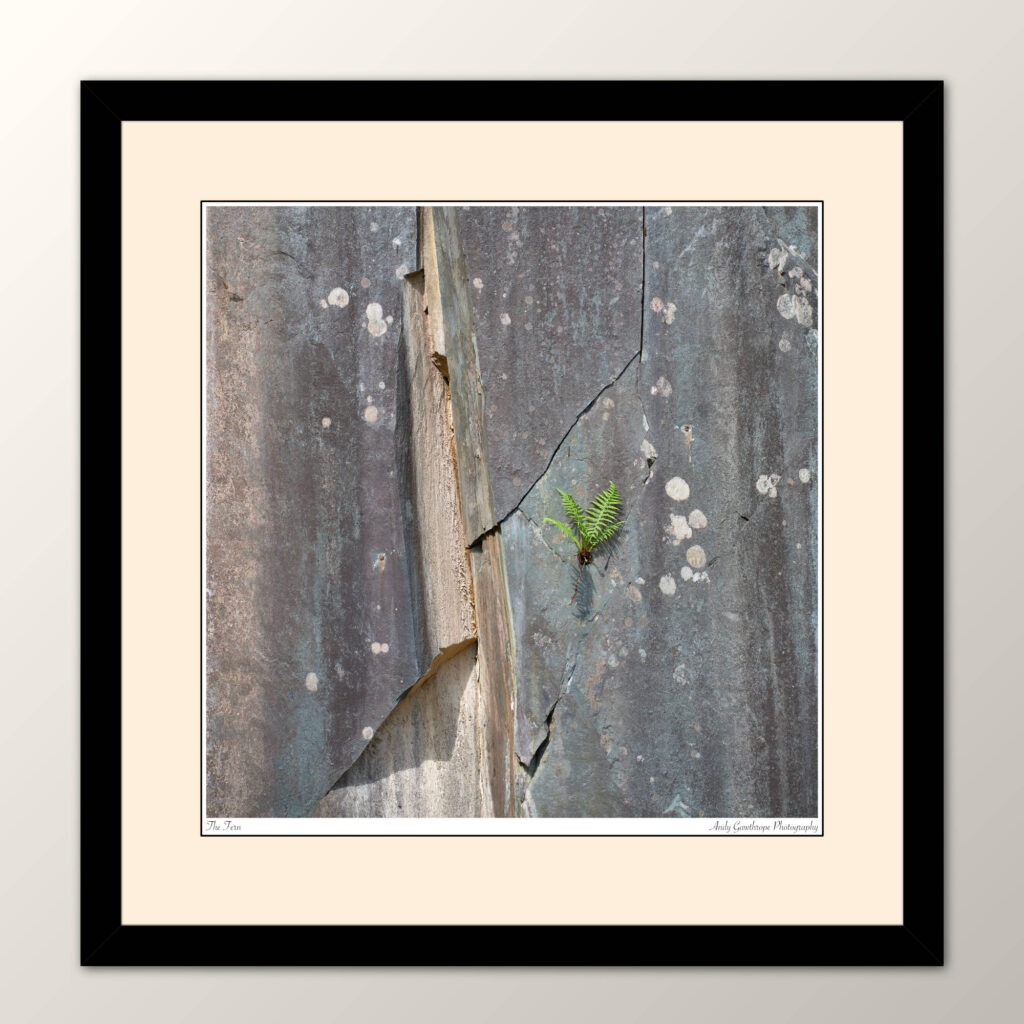
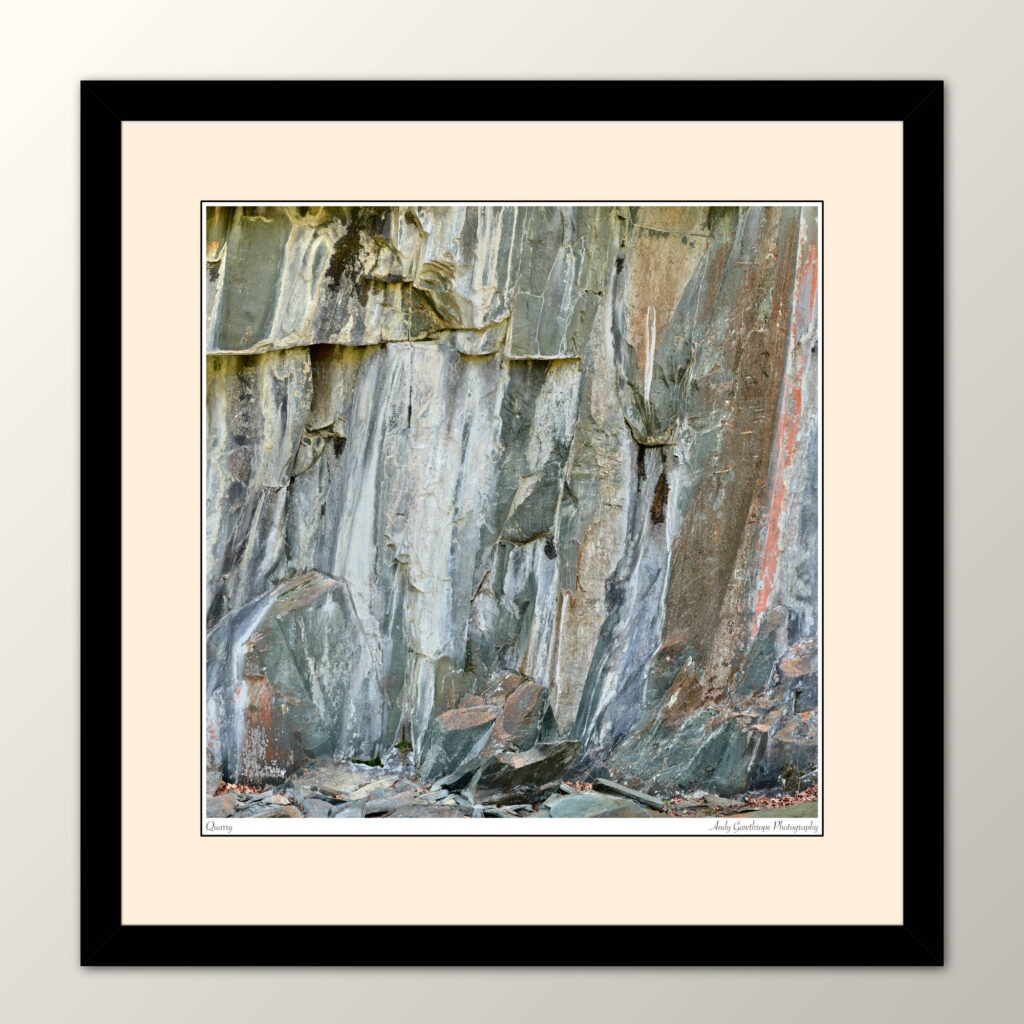
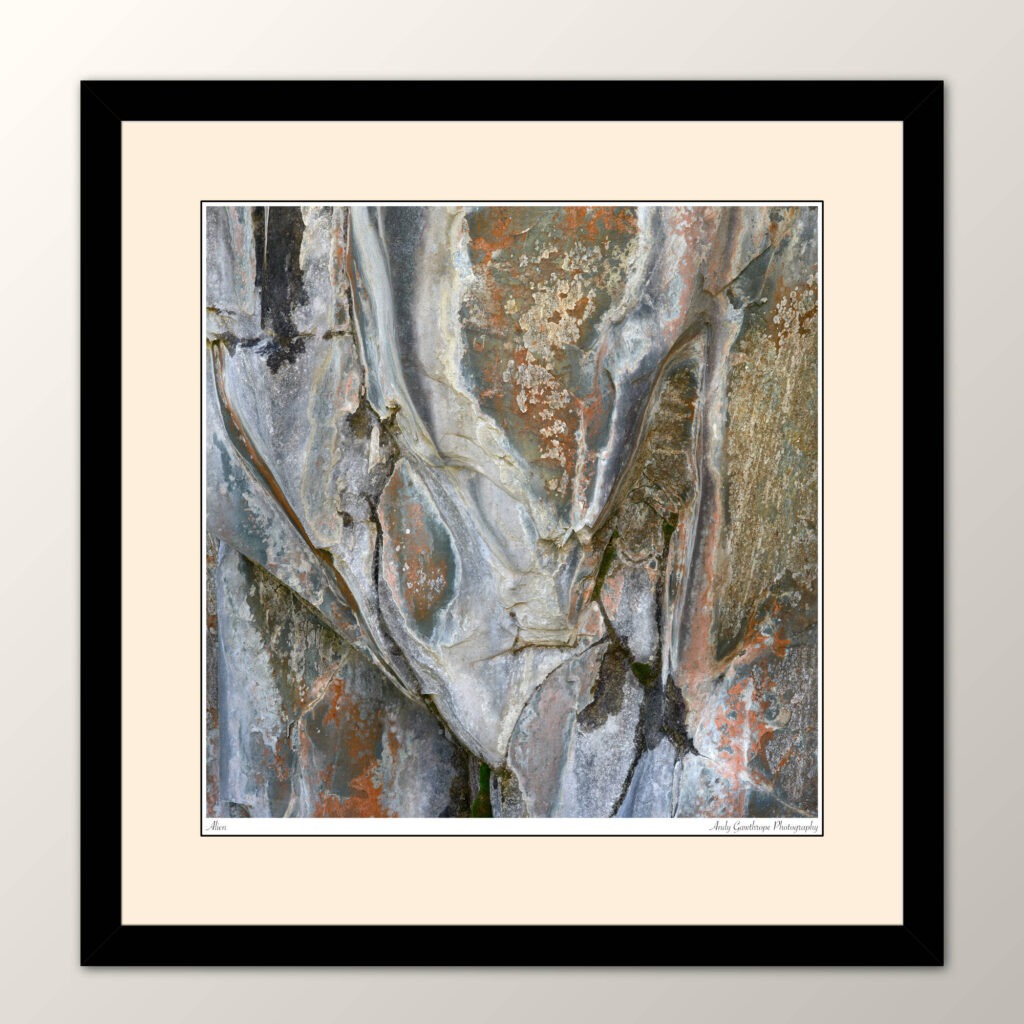
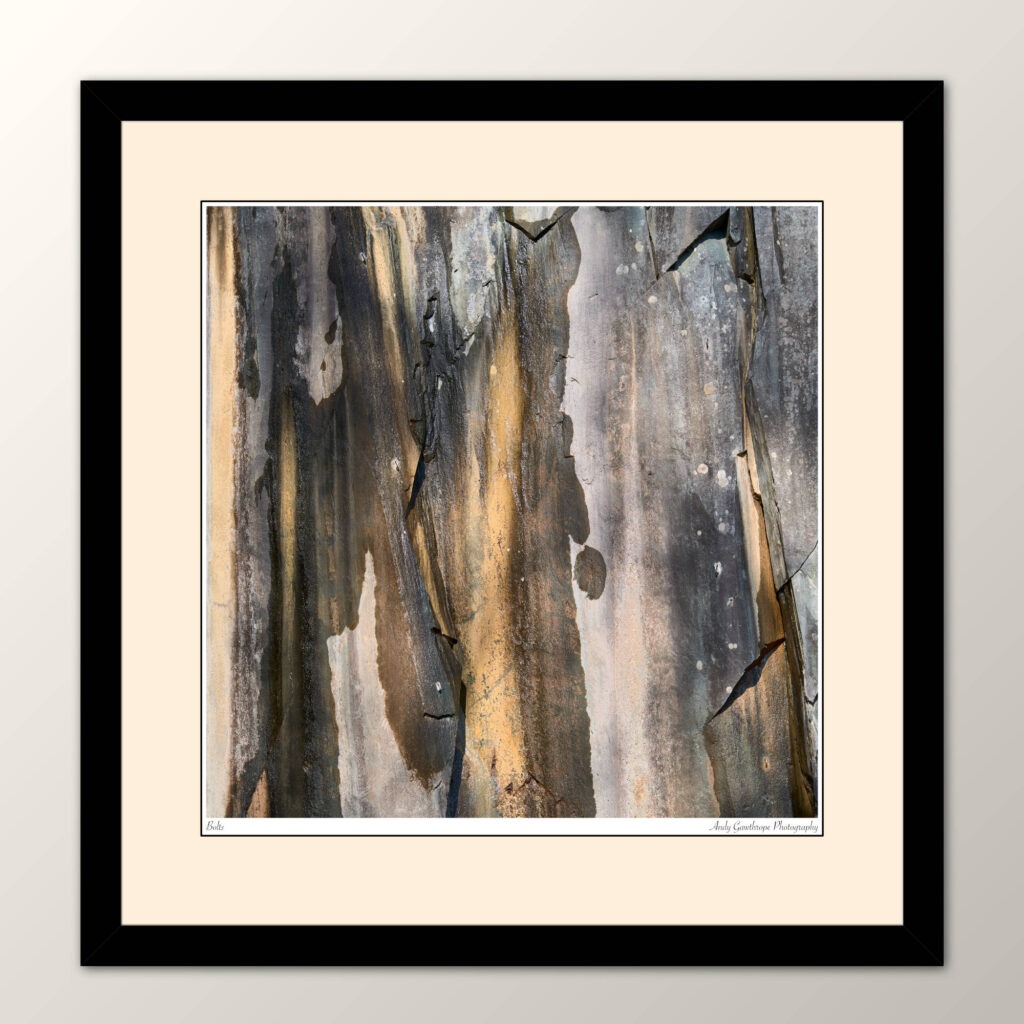
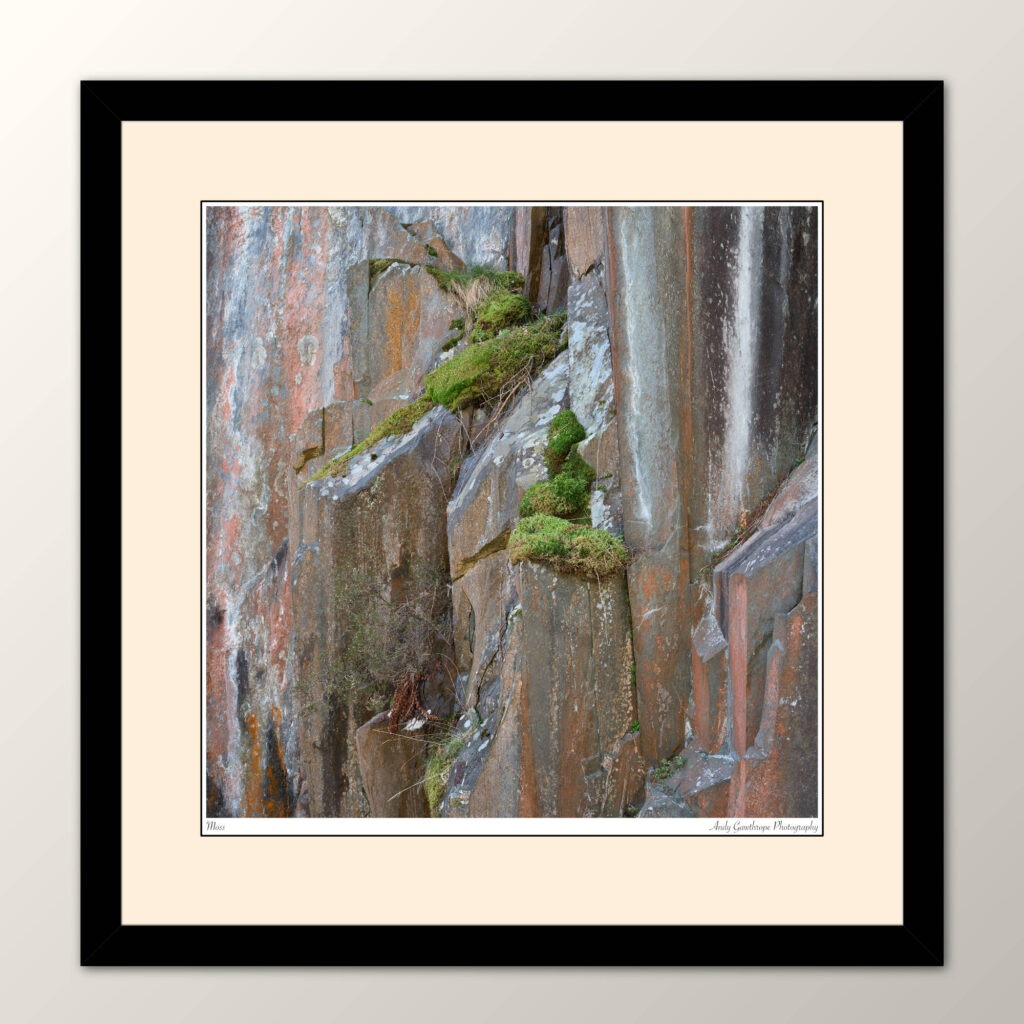
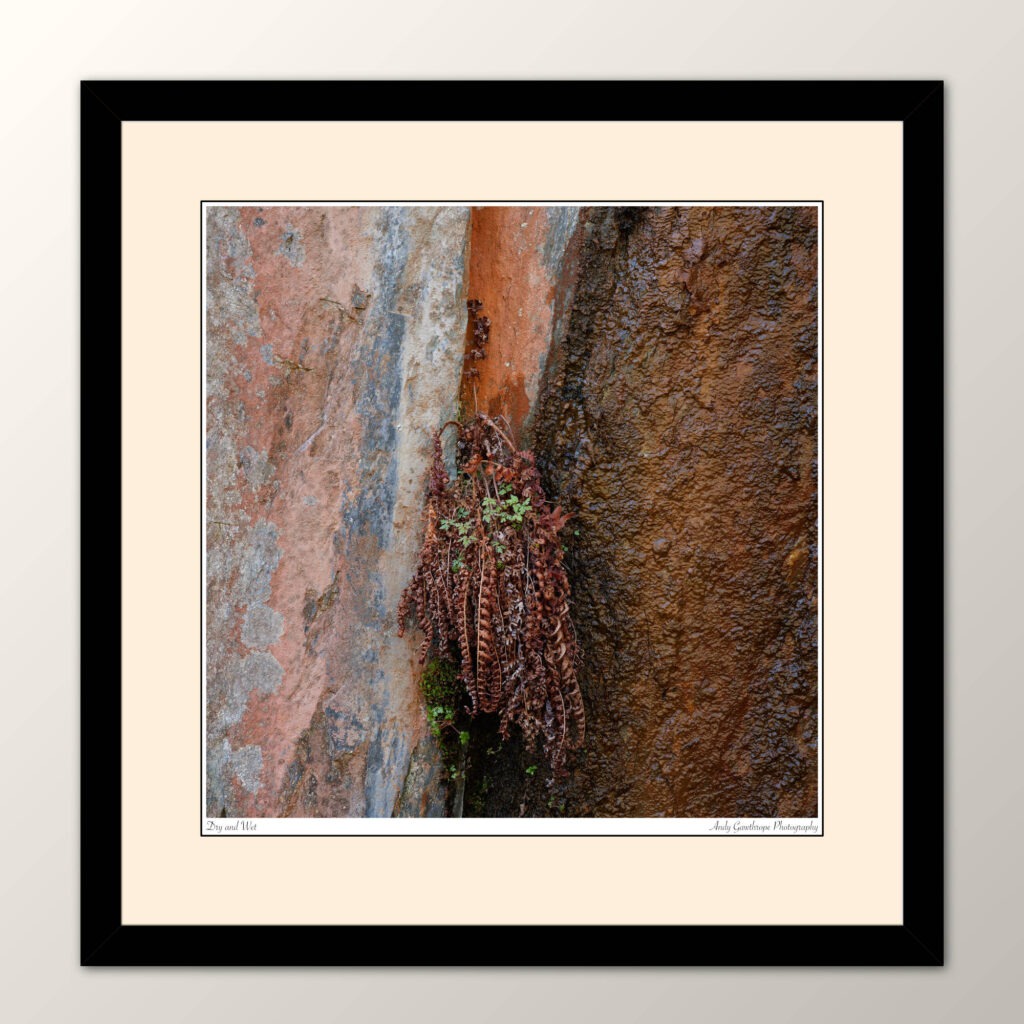
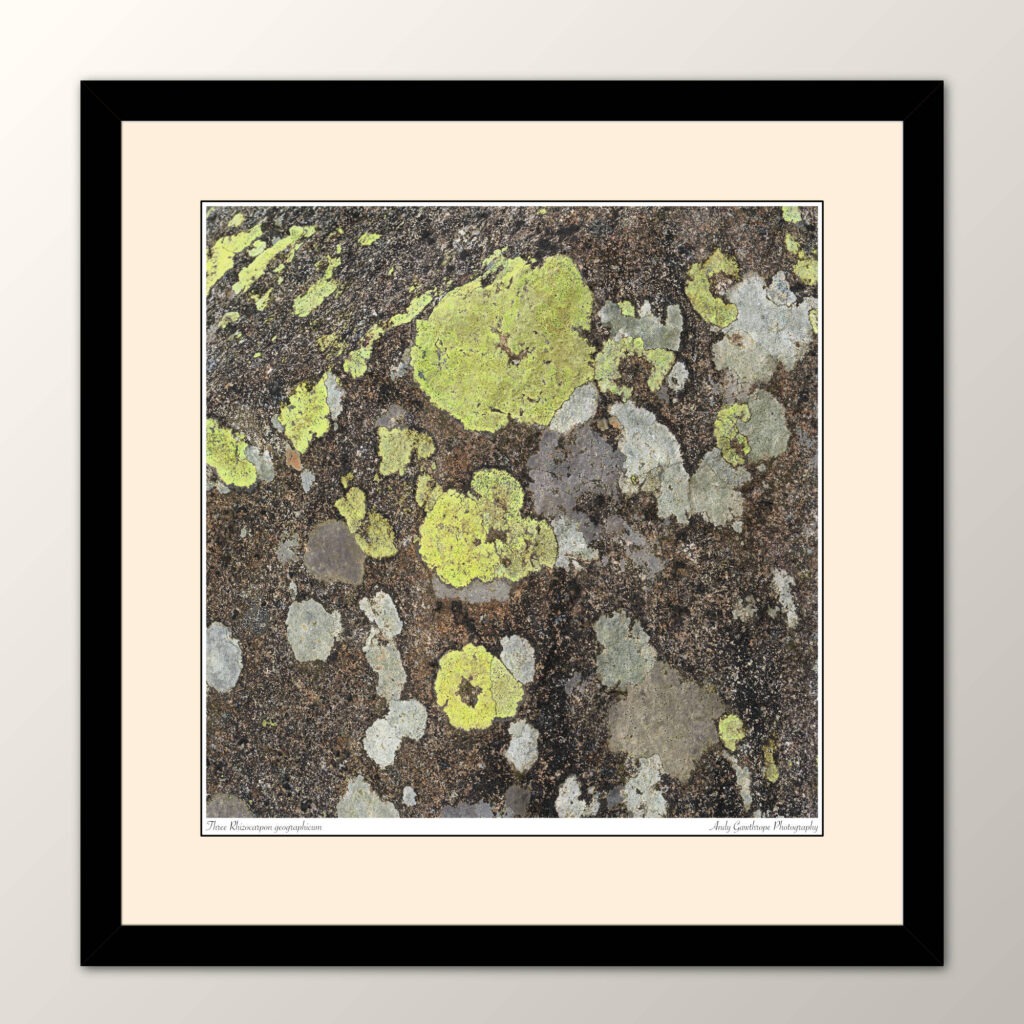
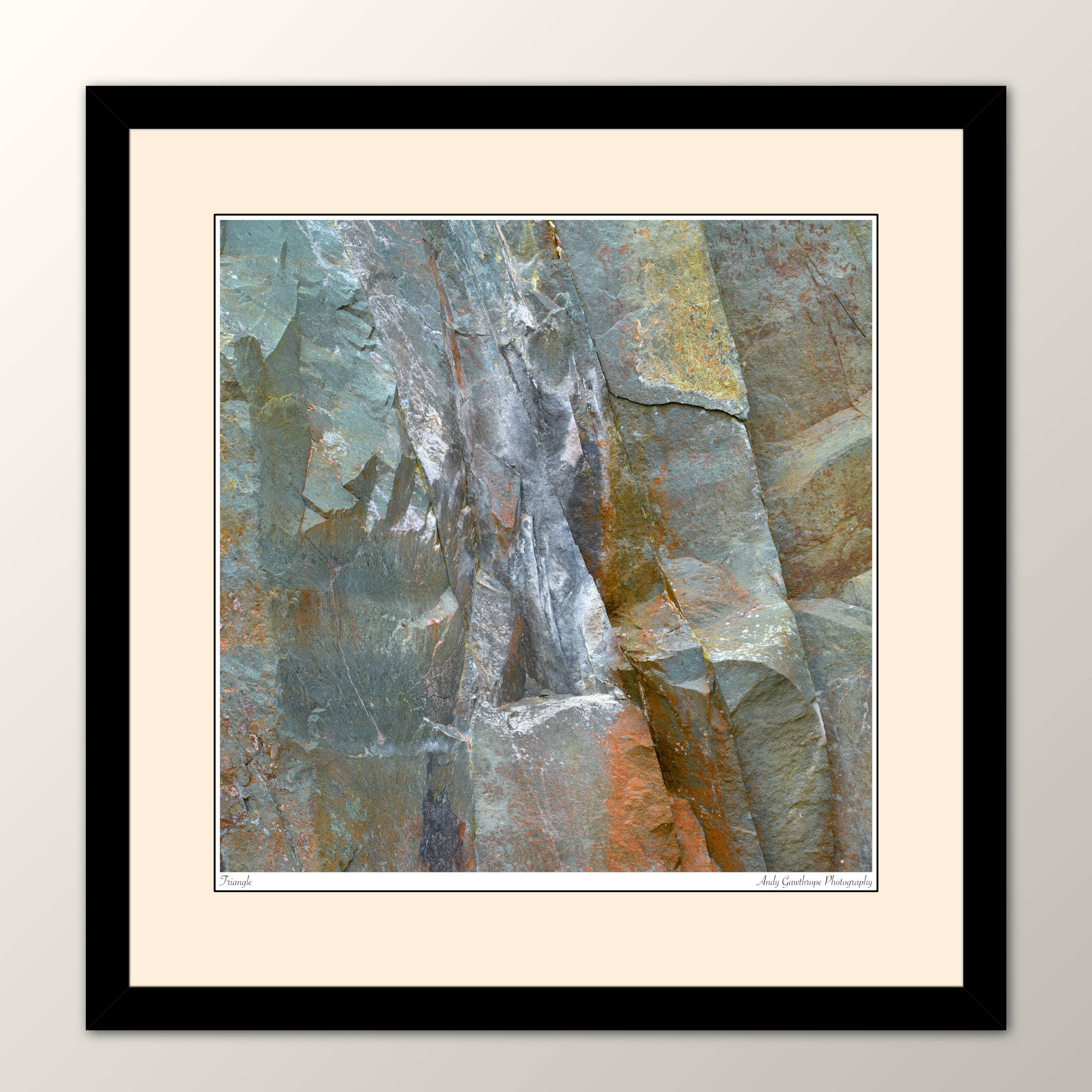
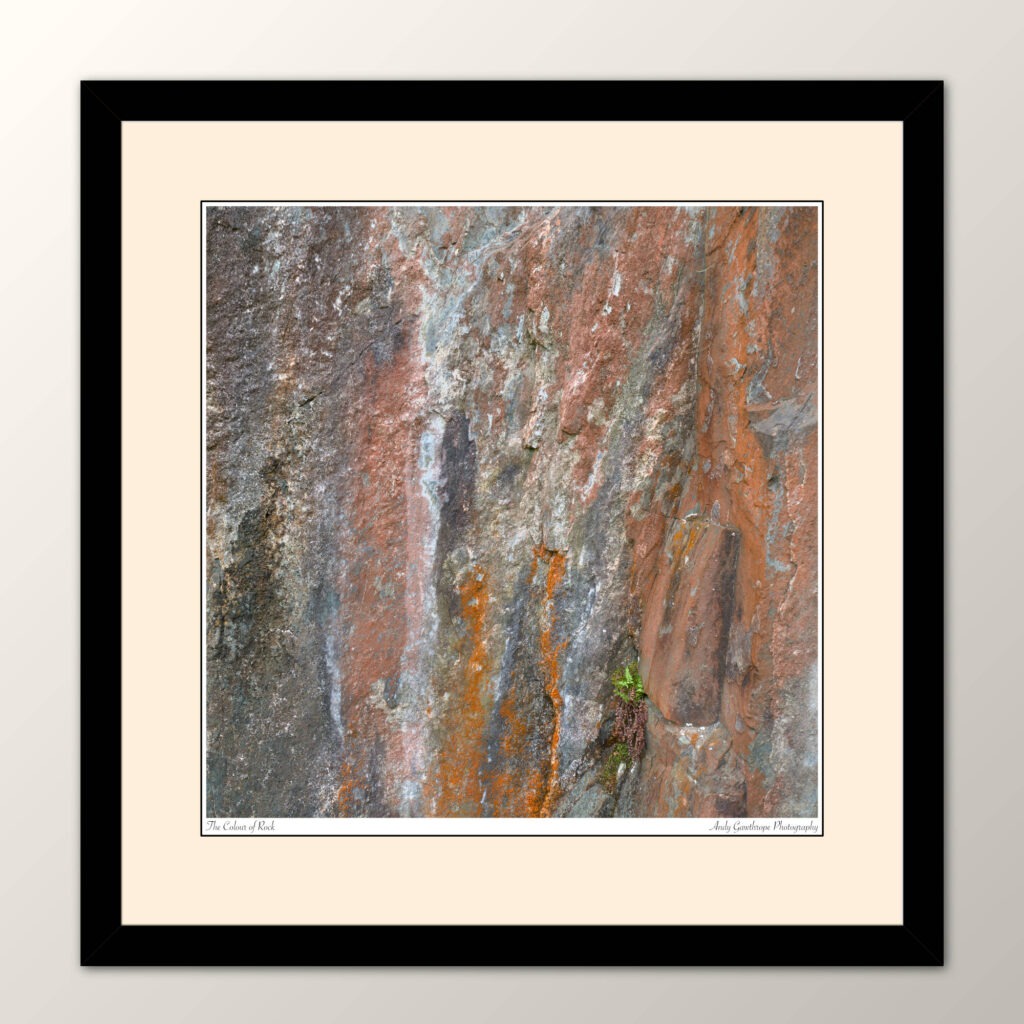
    At the risk of upsetting many geologists, I suggest rock is commonly considered as dull and almost uniformly grey! What this project shows is that rock can be many different colours depending on its mineral composition and is certainly not a boring uniform grey! Some of my favourite images from the project are the parallel, vertical silver stripes. Not only are they a bold pattern but they are very simple with lots of detail and the square composition adds that little extra tension. I like the questions that come to mind. Just what are those stripes and where do they go? What am I looking at? I also like those with blocks of orange, pink, black and brown colours. Again I’m drawn to the images and forced to question what I see. These are the abstract images. With other images the subject is clear, such as the tiny green fern growing in a pocket on an otherwise clean, grey rock-wall. It’s so incongruous that I instantly knew it had to be in a photograph. For that and a few others, I felt context was important and chose to include a greater amount of rock.

    Conclusion

    This project deliberately constrained itself to a few places in Borrowdale so as to be manageable and not open-ended. But I’m of the mind that it could be extended to other area’s and could grow in coming years. Stylistically it’s been very different and a refreshing change.

    Many of the photographs in this post will soon be available as individual prints or sets of prints on the Andy Gawthrope Photography website.

    I do hope you’ve enjoyed reading this and seeing the images from the project. Please leave a comment below.


    All images are copyright Andy Gawthrope Photography.
  • Autumn colour in Borrowdale

    Autumn colour in Borrowdale

    It’s been a long, hot, dry and sunny summer in the UK; the best for many a year.  But long days filled with dust and haze make it my least favoured time of year for photography.   In fact, the camera stayed in its bag for the whole time!  With Autumn approaching and in September I returned to Dartmoor but it was a week of high winds and road-level clouds all thanks to the remnants of US hurricanes making it across the Atlantic.  Nothing came from that trip πŸ™

    A few weeks later and with Autumn in full swing I thought I’d try a trip to the English Lake District, staying at the Bridge Hotel in Buttermere.  The Bridge is a lovely traditional family owned hotel with much history; its somewhere I’ve stay before on at least two occasions.   In the bar at the back of the hotel are five or so large landscape photographs of the area framed and hung on the walls.  They’ve been there for many a year but the colours still look great πŸ™‚  One of these day’s I’ll ask who the photographer(s) were as there is no indication on the frames.  Shame.   The Bridge is slightly cheaper than many of the Borrowdale hotels and it’s only a short drive over the Honister pass.  The Buttermere & Crummock Water area is also much, much quieter than Borrowdale and being a school holiday week it made a stay in the Lakes much more pleasant. My thanks to all the staff at the hotel, especially for receiving a truck wheel after mine was stolen shortly prior to the trip!

    Borrowdale Autumn No. 4
    Borrowdale Autumn No. 4

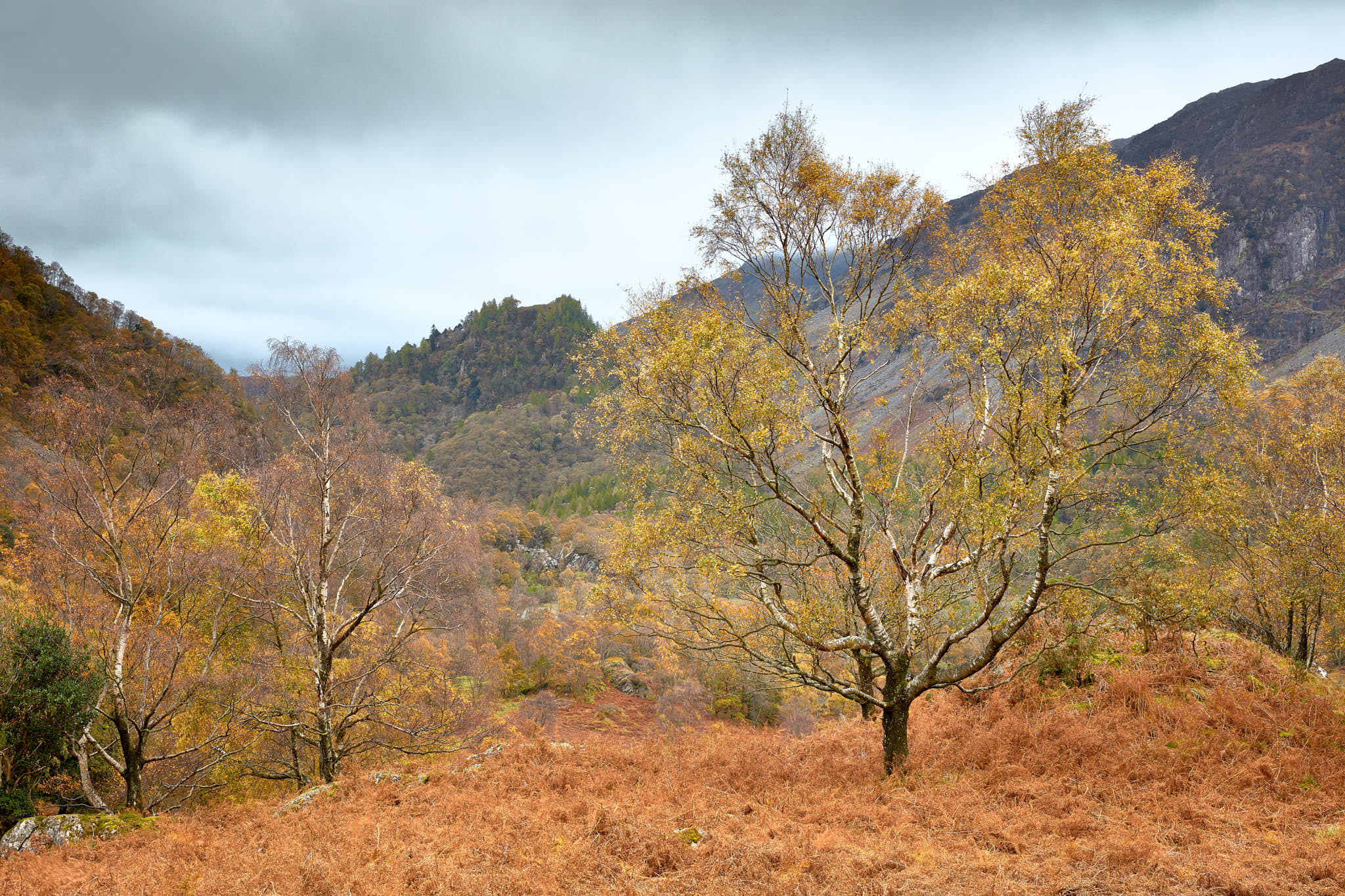
    I do think that I’ve managed to upset some weather gods tho as again it was predominately a cloudy week, but unlike Dartmoor there were great colours that made up for the dull weather.  In fact the first good day of the trip was the day I left!  Just my luck πŸ™  Several nice images did come from the week tho, nothing I’d call special, just nice.  Sufficient reason to return, perhaps next year, with the hope of better light.  But I’d also like to see what snow does to the landscape.  Trees without leaves, the ground covered in a simplifying duvet of white and distant rocky outcrops could look quite dramatic.  Add a little colour too, and wow… πŸ™‚  O’ to be a painter rather than a photographer sometimes!  Reality is such a pain!

    So, perhaps the title for this post should be ‘Buttermere yet, yet again!’ but as its mostly about Borrowdale that doesn’t seem right.  During Christmas 2017, I did much planning for the forthcoming year and one of the projects I settled on was to photograph Borrowdale in the following Autumn.  The intention was to get off the beaten tourist tracks and explore something new, new too me anyway and that’s what happened.  It was a real pleasure parking at a National Trust car park only to head off in the opposite direction to everyone else, find some small, moss covered stile/gate and cross into new, unexplored territory.  It should have come as no surprise to find the occasional photographer crouched behind a tree or bushes but as the area was so large, what photographers were about, didn’t get in each others way.  Well I don’t think so. πŸ™‚

    Borrowdale Autumn No. 2
    Borrowdale Autumn No. 2

    Despite it being a school holiday week and towns such as Ambleside, Grasmere and Keswick being rammed with people, away from the tourist hot-spots was really very quiet.  Just photographers and dog walkers!  O’ and occasional shouts of ‘Climbing’, ‘Off belay’, ‘Safe’ emanating from the crags.  One pair of climbers were obviously having a hard time hearing each other, but away from the crag every shout was heard clearly!

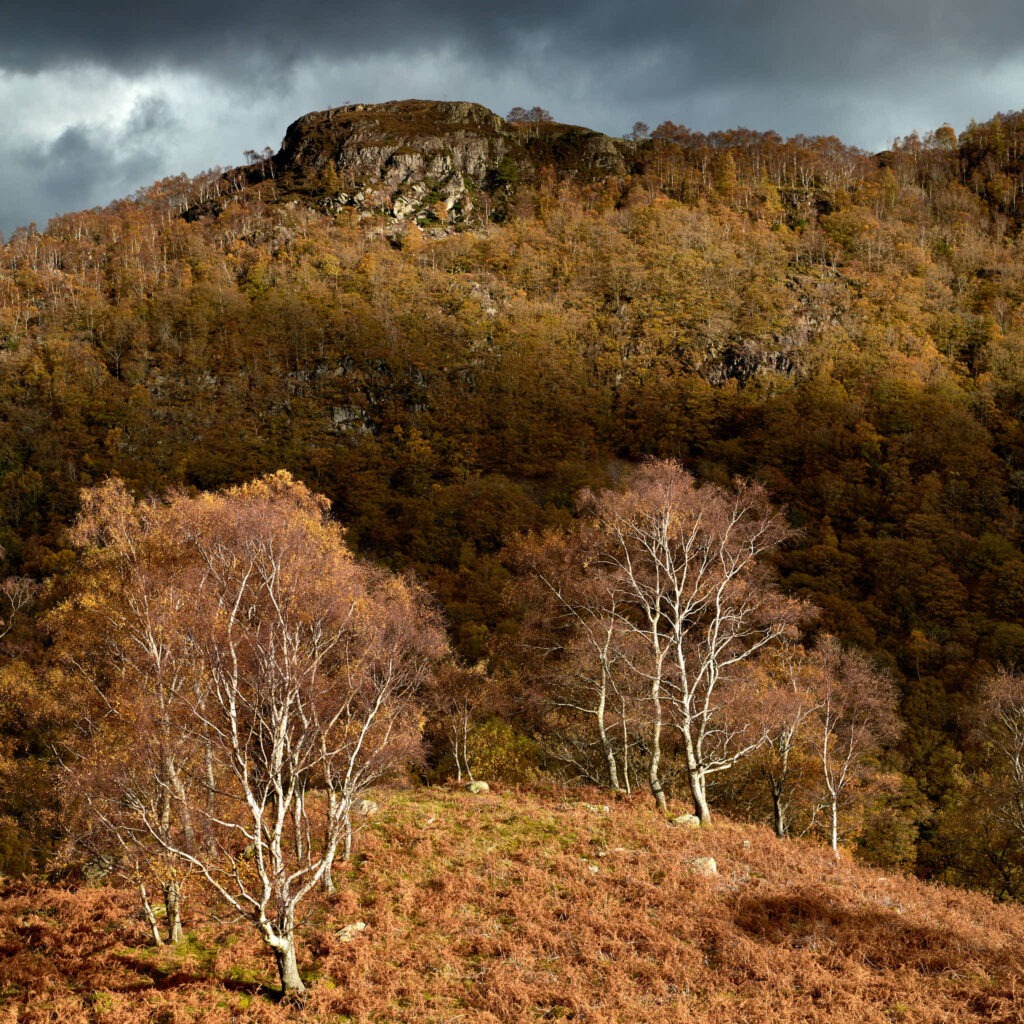
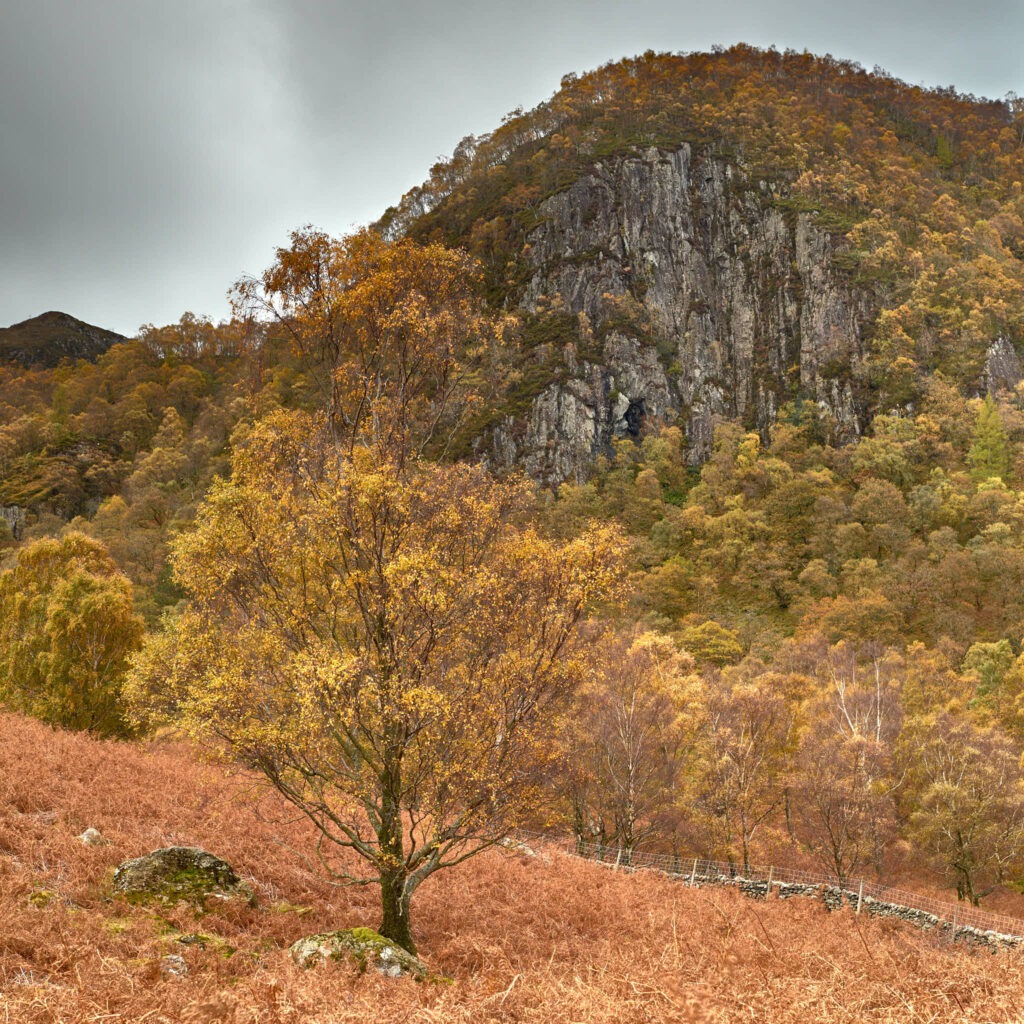
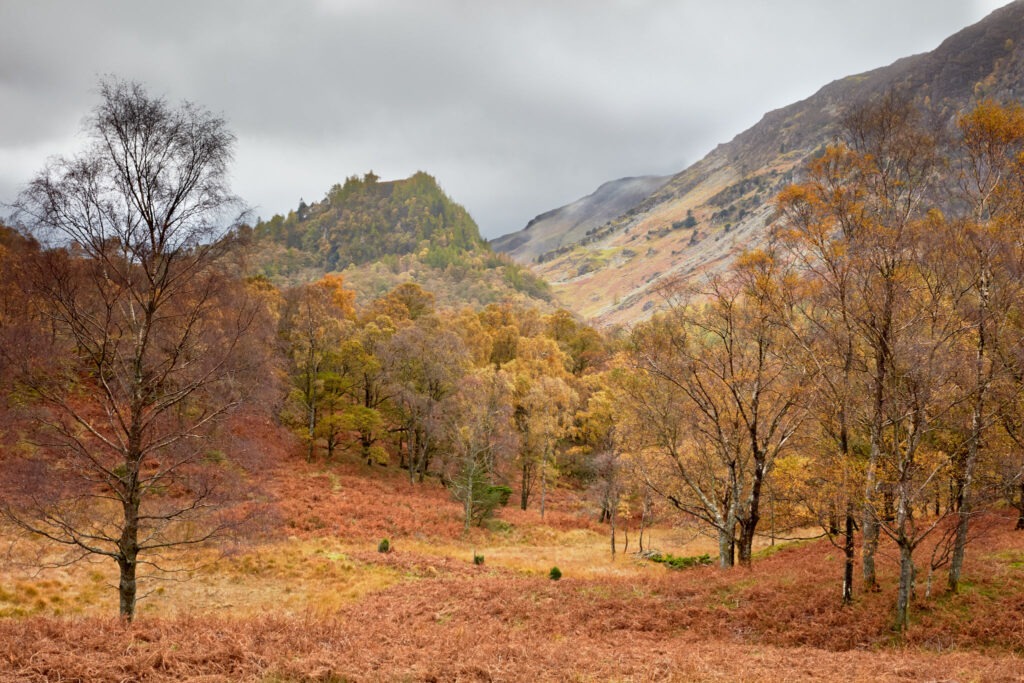
    So, getting back to Borrowdale.  As it happens I recognised a few off the views from the work of others whilst rooting about in the woods, so I certainly cannot claim new and un-photographed territory.  Worst luck!  I doubt whether there is anywhere new and un-photographed in the Lakes these days.  Borrowdale is, of course, synonymous with Castle Crag.  It’s the smallest summit in the famous series by Alfred Wainright and he described the wooded area between it and the River Derwent as β€œthe loveliest square mile in Lakeland” and I think I agree!  It really is a lovely place.  In addition to dominating the Southern end of Derwent Water and Borrowdale, Castle Crag has a wonderful, almost conical shape when viewed from the North.  Including Castle Crag in some photographs was something I had specifically wished to do and, as it turned out, it wasn’t at all difficult!  It was actually quite hard at times to shoot such that it wasn’t in the frame!  As you can see, it made it into this post too πŸ™‚

    Borrowdale Autumn No. 1
    Borrowdale Autumn No. 1

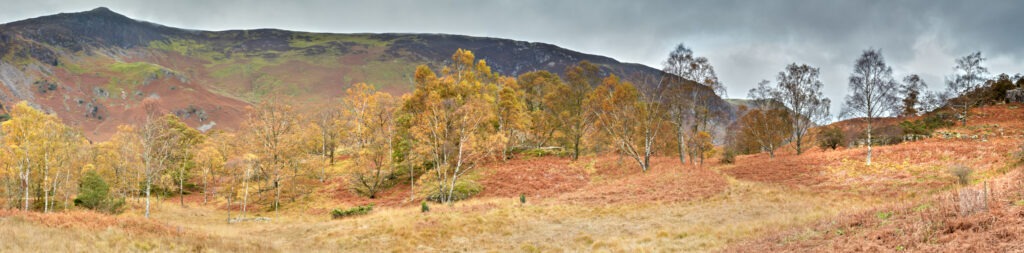
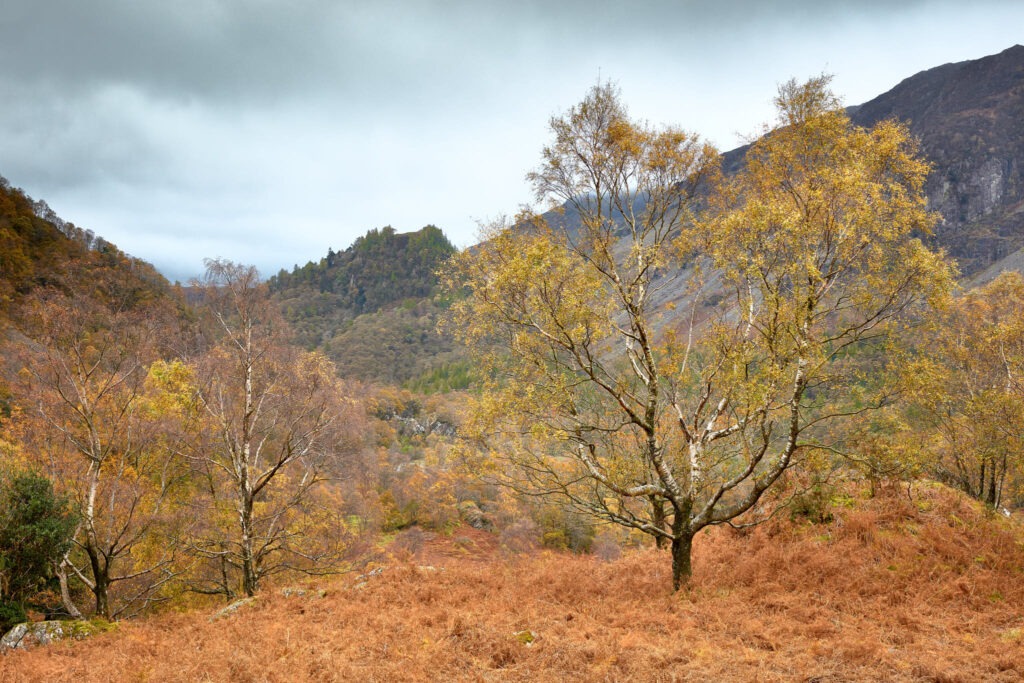
    Common to nearly all the photographs from the week are the grey clouds as can be seen in this post but sometimes there was a little sunlight to lift the colours which made all the difference.  To be honest the Autumn colours were probably a little past their best during the week but speaking with a more local photographer Autumn has been really short this year.  Just two weeks previously the leaves were still green.  Certainly by the end of my week there were noticeably fewer leaves on the trees than at the start of the week and there was always a steady trickle of leaves falling.  Most of the red colours had gone but there was still a great variety of yellow, gold, green and, yes, the bracken really was a deep brown!

    One characteristic of the area that made it special for me was the space between the trees.  It wasn’t dense woodland packed with trees; there was plenty of open ground punctuated by either solitary or small groups of trees, sometimes with rocks or other interesting objects at their base.  This made for more interesting compositions and gave the subjects ‘room to breath’.  

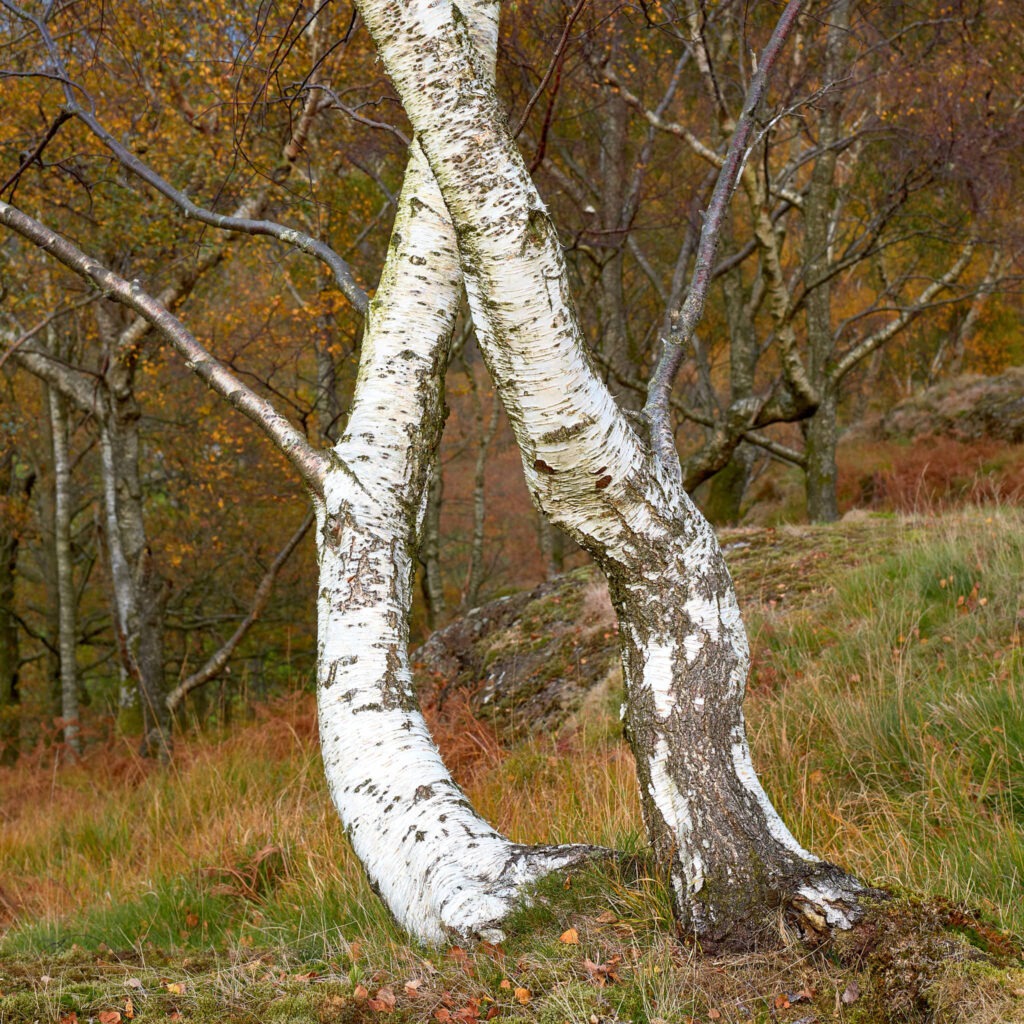
    Whilst I’m no arboriculturist, the trees looked like Silver Birch and in the gloomy conditions their light/silver coloured trunks and branches added a skeletal component helping emphasise their structure and add a little interest.  Sometimes tho, when the sun did peek out from the clouds the light/silver colours became very bright reflecting sunlight and making exposure difficult.

    Entwined
    Entwined

    Most of the photographs from the week set a tree/trees in the context of  their landscape, but I was also looking for interesting close-ups too.  Almost at the top of the hill and tucked at the back I spotted the two in the photograph.  Its not just the curving trunks I like but the detail in the bark πŸ™‚  It was shot at F8 to add a little separation between the main subject and the background, a wider aperture blurred too much of the main subject.  When viewed at 100% the Silver Birch trees are wonderfully sharp and its probably my favourite image from the whole week.

    Not far from these trees a small patch of red and green moss hung to the side of a rocky step.  It was really beautiful and very, very different from the normal big landscapes I photograph – the opposite extreme!  Perfect job for a macro lens, but I didn’t have one so I made do with the 50mm but the results were pretty disappointing.   But I learn’t a few lessons trying so all was good πŸ™‚

    Ah, the 50mm lens… That was a present to myself earlier this year.  Its a Sigma Art model and it seems to have become my go to choice.  It just seems to magically frame whatever the subject!  It’s great for single exposure images but, importantly for me, panoramic’s too.  There are two lenses always in my landscape bag now, the 50mm and a 21mm.  The 21mm used to be my go to lens but nowadays it only get used when the much wider field of view is needed.  Shooting from a little further back and with a little magnification really seems work.  A few years ago I’d never have considered 50mm being my default lens for landscape work – at 35mm full frame anyway.

    Castle Crag
    Castle Crag

    Well, that was Autumn in the Lakes.  It seems fitting to end this post with a photograph that summed up the weather.  Clouds covering the high fells, grey cloud but lovely colours. πŸ™‚  Roll on winter and let’s hope its a snowy one πŸ™‚

    If you have enjoyed reading this post, found it useful or just simply enjoyed the photographs please share it on social media.

    Thanks,

    Andy


    All images are Copyright Andy Gawthrope Photography.