Tag: Wales

  • Forest of Dean 2023

    Forest of Dean 2023

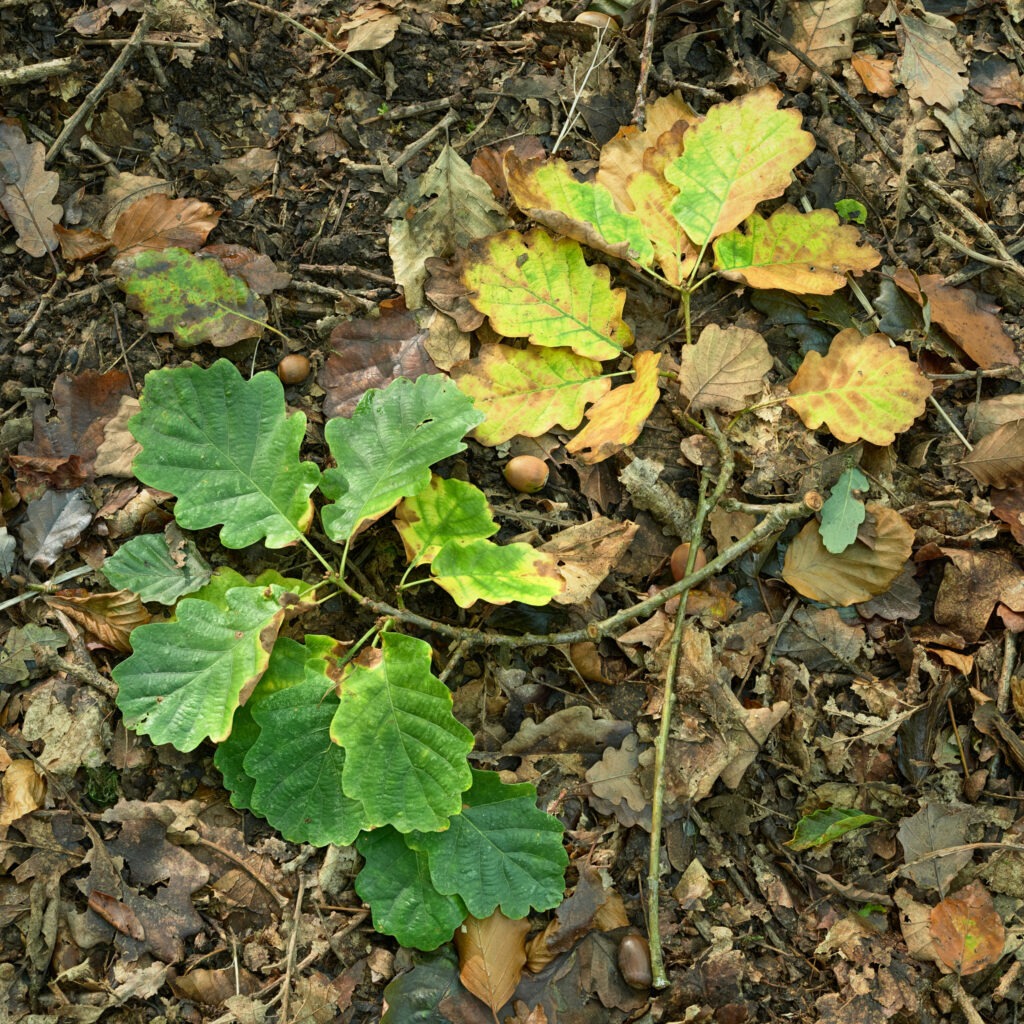
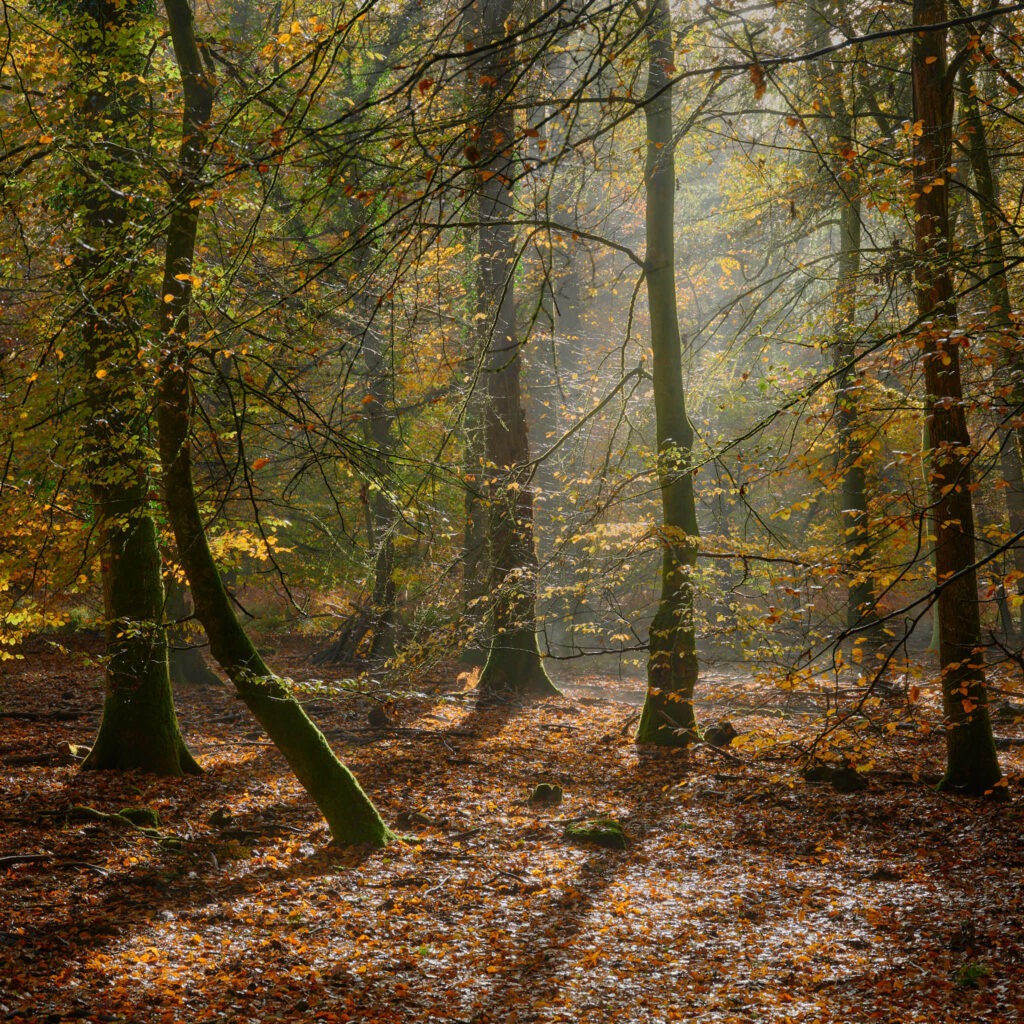
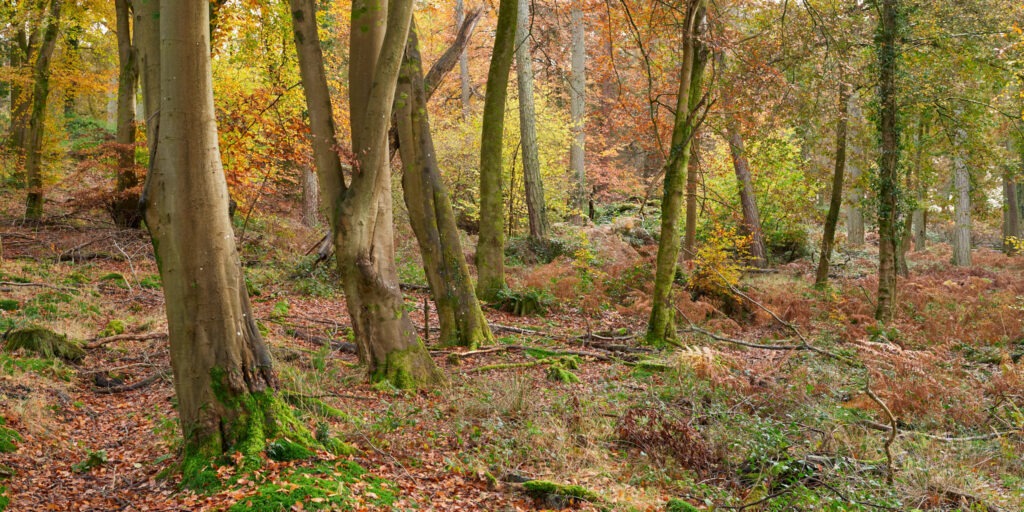
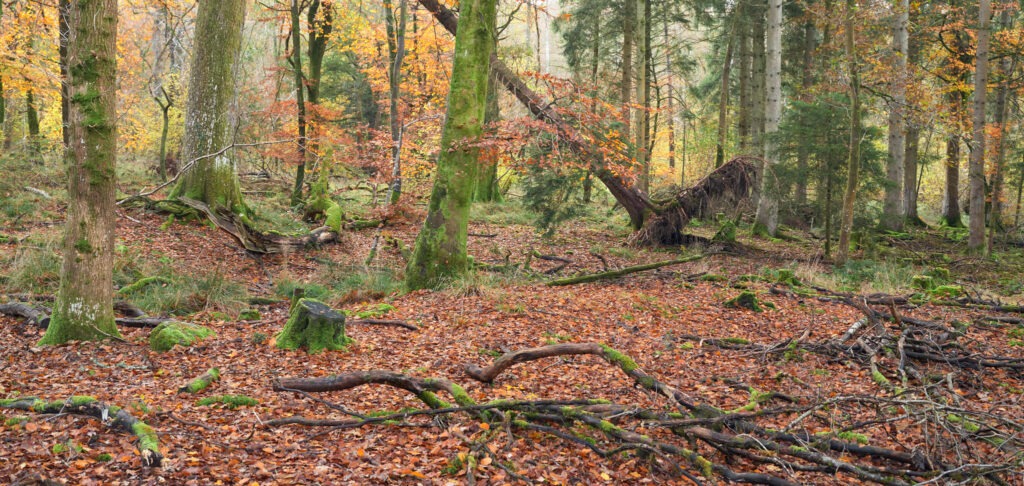
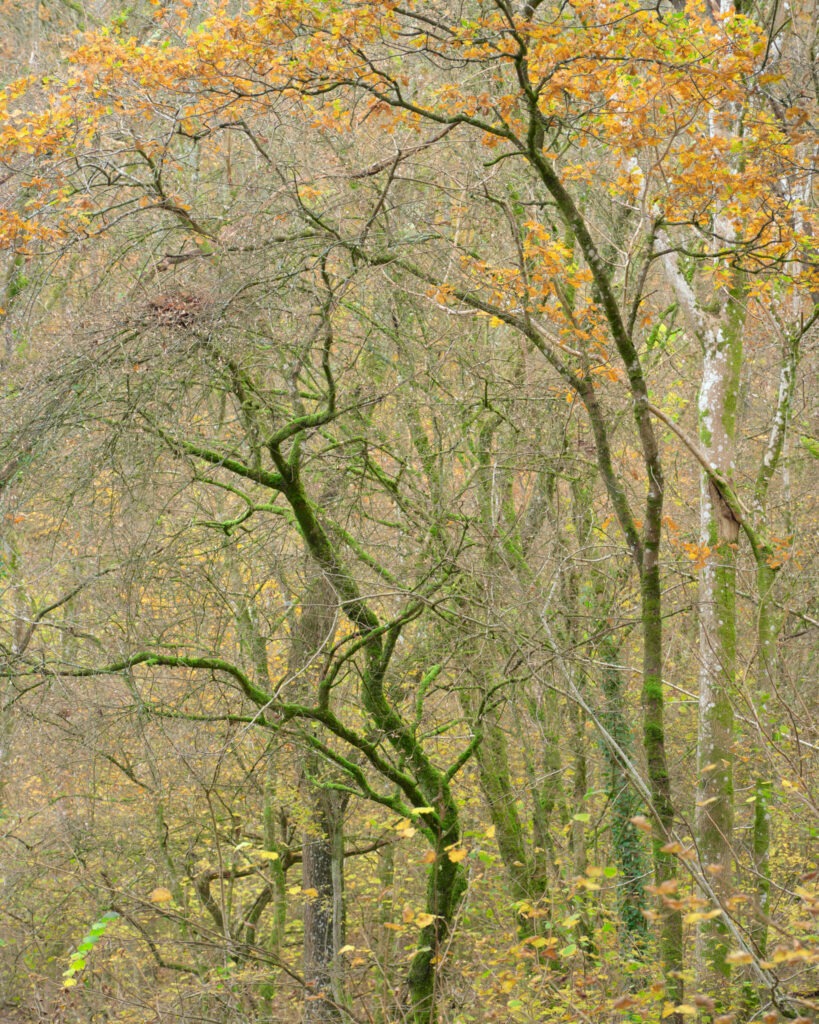
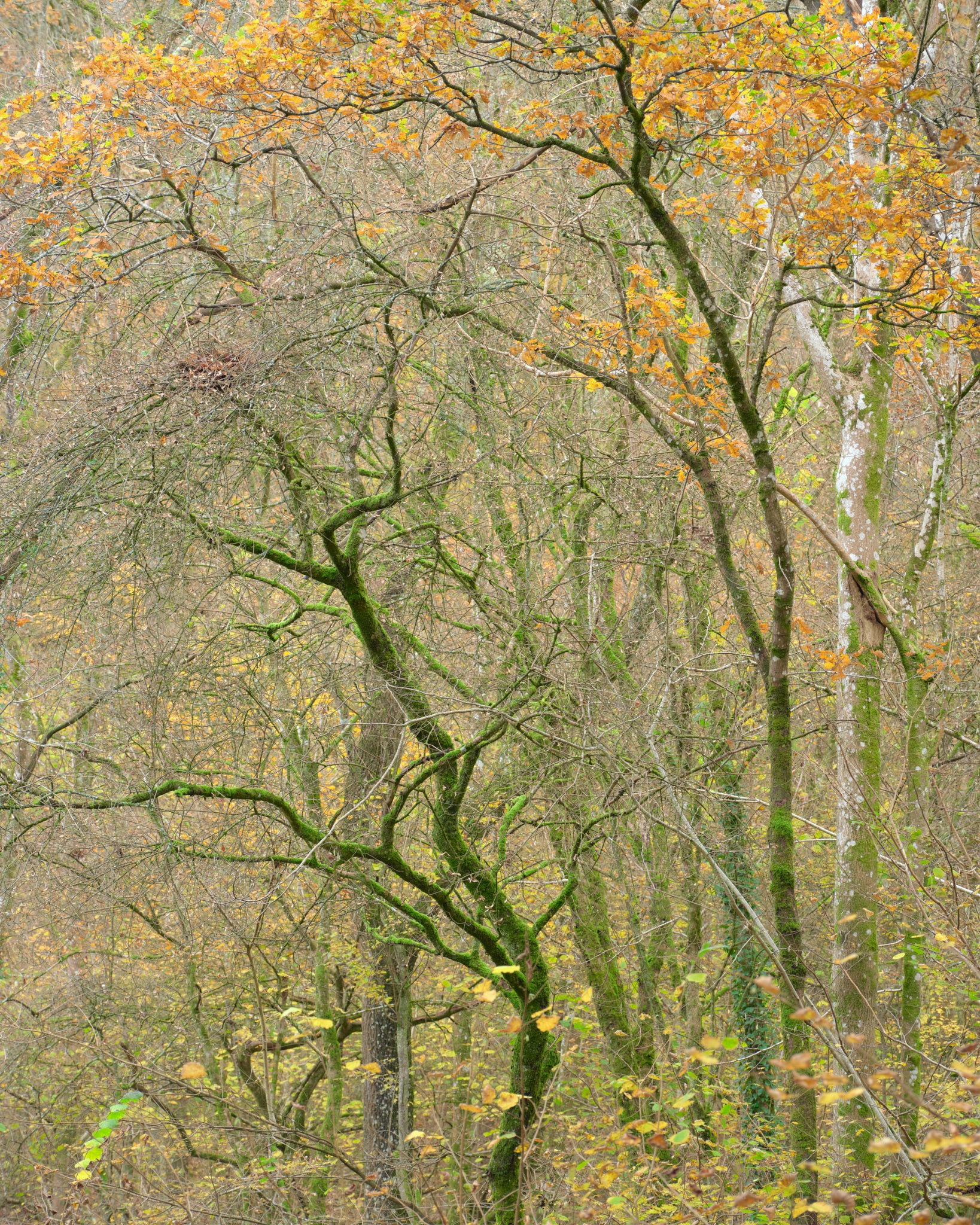
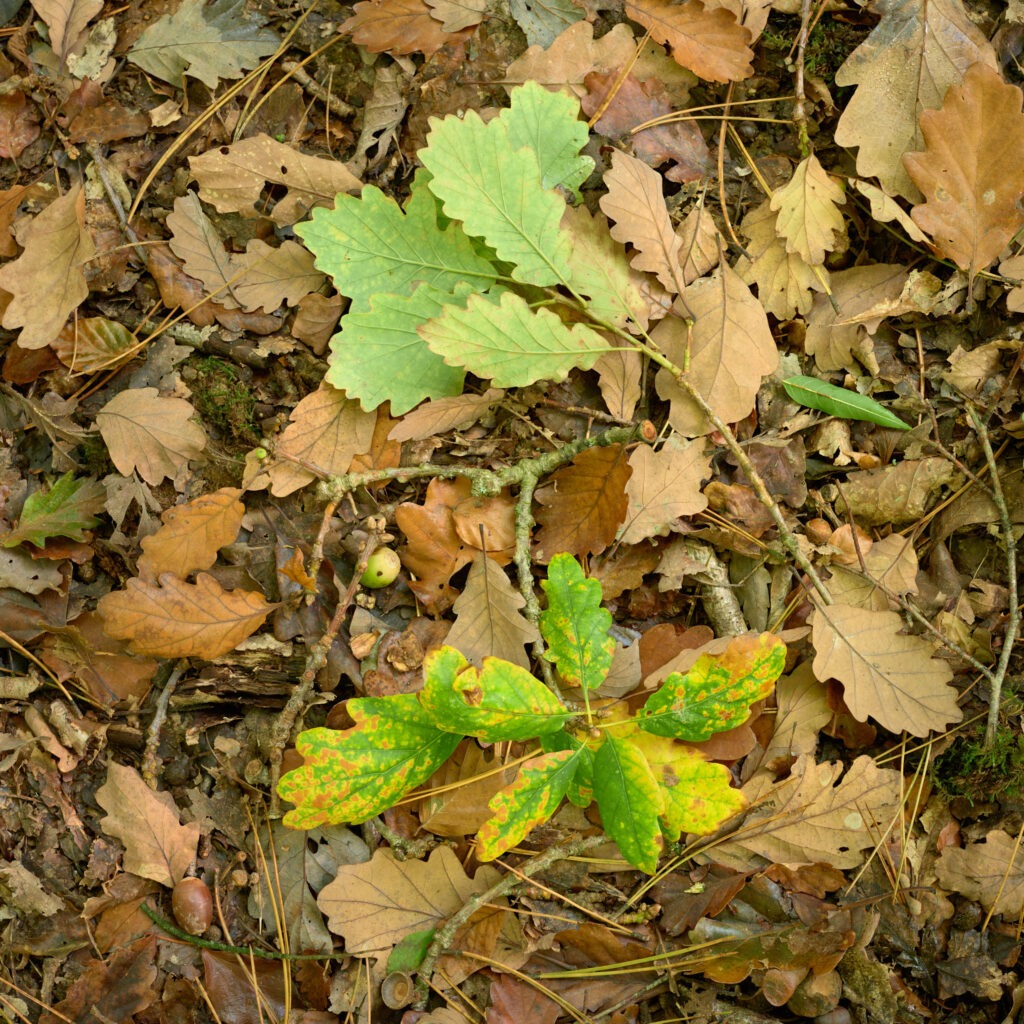
    Here in the UK South West the trees started to turn in early October but there was really no noticeable mass change until the second week of November and after a few chilly nights and windy days. Afterwards the rate at which leaves changed from green through yellow, gold to brown seemed to increase and by the fourth week of November, Autumn was pretty much over. This change is clearly noticeable in the photographs I’ve chosen to include with this post. Those made first, fallen leaves on the ground, were made on 15th October and the last, named β€œBurnt Wood No. 1” – located near the town of Wickwar further to the East – on 22 November.

    This year I chose to concentrate mainly on my local forest – The Forest of Dean – rather than flit around too much between different locations. For those not familiar with the forest, Forestry England describe it as β€œβ€¦a historic forest with its origins as a royal forest pre-dating the Norman Conquest of 1066. The Forest has been historically isolated and bypassed, sitting as it does between the Rivers Severn and Wye on the border of England and Wales.”. It is a working forest and, as such, consists mostly of younger, straight trees be those evergreens or deciduous. The deciduous trees clearly make for more colourful Autumn photography and are primarily Beech with a little Oak, Sweet Chestnut, Ash and Birch.

    Writing this, I find myself again asking why I enjoy being in woodland and why I enjoy making woodland photographs. It’s a very hard question to answer as it’s more β€˜feeling’ than something easily placed into words. I do know however, that I find woodland relaxing, calming and peaceful. There is something about the enveloping sounds, colours and life-stories. It often feels like the passing of time slows and with it an awareness of surrounding increases. Move slowly and quietly and after just a short while it’s as if the forest accepts a visitor and carries on around you. Stood still, making a photograph you notice the rustling of leaves as air moves through the trees; squirrels frenetically preparing for an approaching Winter, birds moving in the trees even beatles, ants and other small bugs crawling around on the forest floor. Occasionally deer will appear through the trees, stood still and watching, before bounding away. I’ve yet to see the boar but evidence in the form of disturbed ground is all around. The place is alive! Compelling too is the idea that a forest is a record of time, of the past, present and the future. The forest floor is the canvas on which time is recorded. It is layered with tree stumps, fallen/broken branches, leaves of Autumn’s past and saplings which in-time will become trees.

    From a photography perspective woodland, including forests, are chaotic, hard to photograph places. The techniques required are common to photography generally, especially Landscape, but I believe observation especially important as it’s foundational to identifying compositions in messy woodland environments. Given messy environments, simplification usually leads to better results. Sometimes finding simplification means looking down, as in leaves on the ground, or finding contrasts in shape, light or texture – β€˜Burnt Wood No. 1’.

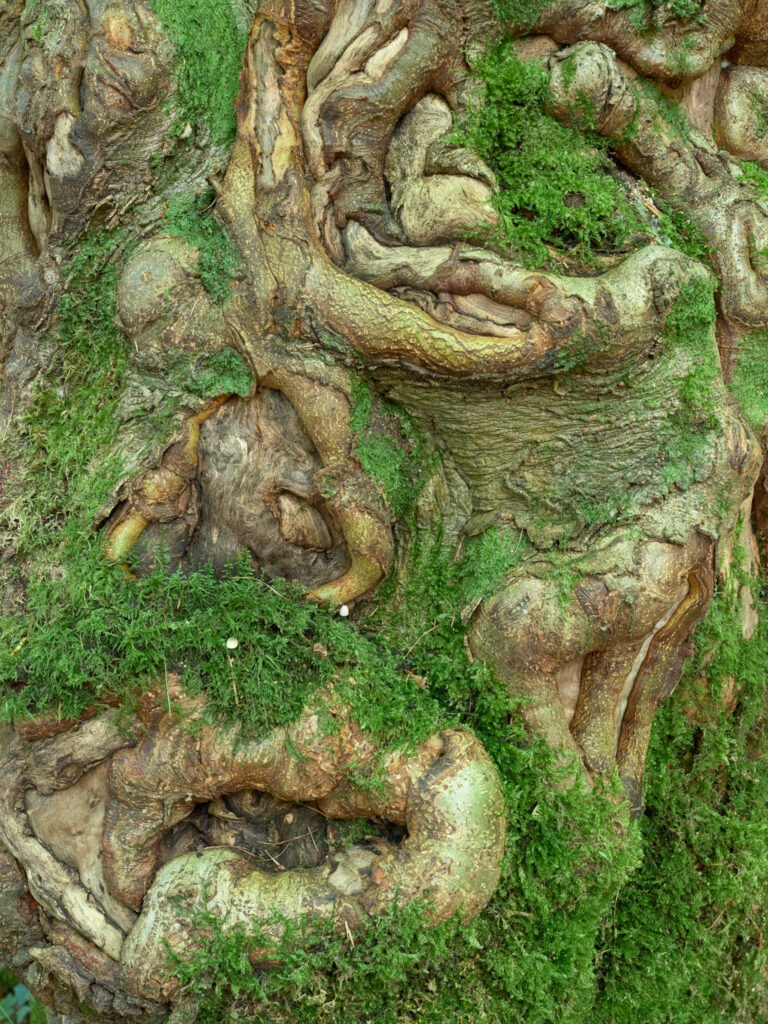
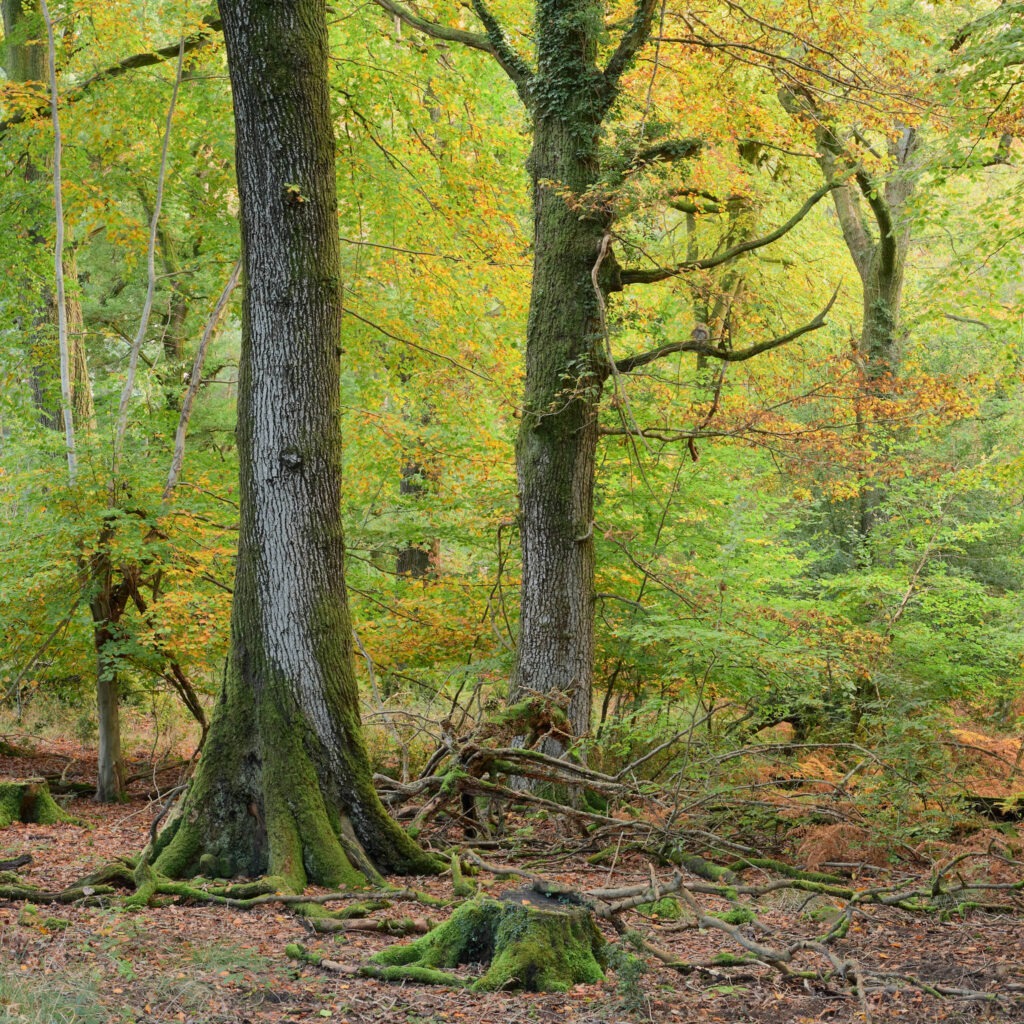
    β€˜Beechenhurst Inclosure No. 3’ is one of my favourites from this Autumn. It was made early in the season so everything is still quite green but I feel it encapsulates that feeling of β€˜forest’ discussed above. It includes the messiness in a controlled way and the life-story of old and new in the forest. Next Autumn it may look quite different with further new growth and decay. It will be interesting to return. I feel I must mention β€˜Face in the Tree’ as it was a total surprise and lucky find; It was also huge fun making the photograph! Whilst slowly walking through the forest looking for compositions I spotted what immediately stuck me as a face low down on a trunk. It struck me as so realistic that I actually checked someone hadn’t done it on purpose! It certainly showed no signs of being nothing more than natural in origin. The eyes, nose, mouth and cheek bone were so clear!

    Andy

  • Snowdonia

    Snowdonia

    Snowdonia is great as it has ‘real’ mountains! ‘Real’ because they are rugged, craggy, weather beaten peaks quite different from their rolling, greener English cousins. Like all mountains they influence their local weather and so despite visiting a few times since the late winter of 2019 I’ve not been too lucky with the weather. Some trips have had blue skies and zero cloud others total cloud cover. This time tho I was more lucky πŸ™‚

    My problem with Snowdonia is there are just too many big mountains packed into a small area separated by deep valleys. This inevitably seems to mean that gaining altitude is necessary to catch the best morning or evening light and to reach a location where a subject can be framed, placing it in context. What I’ve learnt is mountain photography is much harder than it looks! I’m convinced there is huge potential but I’ll admit to finding it challenging, in part, because of an unfamiliarity with the area that comes from living a couple of hundred miles away.

    One of the most important things I’ve realised is that you don’t need to be on the top of a mountain. I guess, I knew that anyway but it’s especially pertinent when getting to the top may mean a further hours of hiking and several hundred metres of ascent with heavy camera gear. Locations at about half height seem to work well as there is terrain below and above to fill a frame. Another thing I’ve realised is that it helps to be some distance away from your subject as mountains are big things! So, locations around the periphery looking-in towards the mountains work well. That was the rationale I applied on my recent visit and it seemed to work.

    It is said that success breeds success and whilst I’m pleased with the results – as they are nice photographs – they do underscore potential given the right conditions and further exploration. So, I’ve now got compositions in mind for my next visit which given good conditions should deliver even better results. πŸ™‚ Unfortunately, that trip may be a little way off.

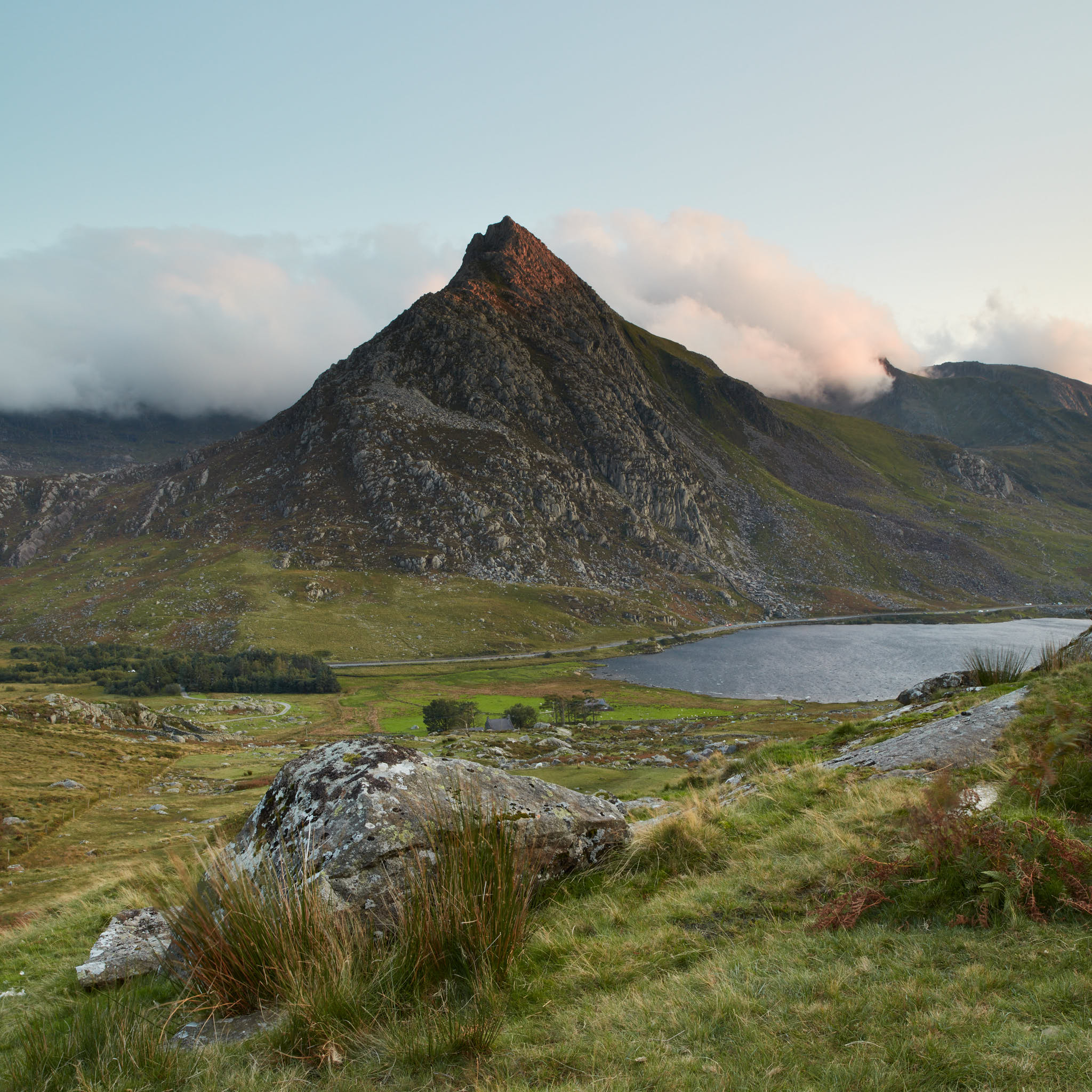
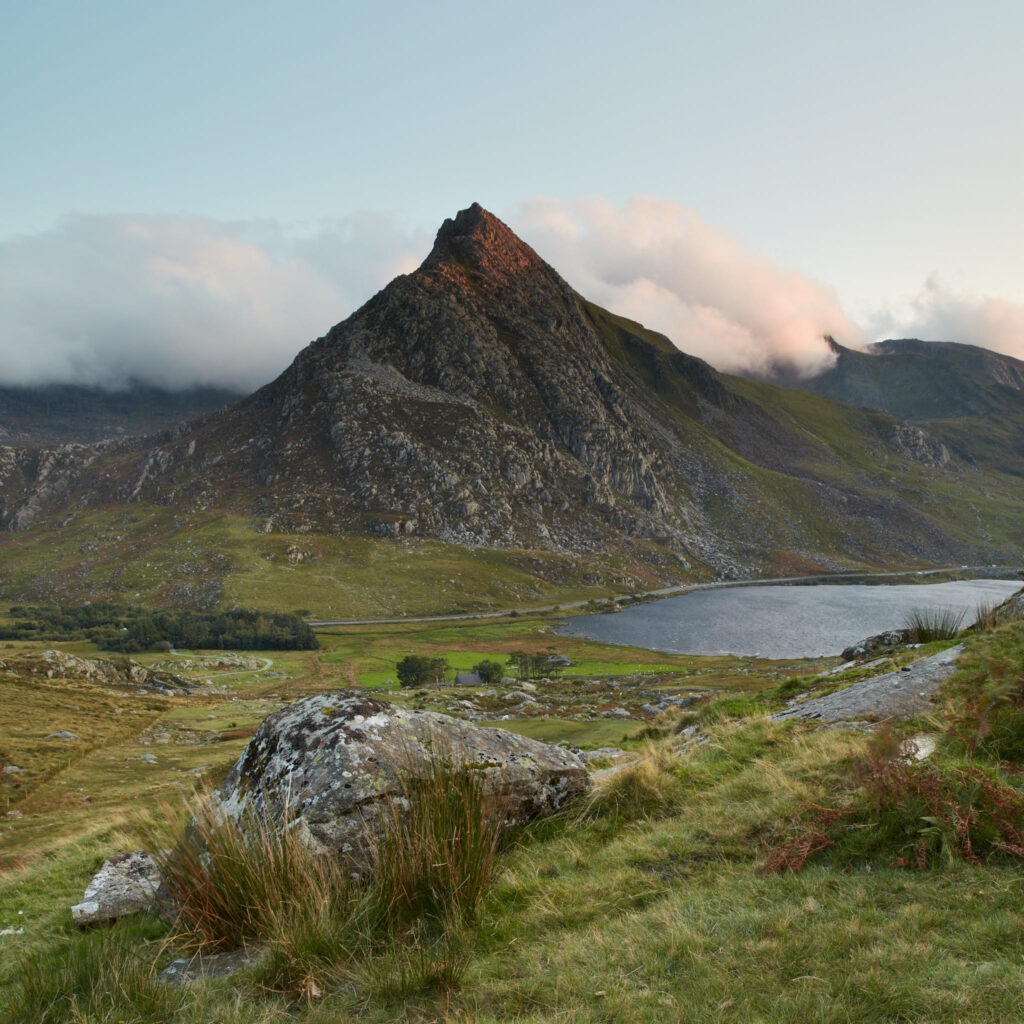
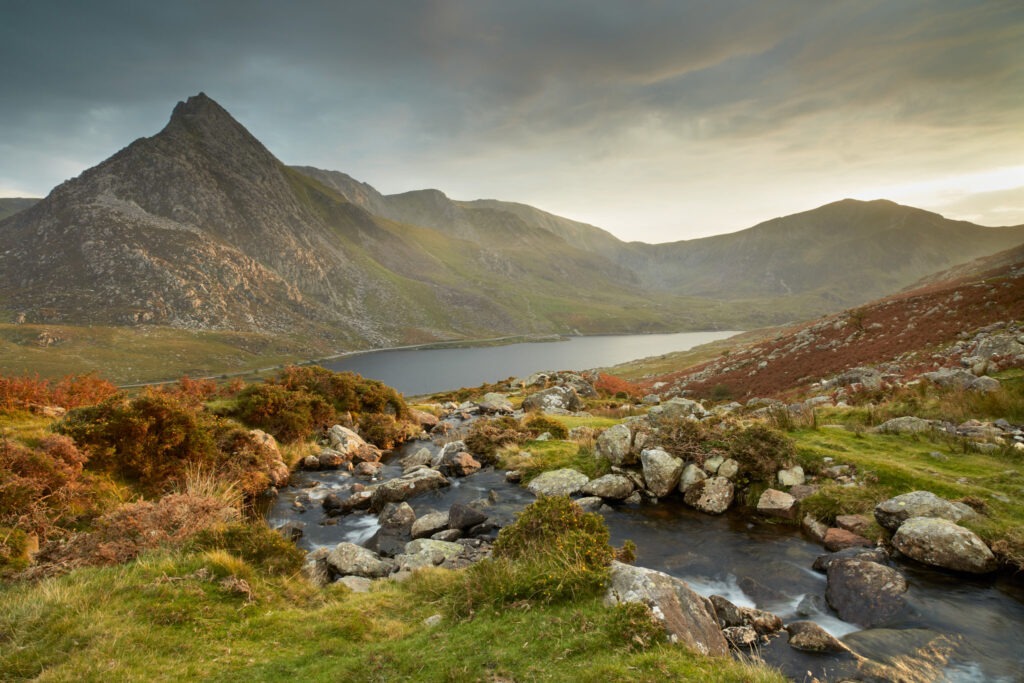
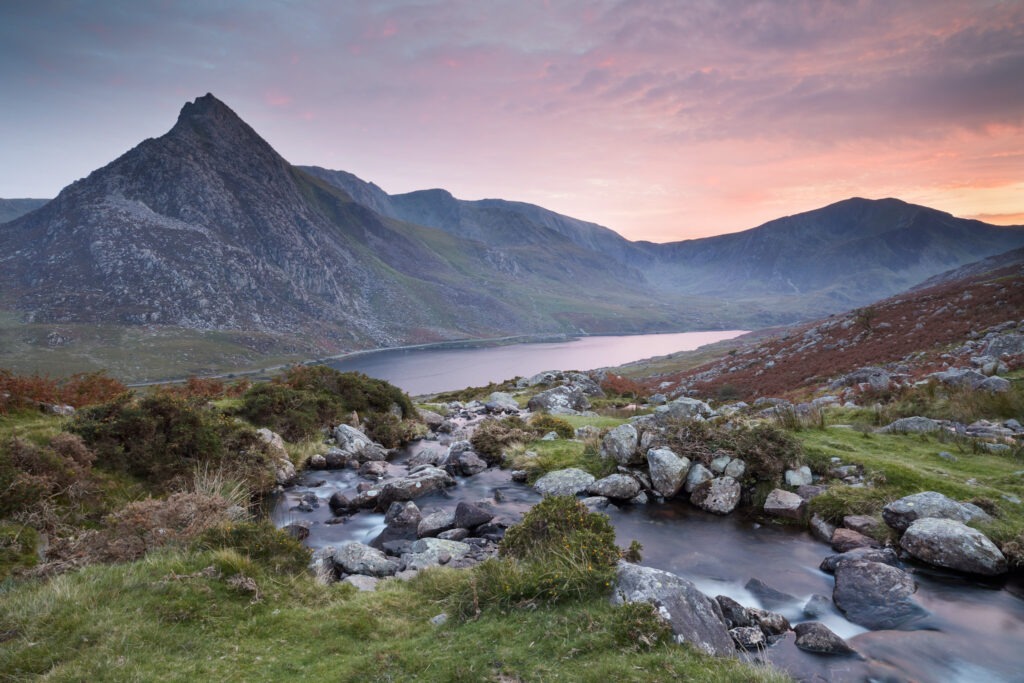
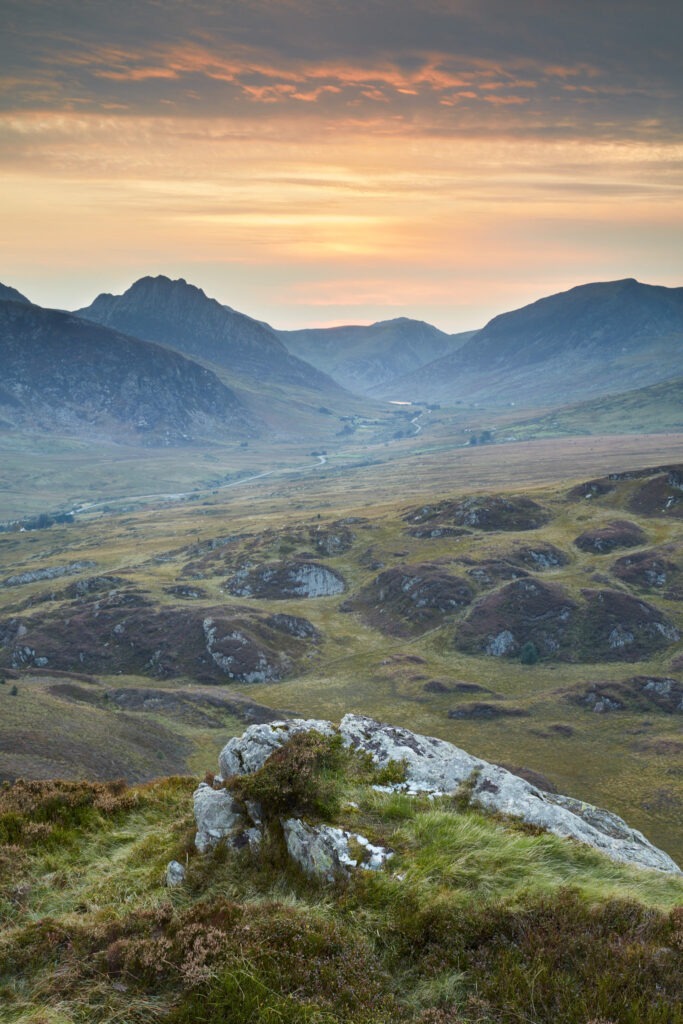
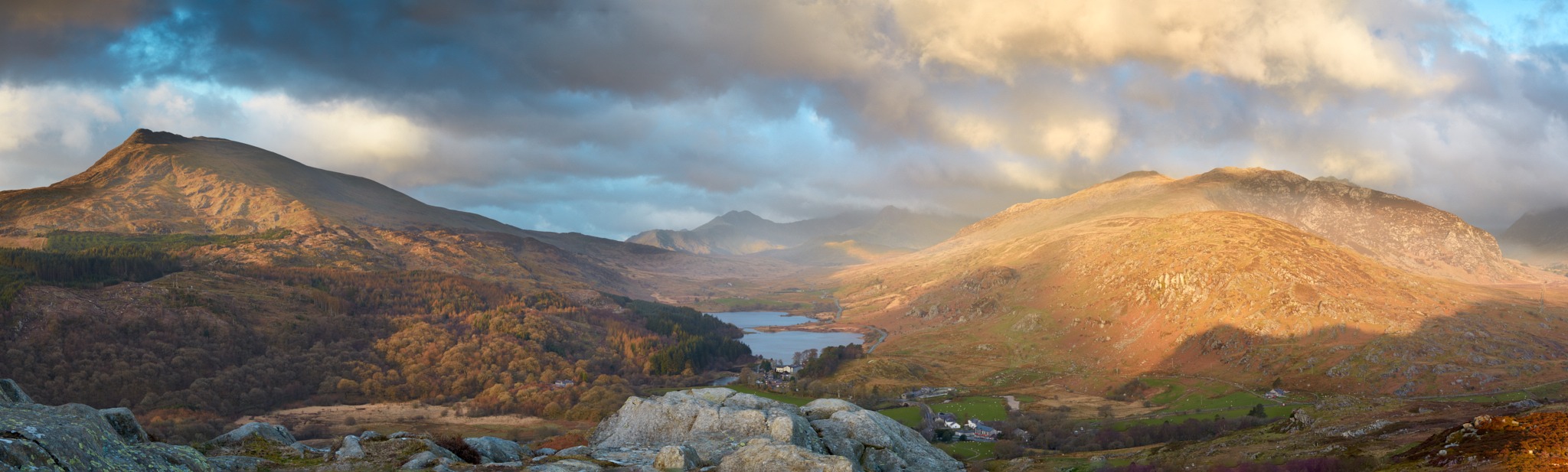
    The four images in this post have a common component – Tryfan. It’s shape, it’s long serrated back, make it one of the iconic profiles of Snowdonia.

    If you like the images or this post please share. Thank you.

    Andy


    All images are Copyright Andy Gawthrope Photography.

  • Snowdonia again…

    Snowdonia again…

    Finding a suitable place to camp on the top of Glyder Fach was tricky as it’s just one mass of shattered, weathered rocks each way too big to move.  But after some searching I found a spot just large enough for my little tent on the South-Western side beyond the the summit.  It was a reasonably sheltered spot and had a great view across the valley to the Snowdon massif.

    It had been a long, warm, sunny day and the stable weather continued through the night.  With little wind the night was eerily quiet, the only sound being the occasional rustle of the tent.  There were a handful of hardy sheep roaming the summit, picking at what grass was bold enough to poke through the rocks at sundown but they seemed to vanish with nightfall perhaps off in search of somewhere lower and warmer.  Without cloud-cover the temperature dropped significantly and I knew by morning it would be chilly.

    A lesson I learnt years ago in Antarctica is that cold batteries just don’t work.  My sleeping bag has a little pocket on its inside and I popped the battery from the camera into the pocket just to ensure it stayed nice and warm overnight.  But having a lump of hard plastic inside your bag does get a bit uncomfortable if it gets underneath you during the night!

    Starting the day on-location was just great!  No worrying about travel delays, parking, getting to the venue in time etc.  All I had to do was gather-up my old duvet jacket, camera, tripod and walk a few hundred metres.  Simple!

    Standing outside the tent in the early morning was wonderful.  It felt so good stood there on the top of Glyder Fach with no-one else around drinking a cup of hot coffee πŸ™‚  By the time I left the tent it was already pretty bright.  The sun was still below the horizon but it wouldn’t be long.  The sky was already a light blue and filled with contrails from aircraft presumably inbound from the US to airports across Europe.

    Castell y Gwynt
    Castell y Gwynt

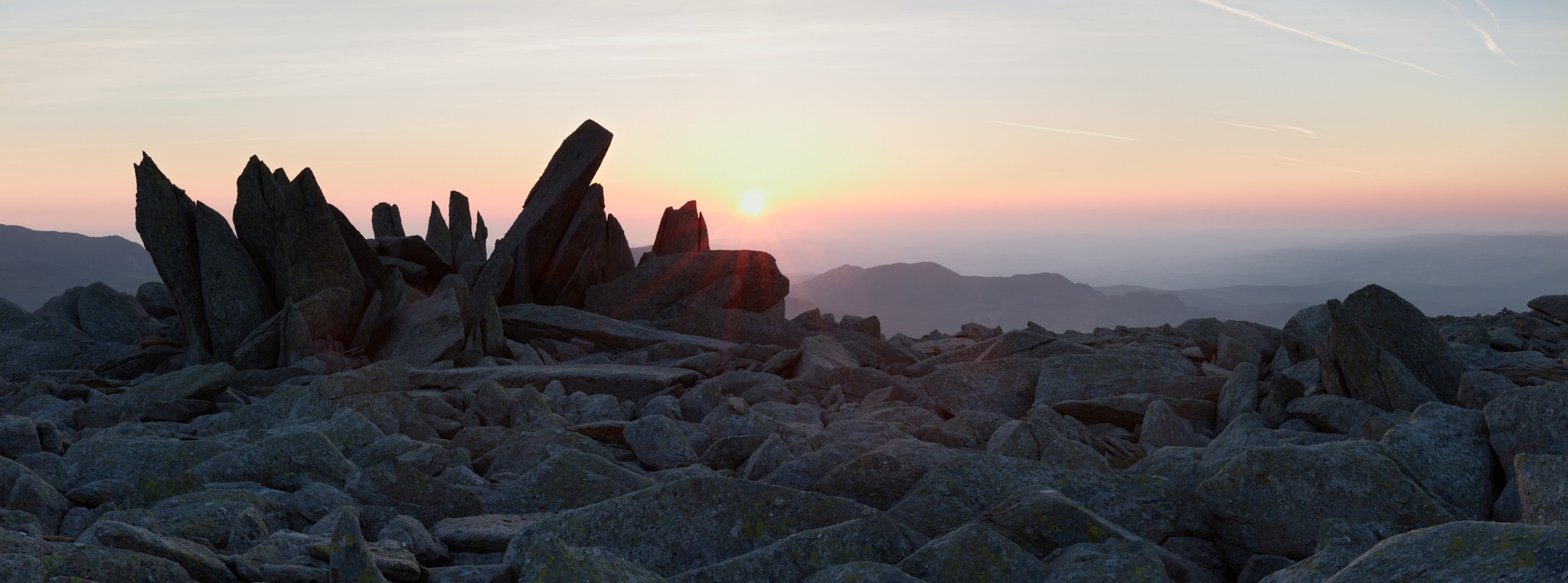
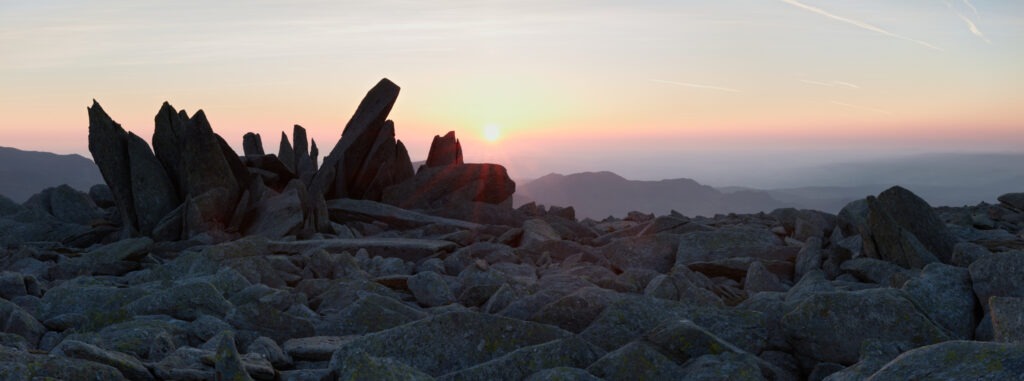
    I strolled back to where I’d been the previous evening in search of a composition.   I could see there would be little colour on the ground and knew that any colour in the sky would be fleeting.   In the end I went with the photograph at the top of this post as I didn’t find a composition from the South or Eastern sides that seemed pleasing.

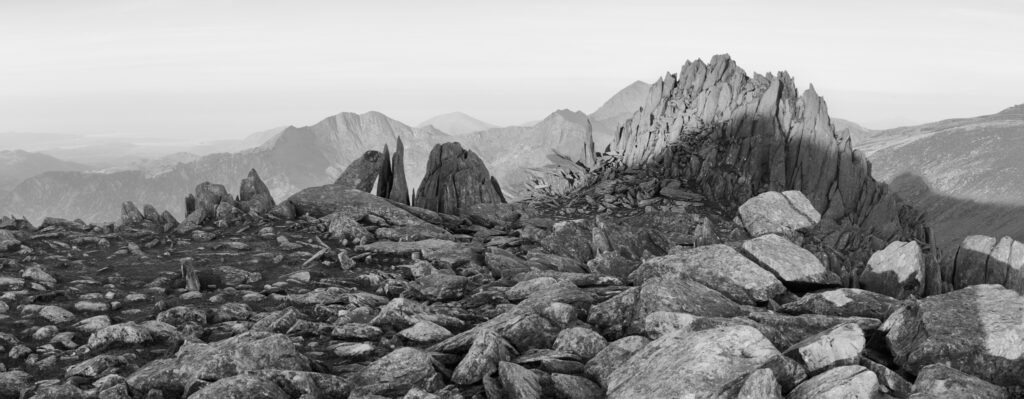
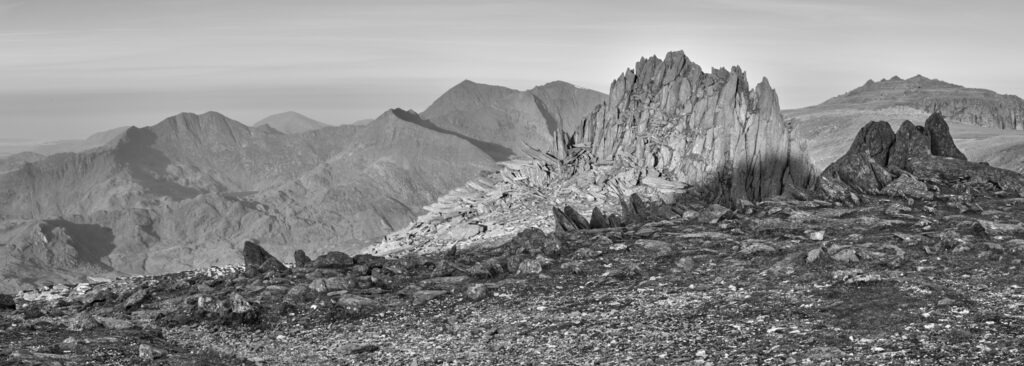
    Once the sun had risen the light quickly changed and everything became very bright.  Fortunately, with the sun still low in the sky there was some contrast between what was sunlit and what was in shadow.  As I walked back across the summit towards the West, the sun was just catching the top of Castell y Gwynt and the Snowdon massif beyond.

    Finding a composition took some time.  The sun rose higher with every passing moment and with it the shadows lessened and the haze grew.  I would have loved a composition of Castell y Gwynt with a clean background and a simple foreground but, despite searching for some time, I didn’t find one.  Perhaps it’s on the Western side.  The rocks seemed scattered randomly across the foreground apart from where the feet of countless walkers had formed a track, but the track didn’t seem to fit any composition and the Snowdon massif was very prominent in the background!

    Castell y Gwynt
    Castell y Gwynt

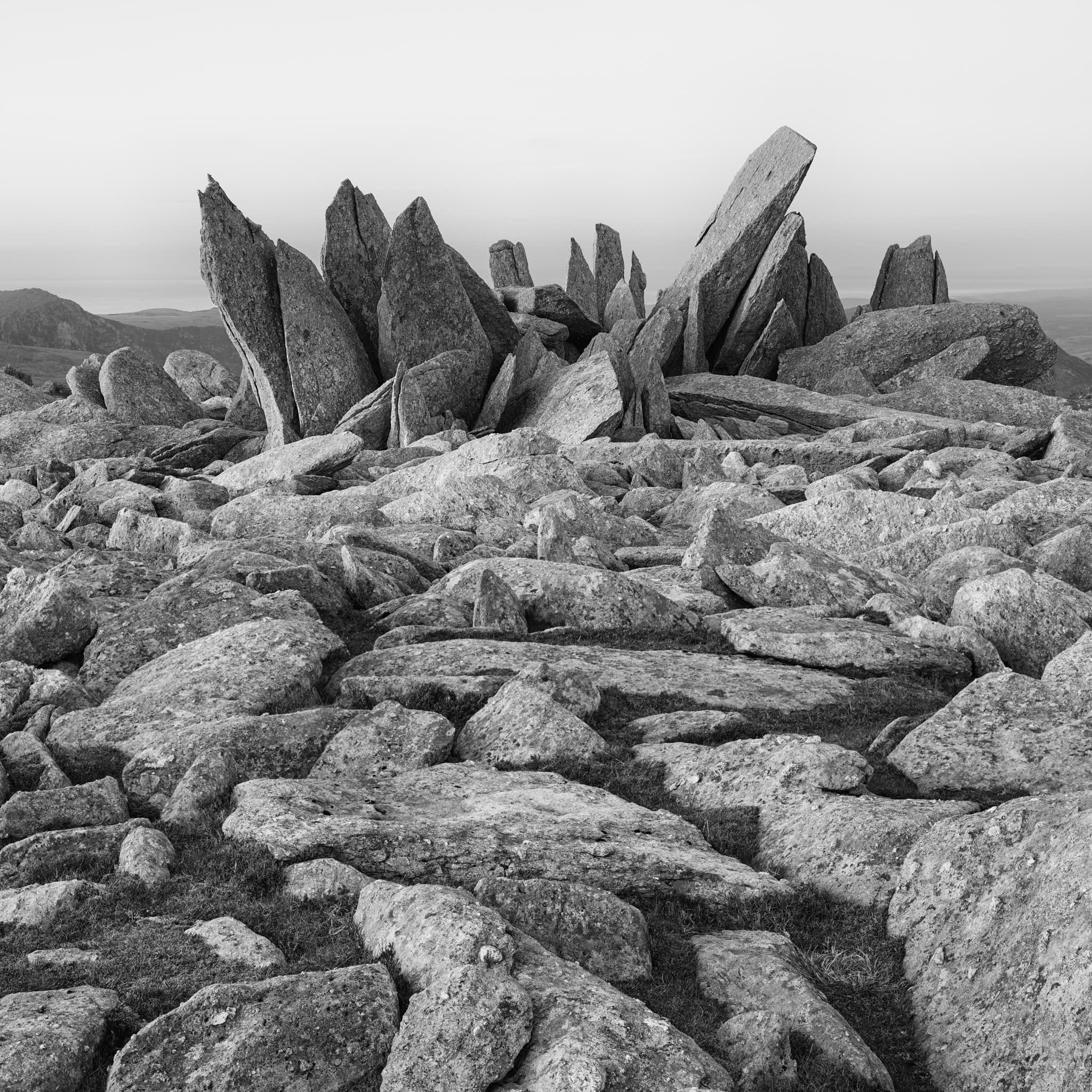
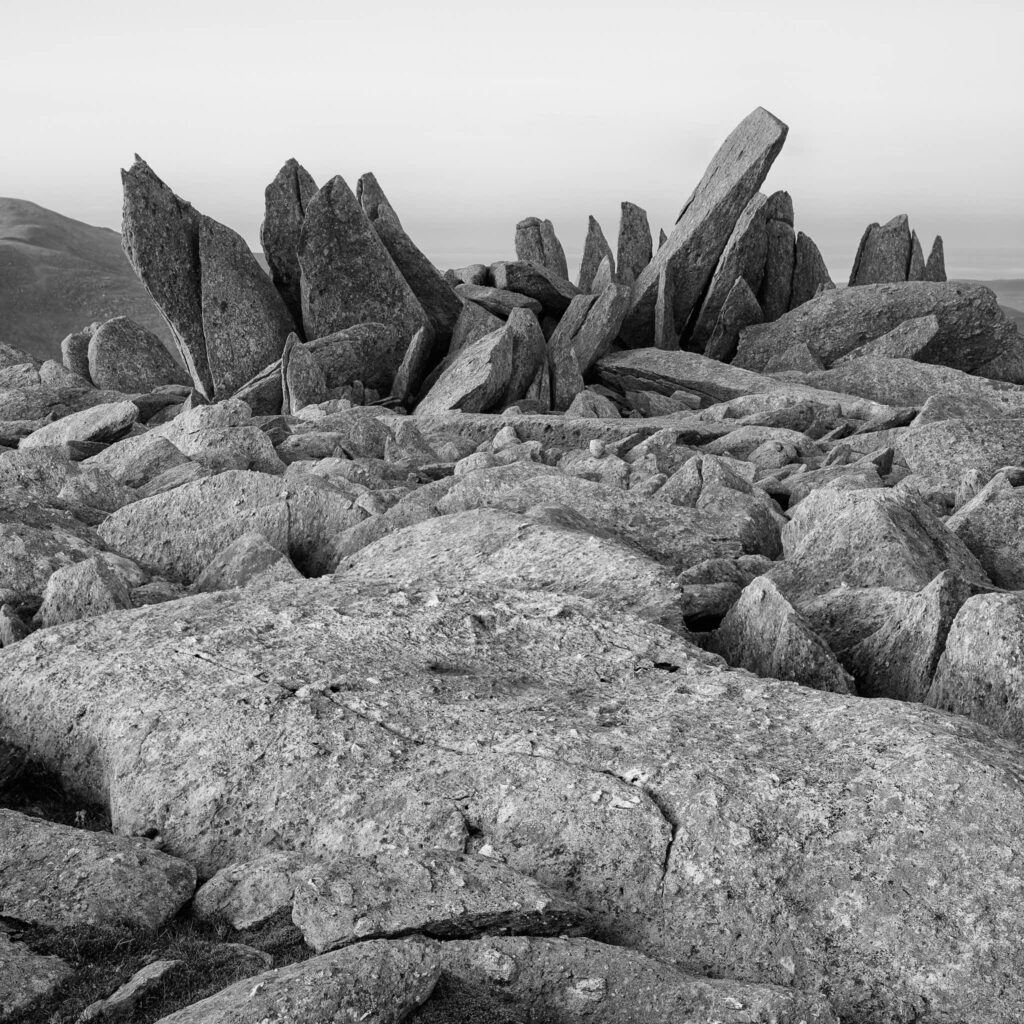
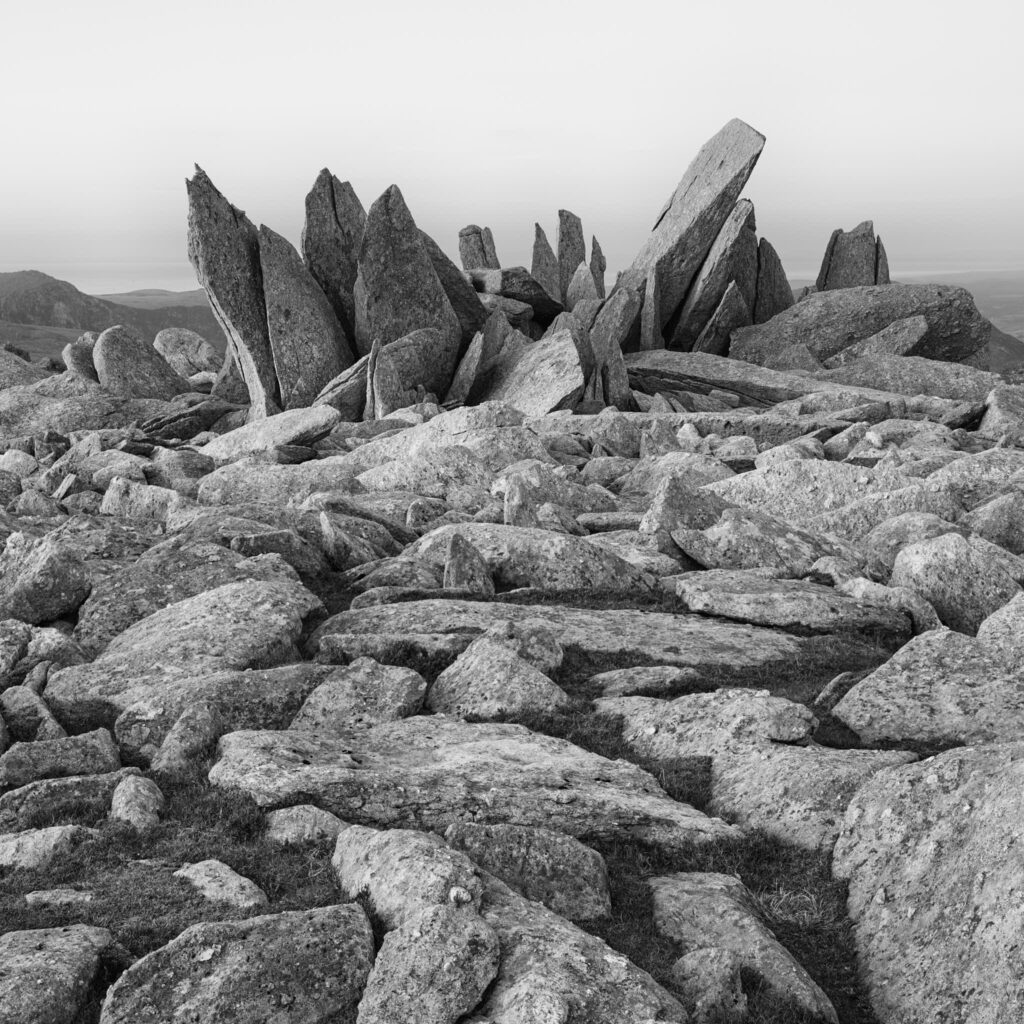
    After the sun rose too high I headed back to the tent, had a little breakfast and descended back to the valley.  At that time the only photograph I thought may have worked was the colour one at the top of this post.  Several days later though and back in the office I processed the two monochrome photographs above.  When viewed at full-size they are nice;  there is a huge amount of detail in the foreground rocks and in the more distant features.

    To save weight I chose to carry only a 50mm lens.  The thinking was that 21mm would be too wide and the 70-200 too long and heavy.  With hindsight, I was happy with that choice.  There was too much haze to make use of a longer lens and as panoramic formats always seem better with a little magnification the wide-angle lens would have been a poorer choice.

    All-in, I’m pretty happy with the photographs from this trip.  Next time I’ll avoid going when the weather is so good!  A winter, snowy trip would be fantastic πŸ™‚  Anyone one mad enough to join me? πŸ™‚

    Andy


    All images are Copyright Andy Gawthrope Photography.

  • Glyder Fach

    Glyder Fach

    On this trip I planned to stay in the Ogwen valley at the Gwern Gof Isaf campsite but on arrival it was full with large trailer vans, generators and a catering / bar tent.  All the fluorescent yellow clad security guards would say is that it was for a film…  But they probably didn’t know more either!  Clearly, it was no small film crew as there must have been facilities for several tens of people.  A short distance away was a temporary stables full of horses.  So, a large budget film requiring mountain scenery and horses.  In 2015 King Arthur was filmed in just this part of Wales…Could this be a sequel?  Who knows πŸ™‚  Anyway, to avoid all the noise I went a little further down the road and stayed at Gwern Gof Uchaf – a small, basic, farm campsite.  This turned out to be a better choice as there was an excellent path from the site past Tryfan into the mountains.

    In the Northern hemisphere June 21st is the longest day and with a little over a month before the longest day the sun rose early and set late.  At the campsite, in valley, the sun was obscured by the mountains for some time at sunrise and sunset so, some height really helped catch the morning and evening light.  Sunrise/sunset times were at about 05:20/21:10 according to the apps PhotoPills and The Photographers Ephemeris.  Whilst the timings seemed correct in the valley, at altitude these times seemed somewhat off.  At the top of Glyder Fach (994m ASL) sunset seemed almost 50 minutes later.  Hopefully it’s possible to configure an elevation in the apps.  Some investigatory work required!

    Being high in the mountains for sunrise/sunset I knew would be impossible from a valley base due to, what would be, very late descents and early ascents.  So, a plan was hatched to carry everything needed for an overnight stay including camera gear into the mountains during the late afternoon, photograph in the golden and blue hours, sleep then awake already on location for sunrise.  After that the plan was to return to the valley, rest and repeat the next evening.  As it turned out the plan was pretty solid πŸ™‚

    Glyder Fach
    Glyder Fach

    Two things were a problem tho.  My fitness and the sunny, warm, cloudless sky.  I knew hauling gear was going to be hard and it was!  My legs, hips and back ached afterwards πŸ™‚ The fully loaded rucksack wasn’t actually that bad tho.  It was never weighed but it could be lifted one-handed onto the shoulder without straining.  Note to self: More fitness required!  After a full day’s rest the body seemed to recover which was good πŸ™‚  The bigger problem was the cloudless sky caused by a high pressure system sat over the country πŸ™  That meant there were no interesting clouds in the sky to add colour, interest or detail.

    The photographs in this post were from the top of Glyder Fach.  Both are the result of a 3-image focus stack with each component image exposed at F8 to achieve excellent overall depth of focus.

    With only a little colour in the sky and some subtle yellows and greens of lichen clinging to the rocks any wow factor seemed to be lacking for a colour photograph.  But the strong shapes and excellent rock textures lent themselves towards a monochrome photograph.  Some dramatic sky and light would really have helped tho. πŸ™‚

    Despite the temperature being about 18/19 degrees Celsius in the valley during the afternoon, after sunset on top of the mountain the temperature quickly dropped and with the rise of a slight breeze it became cold quickly.  Having hauled a small stove, a hot drink was nicely warming before crawling into a cozy sleeping bag for the night.  By that time it was pretty late, about 2300hrs, and sunrise was only a few hours away!

    Next morning I awoke whilst it was still dark, put my head outside the tent to check the sky for cloud and was greeted by a sky full of bright starts.  It looked fantastic. πŸ™‚ Probably the sort of light astro-photographers would crave πŸ™‚

    Sunrise the following morning was through a cloudless sky.  It will be the topic of the next post.

    If you have enjoyed this post or just like the photographs, please like on social media.

    Thanks πŸ™‚

    Andy


    All images are Copyright Andy Gawthrope Photography.

  • For days in Snowdonia

    For days in Snowdonia

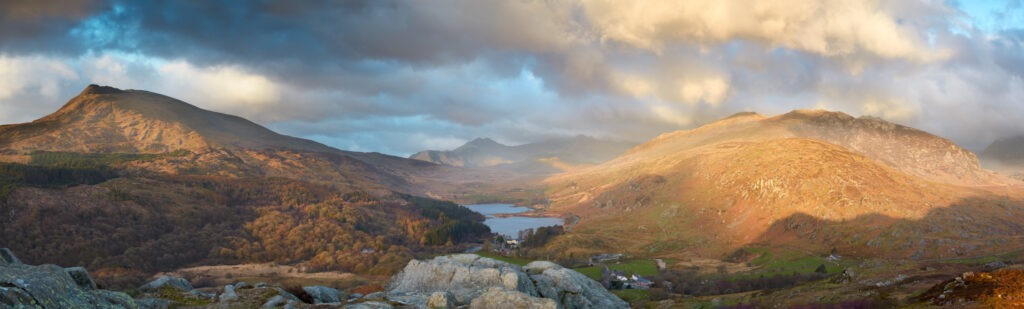
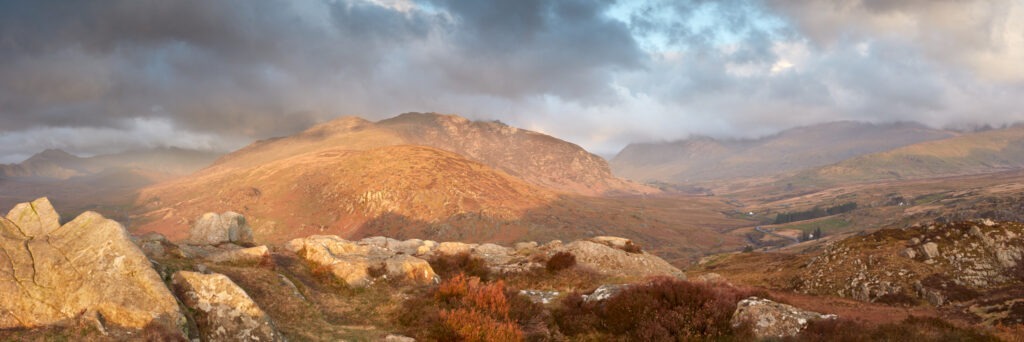
    For some time now I’ve been meaning to visit Snowdonia in North Wales.  Although it’s somewhere I’ve been climbing and walking over the years I’ve not been primarily for photography before.  All the images below can be viewed in a larger size if selected.

    Wind the clock back to December when this trip was conceived and it was to be a week in the Scottish Cairngorms surrounded by snow-covered mountains and fabulous light.  Well, that was the idea.  With hind-sight, perhaps the idea was a little optimistic but, at the time, sat in front of a warm fire with a glass of Jura anything seemed possible.  The closer the trip came, the less it looked like my fire-side dream would be realised.  The Cairngorms were devoid of snow.  Yes, the gullies and sheltered North facing slopes had snow but there was lots of brown – not what I was after.  A good indicator of conditions is the Loch Morlich webcam which looks across the loch to the Northern corries and Cairngorm ski centre.  If you don’t know of it, take a look here

    _GP_2958-pano-AGP-News-1200px@72ppi-sRGB-VW.jpg

    So, where to go?  Clearly snowy photographs weren’t to be had so why drive all the way to the Cairngorms when there are mountains closer to home.  That’s why on one overcast, damp Sunday afternoon I arrived in Snowdonia choosing to stay at the Tyn-y-Coed Inn near Capel Curig.  Previously I’ve camped and been to the Inn for many a meal or beer, but this was early March and a week camping could have been miserable.  Clearly it was very early in the season as the Inn was almost empty.  A little too quiet but with early starts that suited me just fine. 

    Having been to this part of Snowdonia before, albeit some years previously, I had good primary and backup plans for the first morning.  Well that’s what I told myself! But tired after a long drive and feeling sleepy I wasn’t so sure.  What would that light do?  Would getting up at 03:30AM be worth it?  Wouldn’t it be better to sleep-in to ensure I was fully recovered from the drive?  Dam those nagging doubts!  So, plans were reviewed and updated after getting some local knowledge πŸ™‚  In fact the barmaid was an invaluable source of information – they normally are!  Photography lesson No.1 – Always seek local knowledge!  The revised plan got me an extra half hour in bed too.  Result!

    The revised plan was to take a relatively short and easy walk to a low hill I hadn’t even considered when poring over the map in Bristol.  Sounded good!  Well, yes it sounded good, too good.  It was dark by then, would be dark on the walk-in and so route finding was going to be interesting!  The verbal description was something like: turn right off the road at the school house, follow the path through the woods and when you reach the end of the trees, turn right up a hill and through a gate then head to the hill.  Mmm, I knew this wouldn’t be as easy as it sounded.  Following paths though woods and not getting lost, at the best of times, is tricky, especially when you’ve never seen the path, the wood and its pitch black!

    With head torch on, I very carefully followed the path through the woods and it was actually pretty straight forward but of the remainder, that was different.   The sections I expected to be simplier turned out to be much more tricky!  What the barmaid didn’t communicate was that the hill could only be crested on its North side, an approach from the obvious East side, the side from which I approached, was craggy and insurmountable.  Stumbling through calf-high tussock grass, fording streams and being blocked by craggy rocks took its toll in time and energy but in the end hot, sweaty and exhausted I made it in-time for sunrise!  Of course, with sunrise came light and my tortuous approach looked ridiculous.  Why had I turned left there?  How could I not have seen that bridge over the steam?  etc etc.  Suffice to say, the way back was a doddle and took a fraction of the time!

    Was it worth it?  Most certainly.  The first couple of images in this post are from that morning.  The light and clouds were just fantastic.  That high-pressure system was close-by and the clouds were breaking – perfect timing πŸ™‚  With its arrival tho, the weather became a little too blue and each day soon after sunrise it became very hazy.  First light was definitely the best time as there was some, just a little, cloud and the haze wasn’t so noticeable.  It was a trip were sunrise was the best time for photography.

    The trip provided a nice introduction to Snowdonia and I’m convinced there will be further trips this year.  Trips that will probably involve some rough camping and more mountain photography.  Now, to schedule that weather….

    Andy


    All images are Copyright Andy Gawthrope Photography.

  • Marloes evening

    Marloes evening

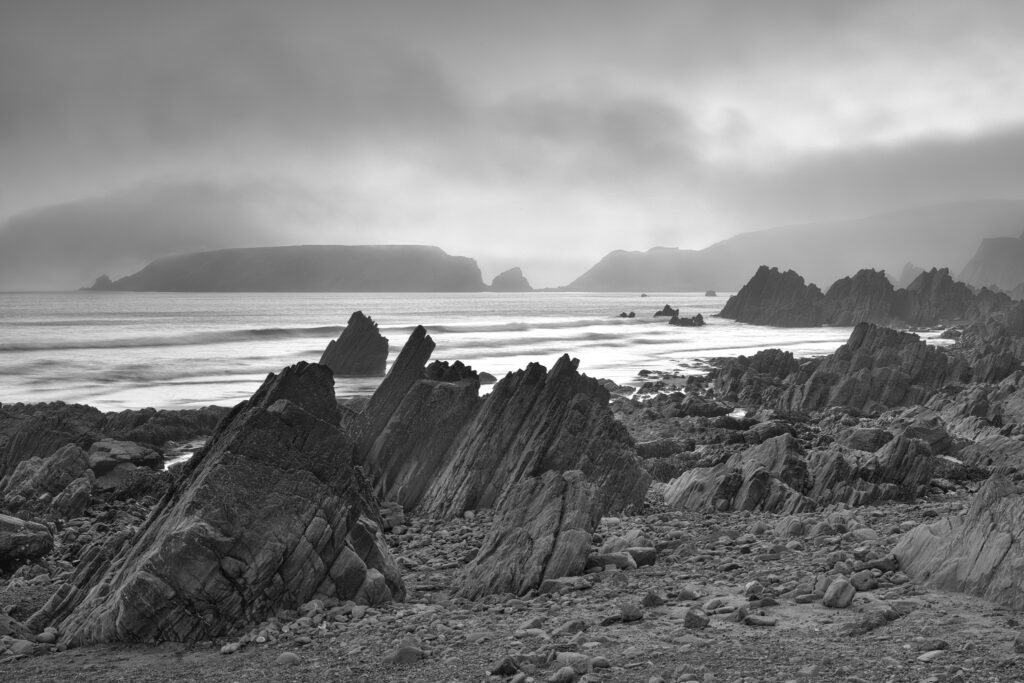
    The first weekend in May is a three-day public holiday.Β  Mainland England and Wales were basking in strong sunshine under blue, cloudless skies – Not the sort of light that normally inspires me.Β  However, the coast in Pembrokeshire was forecast to have a few clouds.Β  That sounded more interesting and had the potential for some nice evening light. πŸ™‚

    During the drive from home the temperature was consistently about 24 degrees Celsius; I was wearing shorts and a tee-shirt…  I arrived, to find the coast covered in sea fog!  Moments after arriving I was wearing trousers a shirt and fleece top! It was 12 degrees πŸ™‚

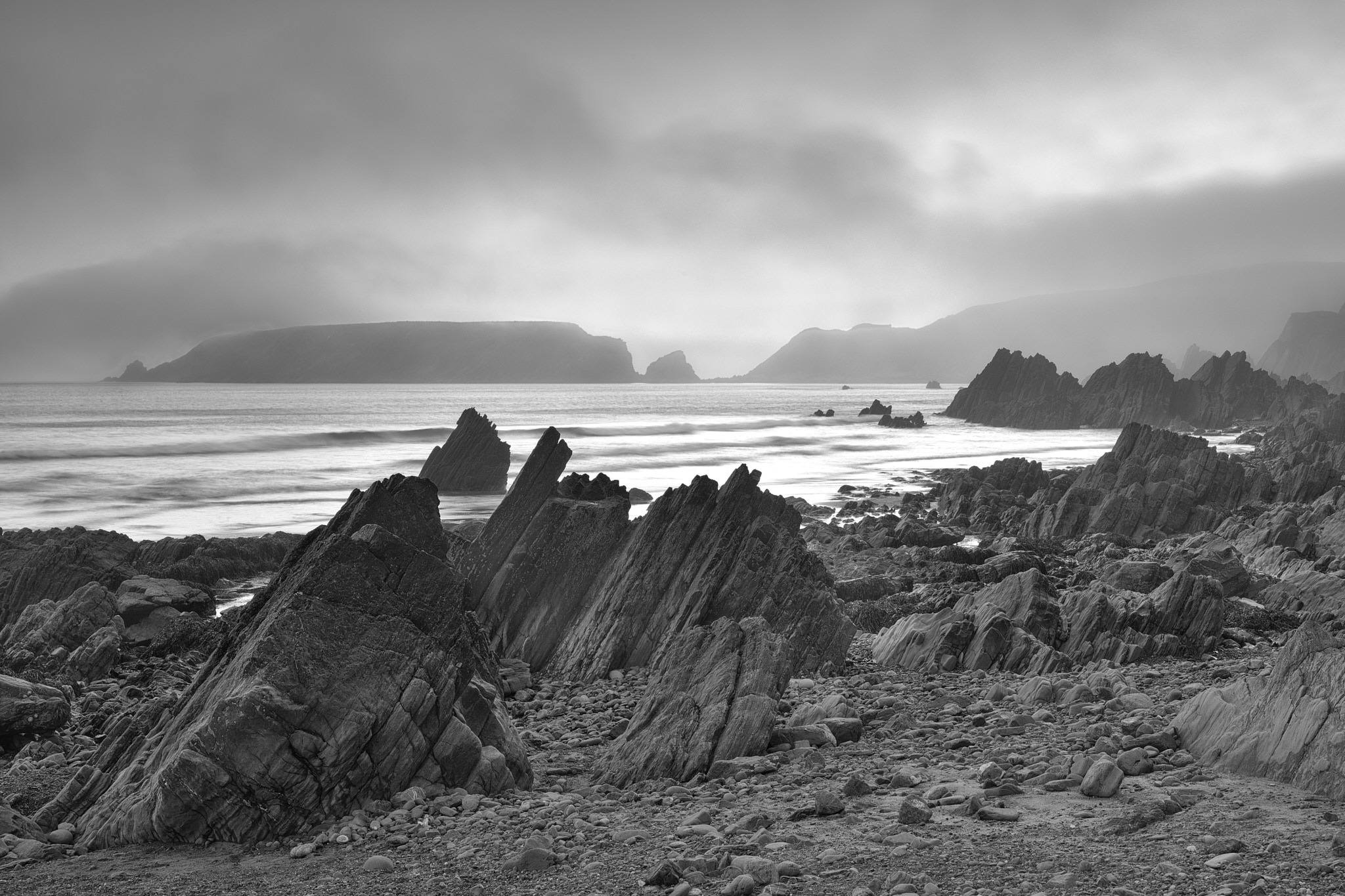
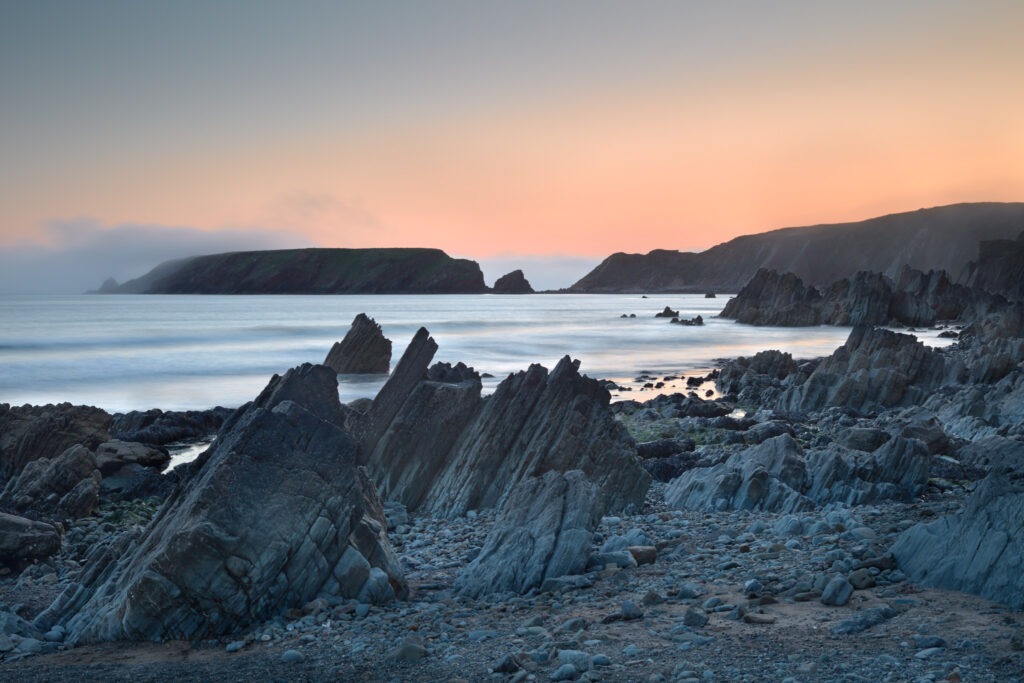
    Marloes Sands is a long sandy beach with rocky outcrops on the Southern side of the Pembrokeshire coastline.  Its a lovely spot with large rocks that protrude through the sand and have the potential to look great in soft evening light… I knew it was late in the season, but the tide was about right so worth a punt!  Nothing ventured – nothing gained and all that.  As it turned out, it was a little late as the sun set a little too far to the North so the rocks that are grey/black in colour dropped into shade earlier than I’d have liked.

    But the fog, now that was a problem πŸ™  It wasn’t the thin sort through which the sun would shine; this was thick and totally obscured the sun.  A couple of hours before sunset I headed over to the beach and was relived to find that whilst the North facing coast was under thick fog the Southern side was starting to clear.  But it was still cold and I wished I’d brought more clothing.  The first image was captured soon after it started to clear.  By the time the sun set, the sky was almost completely clear and the residual cloud/fog resulted in a soft orange glow in the Eastern sky.

    Marloes sands
    Marloes sands

    Not long after the sun set I returned to the camp site on the Northern coast where I was staying.  It was still completely encased in fog!  Marloes Sands faces South and is a location for late afternoon/evening light depending on the time of year.  Its not a morning location.  The following morning dawned still in thick fog and cold.  The weather was forecast to deteriorate by evening so I returned to Bristol in search of fairer weather.  A mile inland the flog broke and I returned to blue-sky, sunshine and warm temperatures πŸ™‚

    Andy


    All images are Copyright Andy Gawthrope Photography.

  • Puffins

    Puffins

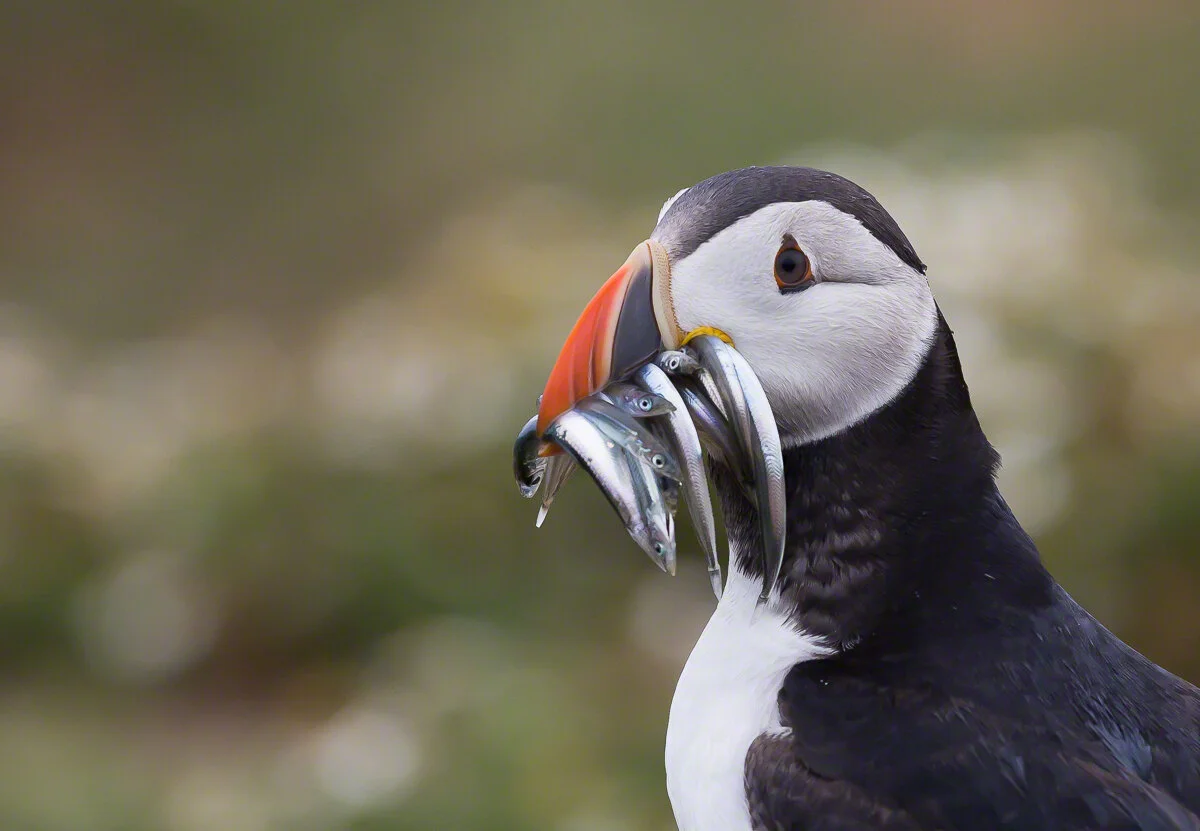
    Puffins are such cute things!  I’m writing this from a hotel bar in Lerwick, Shetland whilst waiting on some light for costal landscapes.  Now, I associate Shetland with ponies and hand-knitted woollen jumpers.  Not with Puffins!  Anyhow, they are clearly a tourist attraction and the local shops are filled with them. No, not real ones, but photo books, pictures and little knitted woollen ones!  I guess tourists fresh off the tour ships that dock in Lerwick will buy anything!

    These images are not from Shetland but from another part of the world that has lots of puffins – Skomer Island off the West coast of Pembrokeshire. The Skomer puffin chicks must mature slightly ahead of their Northern cousins as they usually depart the nest about a month earlier in July.

    Puffins are about 6 to 10 inches high and a mix of black and grey, almost white, feathers but as they nest underground their feathers can often be coated in an earthy muddy brown.  Puffins, unlike all other flying birds I know, are not bothered by the presence of humans.  They will stop and look at you, perhaps come and have a closer look and then walk past just inches away before taking to the air.  But if they are returning to their nest with food they are very nervous things indeed, looking to get underground as quickly as possible and before they are attacked by other birds seeking to snatch their catch of fresh sand eels.

    Puffin in flowers
    Puffin in flowers

    So, to photograph puffins on the ground a big lens is not required.  In fact a 70-200mm does just fine; it also helps to have something even shorter – a 50mm perhaps πŸ™‚ Whatever the lens tho, it really helps if it has a wide aperture, something like f2.8 or better.  This helps blur backgrounds and keeps the puffin as the centre of attention.  They watch the sky far more intently than any surrounding humans and in doing so often tilt their heads slightly to the side to gaze up at the sky.  In doing this they place a lovely catch-light in the otherwise dark eye πŸ™‚  The effect can really help make a picture pop. πŸ™‚

    If you like to photograph wildlife and haven’t been to Skomer, Farne Islands or the Shetland Islands, then what are you waiting for?  Late Spring to Summer is the time to go πŸ™‚

  • Dunraven Bay

    Dunraven Bay

    For some the onset of Winter will be a perfect excuse to hunker down beside a nice warm fire but to the landscape photographer, well, let’s just say we are made of different stuff. Those long, boring blue sky days are gone, replaced with far more dramatic weather that can bring our photography to life. There is nothing like crashing seas, dark threatening clouds, snow or the dramatic lighting that comes from Wintery weather.

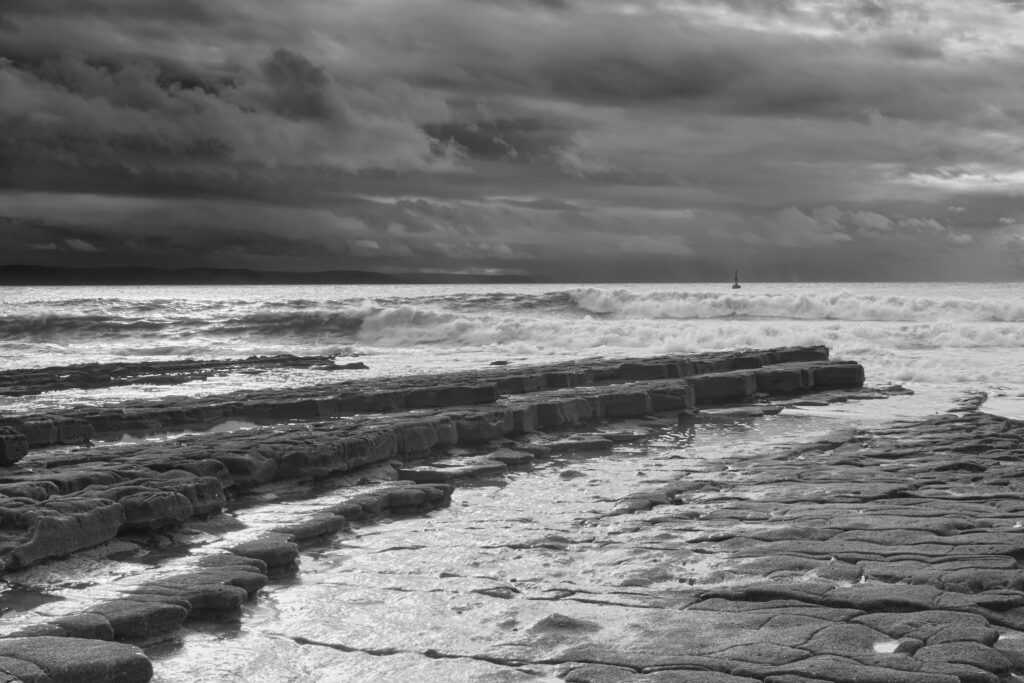
    A recent Sunday was forecast to be cloudy in the morning followed by a period of clear sky before wind and heavy rain swept up the Bristol channel arriving around sunset. This forecast sounded promising not due to the period of blue sky and thus sunshine but because of the approaching windy and wet weather! So, just before lunch I set out for a part of the Welsh coast just South of Bridgend as it’s somewhere not too far from home and easily accessible. Leaving home the sky was a thick grey, water laden mass of cloud but on crossing the Prince of Wales bridge from England into Wales it miraculously cleared and I had to reach for the sun glasses! This is rare! It’s normally just the opposite!

    At the coast the sky was still almost entirely clear, the light extremely harsh with strong reflections from the sea, rock pools and every wet rock recently uncovered by the receding tide. The level of glare and contrast was huge. πŸ™

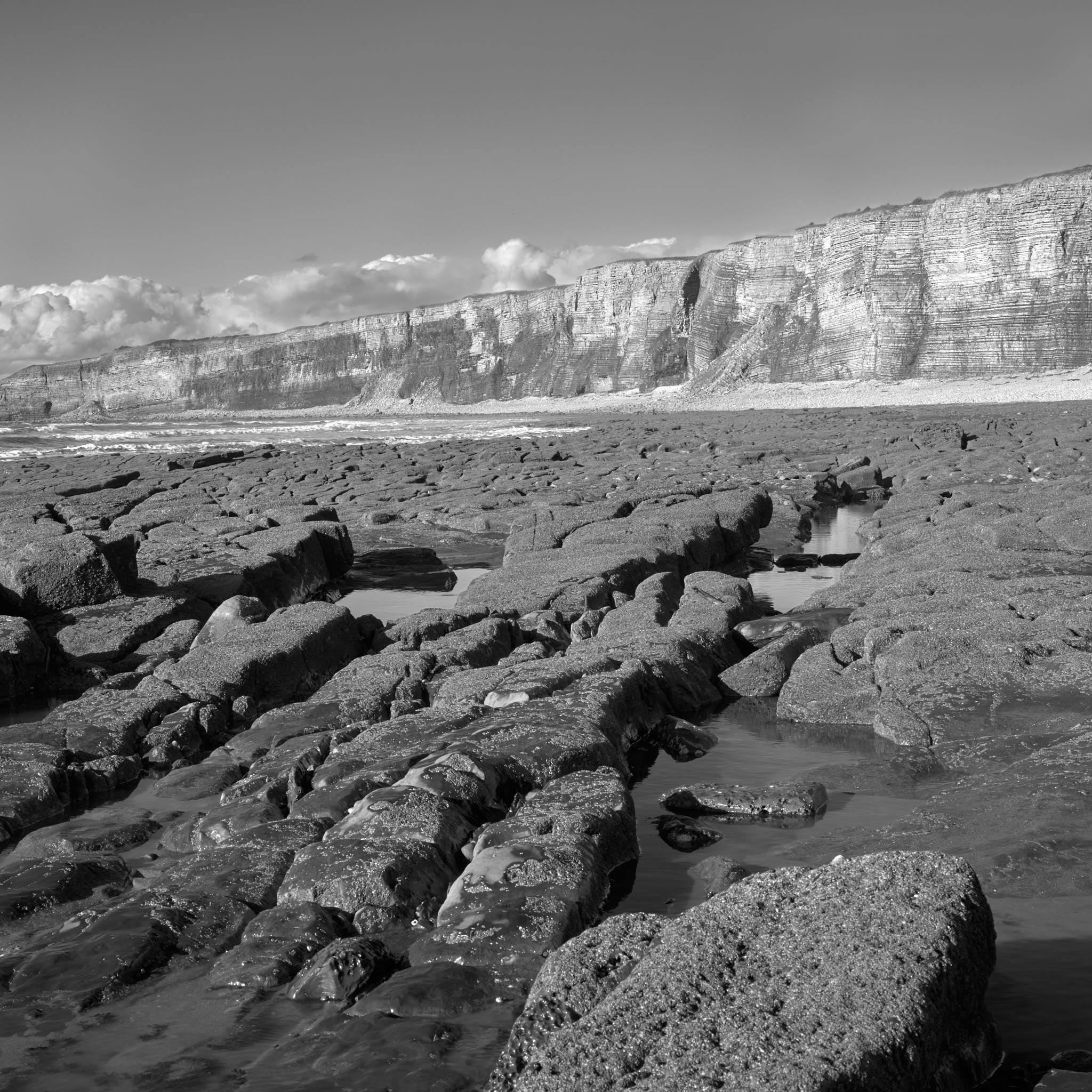
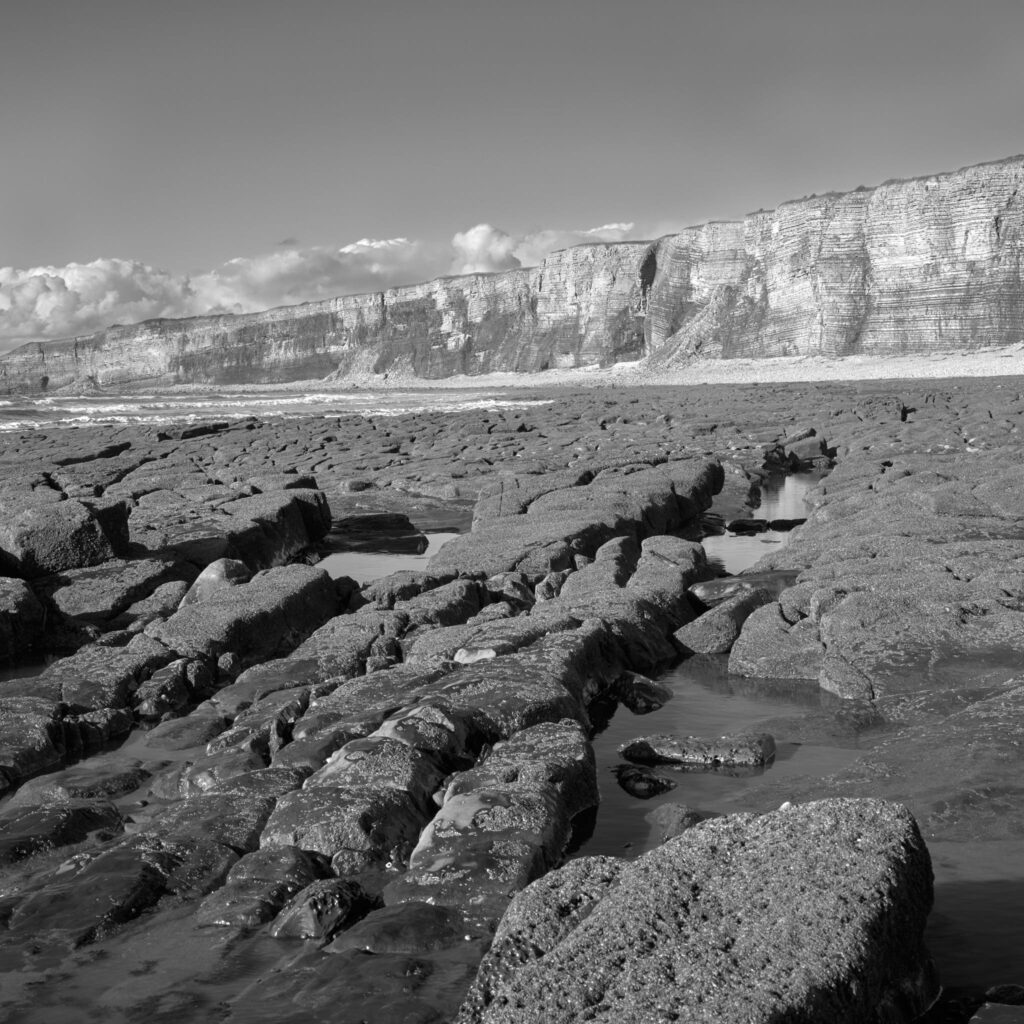
    That part of the Welsh coast isn’t sandy nor does it have pretty rocks. The land appears to be formed in layers of rock – see the cliffs in the first photograph – and where the sea has eroded the land it’s left a pock-marked pavement which extends out under the sea at high tide. I’m sure there will be a geological name for this type of feature. Perhaps a reader can let me know? At low tide, as on that day, the pavement presents a grippy surface that’s easy to walk on as its covered in barnacles. This makes moving around with camera gear really easy.

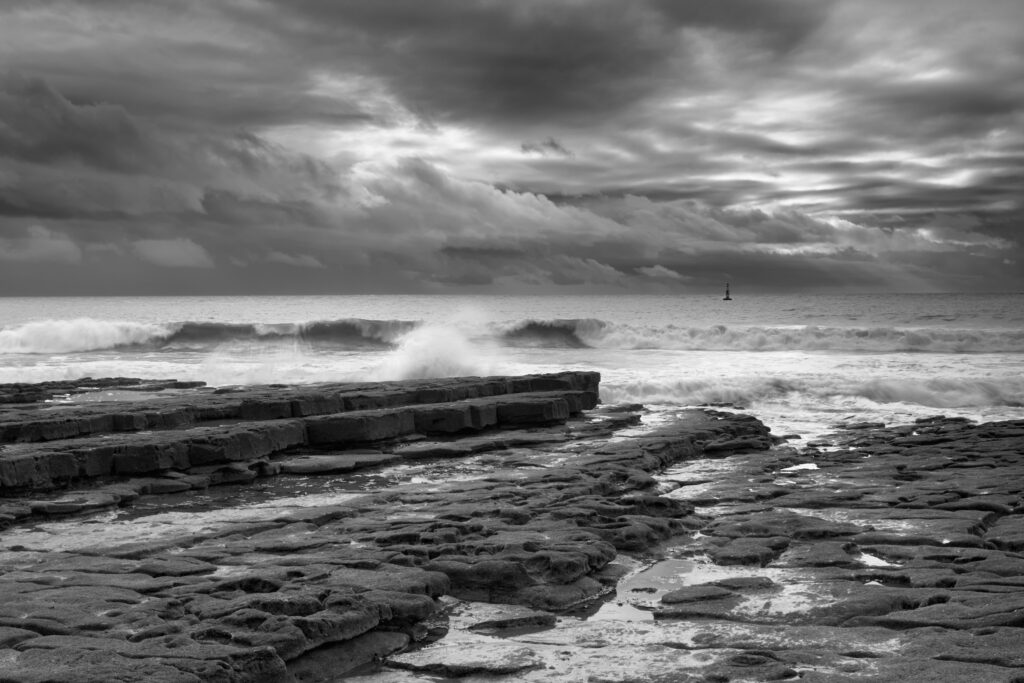
    I pottered around the beach for some time searching for compositions. The obvious ones included the long straight lines formed by the edges between different layers of the pavement. Colour was scarce. In fact it was either the dark brown of the pavement rock or the mid-tone grey of small, round boulders. There was no coloured seaweed, no coloured rocks, actually very little of interest. The sea and tide must carry everything away that can move. In the end it wasn’t my eye that found something but my ears. I became aware of a bell ringing and noticed a navigation buoy about 50m off-shore bobbing around in the swell. I felt this when composed with the pavement lines and the sky worked well.

    Stood there on the beach in bright sunshine I could see the distant English coast as a black stripe on the horizon covered by dark stormy clouds. That part of England was getting hammered! I was there for some time watching the clouds and it became obvious that the main interest lay the clouds. Sure enough it wasn’t long before those clouds started to get closer but then they faded away just when it looked like it may get interesting. Fortunately they soon returned, building much as before. The weather forecast wasn’t going to be wrong and I didn’t want to be on the beach when the rain and wind finally arrived.

    Sure enough about 45 minutes before sunset the cloud made it across the water and it started to spit with rain. That was my cue to retreat back up the cliff to my vehicle. Just after the camera gear was stowed and I had jumped in, the skies opened and it started raining – heavily!

    With a big smug smile,

    Andy


    All images are Copyright Andy Gawthrope Photography.