Author: Andy Gawthrope

  • For days in Snowdonia

    For days in Snowdonia

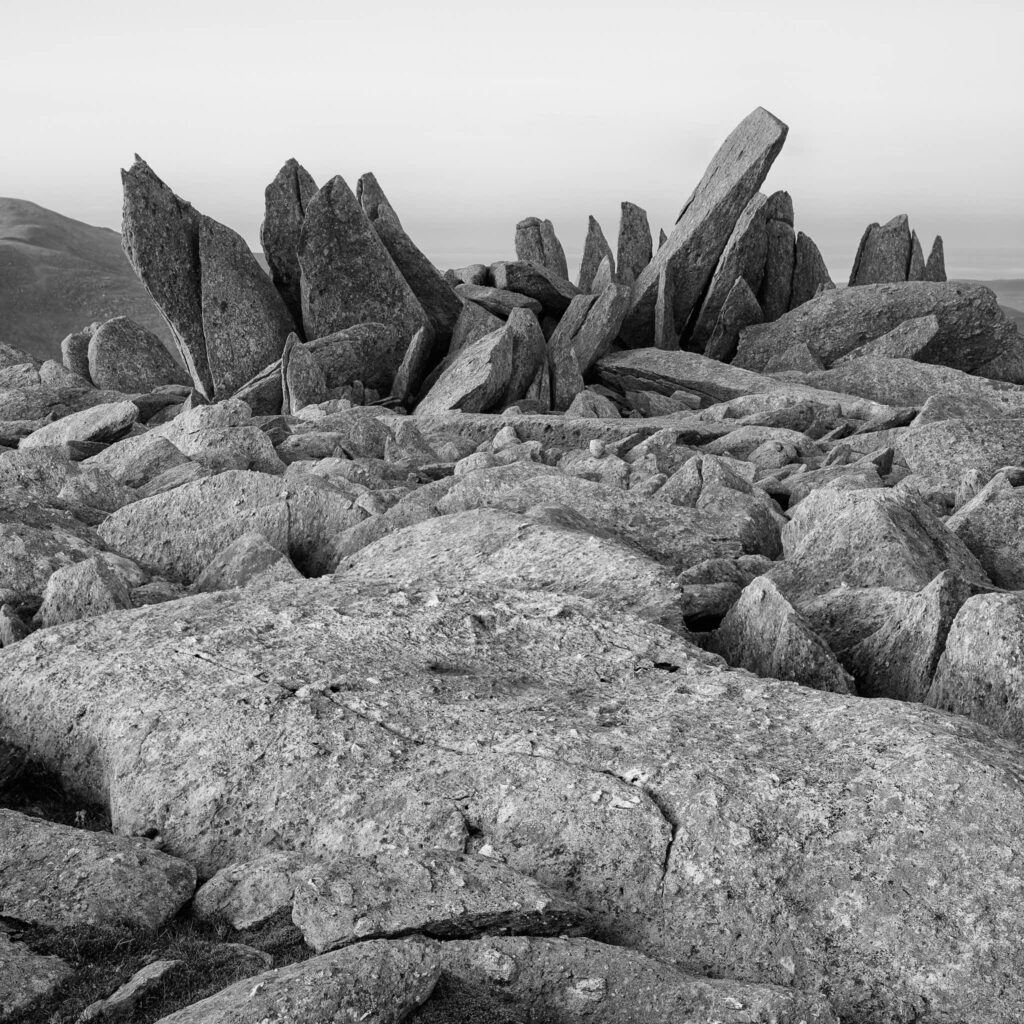
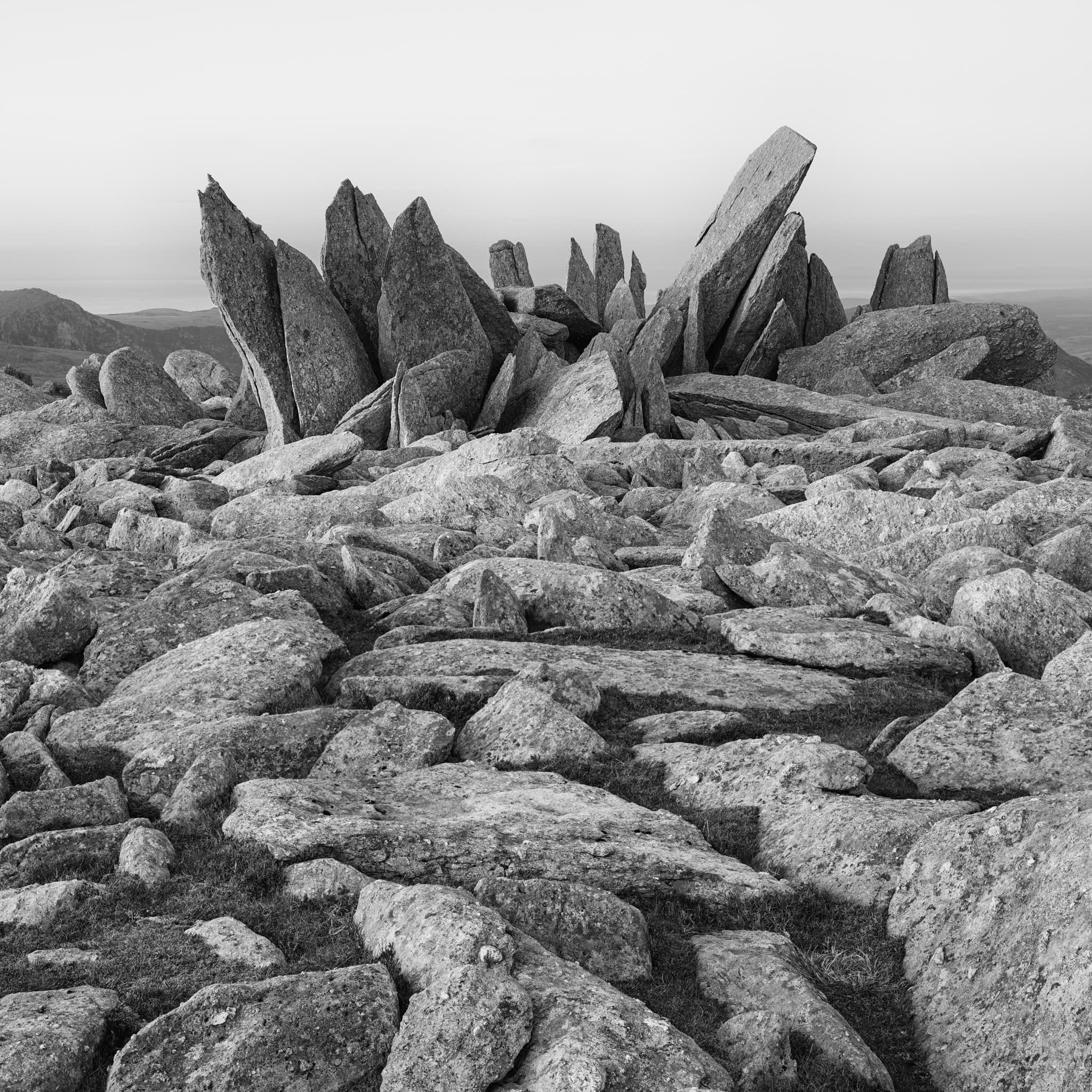
    For some time now I’ve been meaning to visit Snowdonia in North Wales.  Although it’s somewhere I’ve been climbing and walking over the years I’ve not been primarily for photography before.  All the images below can be viewed in a larger size if selected.

    Wind the clock back to December when this trip was conceived and it was to be a week in the Scottish Cairngorms surrounded by snow-covered mountains and fabulous light.  Well, that was the idea.  With hind-sight, perhaps the idea was a little optimistic but, at the time, sat in front of a warm fire with a glass of Jura anything seemed possible.  The closer the trip came, the less it looked like my fire-side dream would be realised.  The Cairngorms were devoid of snow.  Yes, the gullies and sheltered North facing slopes had snow but there was lots of brown – not what I was after.  A good indicator of conditions is the Loch Morlich webcam which looks across the loch to the Northern corries and Cairngorm ski centre.  If you don’t know of it, take a look here

    _GP_2958-pano-AGP-News-1200px@72ppi-sRGB-VW.jpg

    So, where to go?  Clearly snowy photographs weren’t to be had so why drive all the way to the Cairngorms when there are mountains closer to home.  That’s why on one overcast, damp Sunday afternoon I arrived in Snowdonia choosing to stay at the Tyn-y-Coed Inn near Capel Curig.  Previously I’ve camped and been to the Inn for many a meal or beer, but this was early March and a week camping could have been miserable.  Clearly it was very early in the season as the Inn was almost empty.  A little too quiet but with early starts that suited me just fine. 

    Having been to this part of Snowdonia before, albeit some years previously, I had good primary and backup plans for the first morning.  Well that’s what I told myself! But tired after a long drive and feeling sleepy I wasn’t so sure.  What would that light do?  Would getting up at 03:30AM be worth it?  Wouldn’t it be better to sleep-in to ensure I was fully recovered from the drive?  Dam those nagging doubts!  So, plans were reviewed and updated after getting some local knowledge 🙂  In fact the barmaid was an invaluable source of information – they normally are!  Photography lesson No.1 – Always seek local knowledge!  The revised plan got me an extra half hour in bed too.  Result!

    The revised plan was to take a relatively short and easy walk to a low hill I hadn’t even considered when poring over the map in Bristol.  Sounded good!  Well, yes it sounded good, too good.  It was dark by then, would be dark on the walk-in and so route finding was going to be interesting!  The verbal description was something like: turn right off the road at the school house, follow the path through the woods and when you reach the end of the trees, turn right up a hill and through a gate then head to the hill.  Mmm, I knew this wouldn’t be as easy as it sounded.  Following paths though woods and not getting lost, at the best of times, is tricky, especially when you’ve never seen the path, the wood and its pitch black!

    With head torch on, I very carefully followed the path through the woods and it was actually pretty straight forward but of the remainder, that was different.   The sections I expected to be simplier turned out to be much more tricky!  What the barmaid didn’t communicate was that the hill could only be crested on its North side, an approach from the obvious East side, the side from which I approached, was craggy and insurmountable.  Stumbling through calf-high tussock grass, fording streams and being blocked by craggy rocks took its toll in time and energy but in the end hot, sweaty and exhausted I made it in-time for sunrise!  Of course, with sunrise came light and my tortuous approach looked ridiculous.  Why had I turned left there?  How could I not have seen that bridge over the steam?  etc etc.  Suffice to say, the way back was a doddle and took a fraction of the time!

    Was it worth it?  Most certainly.  The first couple of images in this post are from that morning.  The light and clouds were just fantastic.  That high-pressure system was close-by and the clouds were breaking – perfect timing 🙂  With its arrival tho, the weather became a little too blue and each day soon after sunrise it became very hazy.  First light was definitely the best time as there was some, just a little, cloud and the haze wasn’t so noticeable.  It was a trip were sunrise was the best time for photography.

    The trip provided a nice introduction to Snowdonia and I’m convinced there will be further trips this year.  Trips that will probably involve some rough camping and more mountain photography.  Now, to schedule that weather….

    Andy


    All images are Copyright Andy Gawthrope Photography.
  • Saddle Tor (Northern quarries)

    Saddle Tor (Northern quarries)

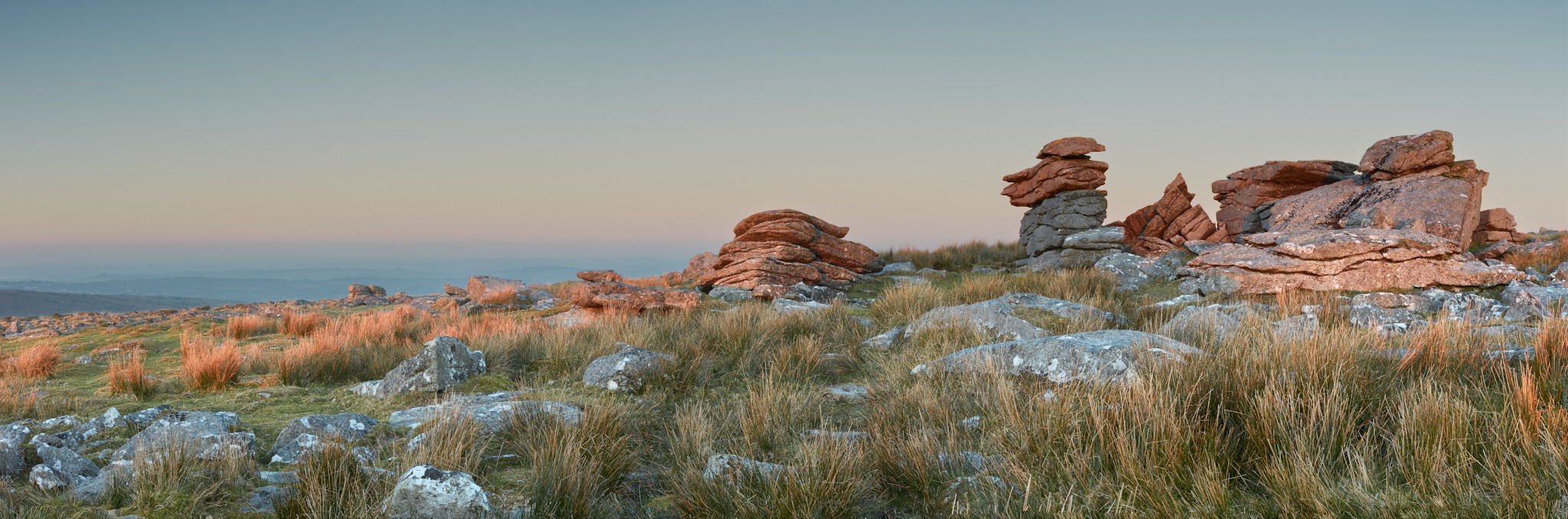
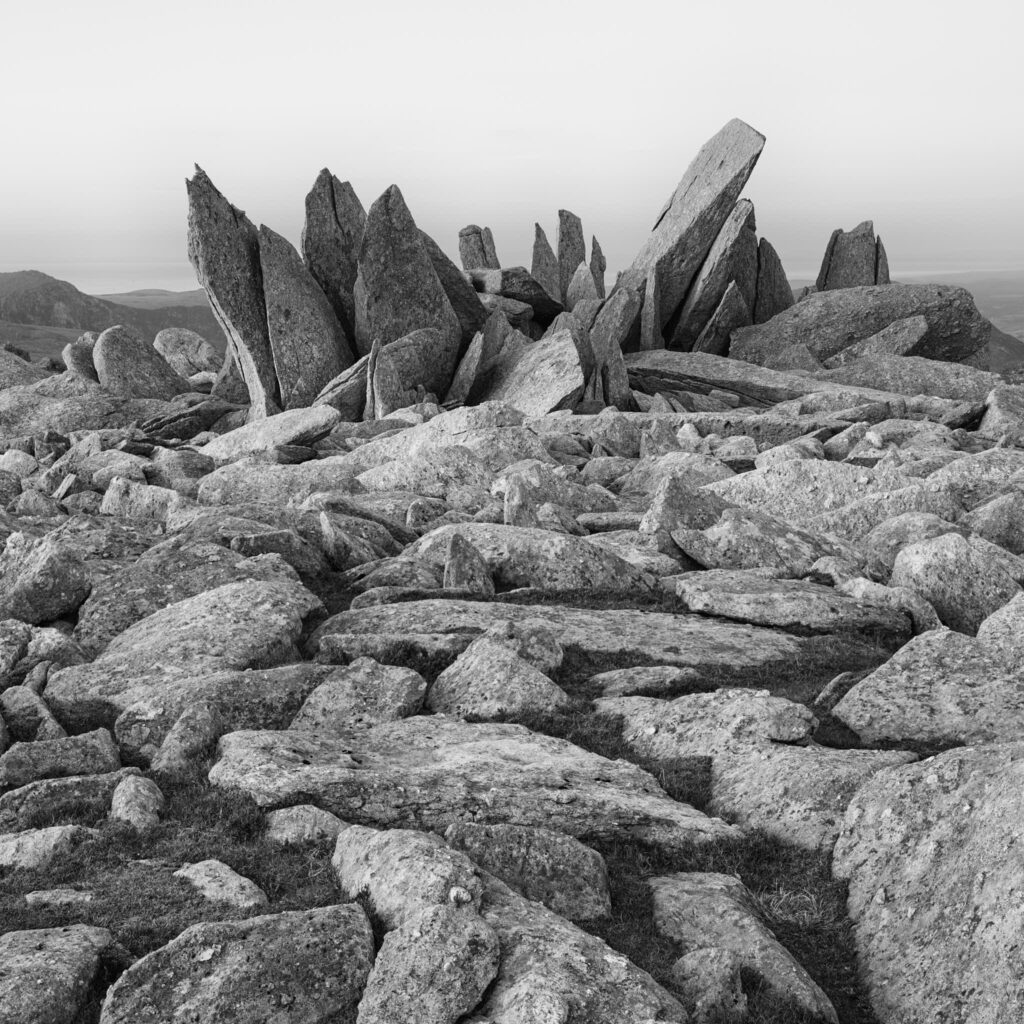
    By the last day of my recent trip to Dartmoor, the endless blue skies were starting to get tiresome.  O’ for a few wisps of cloud and some drama!  Spring was definitely announcing its imminent arrival tho.  By day it was tee-shirt weather but once the sun set it was full-on winter duvet weather 🙂  It felt somewhat silly leaving the truck in warm sunshine but packing boots and winter clothing!

    Although the sky was clear there was always a thickish layer of cloud hugging the ground like a duvet.  Perhaps mother nature knew winter wasn’t quite over.  Like heavy mist it significantly reduced visibility and looked like smog.  Not very attractive.  Big landscape shots just didn’t work.  Come the last rays of a day, it reliably gave a nice orange band across the horizon but not much more.  That low cloud can just be seen in the photograph above towards the left-hand side.

    I’ve photographed and posted regarding these rocks previously.  Their discovery was a genuine organic first for me, but since then I’ve come to realise they are quite famous, why I don’t know, and I usually spot someone with a tripod in the area.  One of these days I will enquire of others what drew them to the rocks.  On this occasion I wanted a different perspective and something that captured the soft orange glow from the setting sun.   The square format is the result of three images stitched with Affinity Photo – my favourite bitmap editor now I’ve escaped the clutches of Adobe.

    I will just plug the Affinity suite of applications as they are truly fantastic and I’m very, very happy to support the company.  I’ve used Photo for over a year now and I’ve not missed or regretted the absence of Photoshop.  It is a superb application and I’m really looking forward to the forthcoming next release.  The application is feature rich and, importantly, stable on Mac.  Previously I’ve used Illustrator for logo’s and artwork needing vector graphics; Affinity Designer has all the capabilities of Illustrator I need and is easy to use.  The third application I used, all be it, infrequently was InDesign, so I’m really looking forward to the forthcoming release of Publisher which is currently in public Beta.  Moving to Capture One and the Affinity suite has saved me hundreds of Pounds per year.  If you haven’t tried the Affinity apps, then I recommend you download and try the trial versions.

    Andy

  • Hart Tor

    Hart Tor

    At the end of February a large high pressure system parked itself over the UK for a few days giving some stable, sunny weather.  Hopefully it was the first of many yet to come but since then its been wet and very, very windy – but it is winter.  Hopefully, the weather will break soon as I found one of my bins flying down the road the other day and tonight, I note, its gone completely – not a sign of it anywhere…  Perhaps a kind neighbour has rescued it, it’s been abducted by aliens or its just gone to that place where all the missing bins go. 🙂

    With the arrival of stable, sunny weather I popped down to Dartmoor for a few days, staying at the Plume of Feathers in Princetown.  Whilst Princetown is notorious for its jail – which, by the way, no longer holds the UK’s most dangerous since the local council refused upgrades – it is also well placed on the Western side of the Dartmoor National Park with good access to most places and surrounded by stunningly beautiful tor’s to its South and West.  Once upon a time Princetown had a railway station that linked it to Yelverton on the Plymouth to Tavistock line.  That would have been a great sight and it’s such a shame it closed in 1956.  Although the railway tracks are now gone its path remains and it now makes a popular walking/cycling route.  Perhaps one day it can be reopened.

    The area just South of Princetown is one of my favourite area’s on the moor and there was one particular Tor I’d been meaning to visit for some time as it looked promising based on mapping and Google Images.  Now, it’s always better to be familiar with a location and its potential before arriving at a shoot, so it was with some trepidation that I drove down the B3212 in near absolute darkness with just stars in the sky.  Would I find the tor in the dark?  Would I get there before the sun rose?  Would the light be good and would the tor be photogenic?  The usual questions that haunt a landscape photographer!  I knew from reviewing the map the previous evening – over a pint of Jail Ale – that a straight line walk-in would likely put me in a boggy stream bed – something I definitely wanted to avoid.  It would be necessary to walk South-East for 500m then South-West for 500 metres.  The plan proved good, although my estimation of the first 500m was off somewhat! But, in my defence, it was completely dark :-).  Still, I used to be better at that sort of thing.  After a while and no sign of a tor I decide I couldn’t afford to waste time and checked the GPS.  Sure enough I had walked too far on the first leg so was to the North and East of the tor.  With the new bearing established off I trotted across the moor trying not to trip on the tussock grass.

    Even with the navigation mishap I got to Hart Tor well before sunrise.  After all, I had deliberately left plenty of time having not been before….  As dawn approached I relaxed as I’d found the tor, I’d got there in time and it was definitely photogenic 🙂  The only problem was going to be the lack of cloud and thus no colour towards the sun.  However, as it got lighter low cloud hugging the land like a fog became visible. Much better!  I just had to wait for the sun and hope.  Fingers crossed 🙂

    With slightly higher ground on the Eastern horizon the sun rose a little later.  This higher angle and the clear sky resulted in little colour towards the sun but some lovely low angle light on the grasses and, thanks to that low cloud, the most gorgeous soft colours towards Leather Tor and Sharpitor.  The result was the photograph at the top of this post;  it is one of my favourites from Dartmoor.

    Andy

  • Leedon Tor

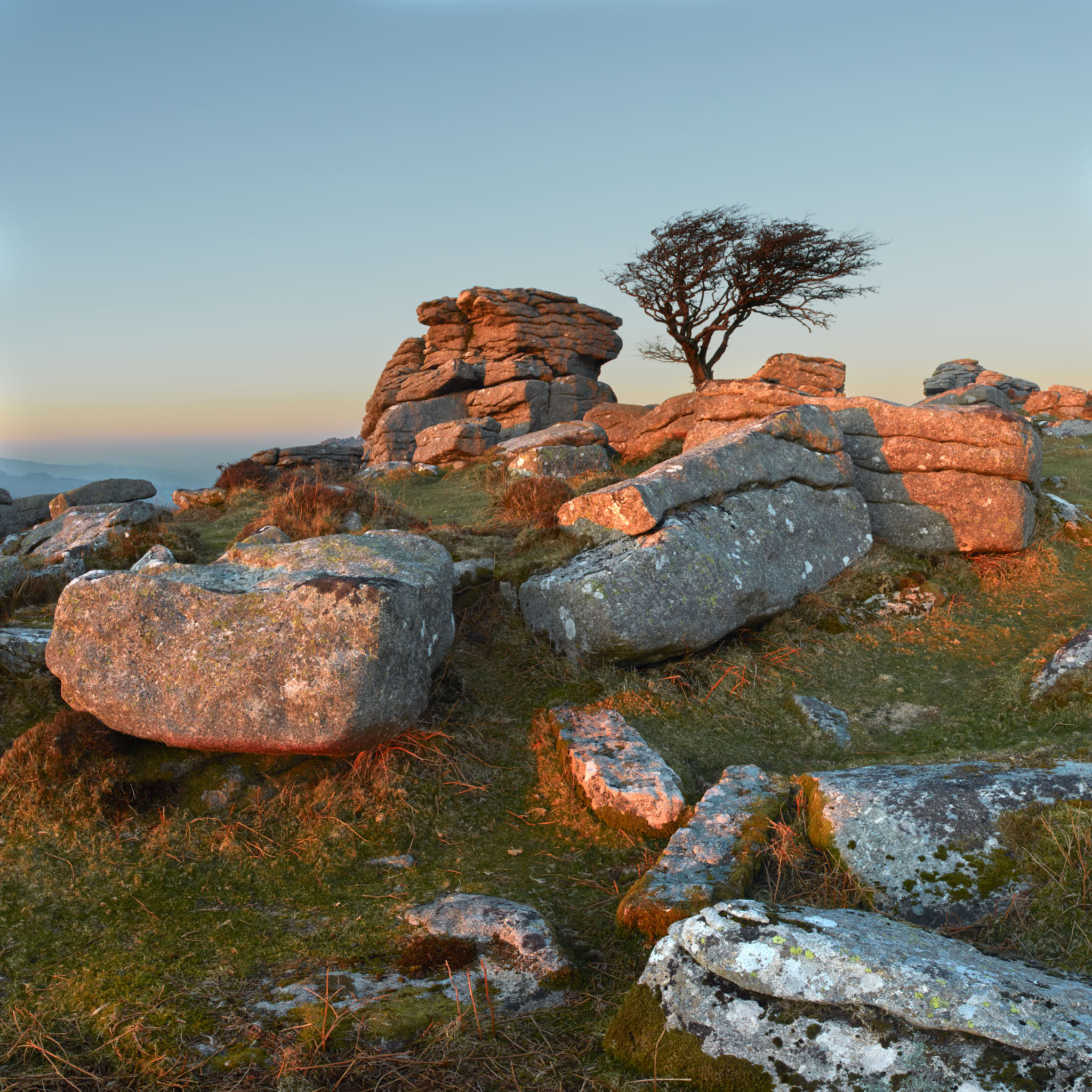
    Leedon Tor

    As readers will know from the preceding post I’ve been exploring the Dartmoor National Park again 😉 There is an area to the South and West of Princetown bounded by Leedon Tor, Ingra Tor and King’s Tor that contains the old railway and some quarries.  This area looked interesting on the map but I was hesitant as its higher than most of the surrounding moor and the tor’s didn’t, on the map, look especially interesting.  A particular objective was to understand what opportunities the quarries might offer as I’ve got this Dwarf kingdom, Lord of the Rings type image lodged in my brain!

    Starting at the Southern end, I climbed Leedon Tor and noted it had potential especially for a nice colourful sunset.  Moving North I explored the railway and the odd lonesome tree before stopping for lunch at Swelltor quarries.  Swelltor faces West and given the right lighting there should be nice black and white photographs, but being midday with high contrast and clear skies the atmosphere was all wrong.  A return visit is needed. 😉  Continuing North, after lunch I arrived at King’s Tor – a large and complex group of stones  – but I didn’t see any simple arrangement that caught my interest.  A small tree on the South-East side does warrant future investigation though 😉

    I was back at Leedon Tor for the golden hour and watched the sun gradually sink to the horizon, but with a sinking feeling I knew nothing was going to happen.  The sky was almost cloudless and although there was a nice orange band at the horizon it just went dark. 🙁  So, back to the pub and another pint of Jail Ale!  The next morning I tried again.  This time the lighting was better and as the first rays of sunlight caught the higher rocks and grasses it painted them in a nice warm soft orange colour.  The photograph at the top of this post captured the moment 🙂

    Looking at the photograph now I see a stack of rock half lit by the sun and it reminds me of another similar stack.  The Bownerman’s Nose which featured in an earlier post here.

    Andy

  • Second Servern crossing

    Second Servern crossing

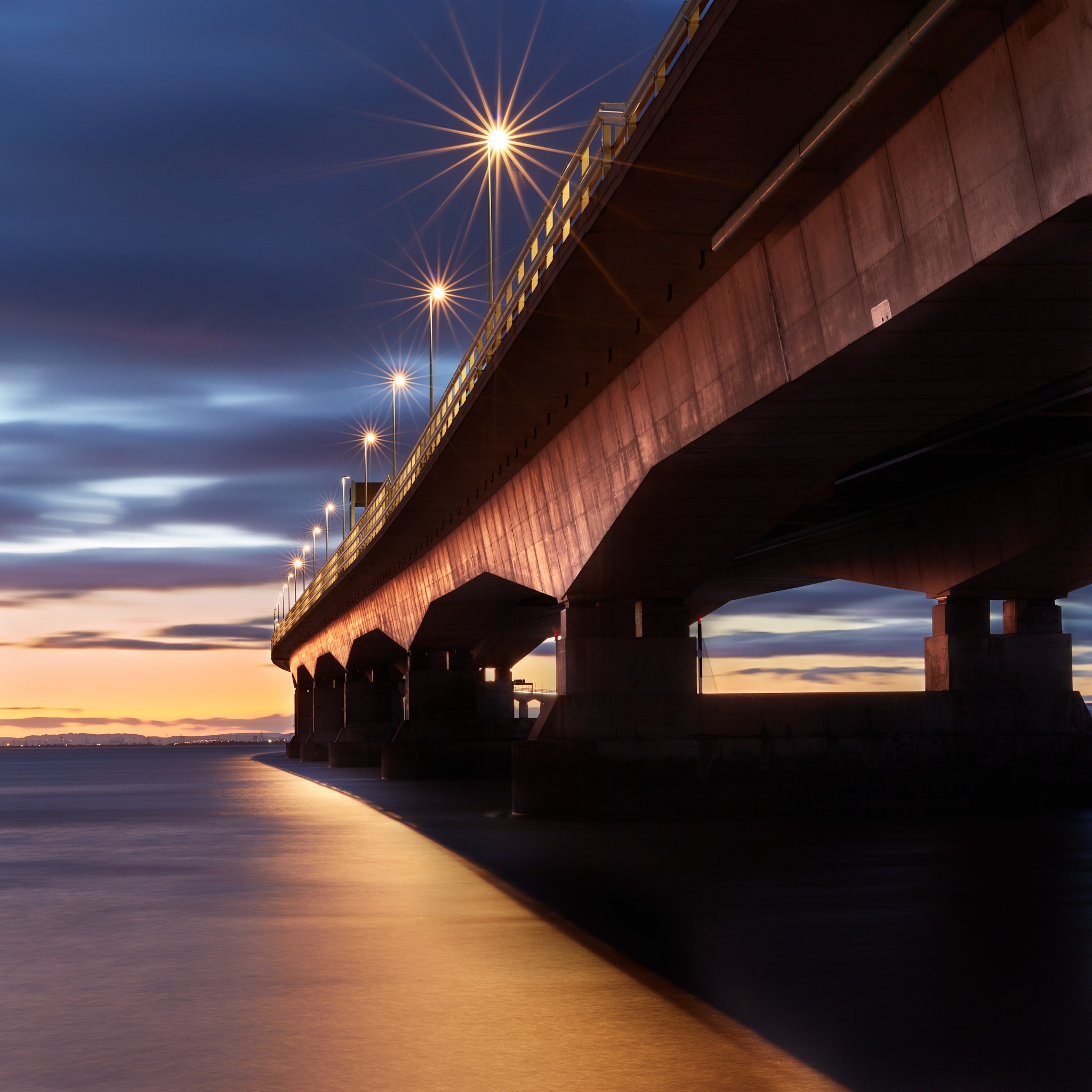
    The Second Severn Crossing also known as the ‘new’ bridge was completed in 1996 and carries the M4 motorway between England and Wales over the river Severn.  Being close to home its something I’ve photographed several times but never during the winter.  It’s a small project right now, as during the winter the sun sets to the South and under the arches thus I’m confident there is a good photograph waiting to be made!

    Earlier this month the sky looked promising but, as is so often the case, a 25-30mph wind blew from the West buffeting me and the camera.  None of the resulting images were pin-sharp and, rather annoyingly, a patch of cloud rolled in at sunset obscuring the sun; the light changed from blindingly bright to grey/blue with no colour. 🙁  This weekend, the sky again looked promising and, this time, there was little to no wind. 🙂  

    The bridge has a semi-circular shape and is best viewed from the North side where it lends itself to a panoramic format and that’s what I spent the golden hour doing.  Several images later and some time after sunset I packed-up and started walking back to the truck feeling happy.  Under the bridge tho, I just had to stop.  The sky still had some nice colour and this was catching the side of the bridge, perfectly illuminating its concrete panels whilst the bridge, deck lights illuminated the water.  It was a lovely scene and hadn’t gone un-noticed by a couple who were taking pictures with their mobile phone.  My version was a ISO 200, 30 second exposure at f16.  A shorter exposure at f8 would have worked well too, but I wanted to blur/smooth the fast flowing water and thus went for the longer exposure time.

    Andy

  • Porlock Weir II

    Porlock Weir II

    Seizing an opportunity between the incessant wind and rain over the Christmas 2018 period, I headed down to the small village of Porlock Weir. It’s situated just under the Exmoor hills on the North coast of Somerset.  It’s not only a pretty little village with a nice harbour but it also has a couple of minor claims to fame.  It’s owners like to advertise it as a film location.  Indeed, part of the 1995 movie ‘Feast of July’ was shot in the harbour and it also made an appearance in the more recent BBC, ‘A Very English Scandal’ television series.

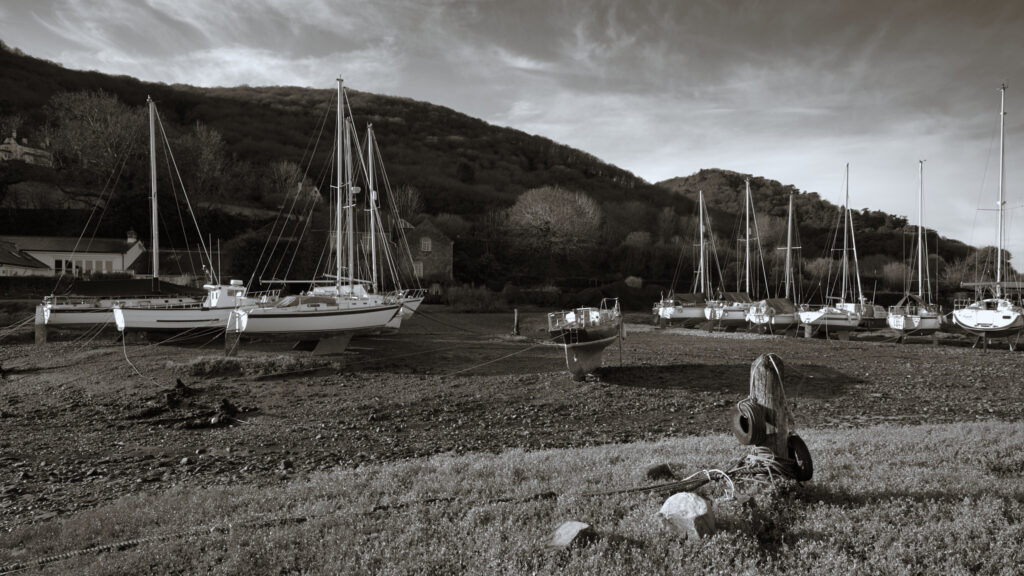
    Porlock means place of the port and Porlock Weir, situated a few kilometres West of Porlock, is its harbour.  The harbour is shallow, controlled at one end by lock gates and used mainly by small pleasure boats so it’s always a bit of a surprise what’s there.  Previously I’ve seen ‘older’ looking wooden sailing boats but on this occasion it was mostly modern ‘plastic’ yachts presumably avoiding the winter weather.

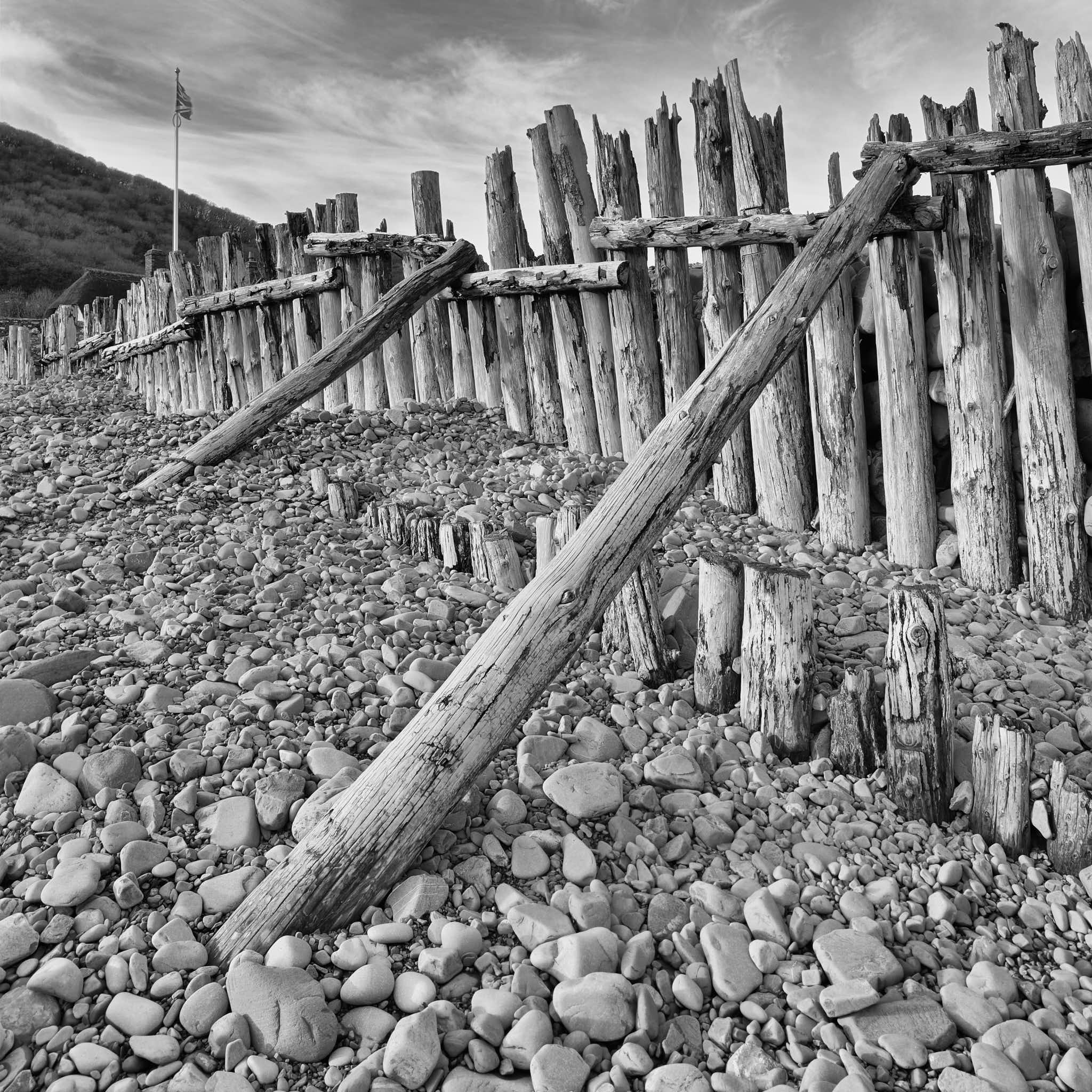
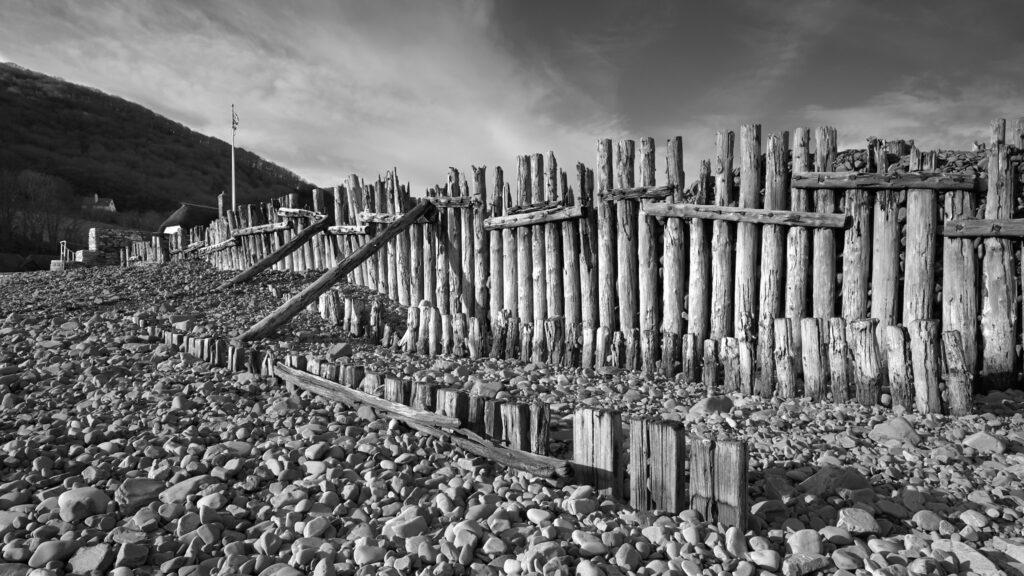
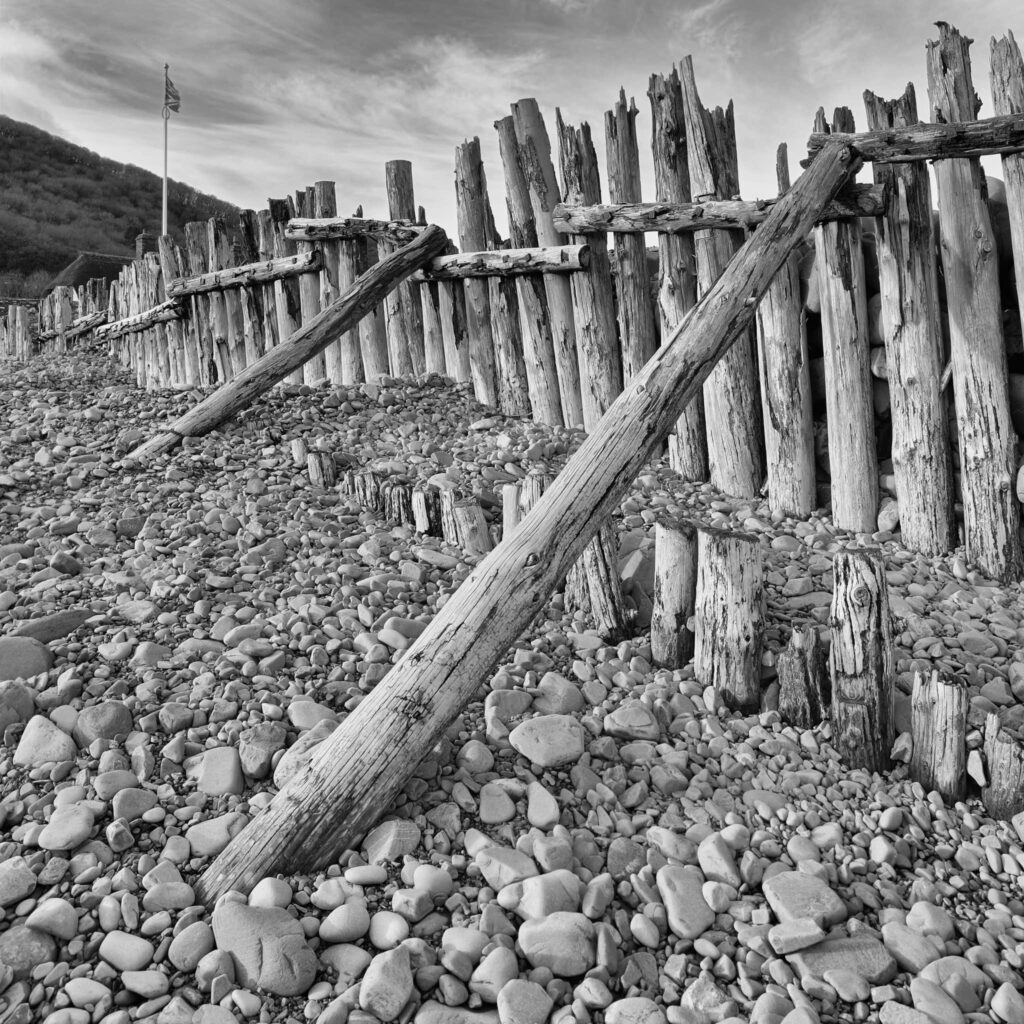
    In addition to the harbour there is a fine groyne constructed from wooden poles each of which must be at least 12-14 inches in diameter.  Probably just as well as it’s holding back a beach of many thousand large, heavy stones which must exert tons of pressure.  The groyne has been there for years and each of the poles is now showing signs of age and exposure to the elements of nature.  It’s a striking structure with exposed natural knots, cracks and textures held together with massive rusting steel bolts.  I’ve photographed the groyne before but always had the idea of returning to capture the wood in greater detail.  The above photograph was captured with a 50mp camera using a 21mm lens so seen at 100% there is a huge amount of detail.  During post-production I opted for a monochrome square crop to remove the whispy clouds and the distractions of colour.

    Porlock Weir Groyne No. 1
    Porlock Weir Groyne No. 1

    Flying at the shoreward end was a Union Jack flag but rather annoyingly it never flew side-on to the camera, but viewed at 100% there is just enough to identify the flag. 😉  Shortly after the photographs were made the whispy cloud thickened signalling the approach of the next weather front and band of wet, windy weather.

    Porlock Weir Harbour
    Porlock Weir Harbour

    Slightly earlier I’d been walking around the harbour searching for something photogenic and found the above wooden post festooned with ropes and a couple of old tyres presumably being used as buoys.  It was almost midday when photographed but being so close to mid-winter the sun was low in the sky and only just peeking above the Exmoor hills.  Half an hour later and it had dropped behind them.  It’s a strangely basic harbour; one side is formed by the land, two sides by the stones that form the beach and the forth by a high set of old and rusting lock gates.  Part of the reason it seems so strange is it’s just a short and easy walk from the harbour floor over a small stony rise to find oneself on the beach facing the sea.  More so when that sea is the Bristol Channel, an expanse of water with one of highest tidal ranges (15m) on the planet!Just a reminder to readers that clicking on the photographs will generate larger versions 🙂

    Andy


    All images are Copyright Andy Gawthrope Photography.
  • Dubs hut and Hay Stacks

    Dubs hut and Hay Stacks

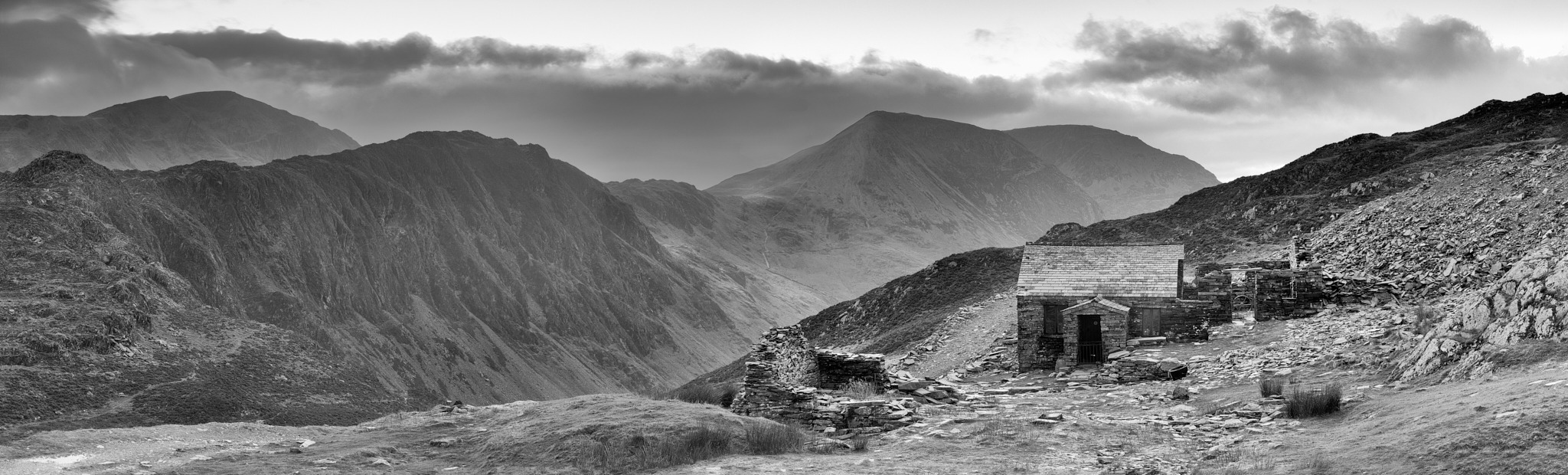
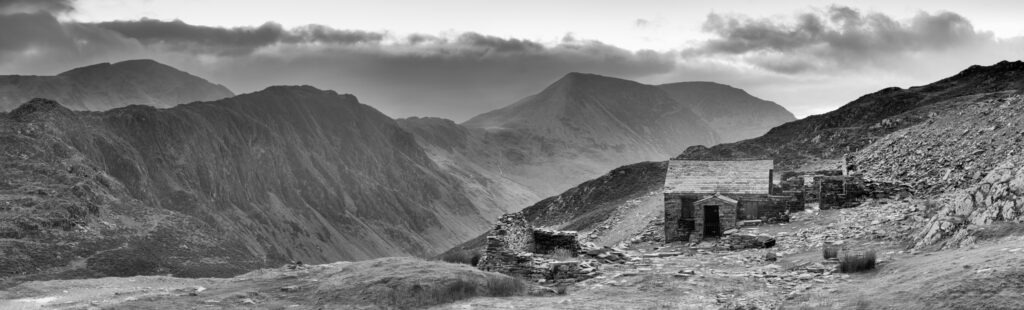
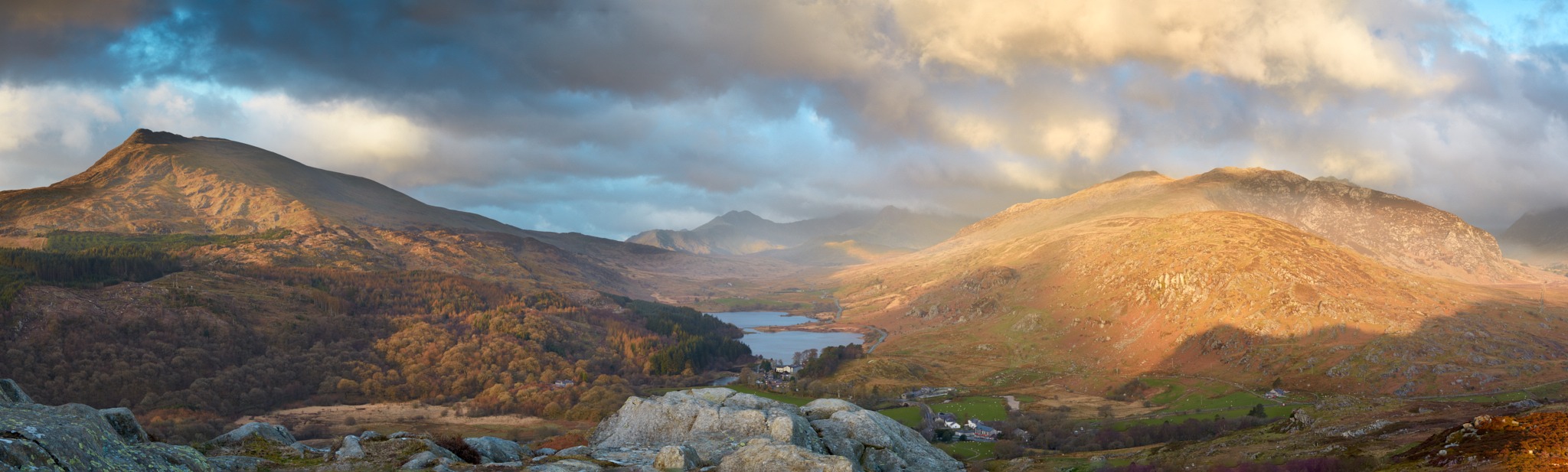
    On my recent visit to the Lake District, one of the aims was to do a little mountain photography.  Unfortunately the cloudy weather put the stops on that, but the day I arrived the weather looked promising.  The plan was to arrive earlier in the day to leave more time for an evening outing, but thanks to hideous roadworks – Birmingham through to Manchester – the journey took much longer than it should have.  So when I had arrived there was only about 1.5hrs before sunset.  Not enough time for much….

    This time of year the sun sets further to the South and behind the mountains in the photograph so, down in the valley, the sun was already perilously close to disappearing behind the mountains.  The only other option was to head to the tops – no easy thing with such little time…  I was staying at the Bridge Hotel in Buttermere so, the quickest access to the tops was a 20 minute drive to the Honister mine car park followed by a mad dash up the track in the hope of getting somewhere nice by sunset!

    So that’s what I did and it almost worked.  I got to the Dubs hut just as the sun set with no time to go further.  In fact, I would have needed to be there about an 1.5hrs earlier to allow a little exploration and setup time.  But that’s how it went 🙁  The result was a very quick hunt for a composition in the fading light.  Anyhow, for what was, essentially, a grab shot I’m pretty pleased with the result. 🙂

    The photograph is the result of stitching three individual images so, like all my panoramic photographs its pretty wide and computer screens don’t them justice.  At full size, the detail in the hut, surrounding stones and distant screes is impressive but this is lost when displayed small-size on computers.

    The plan is to do much more mountain photography over the coming year.  I’ve asked Santa Claus for a carbon fibre tripod 🙂

    Andy


    All images are Copyright Andy Gawthrope Photography.

  • Autumn colour in Borrowdale

    Autumn colour in Borrowdale

    It’s been a long, hot, dry and sunny summer in the UK; the best for many a year.  But long days filled with dust and haze make it my least favoured time of year for photography.   In fact, the camera stayed in its bag for the whole time!  With Autumn approaching and in September I returned to Dartmoor but it was a week of high winds and road-level clouds all thanks to the remnants of US hurricanes making it across the Atlantic.  Nothing came from that trip 🙁

    A few weeks later and with Autumn in full swing I thought I’d try a trip to the English Lake District, staying at the Bridge Hotel in Buttermere.  The Bridge is a lovely traditional family owned hotel with much history; its somewhere I’ve stay before on at least two occasions.   In the bar at the back of the hotel are five or so large landscape photographs of the area framed and hung on the walls.  They’ve been there for many a year but the colours still look great 🙂  One of these day’s I’ll ask who the photographer(s) were as there is no indication on the frames.  Shame.   The Bridge is slightly cheaper than many of the Borrowdale hotels and it’s only a short drive over the Honister pass.  The Buttermere & Crummock Water area is also much, much quieter than Borrowdale and being a school holiday week it made a stay in the Lakes much more pleasant. My thanks to all the staff at the hotel, especially for receiving a truck wheel after mine was stolen shortly prior to the trip!

    Borrowdale Autumn No. 4
    Borrowdale Autumn No. 4

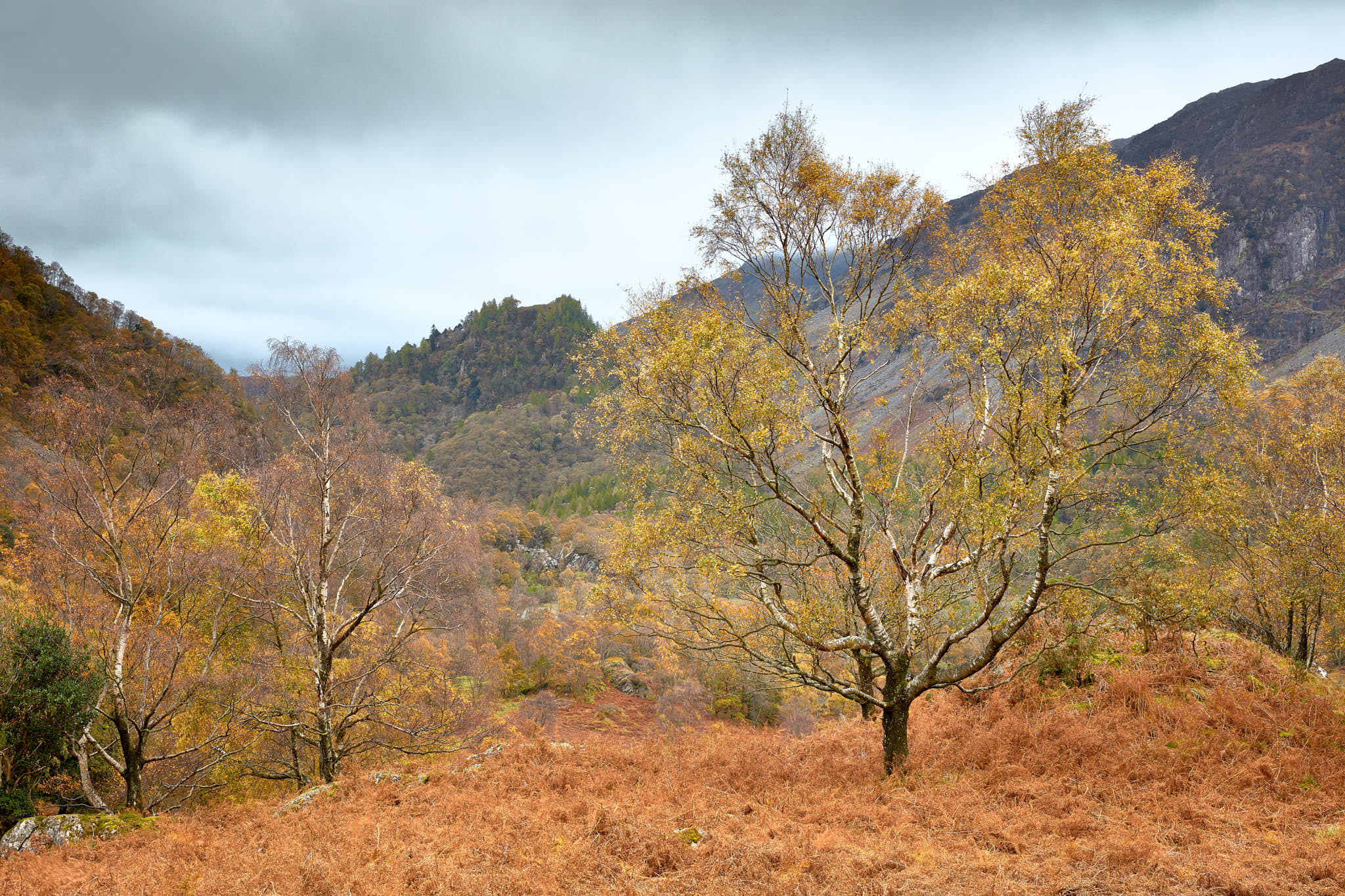
    I do think that I’ve managed to upset some weather gods tho as again it was predominately a cloudy week, but unlike Dartmoor there were great colours that made up for the dull weather.  In fact the first good day of the trip was the day I left!  Just my luck 🙁  Several nice images did come from the week tho, nothing I’d call special, just nice.  Sufficient reason to return, perhaps next year, with the hope of better light.  But I’d also like to see what snow does to the landscape.  Trees without leaves, the ground covered in a simplifying duvet of white and distant rocky outcrops could look quite dramatic.  Add a little colour too, and wow… 🙂  O’ to be a painter rather than a photographer sometimes!  Reality is such a pain!

    So, perhaps the title for this post should be ‘Buttermere yet, yet again!’ but as its mostly about Borrowdale that doesn’t seem right.  During Christmas 2017, I did much planning for the forthcoming year and one of the projects I settled on was to photograph Borrowdale in the following Autumn.  The intention was to get off the beaten tourist tracks and explore something new, new too me anyway and that’s what happened.  It was a real pleasure parking at a National Trust car park only to head off in the opposite direction to everyone else, find some small, moss covered stile/gate and cross into new, unexplored territory.  It should have come as no surprise to find the occasional photographer crouched behind a tree or bushes but as the area was so large, what photographers were about, didn’t get in each others way.  Well I don’t think so. 🙂

    Borrowdale Autumn No. 2
    Borrowdale Autumn No. 2

    Despite it being a school holiday week and towns such as Ambleside, Grasmere and Keswick being rammed with people, away from the tourist hot-spots was really very quiet.  Just photographers and dog walkers!  O’ and occasional shouts of ‘Climbing’, ‘Off belay’, ‘Safe’ emanating from the crags.  One pair of climbers were obviously having a hard time hearing each other, but away from the crag every shout was heard clearly!

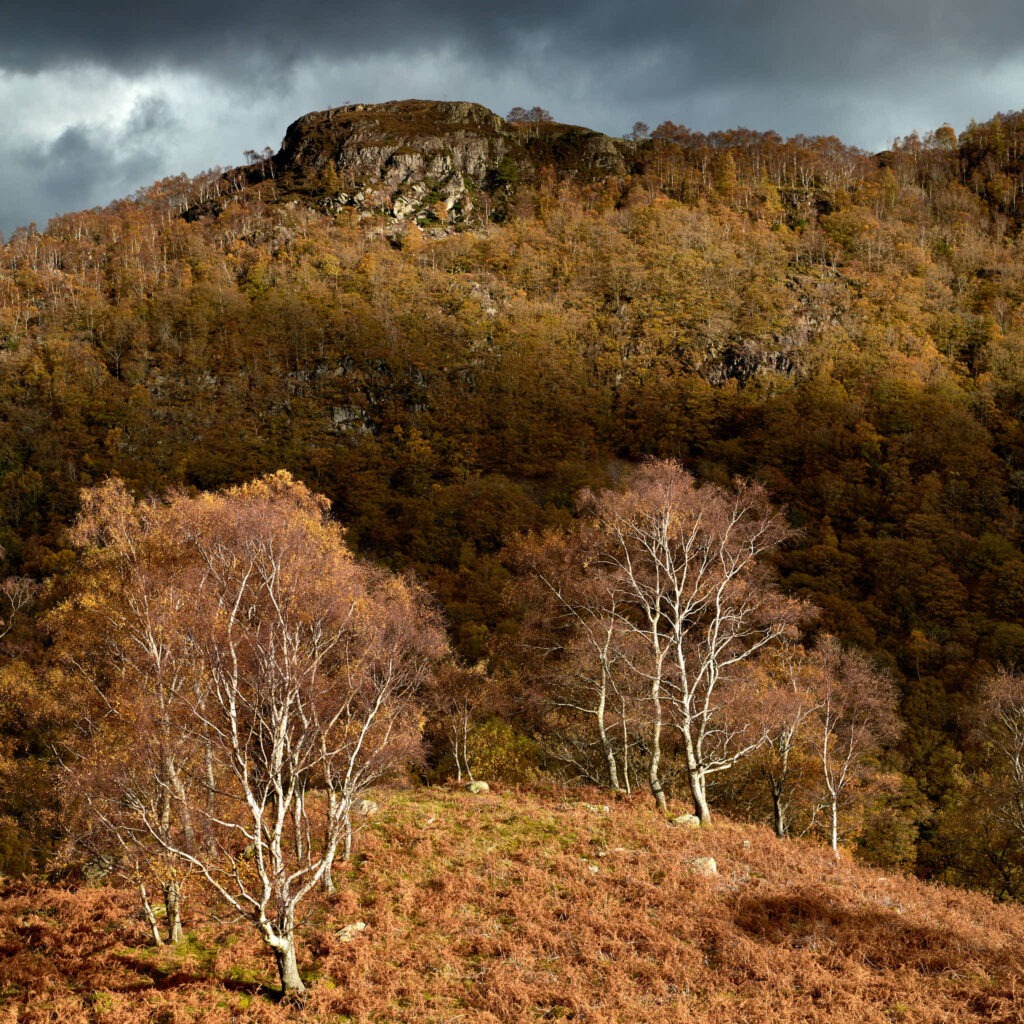
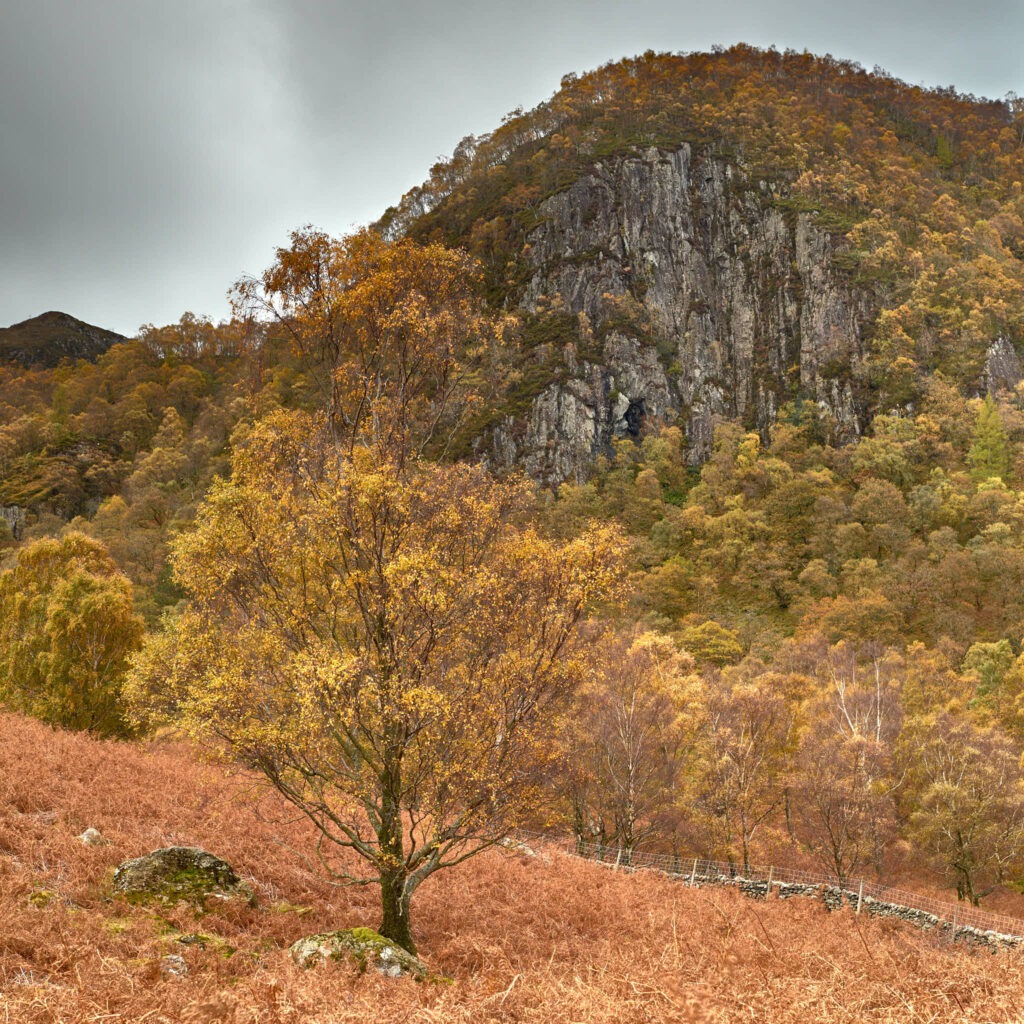
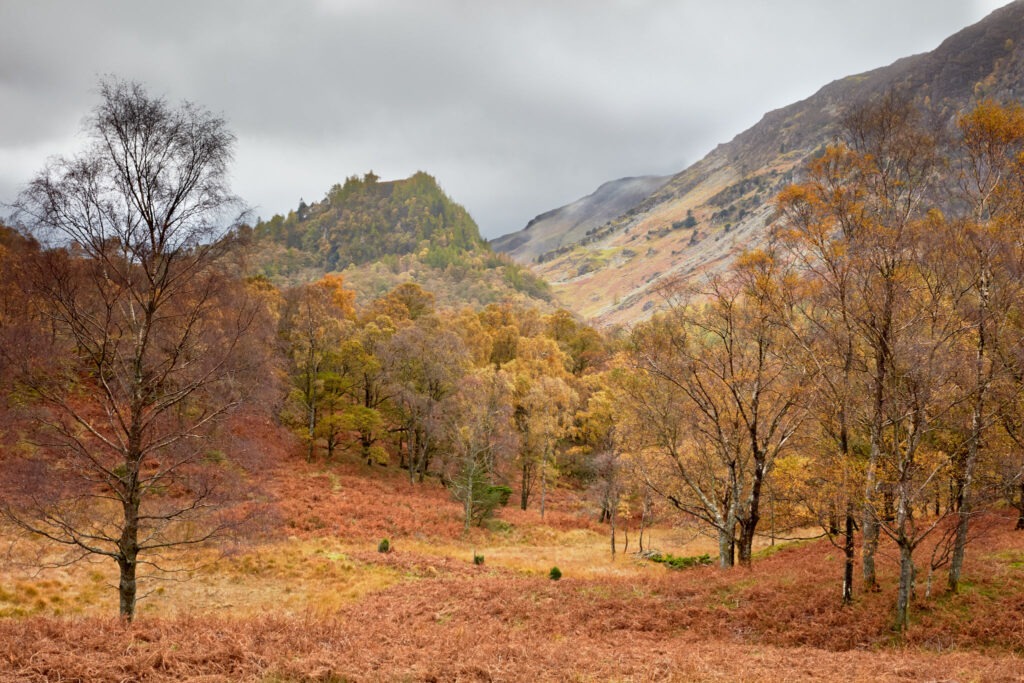
    So, getting back to Borrowdale.  As it happens I recognised a few off the views from the work of others whilst rooting about in the woods, so I certainly cannot claim new and un-photographed territory.  Worst luck!  I doubt whether there is anywhere new and un-photographed in the Lakes these days.  Borrowdale is, of course, synonymous with Castle Crag.  It’s the smallest summit in the famous series by Alfred Wainright and he described the wooded area between it and the River Derwent as “the loveliest square mile in Lakeland” and I think I agree!  It really is a lovely place.  In addition to dominating the Southern end of Derwent Water and Borrowdale, Castle Crag has a wonderful, almost conical shape when viewed from the North.  Including Castle Crag in some photographs was something I had specifically wished to do and, as it turned out, it wasn’t at all difficult!  It was actually quite hard at times to shoot such that it wasn’t in the frame!  As you can see, it made it into this post too 🙂

    Borrowdale Autumn No. 1
    Borrowdale Autumn No. 1

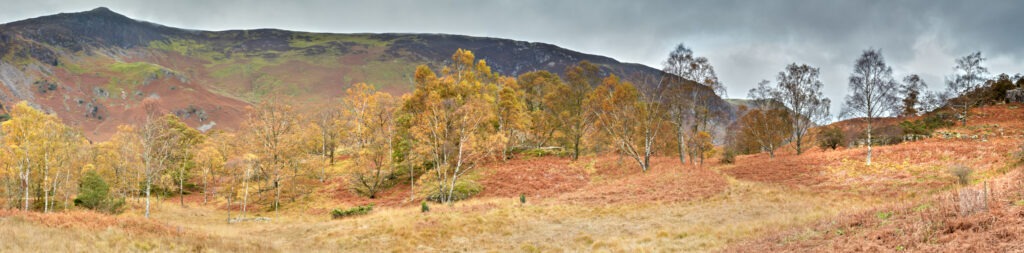
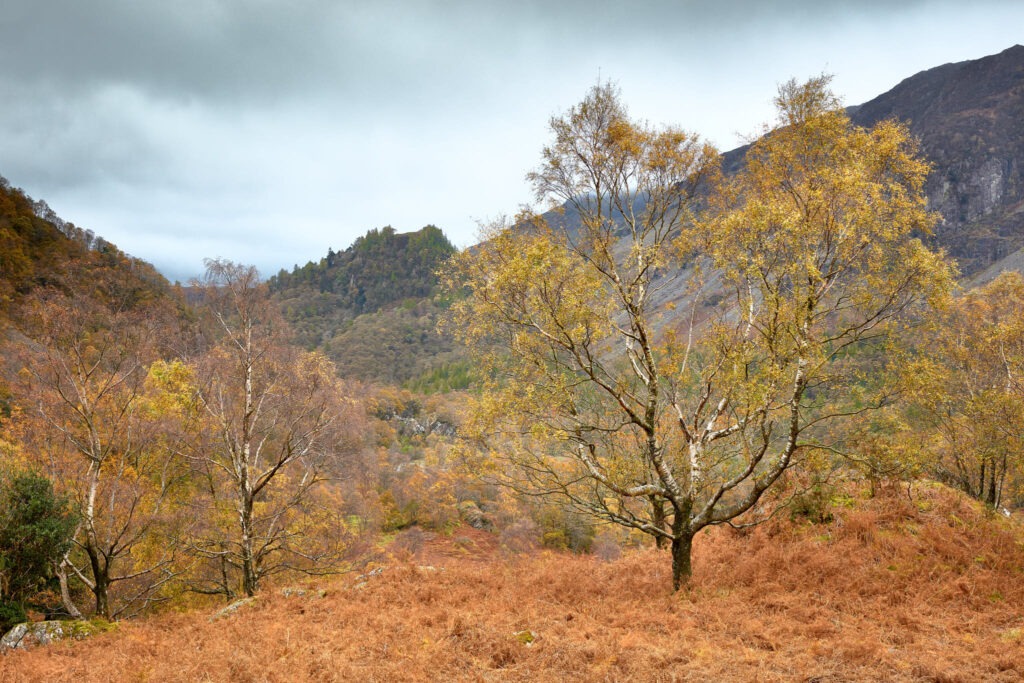
    Common to nearly all the photographs from the week are the grey clouds as can be seen in this post but sometimes there was a little sunlight to lift the colours which made all the difference.  To be honest the Autumn colours were probably a little past their best during the week but speaking with a more local photographer Autumn has been really short this year.  Just two weeks previously the leaves were still green.  Certainly by the end of my week there were noticeably fewer leaves on the trees than at the start of the week and there was always a steady trickle of leaves falling.  Most of the red colours had gone but there was still a great variety of yellow, gold, green and, yes, the bracken really was a deep brown!

    One characteristic of the area that made it special for me was the space between the trees.  It wasn’t dense woodland packed with trees; there was plenty of open ground punctuated by either solitary or small groups of trees, sometimes with rocks or other interesting objects at their base.  This made for more interesting compositions and gave the subjects ‘room to breath’.  

    Whilst I’m no arboriculturist, the trees looked like Silver Birch and in the gloomy conditions their light/silver coloured trunks and branches added a skeletal component helping emphasise their structure and add a little interest.  Sometimes tho, when the sun did peek out from the clouds the light/silver colours became very bright reflecting sunlight and making exposure difficult.

    Entwined
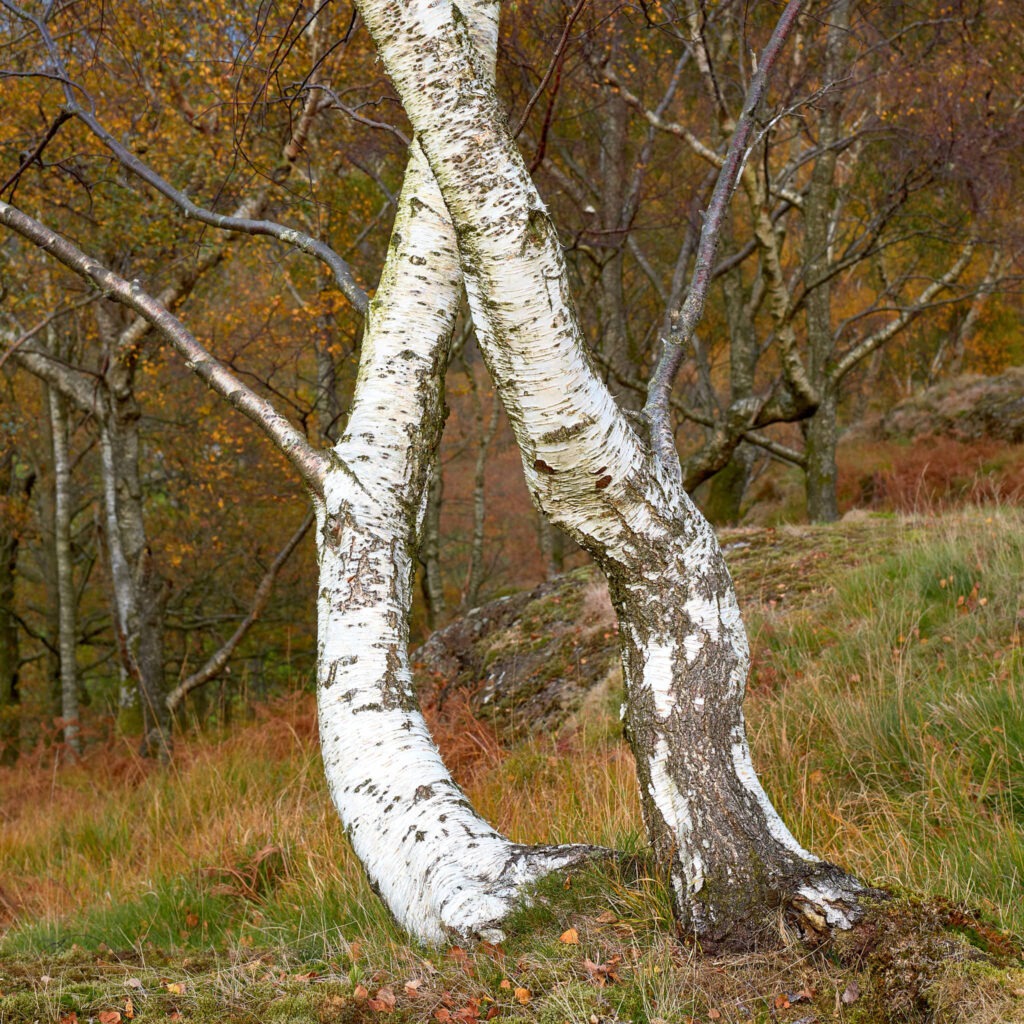
    Entwined

    Most of the photographs from the week set a tree/trees in the context of  their landscape, but I was also looking for interesting close-ups too.  Almost at the top of the hill and tucked at the back I spotted the two in the photograph.  Its not just the curving trunks I like but the detail in the bark 🙂  It was shot at F8 to add a little separation between the main subject and the background, a wider aperture blurred too much of the main subject.  When viewed at 100% the Silver Birch trees are wonderfully sharp and its probably my favourite image from the whole week.

    Not far from these trees a small patch of red and green moss hung to the side of a rocky step.  It was really beautiful and very, very different from the normal big landscapes I photograph – the opposite extreme!  Perfect job for a macro lens, but I didn’t have one so I made do with the 50mm but the results were pretty disappointing.   But I learn’t a few lessons trying so all was good 🙂

    Ah, the 50mm lens… That was a present to myself earlier this year.  Its a Sigma Art model and it seems to have become my go to choice.  It just seems to magically frame whatever the subject!  It’s great for single exposure images but, importantly for me, panoramic’s too.  There are two lenses always in my landscape bag now, the 50mm and a 21mm.  The 21mm used to be my go to lens but nowadays it only get used when the much wider field of view is needed.  Shooting from a little further back and with a little magnification really seems work.  A few years ago I’d never have considered 50mm being my default lens for landscape work – at 35mm full frame anyway.

    Castle Crag
    Castle Crag

    Well, that was Autumn in the Lakes.  It seems fitting to end this post with a photograph that summed up the weather.  Clouds covering the high fells, grey cloud but lovely colours. 🙂  Roll on winter and let’s hope its a snowy one 🙂

    If you have enjoyed reading this post, found it useful or just simply enjoyed the photographs please share it on social media.

    Thanks,

    Andy


    All images are Copyright Andy Gawthrope Photography.
  • Wastwater colour

    Wastwater colour

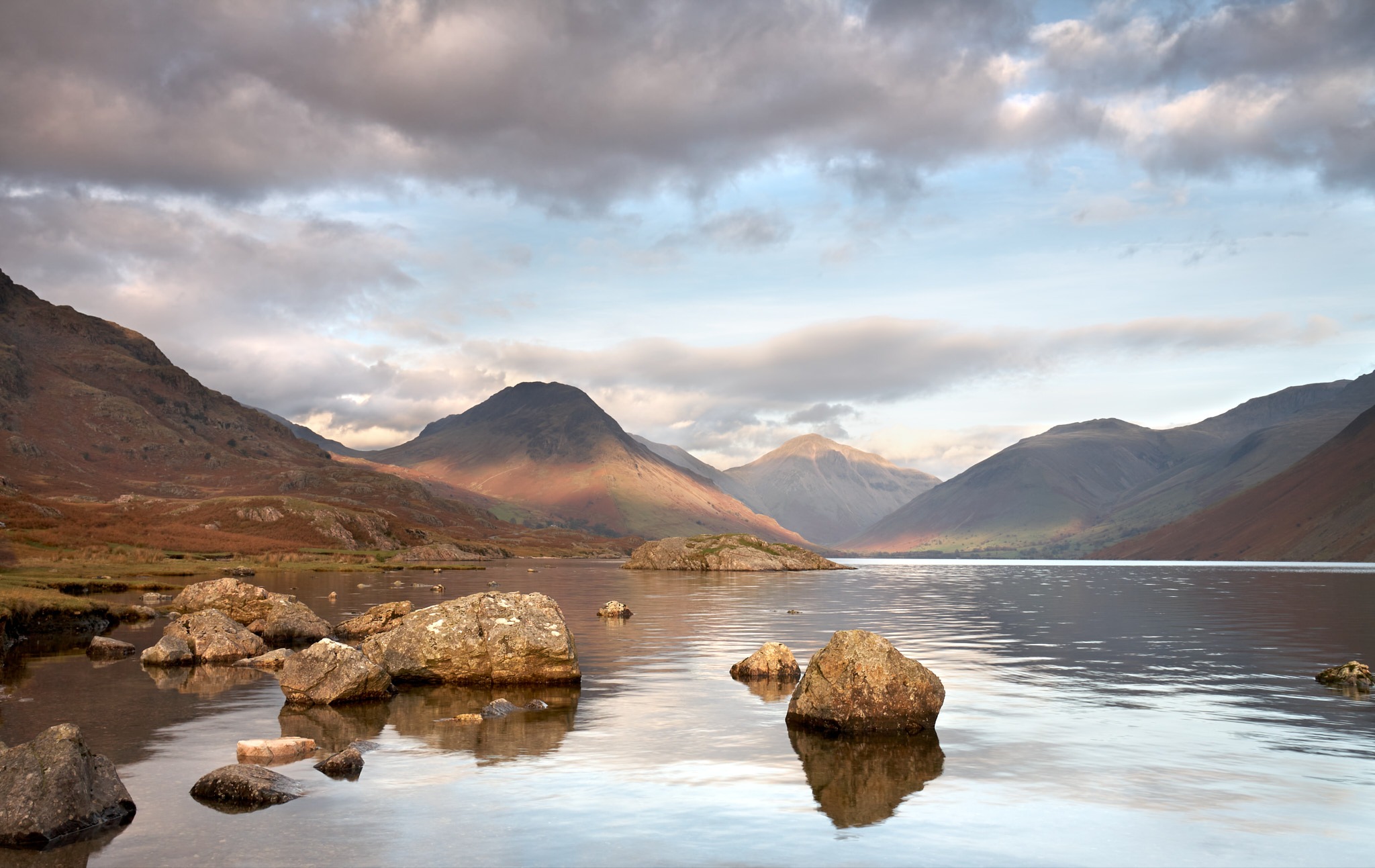
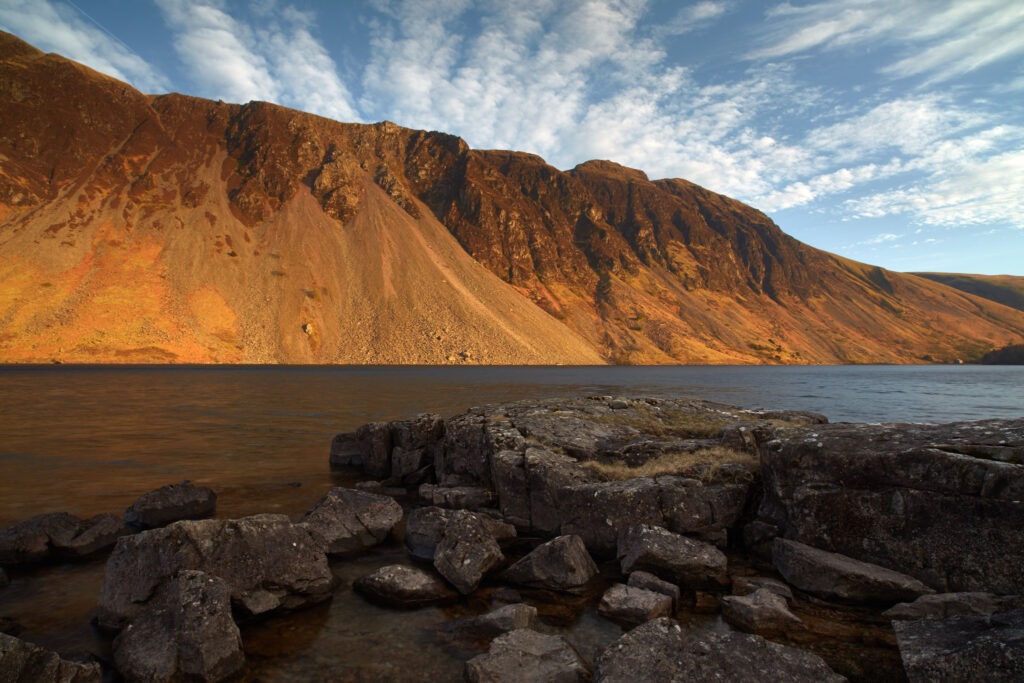
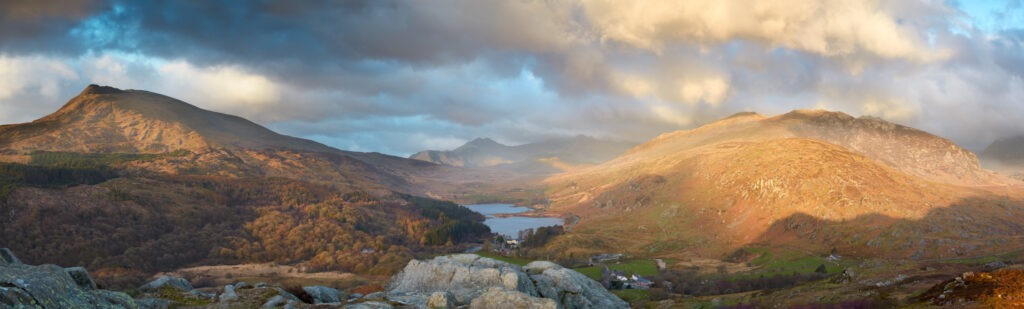
    Back in 2006 I spent a few days in the English Lake District.  As I recall now, it wasn’t the most successful of trips as the weather didn’t generally play ball.  One rainy day the weather was forecast to break late in the afternoon so, to kill a few hours, I took a drive along the small mountain roads across the Hardknott and Rhinos passes to Wasdale on the Western side of the Lake District.  So it was that I found myself on the banks of Wastwater about an hour before sunset.

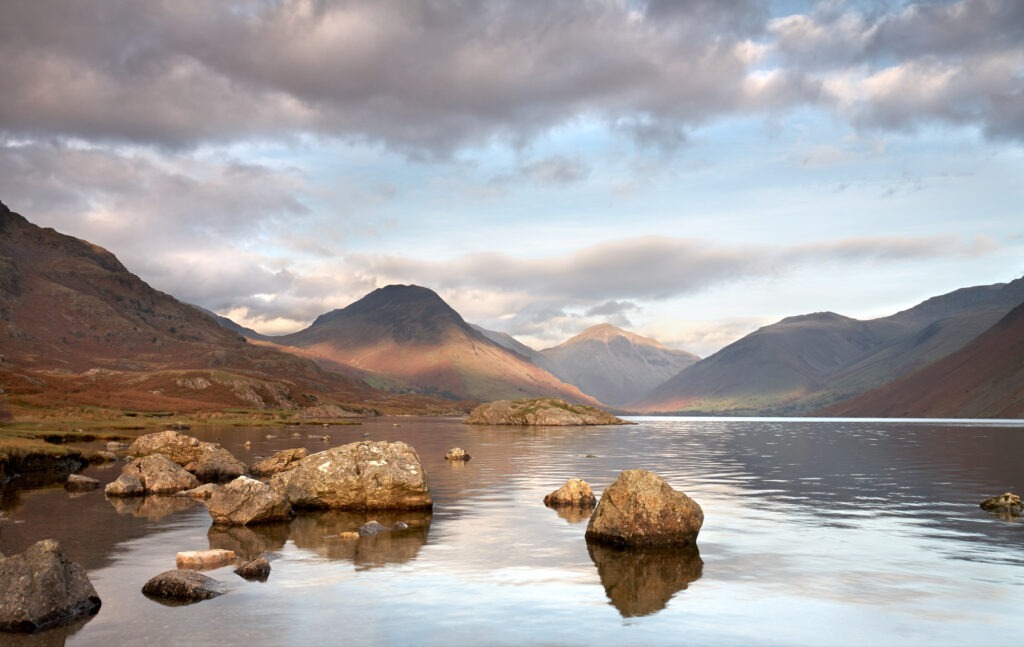
    It’s easy to be complacent, or perhaps I was fully occupied on the photography, but at the time I didn’t realise how special the conditions were.  The setting sun was peeking through a gap in the hills, the sky was filled with a mix of small grey clouds, the type so often found as rainy weather clears and there was a lovely warm light illuminating the rocks and hills from the setting sun.  One of the images captured that evening continues to be a favourite to this day another included a small tree which, sadly, now seems to have gone.

    Those images were captured using my first digital camera, a Canon EOS 5D.  Yes, the first model 🙂  Since that time technology has advanced and despite several subsequent trips those special conditions have never repeated.  This year I decided I was going to make an effort and see what could be achieved with my current camera, an EOS 5DsR.

    Towards the end of April a high pressure weather system was forecast to settle over most of England for a few days with its edge somewhere close to the Lake District so there was a good chance the weather could do something interesting.  That was sufficient to throw the gear in the truck and head North.

    Wastwater No. 5
    Wastwater No. 5

    As readers will know, I prefer to camp if I can.  Mainly because plans can be made, cancelled or changed with speed and ease.  There is no booking hotel rooms and cancelling them when the weather doesn’t perform.  Camping keeps you connected with the environment, with the weather and its quick and easy to get out should the weather offer a good window of opportunity.

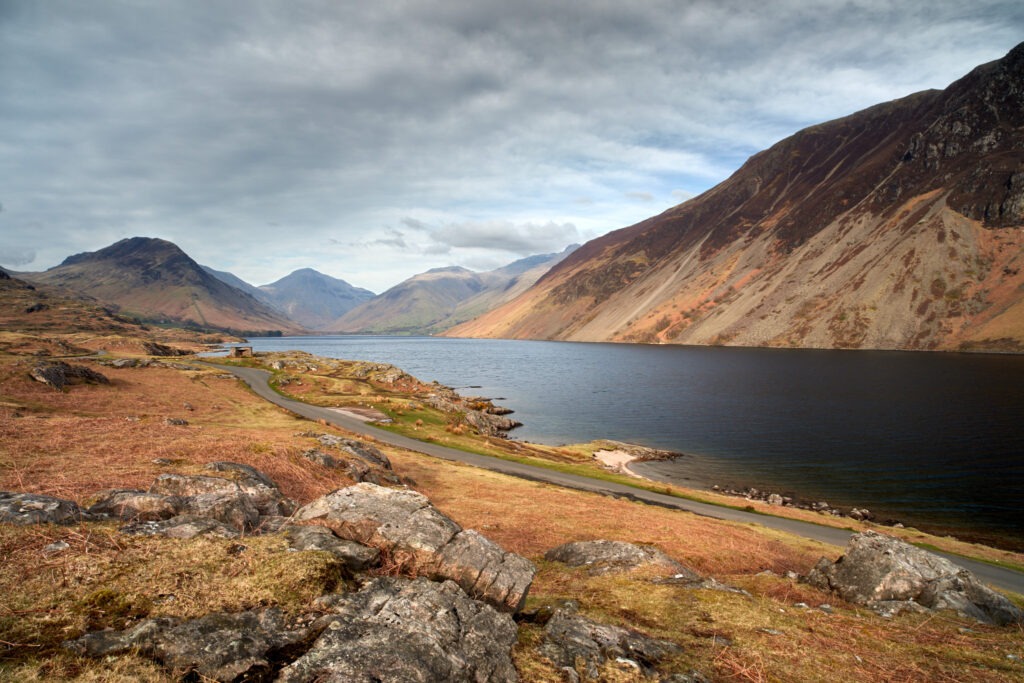
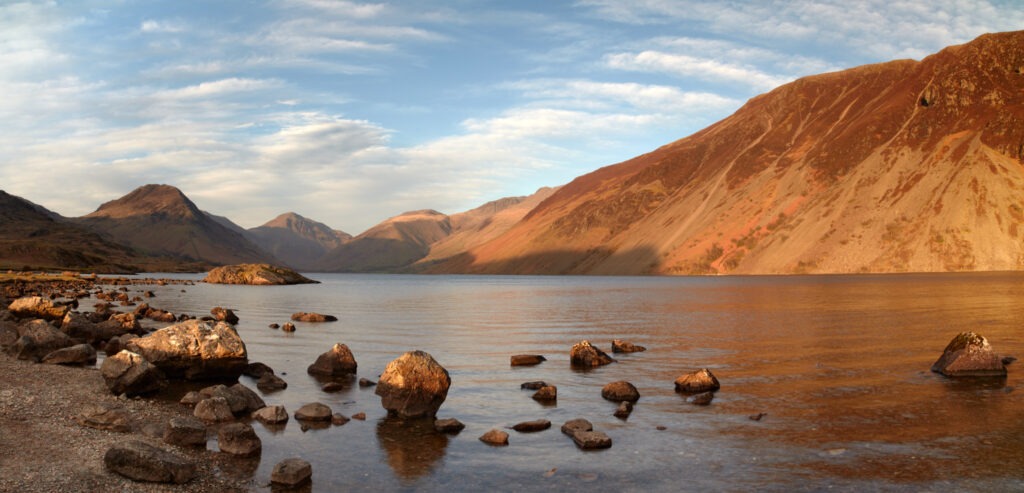
    Wastwater, like any other location in the English Lake District has been photographed many, many times.  I’m particularly interested in what is called the Screes.  Its the side of the hill that runs alongside and drops off steeply into the lake.  The Screes have some lovely shapes and colours given good evening light.  Most other photographs are from the lakeside; fewer from further back and including more of the lake and the Screes.

    On previous trips, I’ve explored the area around the lake quite extensively and so had a good idea from where I wanted to photograph.  Scouting locations really does save precious time that is otherwise wasted when the light is at its best.  So, top-tip: On those days when the light doesn’t do something interesting, go explore and take a snap just as a reminder of a locations potential 🙂

    It was a wet, rainy day when I drove from Bristol but the forecast was for much better weather over the following days. The evening I arrived clouds covered the mountains and the camp site was very wet even waterlogged.  Things definitely didn’t look hopeful and I went to bed that night hoping I’d made the right decision coming North.  The next morning wasn’t much better but as the day progressed the clouds started to break and by sunset things were looking much, much better. 🙂

    Wastwater No. 2
    Wastwater No. 2

    I’ve never really thought about the level of the water in the lake, but compare the photograph above with that at the top of this post…  Many of the smaller rocks in the photograph above are covered by water in the in the first photograph making for a simpler image which I like.  The 2006 photograph was made during the Autumn so the lake may have contained water from the summer rain.  It was only when writing this post that I realised the 2006 photograph and that above where taken from almost identical positions 🙂  Its tempting to suggest this is pure coincidence but the more I think about it, the more I believe there is something special about the composition which is eye-catching 🙂

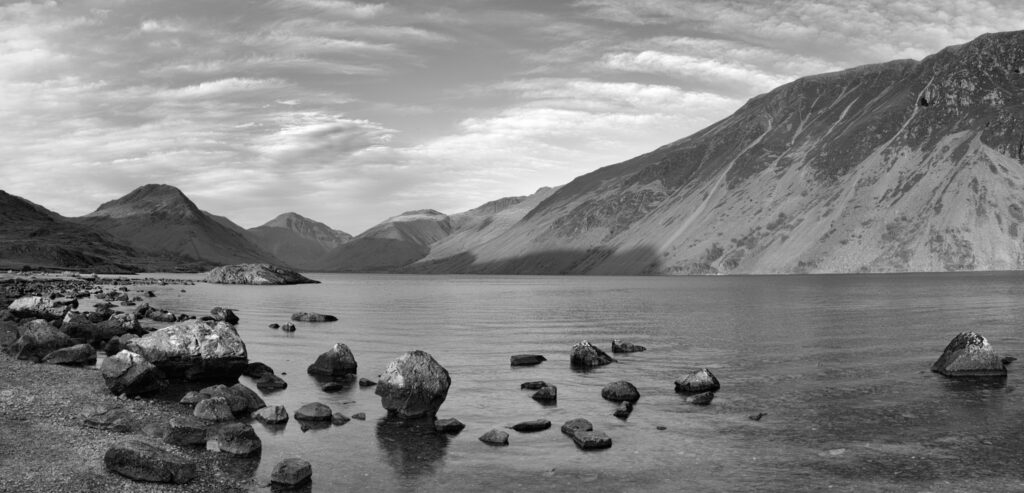
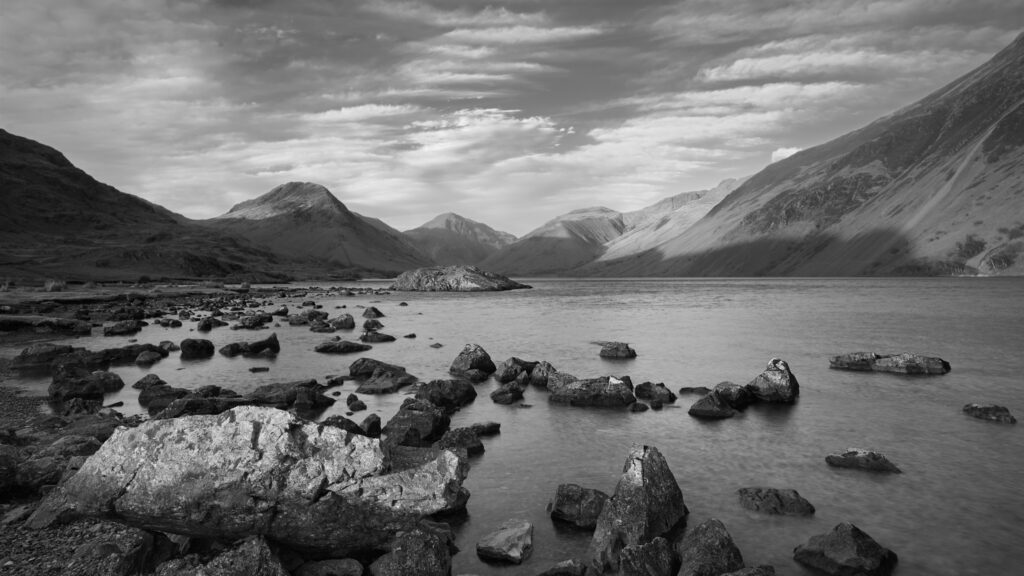
    I stayed at Wastwater for several days and the conditions of that one evening didn’t repeat.  I did get other nice photographs but those from that evening are my favourites.  Whilst I do like the colours in the above photograph, I also really like black & white landscapes too.  They simplify the image removing the distraction of colour.  Actually, the more I view the black and white version the more I think I prefer it to its colour counterpart.

    Wastwater No. 4
    Wastwater No. 4

    The 2018 photographs were captured using a Sigma 50mm or Zeiss 21mm lens attached to an EOS 5DsR body.  The detail captured by a 50M pixel sensor cannot really be appreciated until the images are seen at a good proportion of their full size.  So, I urge readers to click on the images and view a larger, but still pretty small, version.

    After spending a productive few days at Wastwater, there is still some photographs that I’d like to make but those need to wait until the Autumn when the setting sun again returns to an azimuth angle suitable for what I have in mind. 🙂  Below are a couple of further photographs.

    Wastwater No. 6
    Wastwater No. 6
    Wastwater No. 3
    Wastwater No. 3

    Andy


    All images are Copyright Andy Gawthrope Photography.
  • Marloes evening

    Marloes evening

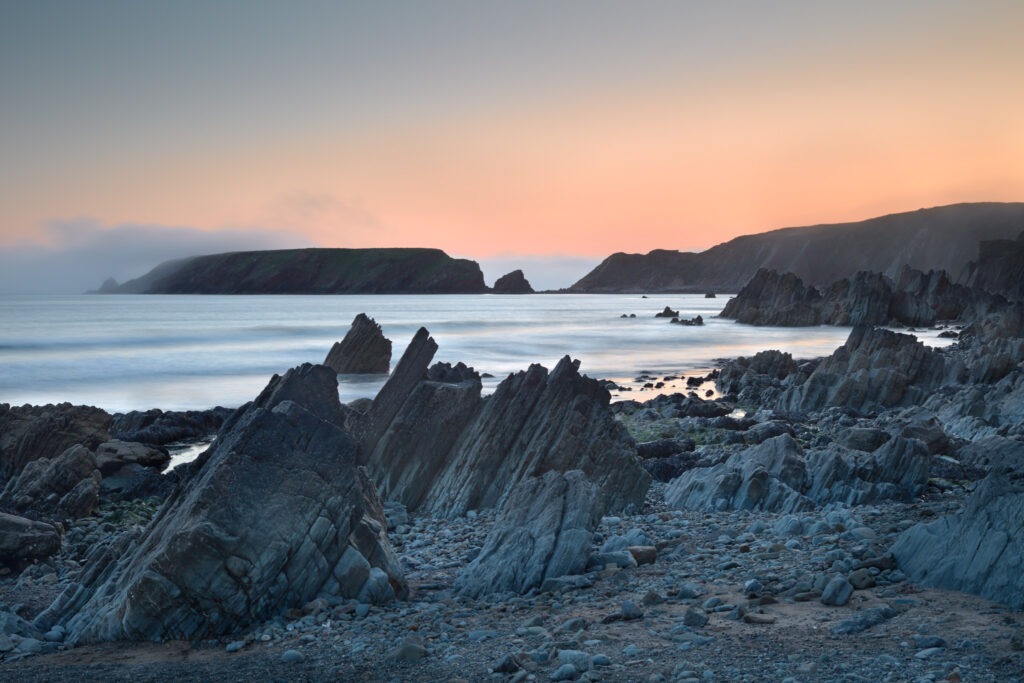
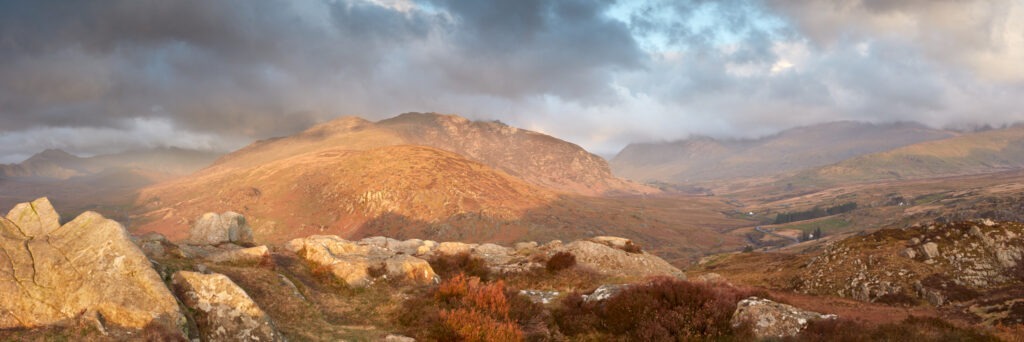
    The first weekend in May is a three-day public holiday.  Mainland England and Wales were basking in strong sunshine under blue, cloudless skies – Not the sort of light that normally inspires me.  However, the coast in Pembrokeshire was forecast to have a few clouds.  That sounded more interesting and had the potential for some nice evening light. 🙂

    During the drive from home the temperature was consistently about 24 degrees Celsius; I was wearing shorts and a tee-shirt…  I arrived, to find the coast covered in sea fog!  Moments after arriving I was wearing trousers a shirt and fleece top! It was 12 degrees 🙂

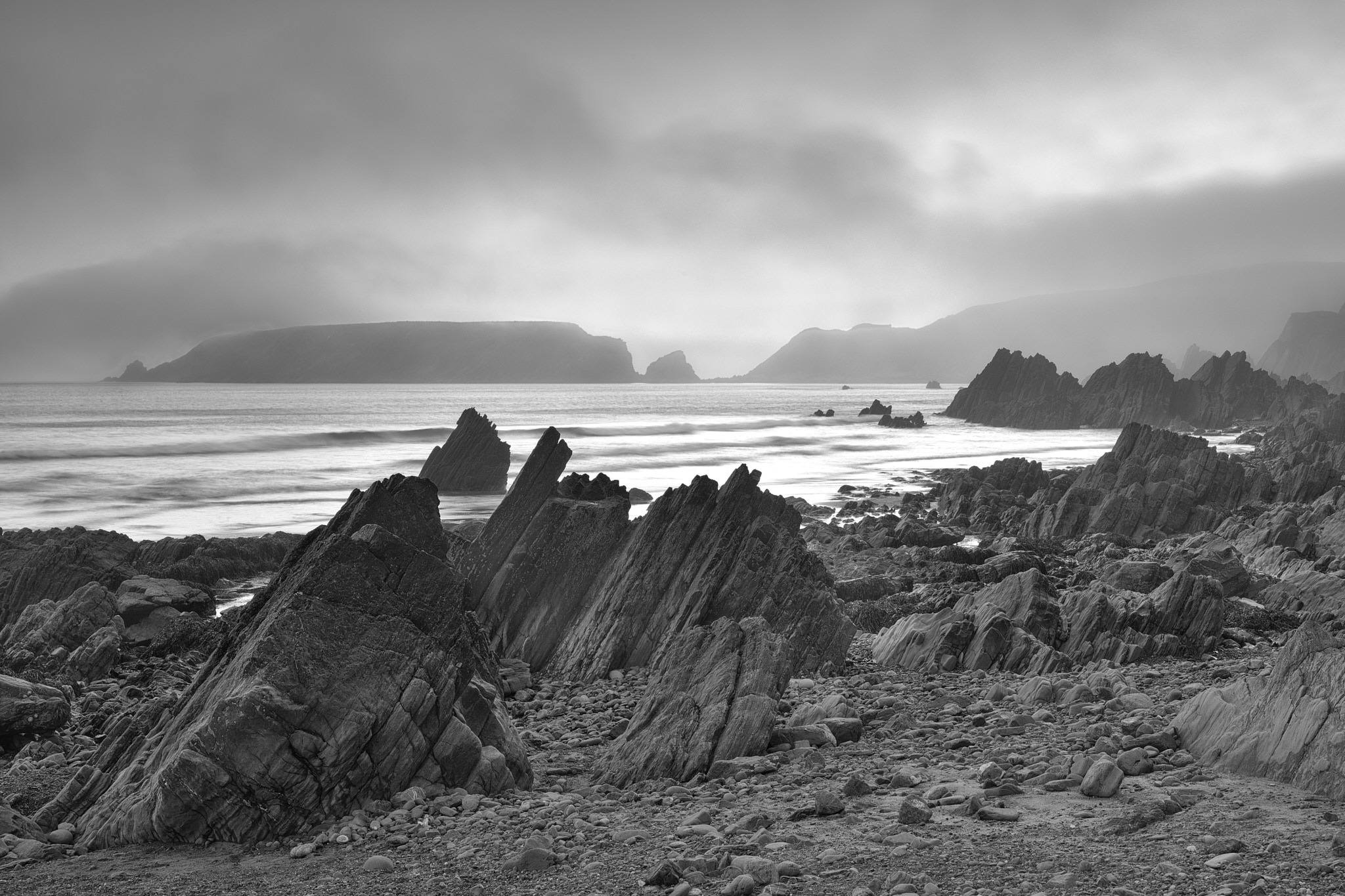
    Marloes Sands is a long sandy beach with rocky outcrops on the Southern side of the Pembrokeshire coastline.  Its a lovely spot with large rocks that protrude through the sand and have the potential to look great in soft evening light… I knew it was late in the season, but the tide was about right so worth a punt!  Nothing ventured – nothing gained and all that.  As it turned out, it was a little late as the sun set a little too far to the North so the rocks that are grey/black in colour dropped into shade earlier than I’d have liked.

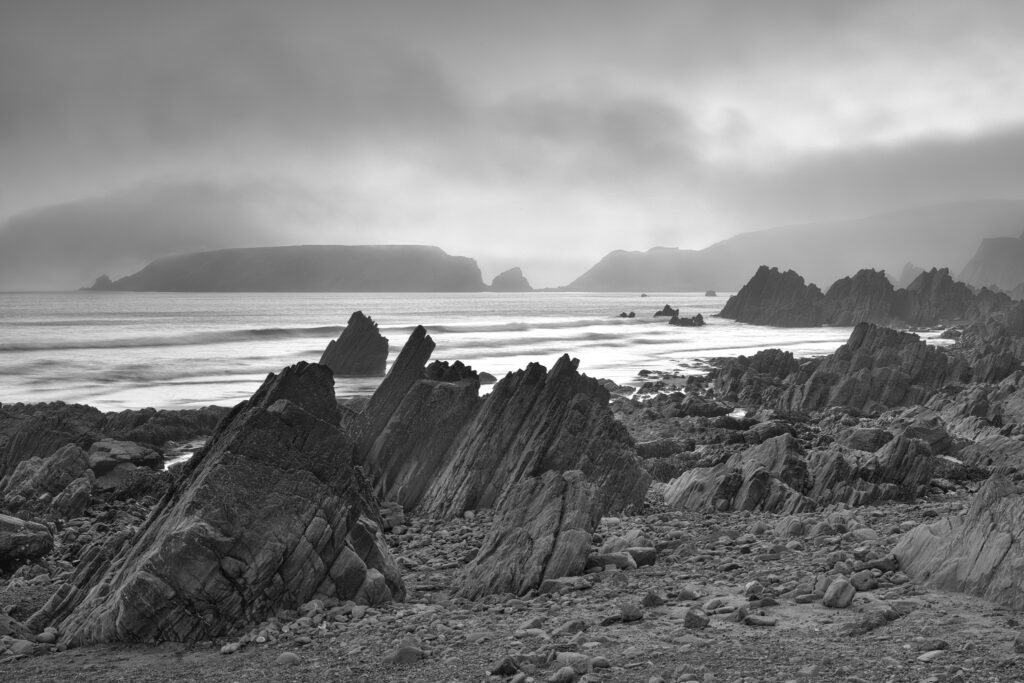
    But the fog, now that was a problem 🙁  It wasn’t the thin sort through which the sun would shine; this was thick and totally obscured the sun.  A couple of hours before sunset I headed over to the beach and was relived to find that whilst the North facing coast was under thick fog the Southern side was starting to clear.  But it was still cold and I wished I’d brought more clothing.  The first image was captured soon after it started to clear.  By the time the sun set, the sky was almost completely clear and the residual cloud/fog resulted in a soft orange glow in the Eastern sky.

    Marloes sands
    Marloes sands

    Not long after the sun set I returned to the camp site on the Northern coast where I was staying.  It was still completely encased in fog!  Marloes Sands faces South and is a location for late afternoon/evening light depending on the time of year.  Its not a morning location.  The following morning dawned still in thick fog and cold.  The weather was forecast to deteriorate by evening so I returned to Bristol in search of fairer weather.  A mile inland the flog broke and I returned to blue-sky, sunshine and warm temperatures 🙂

    Andy


    All images are Copyright Andy Gawthrope Photography.
  • Avebury in snow

    Avebury in snow

    I’m writing this sat outside under the shade of a pear tree, its 26 degrees Celsius, cloudless and the hottest day so far this year.  What really makes it unusual is that it’s a Bank Holiday Monday also known as a public holiday here in the UK.  Its tradition that Bank Holidays are always wet and windy.  Something is very wrong!

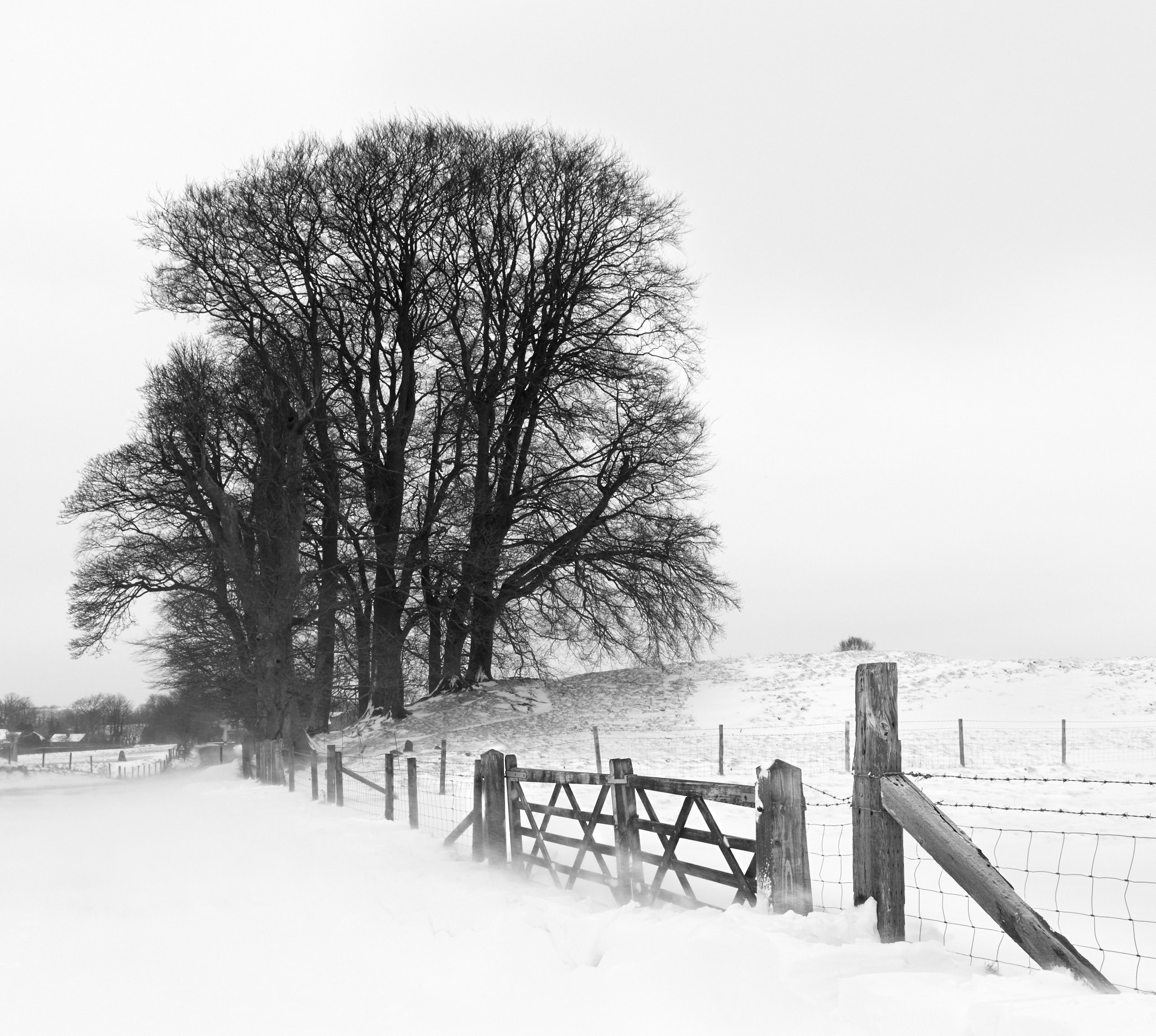
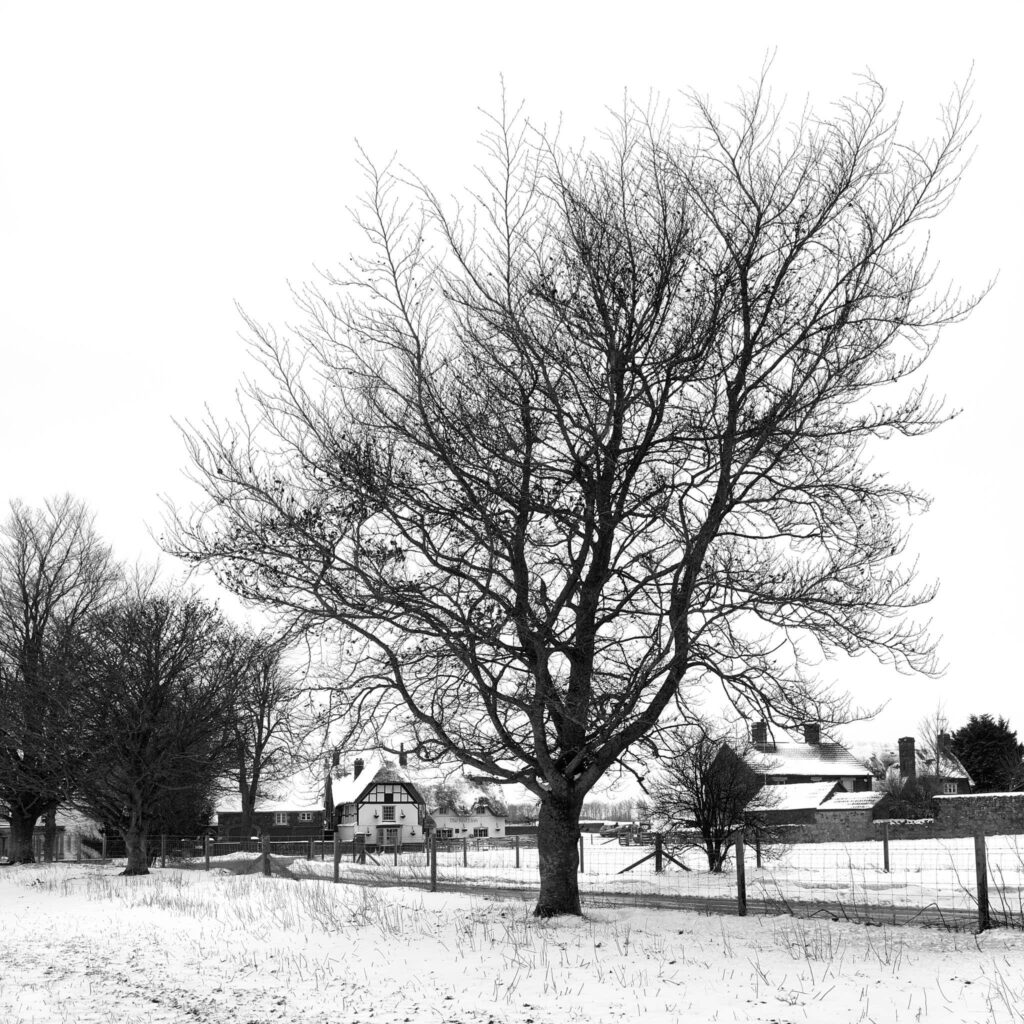
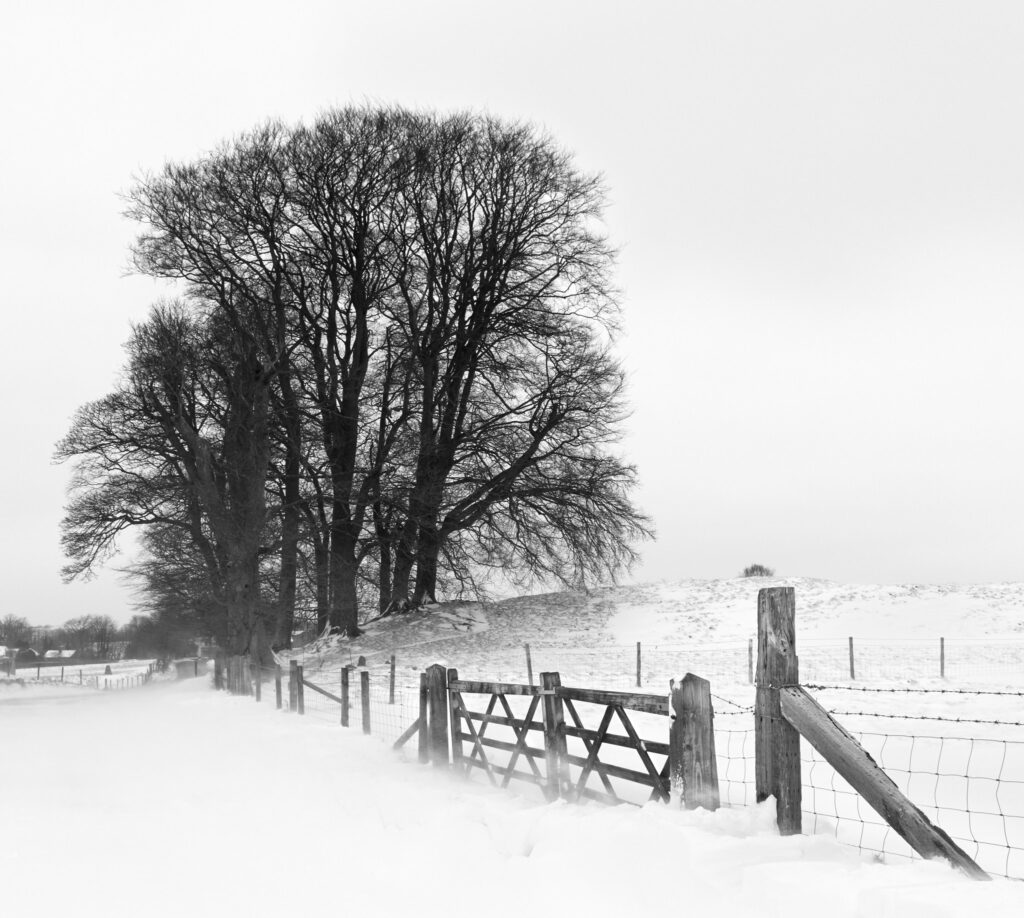
    Not so very long ago the weather was very different. Sub-zero temperatures, snow and wind!  Ah, the British weather 🙂  On one morning the sky was white, the ground white and little colour.  Perfect photography day!  A day for black and white 🙂

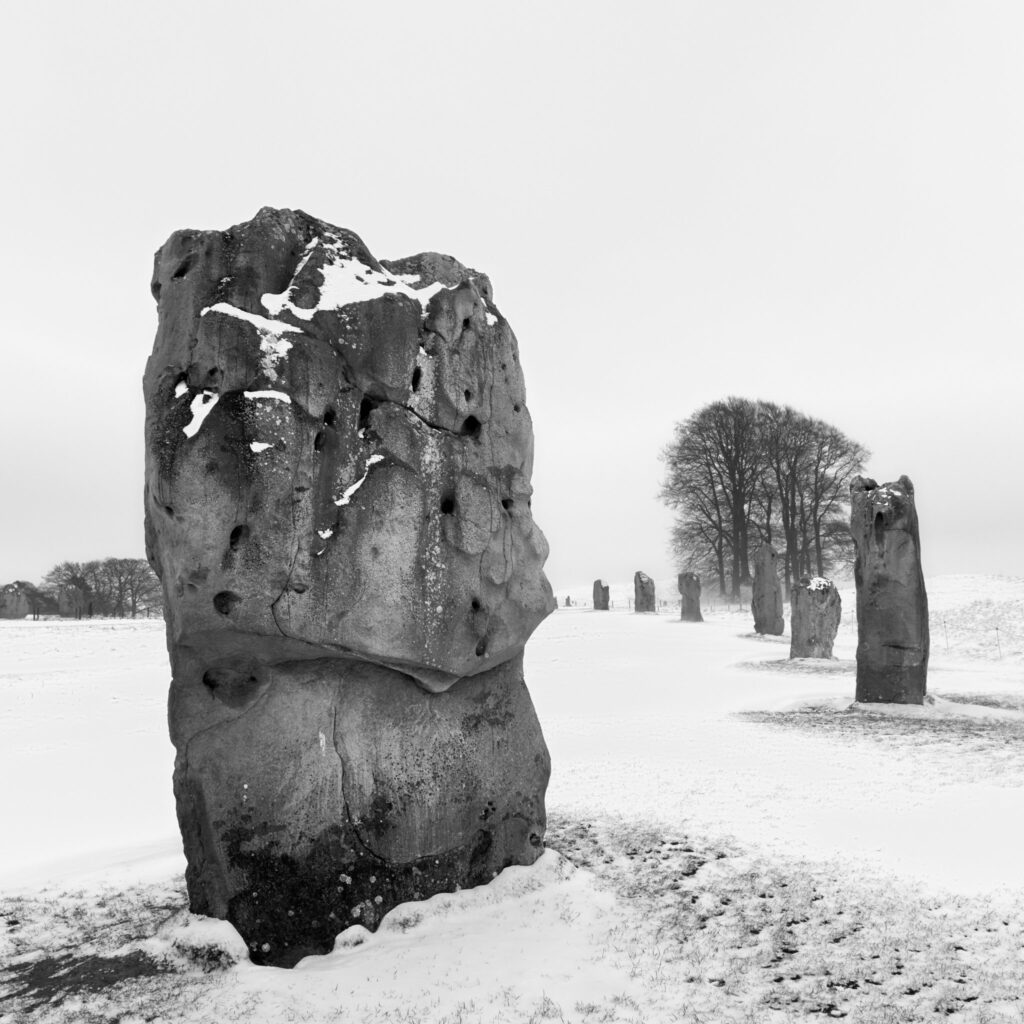
    Avebury stone circle is a Neolithic (stone age) bank, ditch and stone ring enclosing a further two rings.  The outer ring is a little under 350m in diameter.  On such a monochrome day big dark stones set against a carpet of white seemed like the perfect shoot and a nice place to spend a few hours.

    Avebury stone circle
    Avebury stone circle

    It was obvious tho, that it was going to be cold, bloody cold, standing around in those conditions as we photographers do.  Suitably clothed and equipped with a thermos of hot coffee I headed off.  The major roads had been cleared, but the smaller ones in Wiltshire were still covered in their snowy blanket.  A few cars had been brave or foolhardy enough and ventured out, but thankfully, the roads were quiet and, this time, I didn’t get myself stuck in the snow!

    Avebury is managed by the National Trust and they have a little car park just beyond the outer ring.  When I arrived the gate was open, I drove in and parked.  The National Trust don’t usually miss an opportunity to collect visitor fees and I was mildly amused that, on this occasion, the weather had got the better of them. 🙂  From the car park its a short walk to the rings and I cut fresh tracks down the little footpath linking the car park and village centre.

    Two small roads bisect the outer ring dividing it into quadrants.  The South-Eastern quadrant retains some nice stones and its to there I went.  I envisioned a photograph that captured the stark detailed shapes of the stones set against the white of a snowy day; something eternal as the stones have been there for thousands of years and seen many a cold, wintery day.

    Red Lion pub, Avebury
    Red Lion pub, Avebury

    Its not my first visit to Avebury and knowing a location, any location, greatly helps as available time can be spent concentrating on photography rather than hunting photographs.  I knew of this stone, with its glorious pock-marked surface and bands of weathered stone.  It made the perfect subject and I chose to contrast its wonderful surface and bold features against the drifting, snowy background.  It a stone I’ve photographed before and will probably photograph again!

    Almost as famous as the stone ring is the Red Lion Public House which lies at its centre.  The building was constructed around the year 1600 and thus postdates the Neolithic site by about  4500 years!  First licensed in 1850, it has a lovely straw thatched roof and a 26m deep well; its definitely worth a visit 🙂  That morning it looked very olde-worldly covered with snow so I couldn’t resist a photograph.

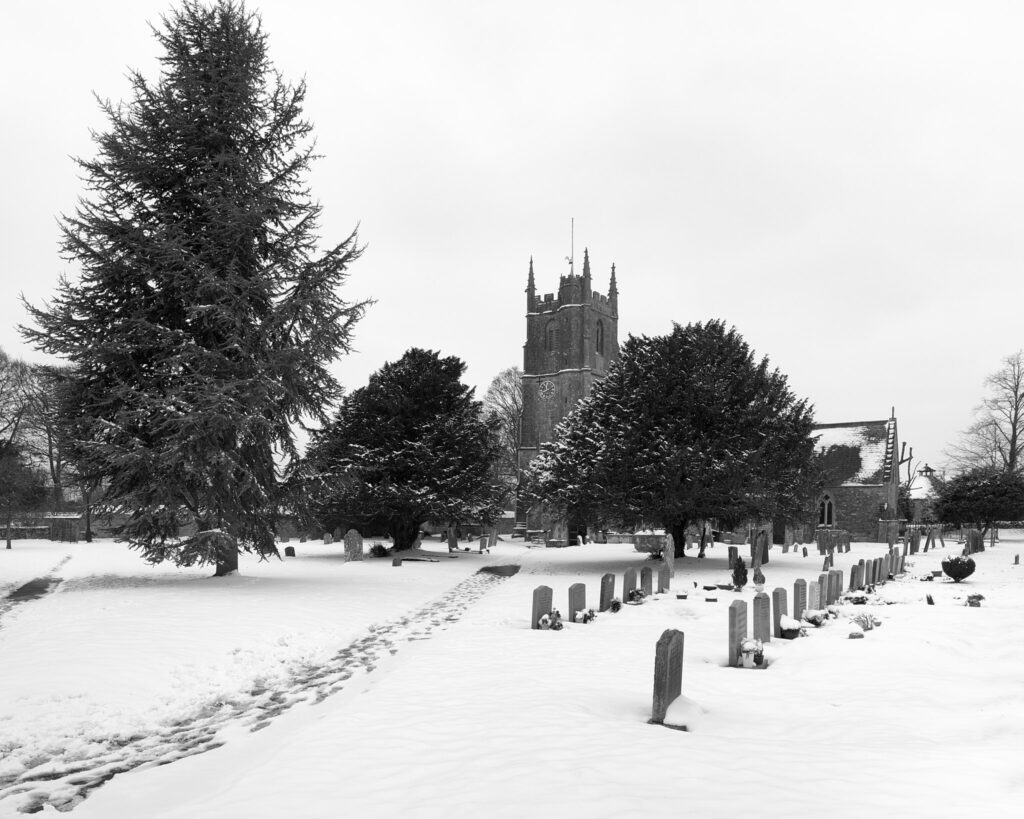
    Tucked away a little to the West of the Red Lion is the little church of Avebury.  It predates the pub by several hundred years!  Thought to have been constructed around the year 1000 it has seen much alteration over the subsequent centuries.  However, it still retains its Anglo-Saxon nave although later altered by the Normans.

    Avebury Church
    Avebury Church

    My visit to Avebury was on a Sunday and it was late-morning before I strolled into to the church grounds.  The Avebury parishioners had obviously been there before me and left their mark.  But I think the footprints on the path bring a reminder of life to what could be a deathly photograph of church and gravestones.

    Before leaving home I decided that the objective of the day was to concentrate on shape, contrast and to convey a sense of winter, of cold or Brrr if you like.  I like to think I achieved that.

    Andy Gawthrope Photography is based in North Bristol, UK.  Readers are reminded that the copyright to each image in this post is held by Andy Gawthrope Photography.

    Andy


    All images are Copyright Andy Gawthrope Photography.
  • Light Fantastic!

    Light Fantastic!

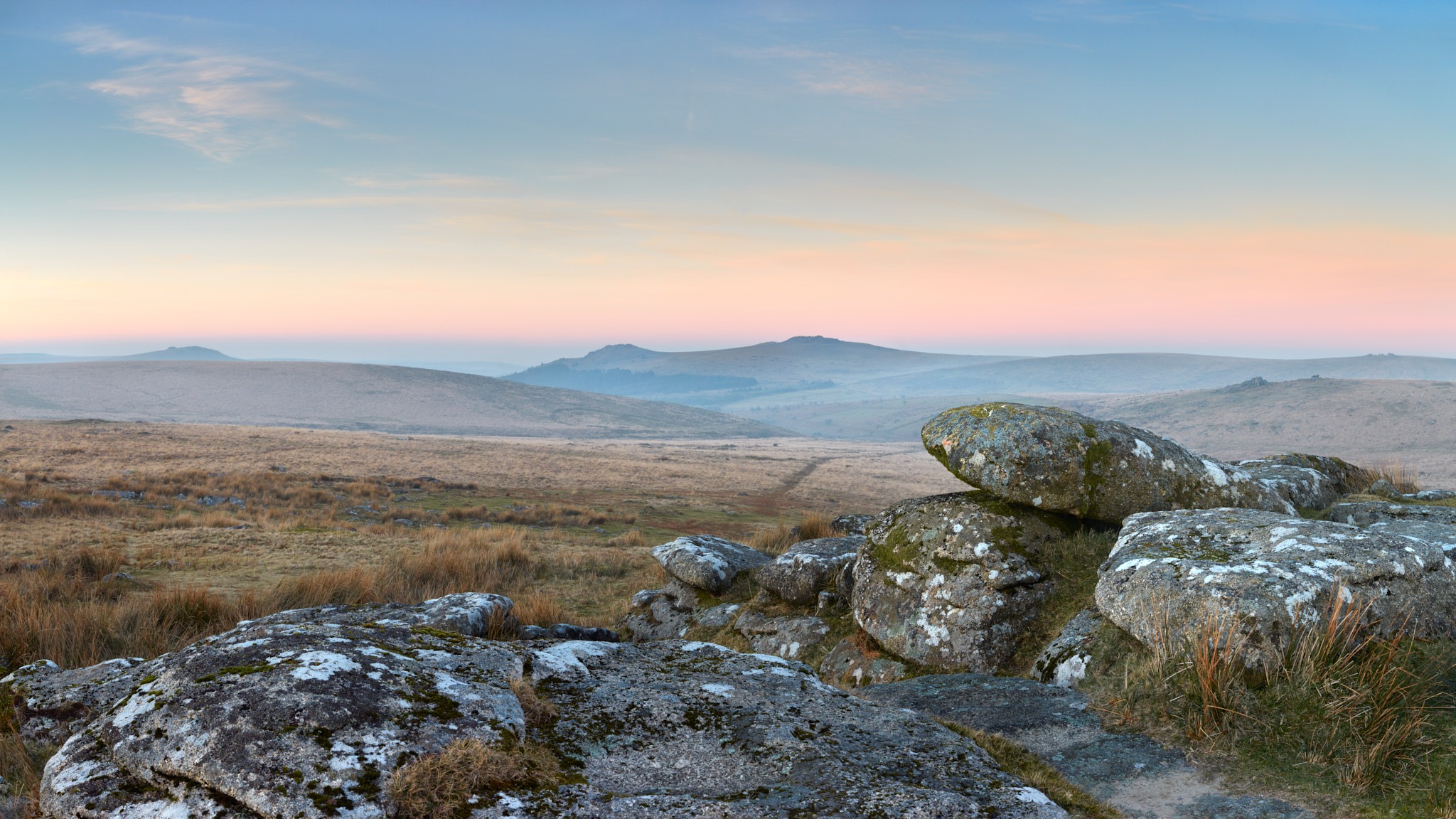
    On my first visit to Dartmoor I recall thinking it was boring open moorland with nothing to make a good photograph apart from the odd rocky Tor!  Well, that was quite some time ago and since then I’ve grown to really appreciate its shapes, subtle colours and rugged looks.  Dartmoor is, I guess, one of those places that grows on you. 🙂  Nowadays its one of my favourite places in England.  Its like a wild animal – for days it will be warm, friendly and accepting then for no apparent reason it’ll have your arm off if you’re not careful. 🙂  Its wild, its rugged, its just the sort of place I like. 🙂

    Early last week, the weather forecast looked promising for a visit but from afar you can never be sure.  Dartmoor weather does what it will and pays little heed to the pronouncements of weather forecasters.  My plan was to be on the very Western side of the moor for evening and spend an hour investigating opportunities somewhere I’d not been before – Hayne Down.  But I arrived later than planned, just after midday and four hours before sunset so there wasn’t really sufficient time to investigate the area and to head further West so I chose to stay.

    The weather was lovely; better than forecast and I could see high and thin cloud which I thought would catch the evening light, there was no wind, it was sunny – but not overly so – and warm.  One of the first photographs of the afternoon was North past a pinnacle of rocks known as the Bowerman’s Nose.

    Bowermans Nose
    Bowermans Nose

    The light was still strong and perhaps not in the best position for the above photograph but the low angle of sunlight nicely emphasised the trees and hedges on the distant landscape.

    In my rush to park and commence photography I’d somehow missed the obvious parking near the top of the hill and parked at its base.  Not good.  The hill was much bigger than I had thought and the approach I chose, following sheep tracks, led through some horrible bracken and grass covered rocks that just wanted to twist or break your ankles.  It was an uphill slog with the sun in my eyes.  Note to self – think about your approach more…  Realising the light was harsh I returned to the truck and moved it nearer to the top of the hill so as to make a dark descent through hidden rocks unnecessary and thus a lot safer.

    On returning to the rocks an hour or so later the light was starting to turn and paint the landscape in a wonderful golden light.  Compare the colours in the photographs above and below.  The foreground is different but the distant hills are the same.  The harshness of the light had gone and things were now getting beautifully soft. 🙂

    Hayne Down
    Hayne Down

    That light continued to improve for another hour before the sun finally dipped below the Western horizon at which point all those thin high-level clouds that I thought might catch the light, did so and turned wonderfully pink to the East and yellow and orange to the West.  Even after sunset I was shooting for a further hour. 

    Days like that are what makes landscape photography so rewarding.  Forgotten are thoughts of the lacklustre days when the weather just didn’t cooperate.  It was one of those days when there was no wrong.  It was magic. 🙂

    If you have enjoyed this article please remember to share it with your friends.

    Andy


    All images are Copyright Andy Gawthrope Photography.