It seems an indeterminate time ago now – its early December 2020 as I write this – but over the Christmas 2019 period I spent a week near Lands End in Cornwall and returned with some nice colourful sunrise photographs. However, there were also some typically Cornish days when the fog rolled in from the sea. Some of the photographs from that trip can be found here.
Returning in September I expected different weather, weather that was warmer, drier and that produced more colourful sunsets. Mmm, let’s just say I was a little disappointed… There was, however, a day of fog that made for some interesting images – absolutely not what I’d expected to capture. I’ll also note that the temperature in that fog wasn’t much warner that it had been back in December/January. Chilly and wet.
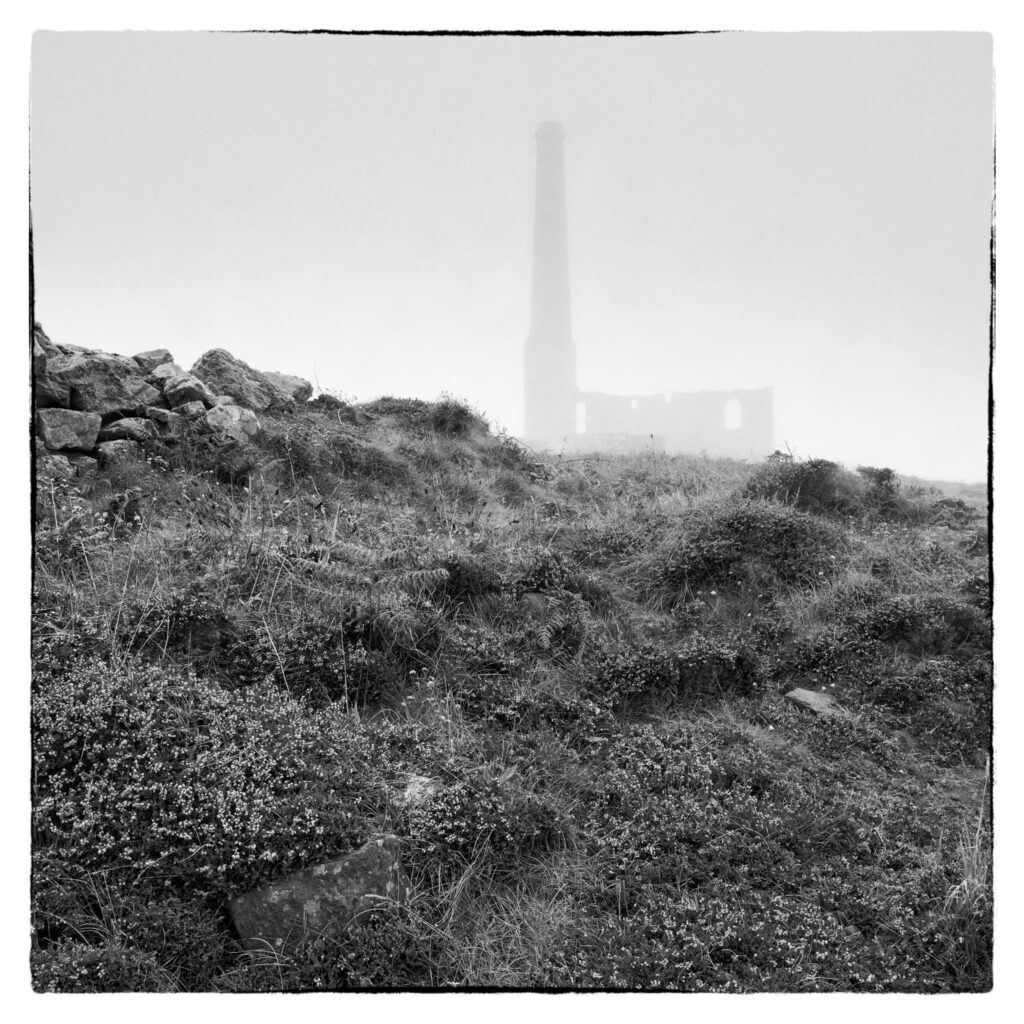
The ground was much more alive with small red/purple flowers than it had been on my previous visit but the fog muted all colour and everything looked very flat in colour images. With the muted colours, shapes became the dominant feature and the just visible outline of the old chimney and ruined power house seemed to scream Cornwall!
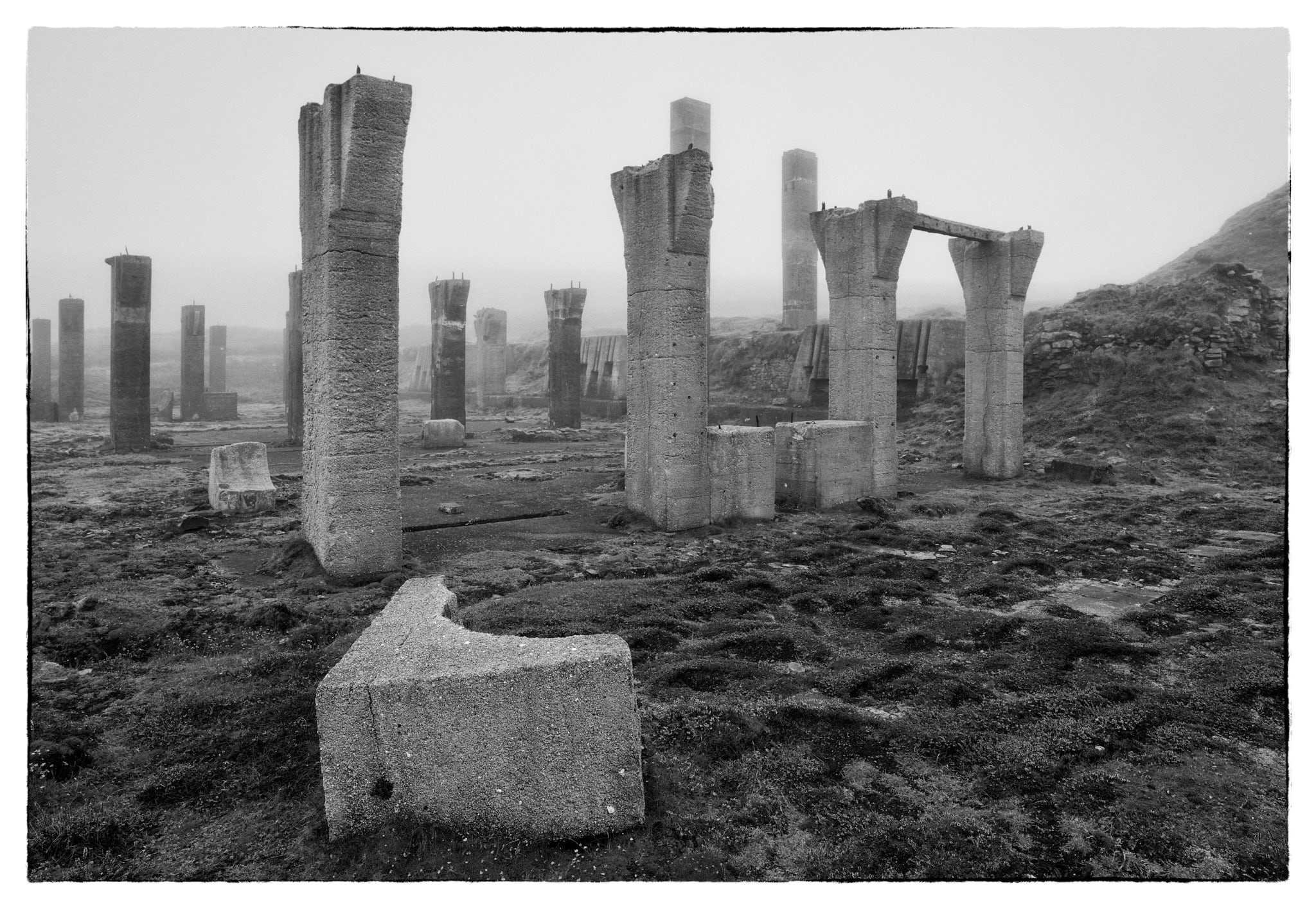
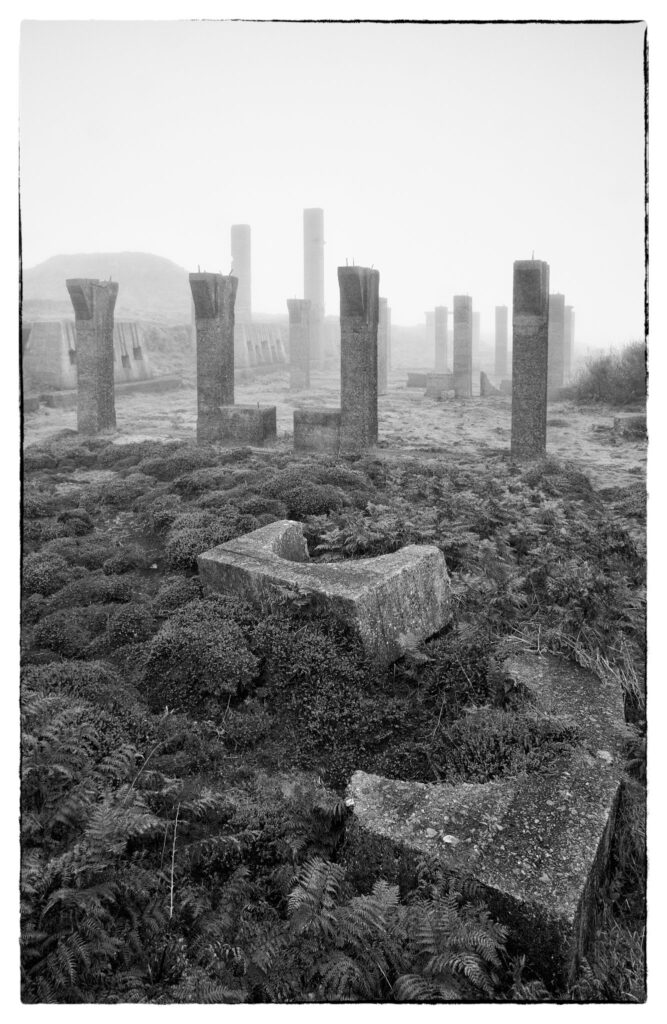
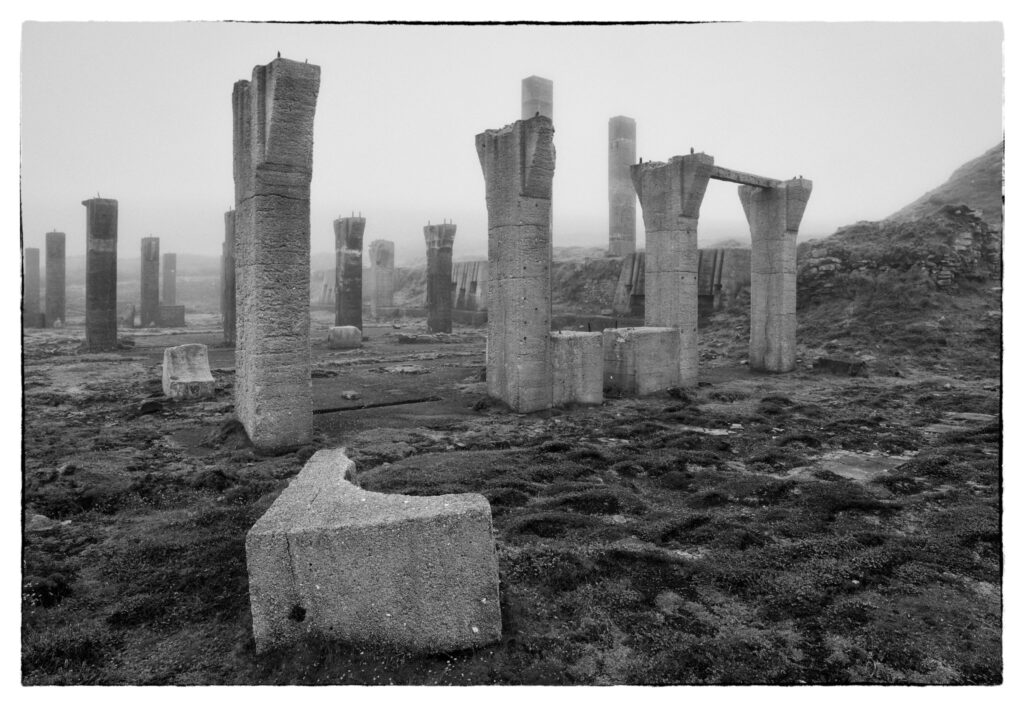
Not far away is a derelict structure whose purpose is a mystery to me. It clearly required massive concrete columns to support something and had big concrete blocks surrounding circular shaped objects. Anyone know what this was? Please leave a message below.
What caught my eye was the regular shapes of the columns all reaching upwards into the fog and how they appeared to stand in isolation like the megaliths of a long forgotten stone age monument.
Andy
All images are Copyright Andy Gawthrope Photography
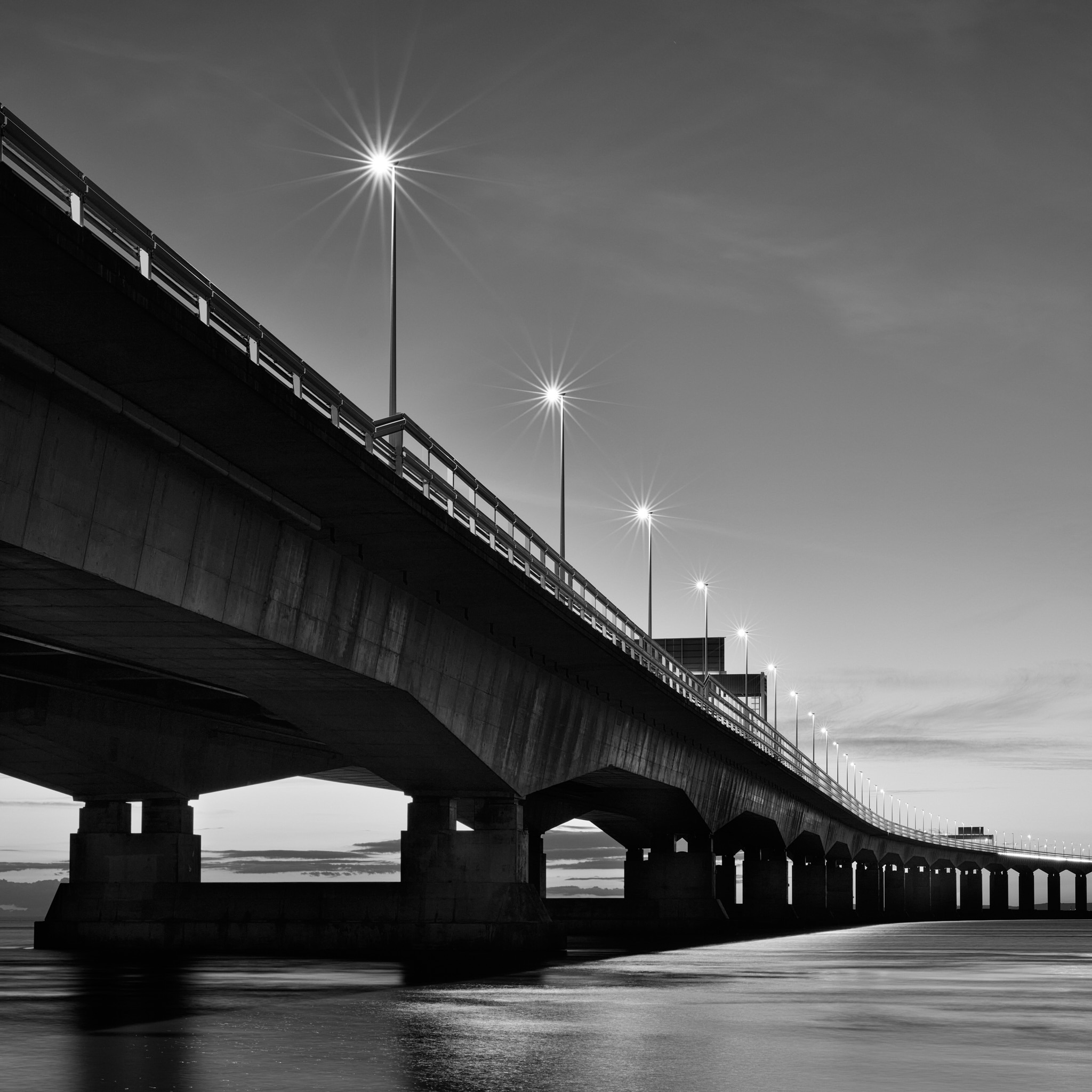
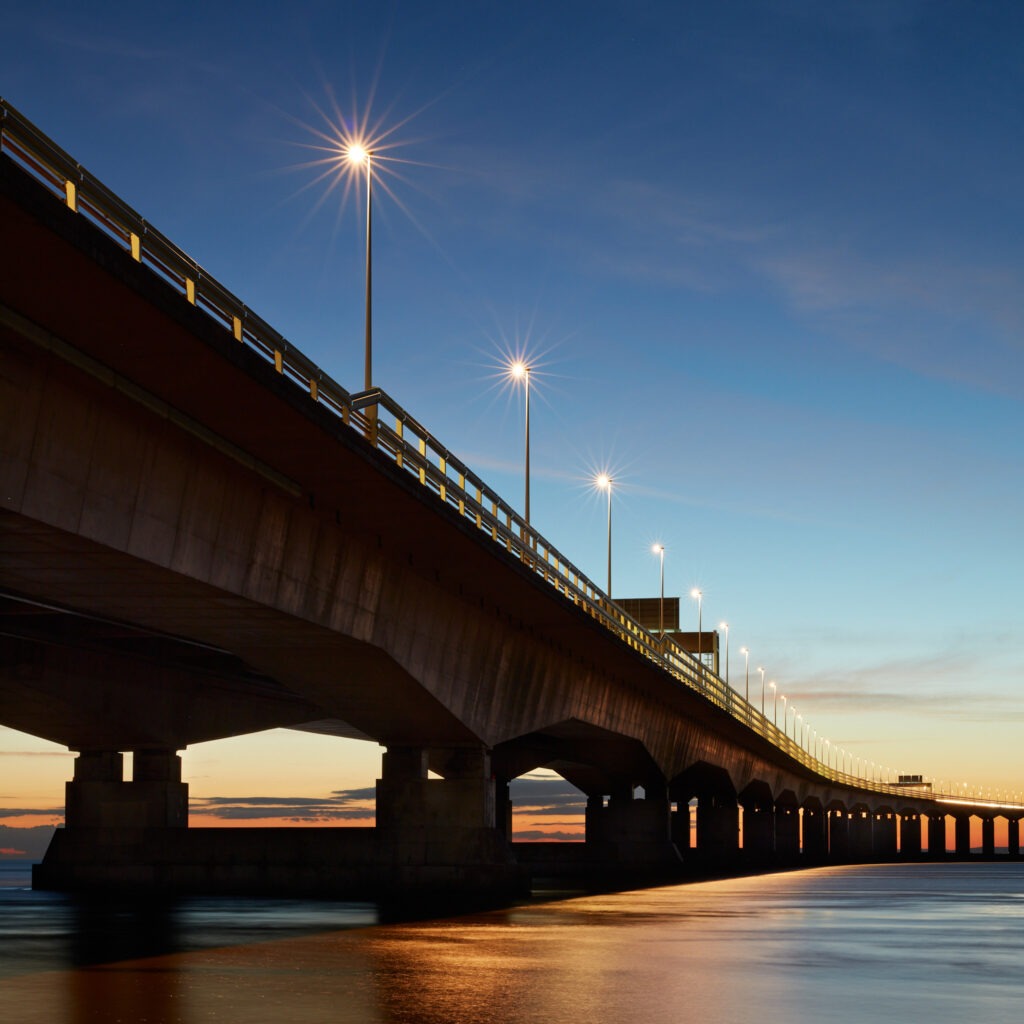
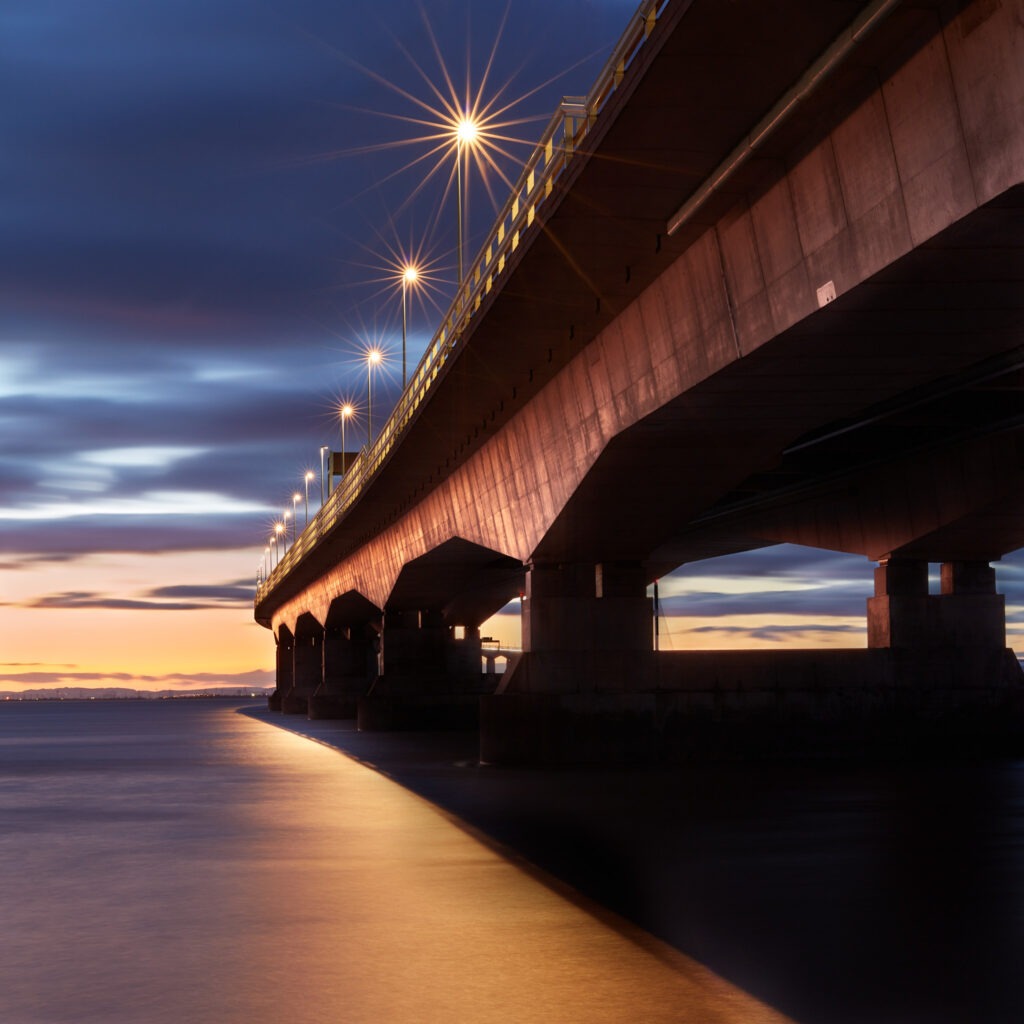
I’m aware a reoccurring subject in my photography is what is now named The Prince of Wales bridge otherwise and more commonly known as, the new Severn bridge or the Second Severn Crossing. In February 2019 I made one of my favourite square photographs but a few months ago I thought I’d have another go but from the opposite side (the North side).
The photograph was pre-visualised as colour and deliberately styled to match my earlier 2019 photograph and side-by-side they make a nice pair. But whilst the colour version is good I really like this black and white version as there are no colour distractions leaving the eye to absorb the bridge and its wonderful, bold shapes.
Below are the colour versions. The first from 2019 and the second from 2020. Clicking an image will open a larger version.
After the doldrums of Summer and its seemingly endless days we have the shorter, cooler and sometimes annoyingly wetter days of Autumn. It’s not just the time when nature again bursts into colour but the change also heralds a return to more variable weather. And here in the UK that equates to a more interesting time for landscape photography.
Now, if I’m honest I find Autumnal photography difficult. Partially as the weather can’t make up its mind what it should be doing, it can be very changeable, but also because I just never seem to be in the right place at the right time to capture those iconic Autumn landscapes that others seem to find so easily. This year I am more minded than ever that Autumn photography or to be a little more precise, Autumn woodland photography is hard and its really important to know of nearby locations.
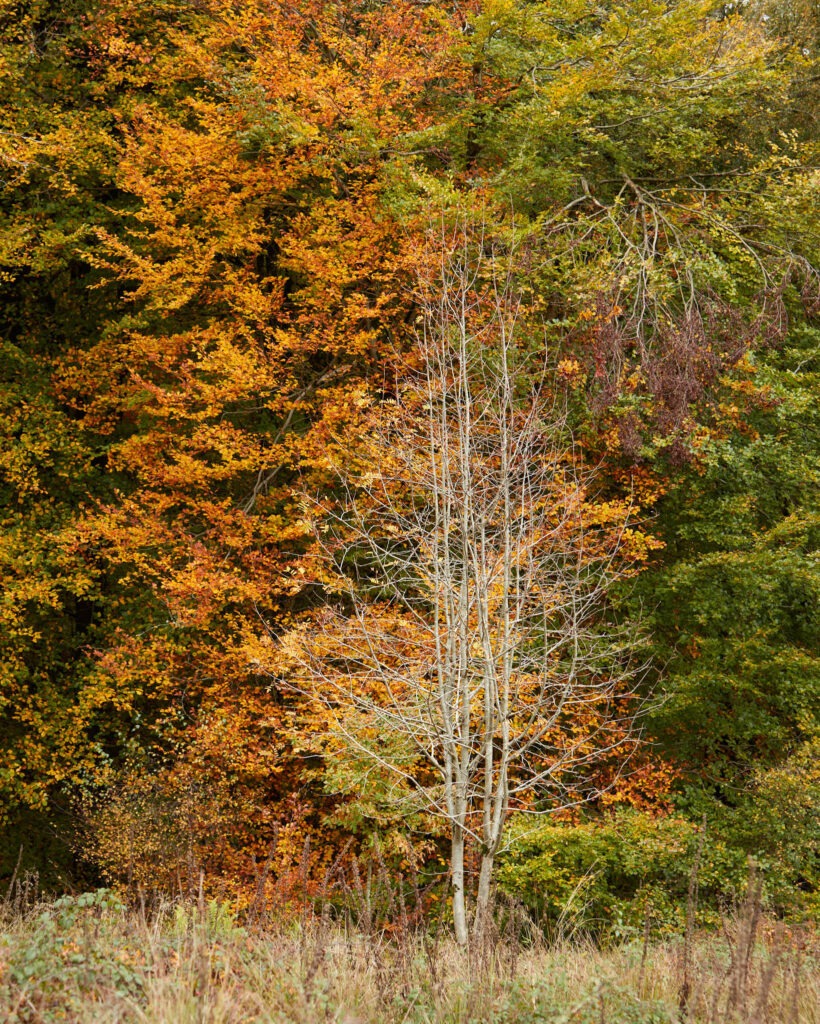
Now, I like my work to be original; I like to avoid repeating what others have done. Yes, sometimes I have taken that classic but I’ve always tried to do something a little different and to not copy. So, whilst I know that arboretums around the country will have wonderfully colourful Maples I just don’t want to photograph what someone else has done that day, the day before and so on. Any quick look on social media will find literally hundreds of near identical photographs of the same tree from the same position. I need something more original, something a bit more wild! To me photographing at an arboretum feels…well, how I imagine a wildlife photographer would feel photographing big cats and elephants at a zoo rather than in the wilds of Kenya. I am merely expressing that we, as photographers, need to be cognisant that whilst a local arboretum visit may be quick, easy and result in wonderfully colourful images they are unlikely to be original.
Sticks and Trees
So, avoiding the temptation of arboretums, I made a concerted effort this year to explore somewhere not far away, somewhere I really should know much, much better. The Forest of Dean is about 15 miles away and sits between Chepstow and Ross-on-Wye on the Western side of the river Severn. I’ve been a few times before without success; I always seem to be in dense forest separated by forestry tracks where one can’t get enough distance from a subject and the ground is dark and uninteresting. So this year I started by thinking carefully about why previous trips hadn’t worked and what I could do better. Pretty soon it dawned on me that you have to find the right type of trees! Boom, there you have it!
Maps by the Ordnance Survey identify three different types of woodland: Coniferous wood, Mixed wood and Non-coniferous wood. It’s the latter two which will have nice colourful trees. Obvious really! Those little tree symbols are not just randomly placed on the map either…their spacing can be used to infer the density of the woodland and woodland that isn’t too dense is better I think. 😉 Depending on the age of the map it’s quite possible that what’s actually there and growing doesn’t match the map tho. This risk can be partially mitigated by using recent mapping and cross-checking with satellite imagery tools like Google Earth. But I don’t think you can be sure until you have boots on the ground!
The result of better preparation, was that with the exception of one, all the area’s visited were much more suitable and even had the right type of trees!
Rooted, Tall trees
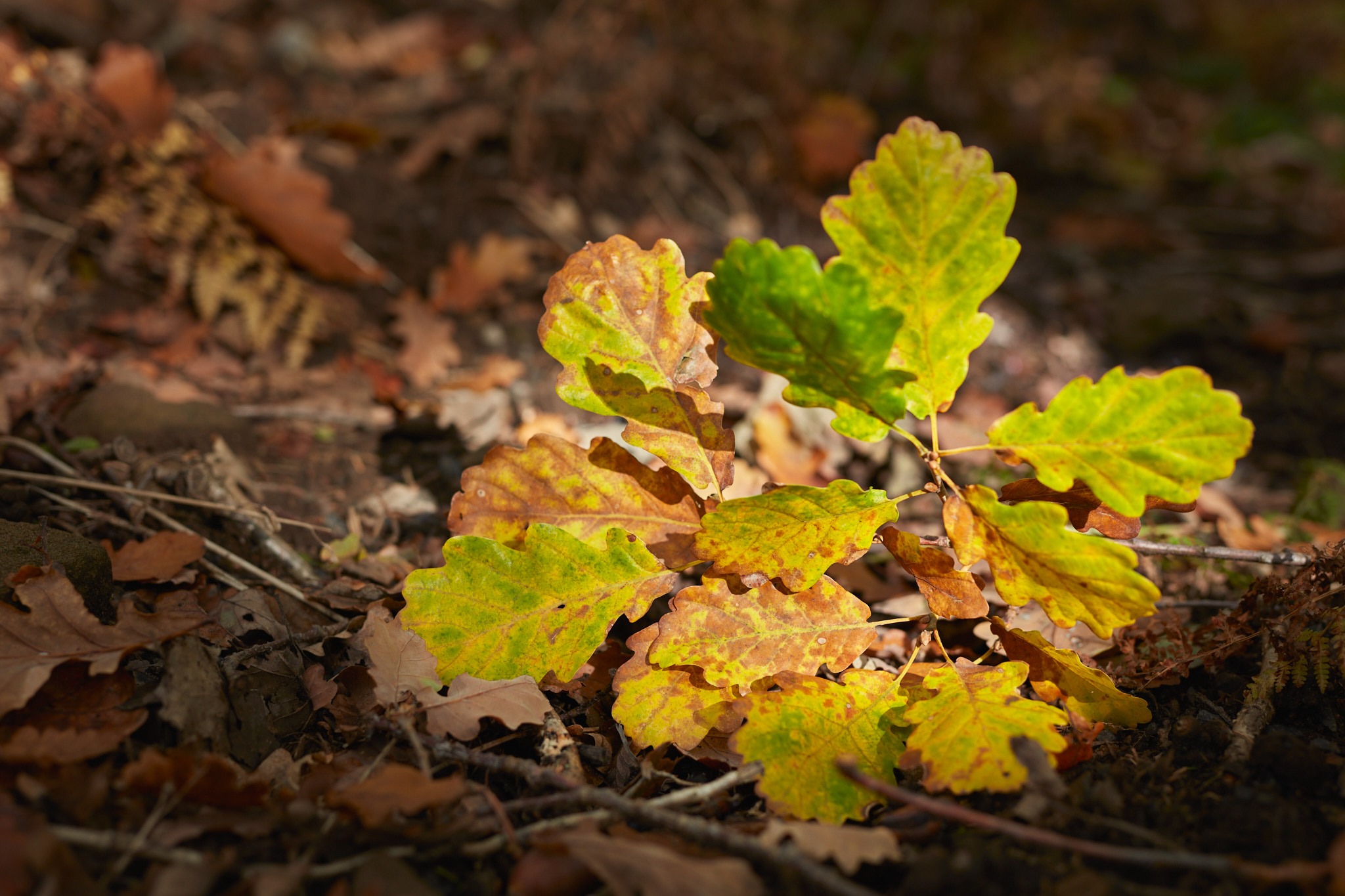
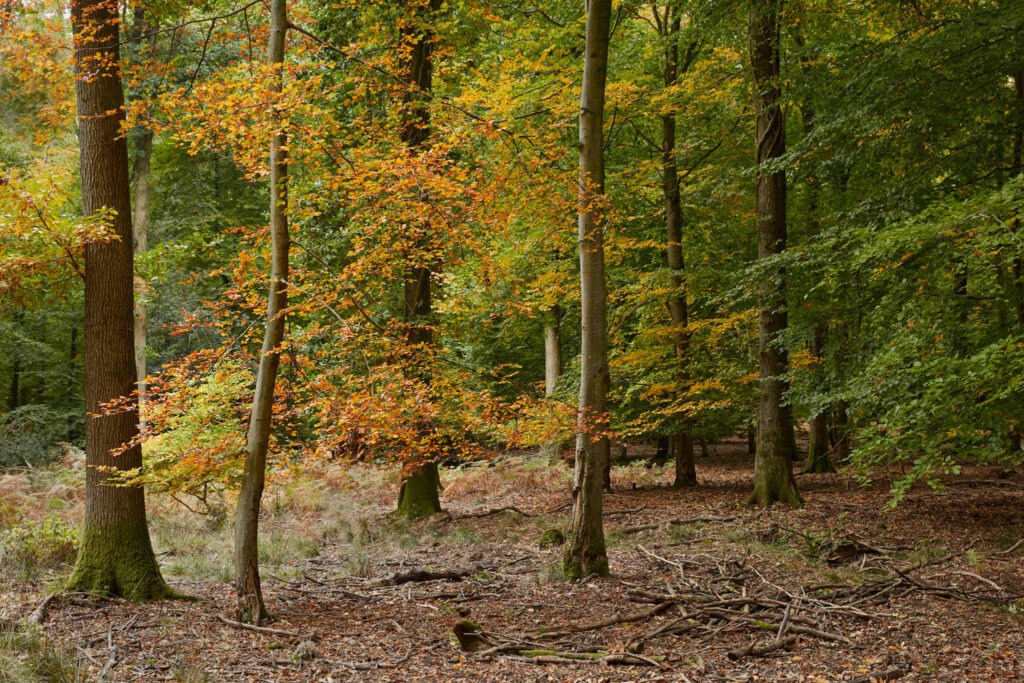
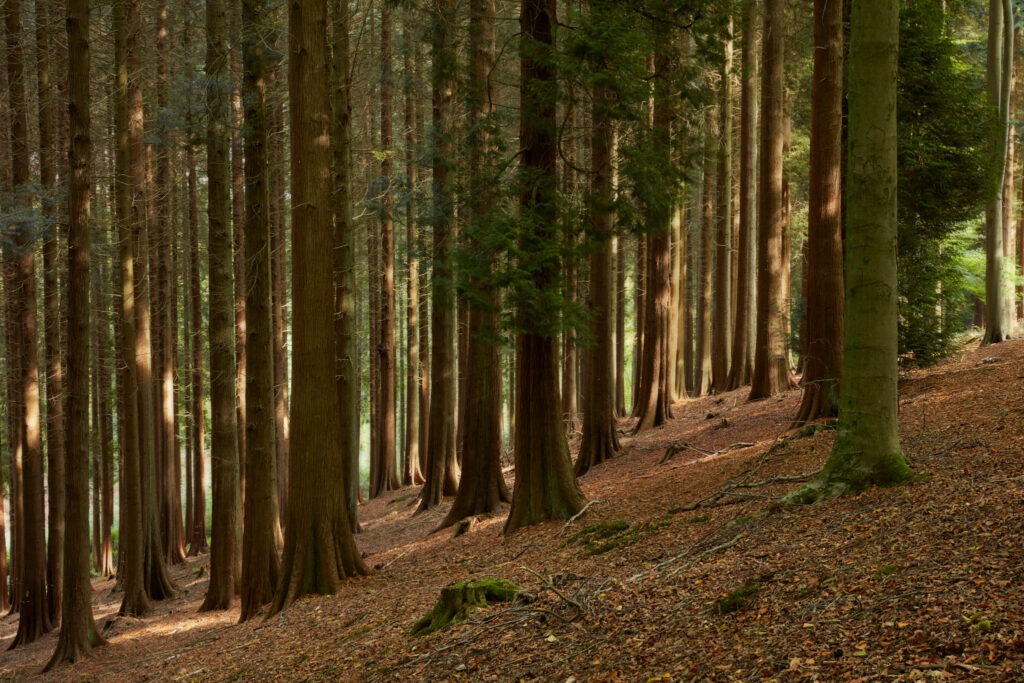
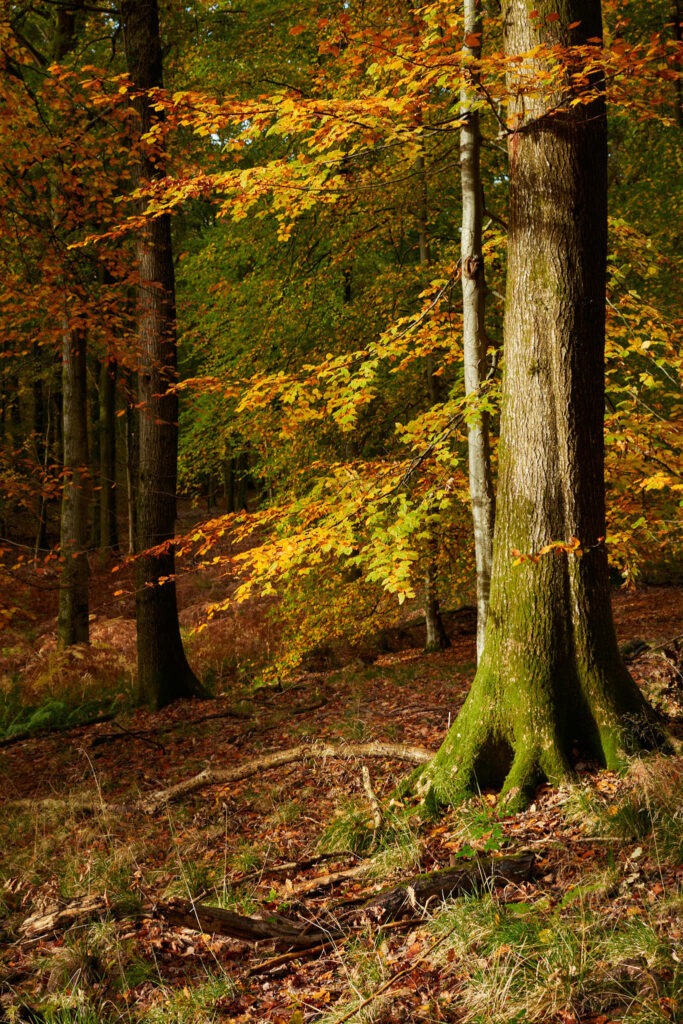
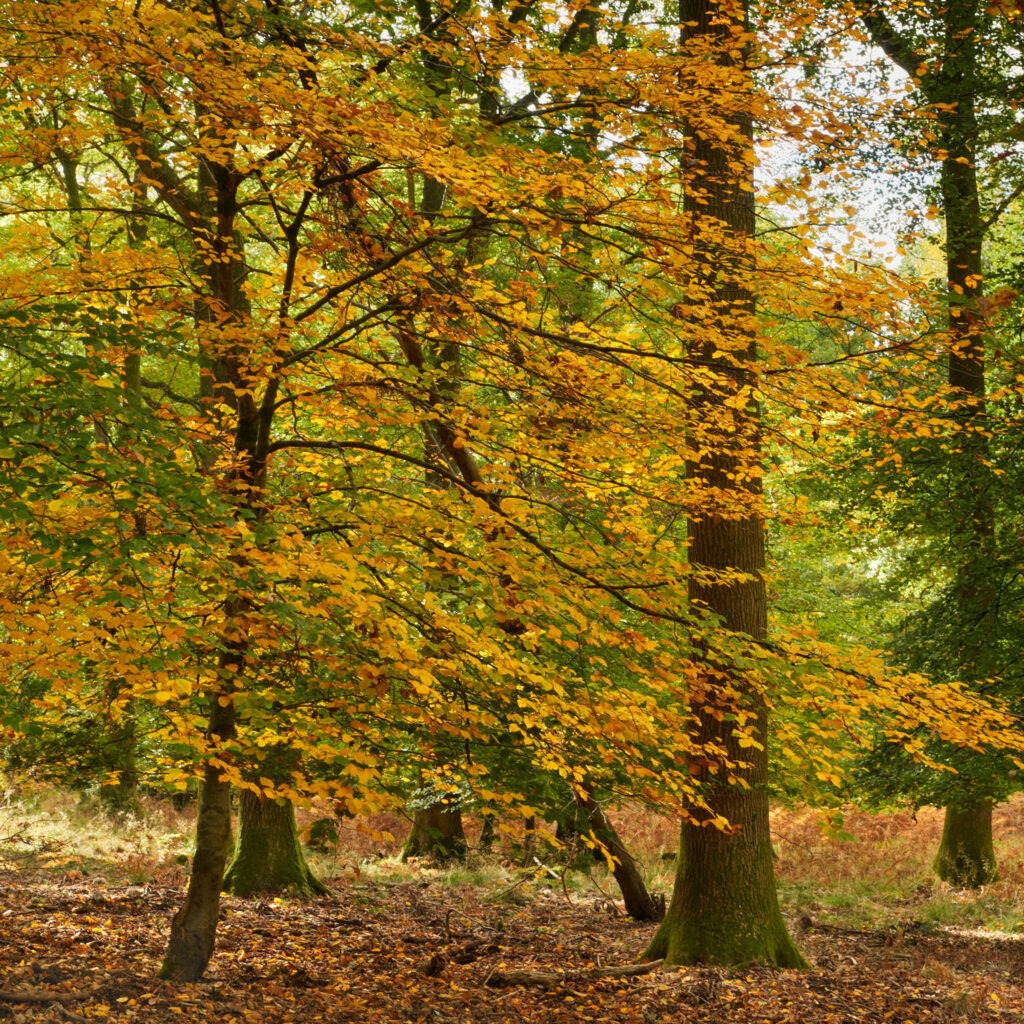
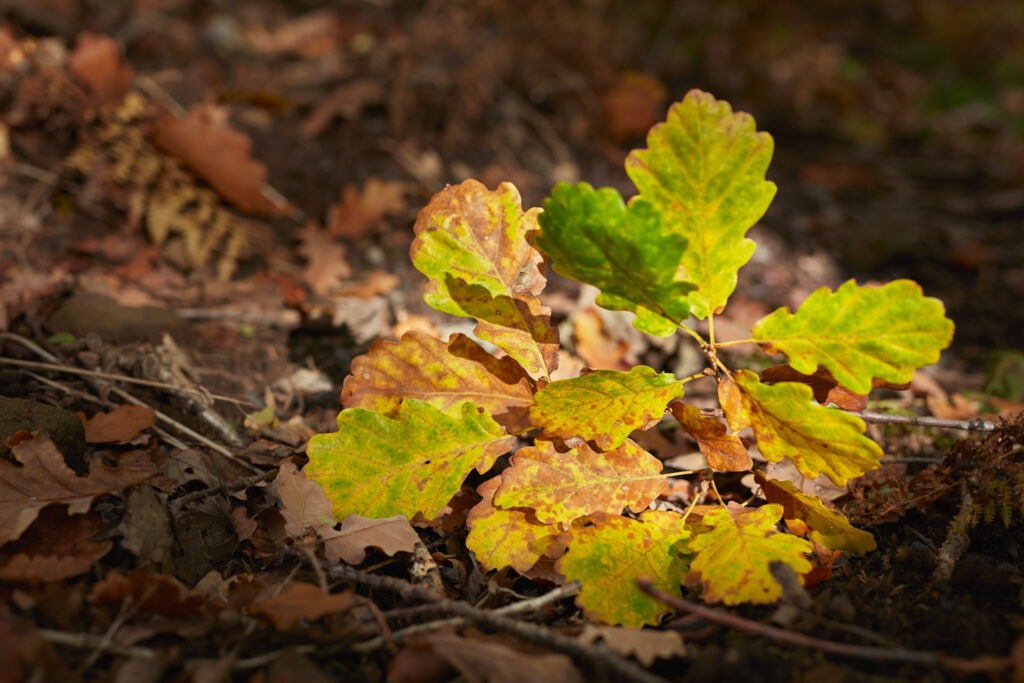
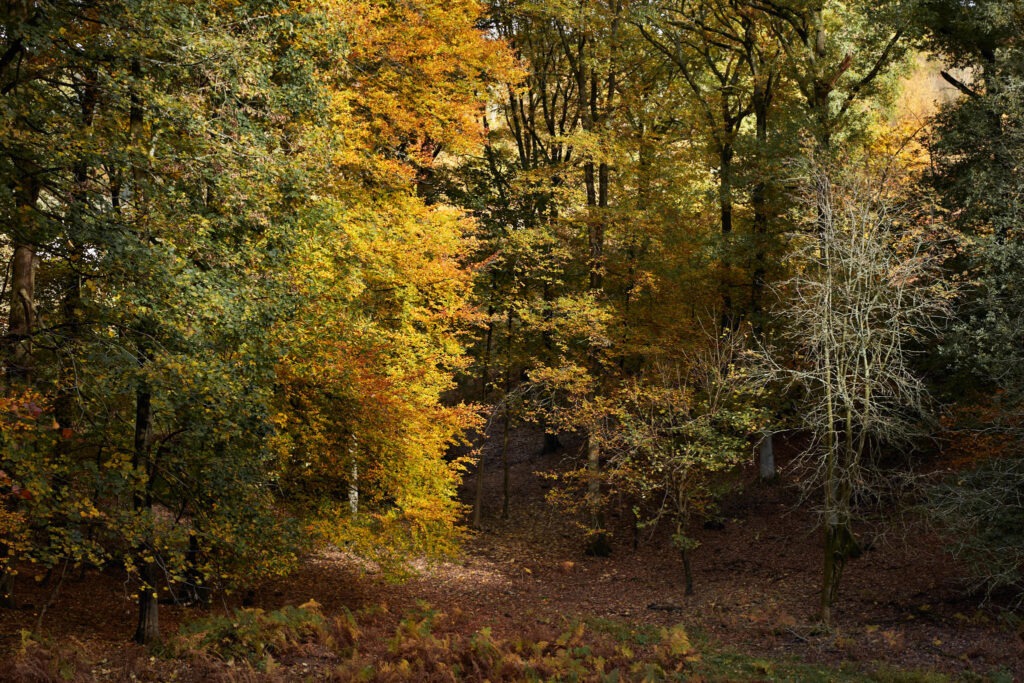
Still, significant exploration was required at each location but the more I explored the more positive I felt and the more I started to see the landscape around me differently. One afternoon I walked to the top of a rise to find a group of uniformly tall, straight trees and the sun streaming in from the side. It was a lovely scene (above). I also found I was seeing the smaller, intimate, landscapes such as the Oak Leaves (top) which were briefly lit by a shaft of sunlight.
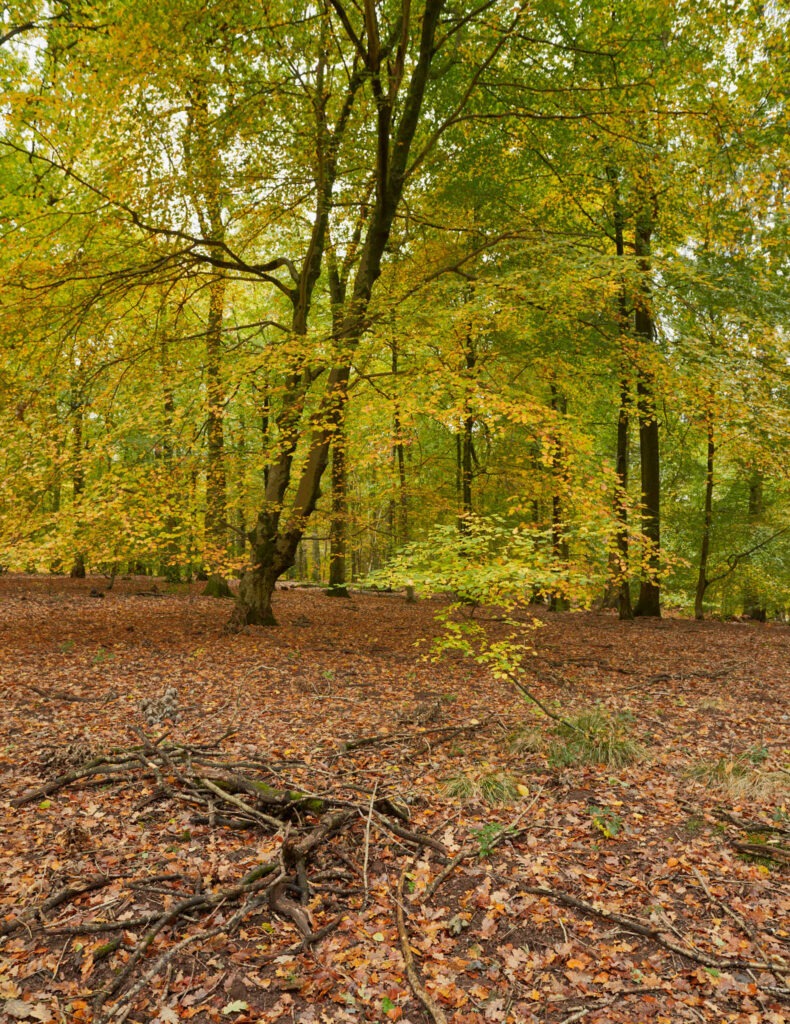
In many places, the forest floor was also interesting and very different to that seen in previous years. It was almost as if the soils had been turned and separated. The ground was pleasant to walk on; it was soft and, well, spongy! In places the fallen branches and sticks where pushed together into what might be described as clusters or groups. It was not orderly enough to be the work of man but something appeared to be lowering the entropy of the forest floor. The area is known for its wild boar and I just wonder if it was them rooting through the soil, pushing sticks aside etc. I never did hear or see any boar tho. 🙁
The Forest of Dean aka The Forest covers a large area and I visited less than a handful of locations this Autumn, some locations a couple of times. The work to identify further locations can be done throughout the year, perhaps in the summer months when things are traditionally quiet. So, roll on Autumn 2021. I know where you are and I’ll be back 🙂
Below are eight photographs from the Forest of Dean this Autumn. Click on an image for a larger version.
All images are Copyright Andy Gawthrope Photography
Snowdonia is great as it has ‘real’ mountains! ‘Real’ because they are rugged, craggy, weather beaten peaks quite different from their rolling, greener English cousins. Like all mountains they influence their local weather and so despite visiting a few times since the late winter of 2019 I’ve not been too lucky with the weather. Some trips have had blue skies and zero cloud others total cloud cover. This time tho I was more lucky 🙂
My problem with Snowdonia is there are just too many big mountains packed into a small area separated by deep valleys. This inevitably seems to mean that gaining altitude is necessary to catch the best morning or evening light and to reach a location where a subject can be framed, placing it in context. What I’ve learnt is mountain photography is much harder than it looks! I’m convinced there is huge potential but I’ll admit to finding it challenging, in part, because of an unfamiliarity with the area that comes from living a couple of hundred miles away.
One of the most important things I’ve realised is that you don’t need to be on the top of a mountain. I guess, I knew that anyway but it’s especially pertinent when getting to the top may mean a further hours of hiking and several hundred metres of ascent with heavy camera gear. Locations at about half height seem to work well as there is terrain below and above to fill a frame. Another thing I’ve realised is that it helps to be some distance away from your subject as mountains are big things! So, locations around the periphery looking-in towards the mountains work well. That was the rationale I applied on my recent visit and it seemed to work.
It is said that success breeds success and whilst I’m pleased with the results – as they are nice photographs – they do underscore potential given the right conditions and further exploration. So, I’ve now got compositions in mind for my next visit which given good conditions should deliver even better results. 🙂 Unfortunately, that trip may be a little way off.
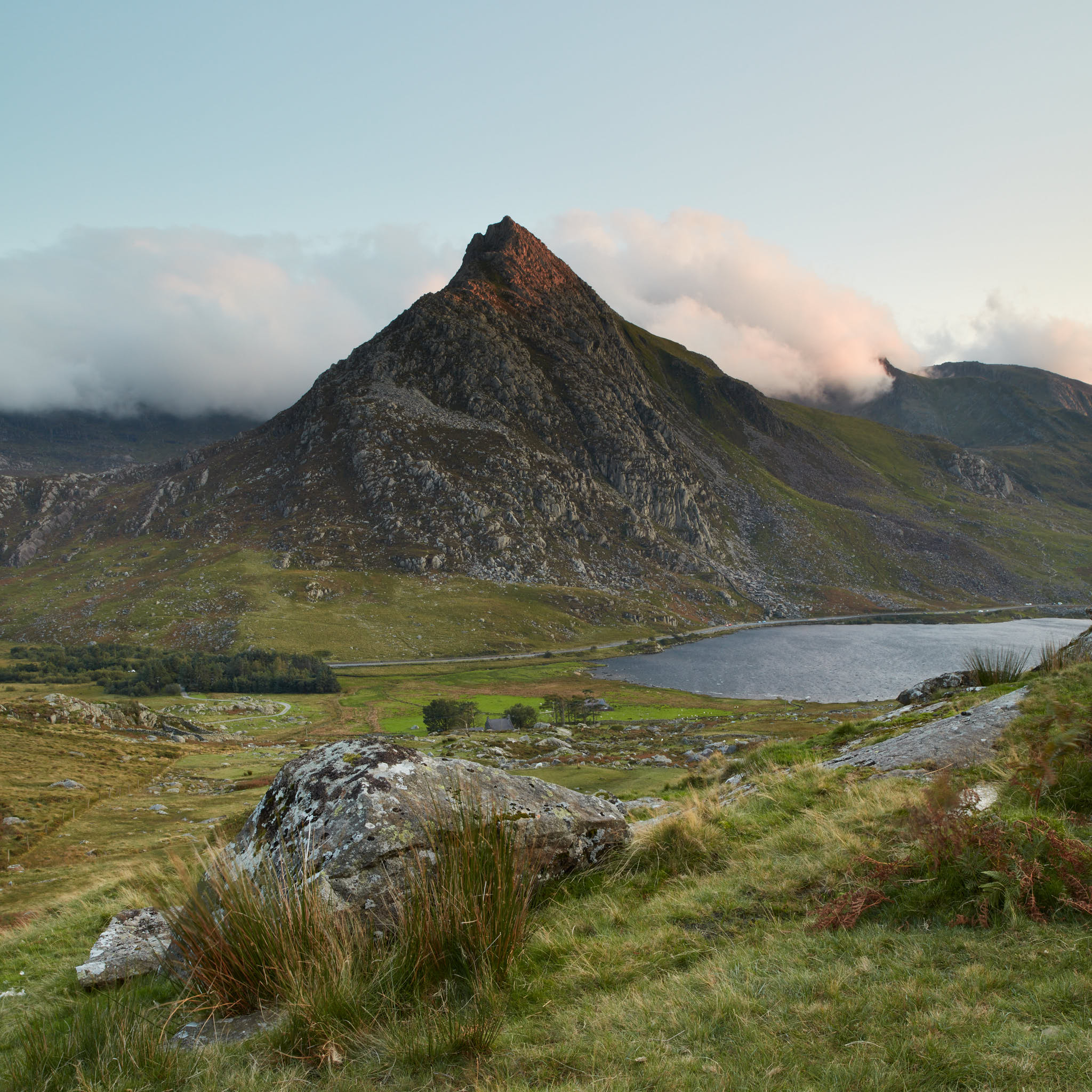
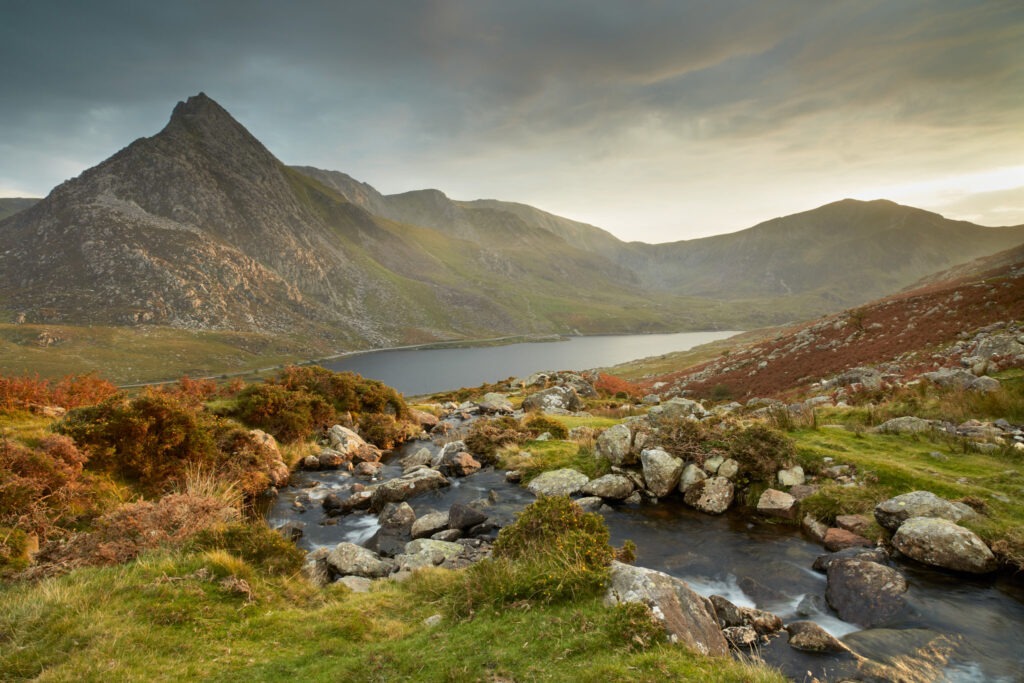
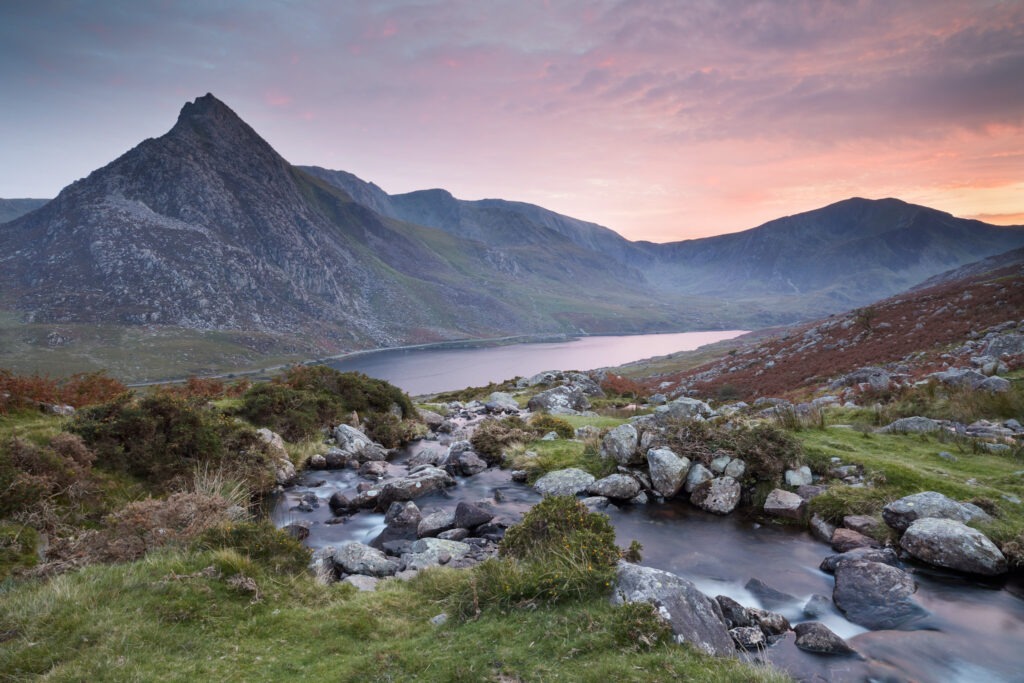
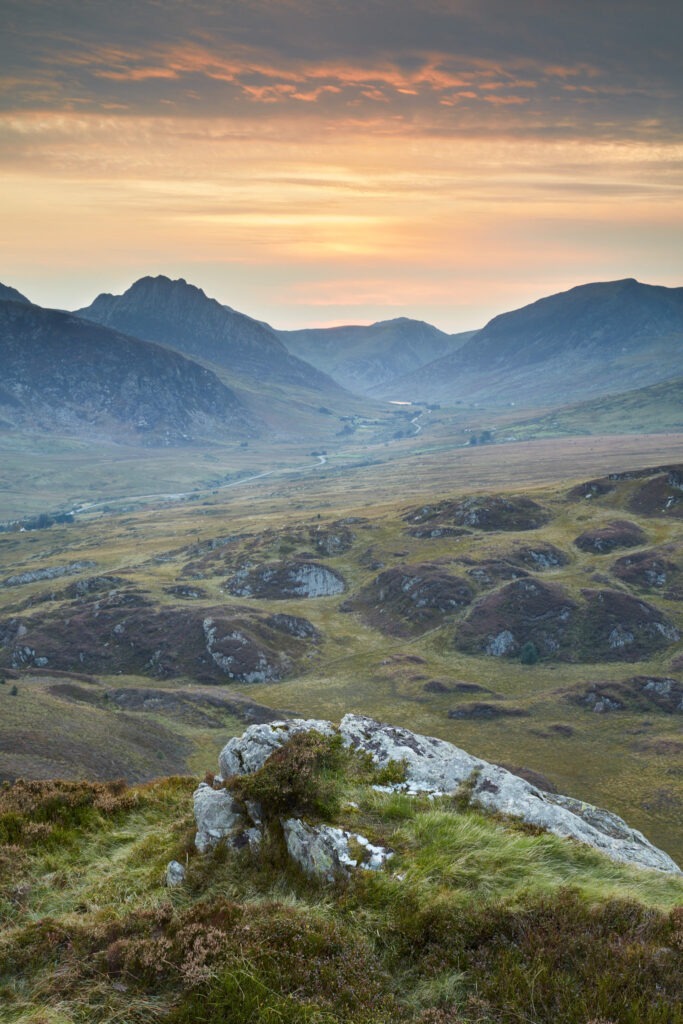
The four images in this post have a common component – Tryfan. It’s shape, it’s long serrated back, make it one of the iconic profiles of Snowdonia.
If you like the images or this post please share. Thank you.
Andy
All images are Copyright Andy Gawthrope Photography.
TryfanTryfan and Llyn OgwenTryfan and Llyn OgwenOgwen valley sunset
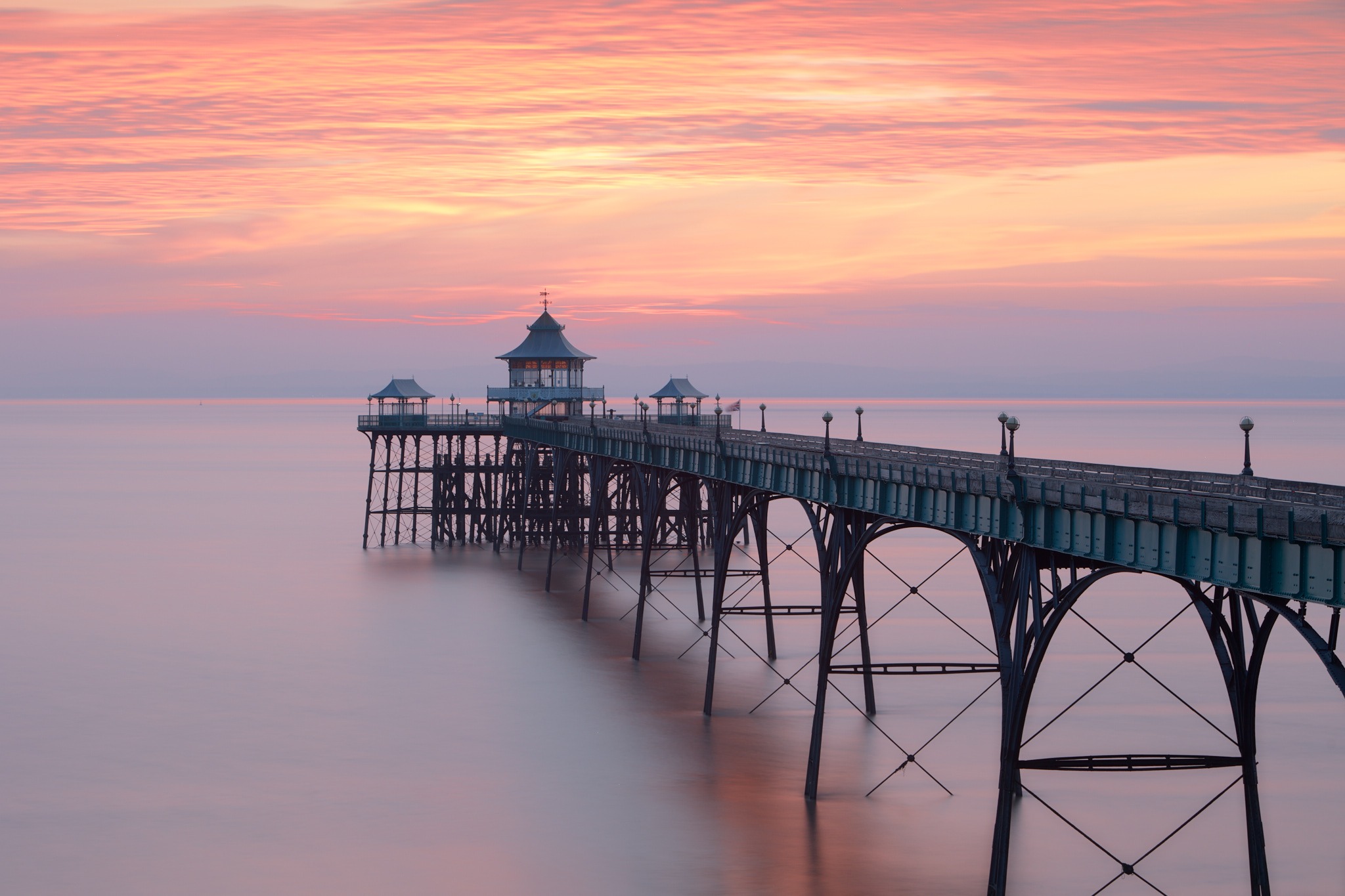
It had been a stinkingly hot early August Sunday with temperatures in the low to mid 30’s with little wind at home. Hot weather indeed for the UK 🙂 That’s the sort of heat that just saps energy so I’d stayed indoors most of the day catching-up with some processing which is where I hatched the plan to retreat to the coast where, hopefully, it would be cooler.
Arriving in Clevedon, a couple of hours before sunset the temperature was still very warm but it was made bearable by a gentle sea breeze. I arrived with lots of time to spare as I wasn’t quite sure what the light would do although I had a strong suspicion that due to the heat and clouds sunset could be nice. About a 1/2 hour before sunset it started to look like something magical might occur, but it was only as the sun approached the horizon that the clouds started to turn a little orange. But over the distant horizon and Wales was a slightly thicker band of cloud – a band reminiscent to that in my previous sunset photograph of the pier. A few minutes after dropping behind that cloud and the horizon the clouds overhead were illuminated from below and turned the most magical yellow/orange colours. It was an awesome sight 🙂
Thanks to the COVID-19 pandemic photography opportunities this year have been limited so it was fantastic to witness such an amazing scene. Its just these sort of events that make Landscape a rewarding photographic genre – all the hard work and lows instantly forgotten! Printed this photograph is glorious. It’s almost minimalist; the soft pastel sea with its hint of orange transitions almost seamlessly into sky and plonked in the middle is the architecturally wonderful pier. I love it and for that reason I’ve made it available in my Limited Edition Prints shop.
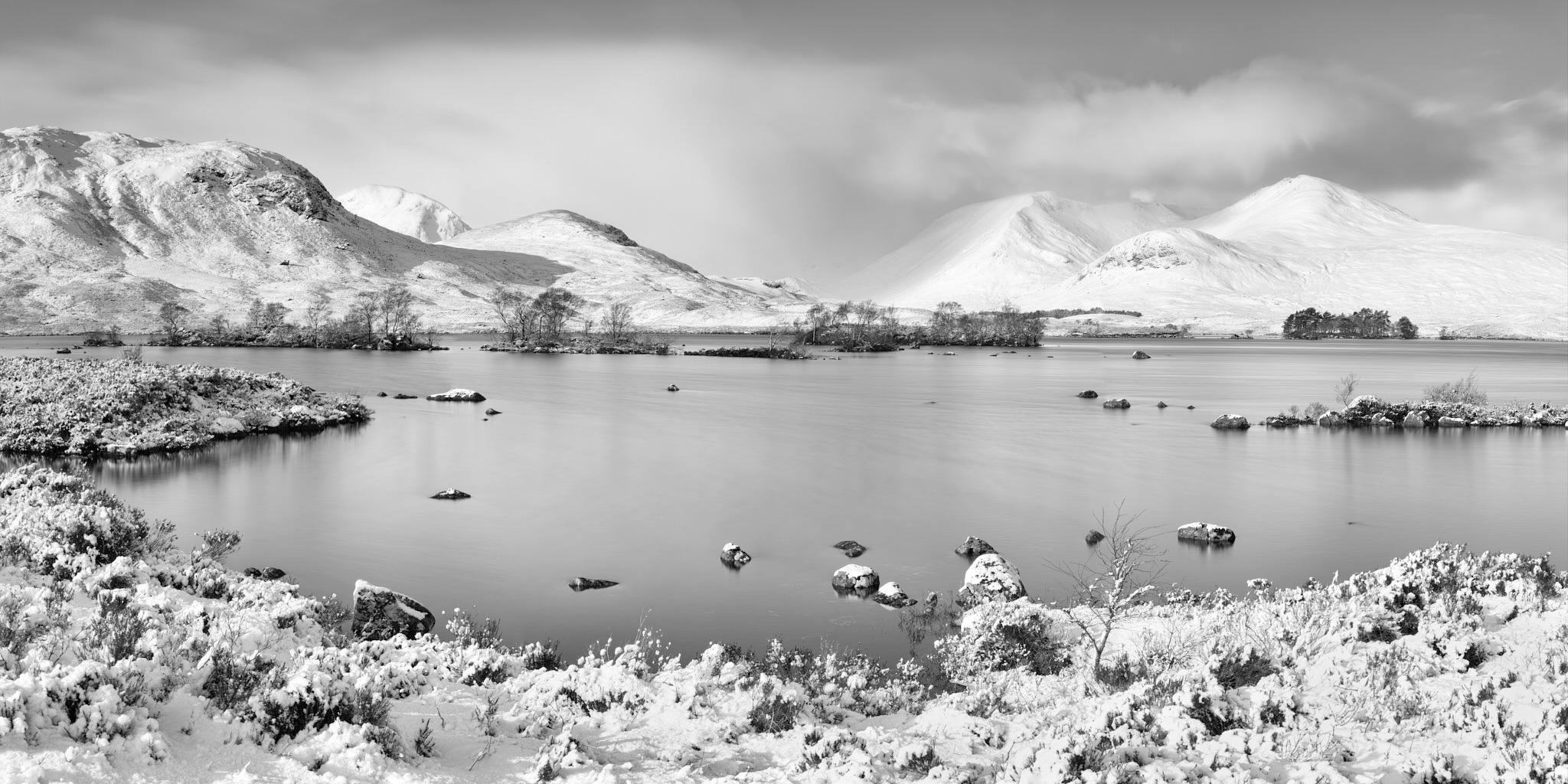
Just up the road from Bridge of Orchy and the hotel where I was staying is a beautiful lochan on the South Eastern edge of Rannoch Moor. Lochan na h-Achlaise has been photographed by many photographers in many conditions and is probably most known for the small islands and little rocks that are dotted along its foreshore. I myself have been there numerous times over the years but I’ve always wanted a snowy or icy photograph. This year I was lucky enough to capture a snowy photograph.
Whether it was just pure chance or that the A82 was still being cleared by ploughs I’m not sure but I found myself alone on the shore of the lochan one morning with snow all around. I must have wandered along the whole of it’s Southern shore making photographs, but the one in this post is my favourite. It’s a composite of several images captured using my trusty EOS 5DSR using a Sigma 50mm Art lens.
Canon imageProGRAF PRO-2100
I started printing my own photographs in early 2019 and have since become a total convert to the print as the output medium. Seeing photographs on small mobile phones, tablets, even large computer monitors just doesn’t do them justice. Modern photographs can be packed full of detail and when printed in large format they can simply blow your mind! This is certainly the case with the above photograph and several of the others from my Bridge of Orchy trip. Seen large there is just so much more for the eye to see; trees change from simple dark shapes to something that recognisably has branches and leaves; even ducks on the distant water start to appear.
Since last year the largest I’ve been able to print is A2 sheet media. However, all that is about to change as the guys at Fotospeed are about to deliver a shiny new Canon imagePROGRAF PRO-2100 printer. This 24″ roll printer will dramatically change my output as it will then possible to produce much larger panoramic prints! I’m really excited and looking forward to it’s delivery as soon as the coronavirus lock-down comes to an end.
So, keep an eye on my shop larger prints will be arrving there in a few weeks. Coronavirus willing. 🙂
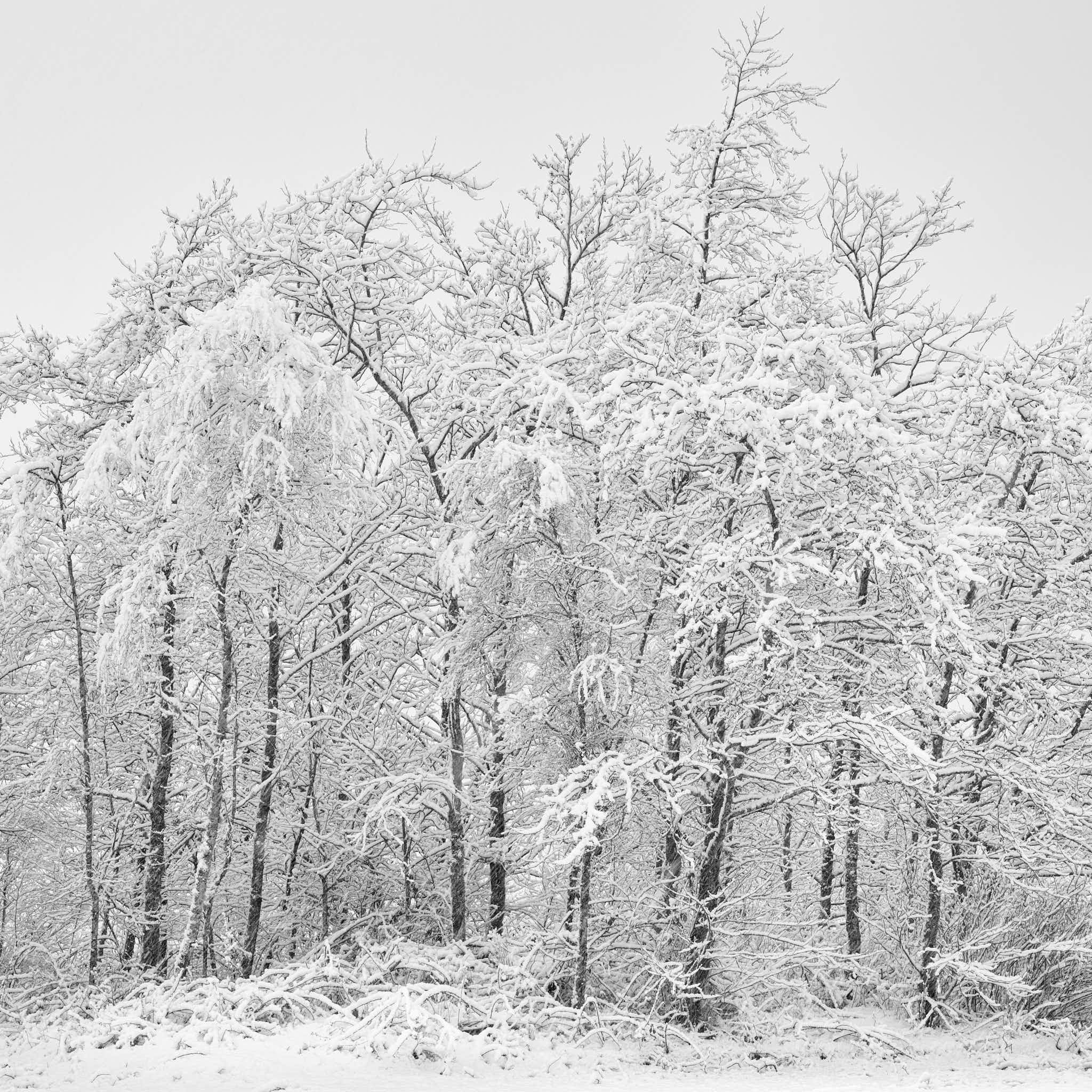
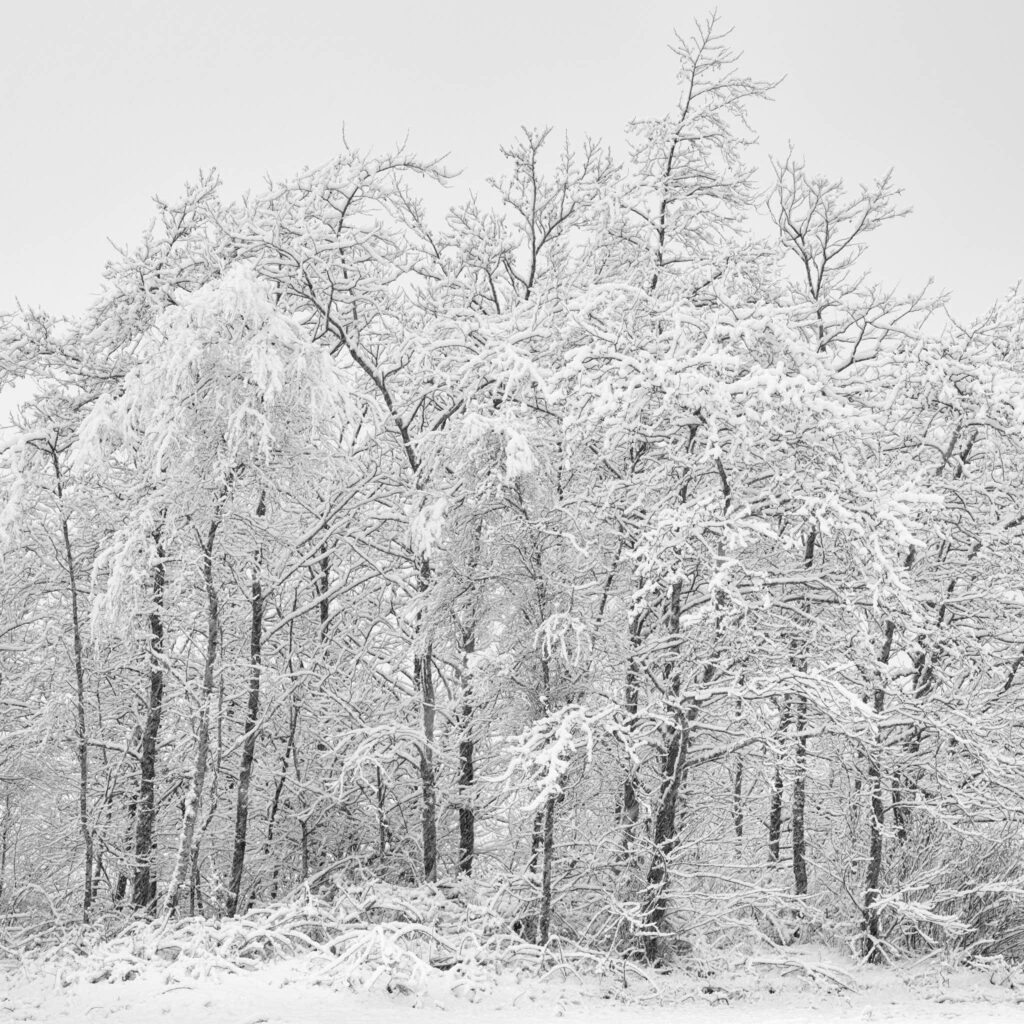
On one morning during my stay at Bridge of Orchy in Scotland I awoke to find everything covered in soft, white fluffy snow. It was a sight to behold. There was only the occasional muffled sound of a car on the normally busy A82 due to the still lightly falling snow. With little to no wind the trees were laden with perhaps 2 – 3 inches of snow and their branches bent over under the weight. It was definitely a photography day!
After a hurried breakfast the hills remained wrapped in cloud. Clearly there was nothing to be gained from plodding up a hill today! An easy day 🙂
The trees from the hotel window on the far side of the car park caught my attention but it felt like cheating to photograph so close to ‘home’ rather than hike along a track or up a hill for hours! Cheating or no, that is where the day started – in the hotel car park! The tarmac was nicely buried under as no car had yet disturbed the snow so unless you knew it was a car park you would never know!
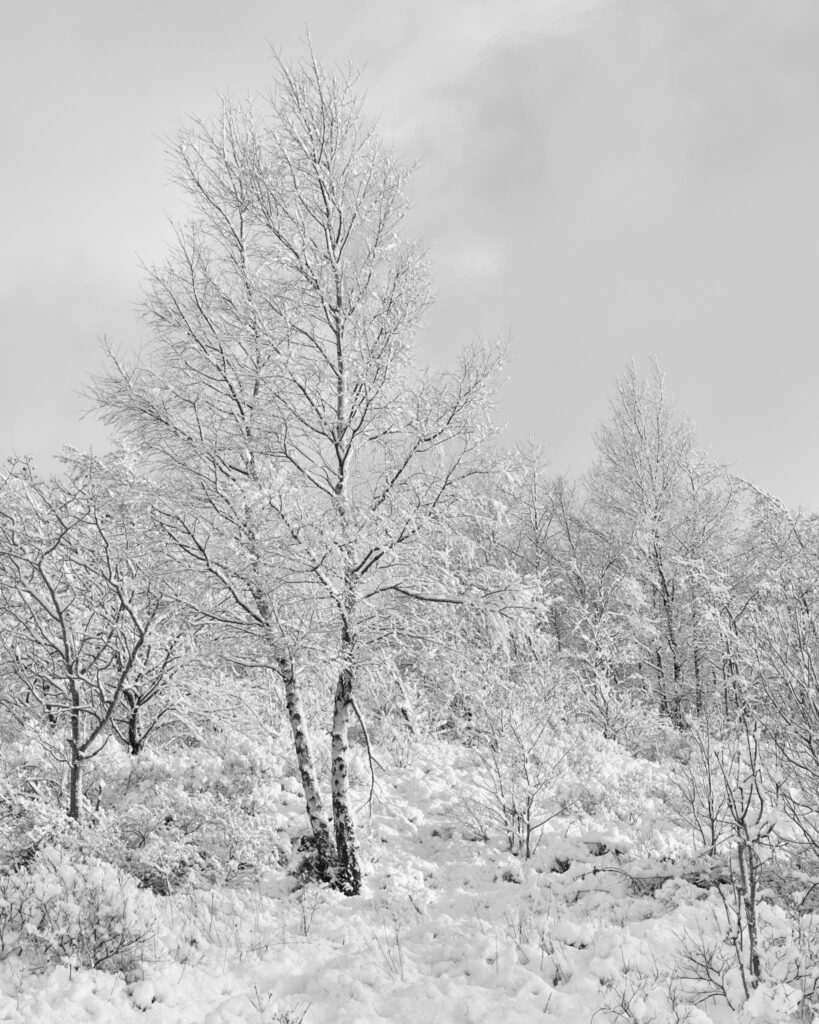
So the first photograph in this post is off the trees at the end of the car park. I was drawn to their shape; the tree that rises and curves from near the centre towards the left and the taller and straight tree to its right. As on previous days, there seemed little reason to consider colour; the scene was just shades of grey!
By the time I’d finished photographing in the car park the wind had risen slightly and snow was starting to drop from the trees. It was time to pack the camera away and follow a small winding path that led through the trees down towards the river and several tall Silver Birch trees. Here the ground was more open allowing sufficient distance between the camera and trees to avoid problems with converging verticals and the need for post-capture corrections.
Snowy tree No. 1
Readers of the preceding post in this series will know I like Scotch Pine trees. But I also like the Silver Birch as they are never seem too large and have wonderful detail in their silver and black trunks.
One of the Silver Birch’s stood a little way from the others; it forked at ground level and had a nice bit of negative space to it’s side. Perfect! This one will almost certainly make its way onto one of my 2020 Christmas cards.
After finishing with the trees I headed up the road, thankfully the snow barrier hadn’t been closed, to Lochan na h-Achlaise but more on that in the next post!
Shortly after arriving at Bridge of Orchy a day started with the hills obscured behind thick grey clouds, there was a biting cold wind and snow was falling at road level. It looked unpleasent outside the hotel windows! Inside the hotel, dry and warm, I reasoned that if the weather broke there would be some good photography so, suitably booted and dressed for a day on the Scottish hills in winter I headed out and up one of the hills overlooking Loch Tulla. Not that you could see the loch or much else! Fortunetly, I had scouted the lower paths the previous day and was confident the higher path would be ok.
My thinking hadn’t been wrong; it was most unpleasent at times with wind blown snow getting into anything not securely closed. Despite the weather upwards I plodded through, in places, thigh-deep drifts which just couldn’t be seen due to the poor contrast. Any reader who has experieced these sort of conditions will know exactly how tiring this sort walking is especially when wearing a heavy backpack and tripod. On occasion it just was not possible to extract a submerged leg as the other would sink equally deep into the snow. When that happened, extraction was an interesting challenge!
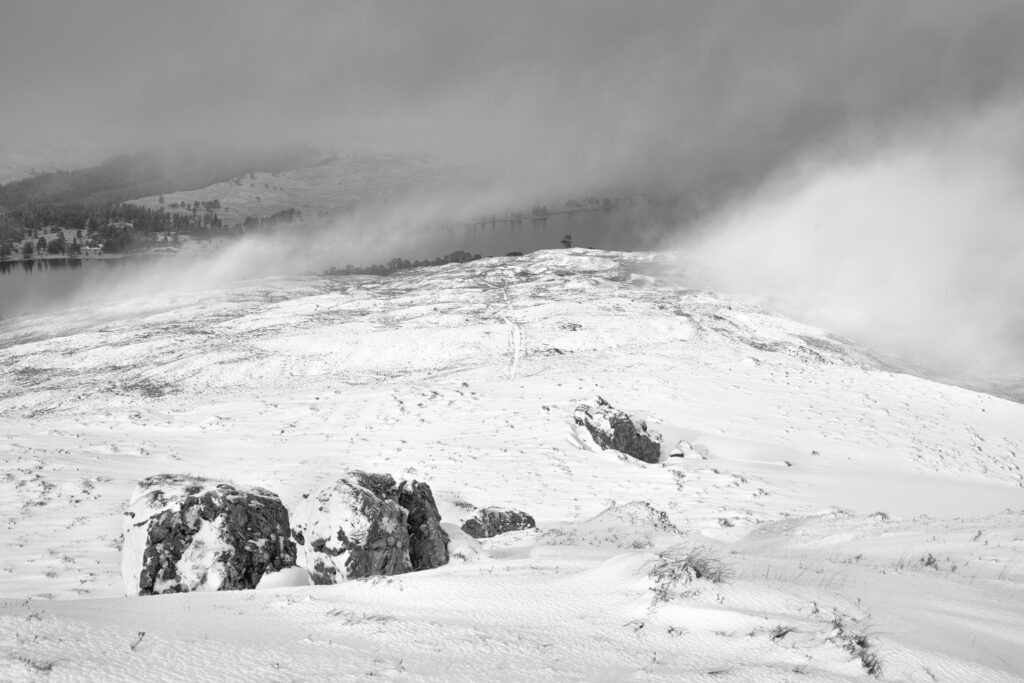
Around lunchtime I reached the top of the hill but decided to stop a little way back down were it was more sheltered from the wind and spin-drift. Here I decided to hunker-down, eat lunch and wait a while for the cloud to break. It didn’t! So, after about an hour of waiting and getting increasing cold I start to head back down. Ten to fifteen minutes after starting my decent I noticed it was starting to clear. Yes! Looking around I could see some rocks over to my right. These are the rock in the photograph above and the only objects I could see that looked interesting. I spent some time with the rocks as the clouds continued to dissipate with, at times, the sun breaking though. I guess persiverence is rewarded!
Snow above Loch Tulla
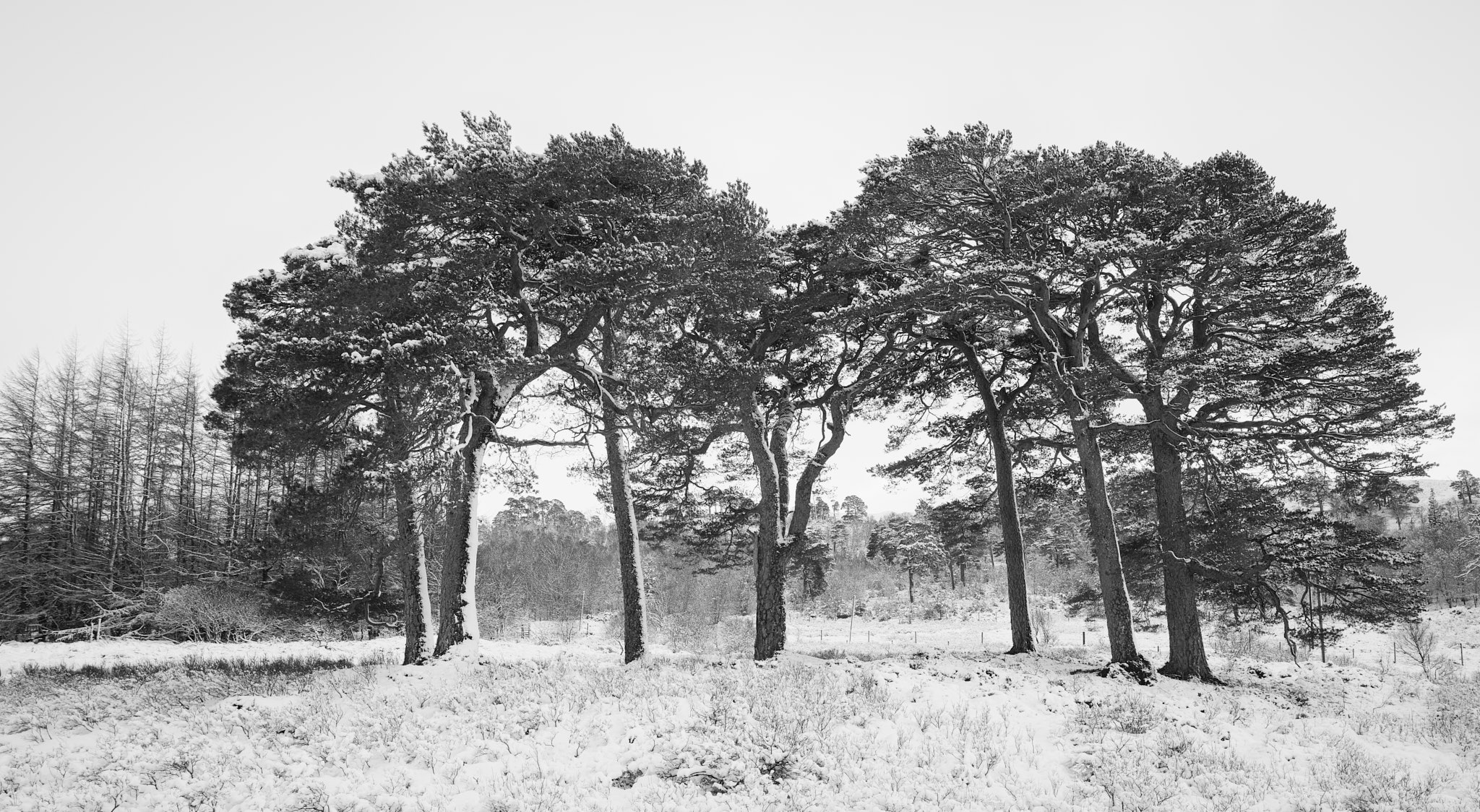
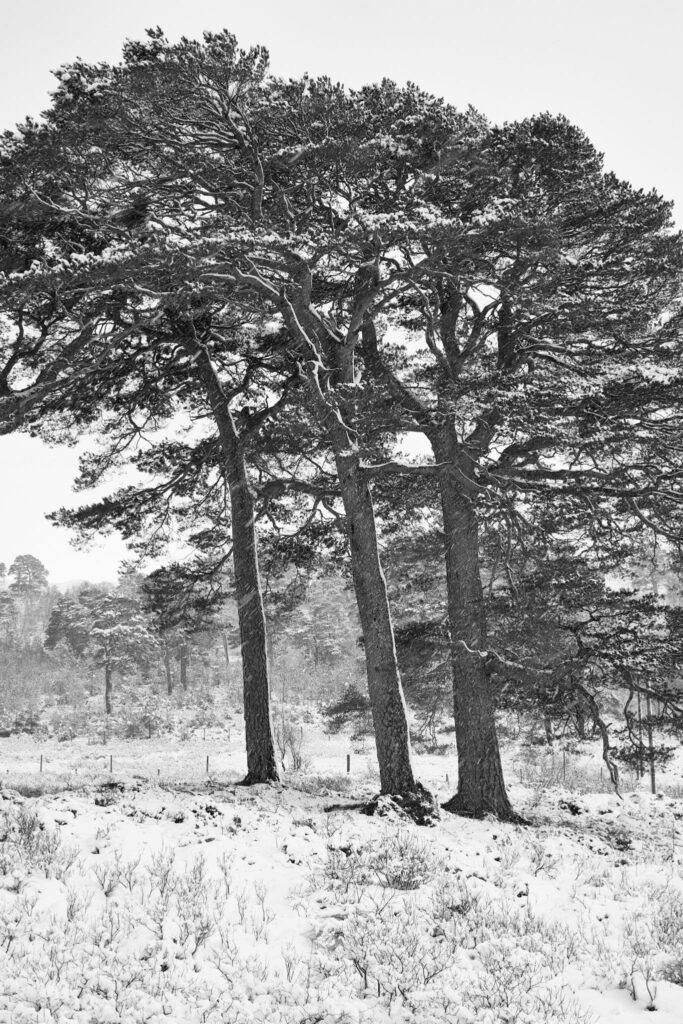
On previous scouting trips I’d noted a small group of Scotch pines set on a knoll well separated from all other trees a short distance from Loch Tulla. I was immediately drawn to their collective shape; the outer trees leaning inwards towards a slightly shorter central tree of a different shape. They seemed to have natural balance – a sense of family. There had been no appreciable rise in temperature or wind from the previous day so snow still clung to their sides further accentuating their shape and texture in the morning light.
Setting-up to capture these photographs I pre-visualised the group of trees in black and white and configured the camera to preview in black and white. This was a straightforward decision as almost everything that morning was black or white! Configuring preview in black and white is a technique I’ve started recently having learnt the tip from another photographer. I find it beneficial with visualisation of the image.
Caledonian pine
The shape of the three right-hand trees and their bold trunks also caught my attention. Framing just these trees provided a simple composition allowing removal of any possible distraction due to the other trees or surrounding landscape. As I was making this photograph a snow shower past through which at first resulted in short white lines on the photograph. Moments later it was a short-duration blizzard and I retreated to the shelter offered by those trees!
February is generally acknowledged to be the snowiest month in Scotland. Most years it’s a fairly safe bet that there will be snow on the mountains, probably down to about 500 metres. At lower altitudes the snow often falls as rain so any snow at ground/road level is often wet and doesn’t hang around for long. By February the days are getting longer, there is more light and it’s possible to shoot all day as the sun doesn’t climb too high in the sky.
This year I spent a week in Bridge of Orchy staying at a hotel of the same name. The hotel had great staff who really knew how to look after their guests; the accommodation, food and beer were all excellent and tucked away on the ground floor was a cozy, quiet guest lounge with large comfy sofa’s and chairs. Looking back now it seems like a different world; the news had stories of a virus in China and people were hoping it didn’t reach our shores. Normal times. But it’s now May and the UK is pretty much in lock-down. For me this has meant that a trip to Skye has been postponed along with trips to Dartmoor, Cornwall and other destinations.
Bridge of Orchy lies to the South East of Rannoch Moor and Glen Coe and is a little lower in altitude. The surrounding hills are lower too so, for the not so fit photographer, they provide an easier option that doesn’t require the commitment and fitness of the larger mountains. For such a small place it’s remarkably well served by public transport partly as it’s on the main A82 Glasgow to Fort William road but also as the overnight sleeper train from London stops there on its way North. So getting to the hotel is really easy!
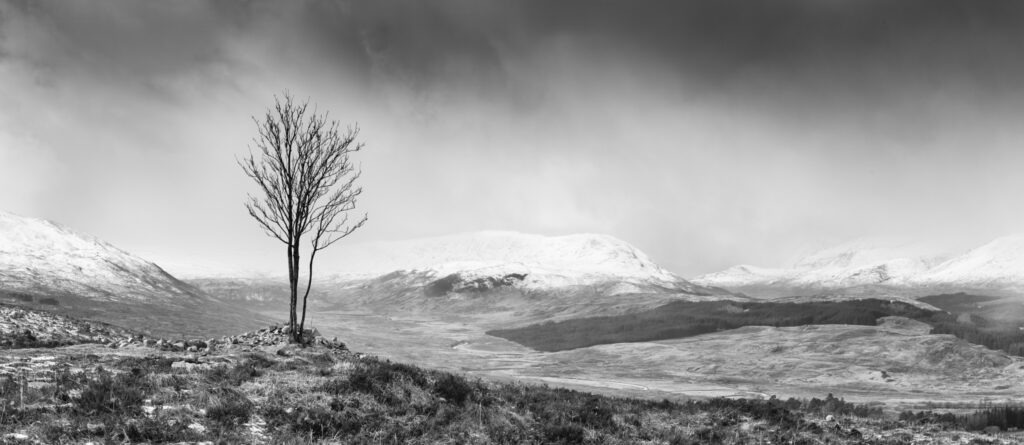
The Watchman
With a thin blanket of snow on the hills and fluffy white clouds intermittently delivering snow the landscape was pretty much just shades of grey so, black and white seemed the most appropriate photography palette. In fact, even before the trip I’d pretty much decided it would be focused primarily on Black and White if the conditions were snowy.
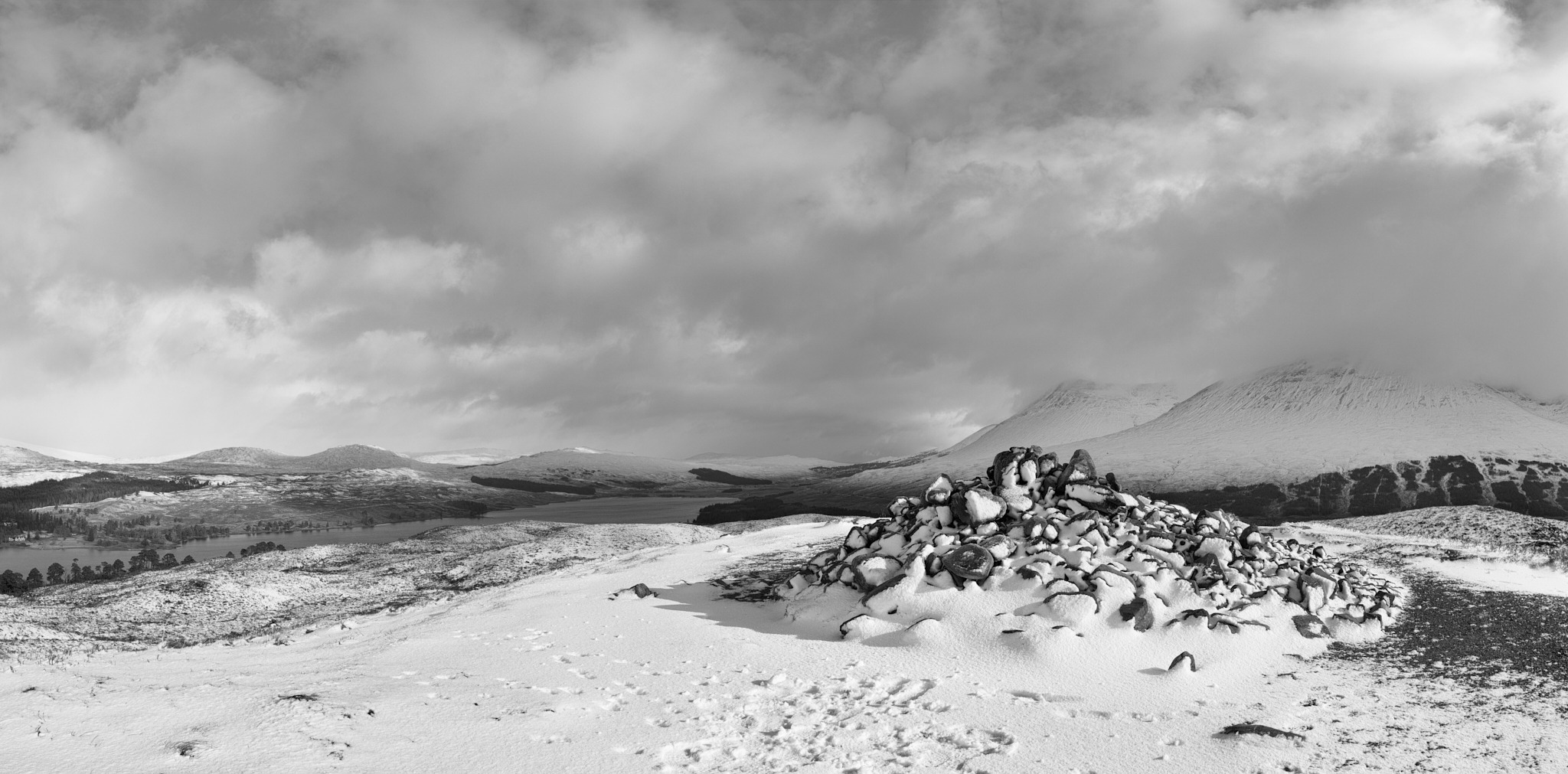
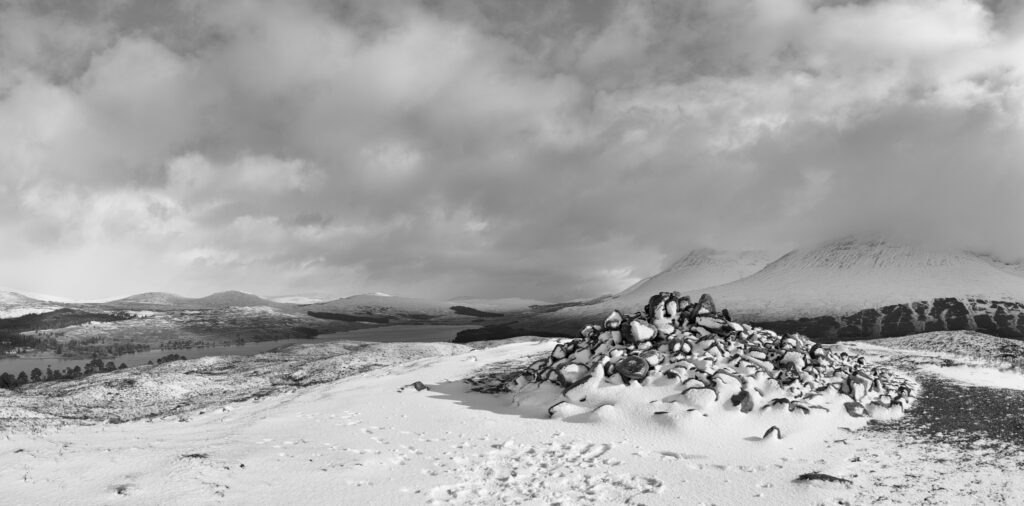
The landscape around Bridge of Orchy is open and provides wide panorama’s after a little height is gained. With a keenness that is always present on the first day in a new location I headed out from the hotel and up one of the surrounding hills. On its crest a large cairn marked a junction of paths. Clearly I wasn’t the first to pass that way since it had snowed as there were lots of footprints next to the cairn. But closer inspection revealed many to be the hoof marks of deer of which, during the week, I would see so many. By the time I captured the photograph at the top of this post the sun had popped-out from behind the clouds providing some strong directional light across the cairn towards Rannoch Moor and Glen Coe. One of the key ingredients that make the photograph work for me are the clouds filling the sky. It was a spot I returned to several times during the week. On one occasion there was fresh unbroken snow surrounding the cairn but the clouds were never quite as interesting.
The second photograph was captured a few days later. I’ve named it ‘The Watchman’ as the lone tree appears to stand watch over a surrounding vast landscape with distant forest ‘hugging’ the land like a quilt. The tree must have seen many types of weather in its few years. There were several good photographs from the trip but this is one of my favorites.
Both the photographs in this post are the result of stitching several 50Mpx images and thus there is a large amount of detail which looks stunning when viewed large. Both are available for sale right now at Andy Gawthrope Photography
Christmas Day 2019 and the weather finally turned nice for a while. The wind dropped and the cloud and sea spray disappeared – it was a joy to be out at first light with the camera. 🙂
Leaving the truck in the little car park behind the tea shop the sky was still dark but with a few stars twinkling overhead I knew it was at least partly clear. So, with a growing sense of anticipation I stumbled up the narrow track to the top of the cliffs.
A few days before I had walked along this stretch of cliff identifying possible locations, checking sunrise and sunset angles and thought this spot may be good. I recall being concerned about the land being too complicated and spoiling the simplicity I sought. But I also thought that the darker land at sunrise would help mask any complexity. Of course that needed the right light!
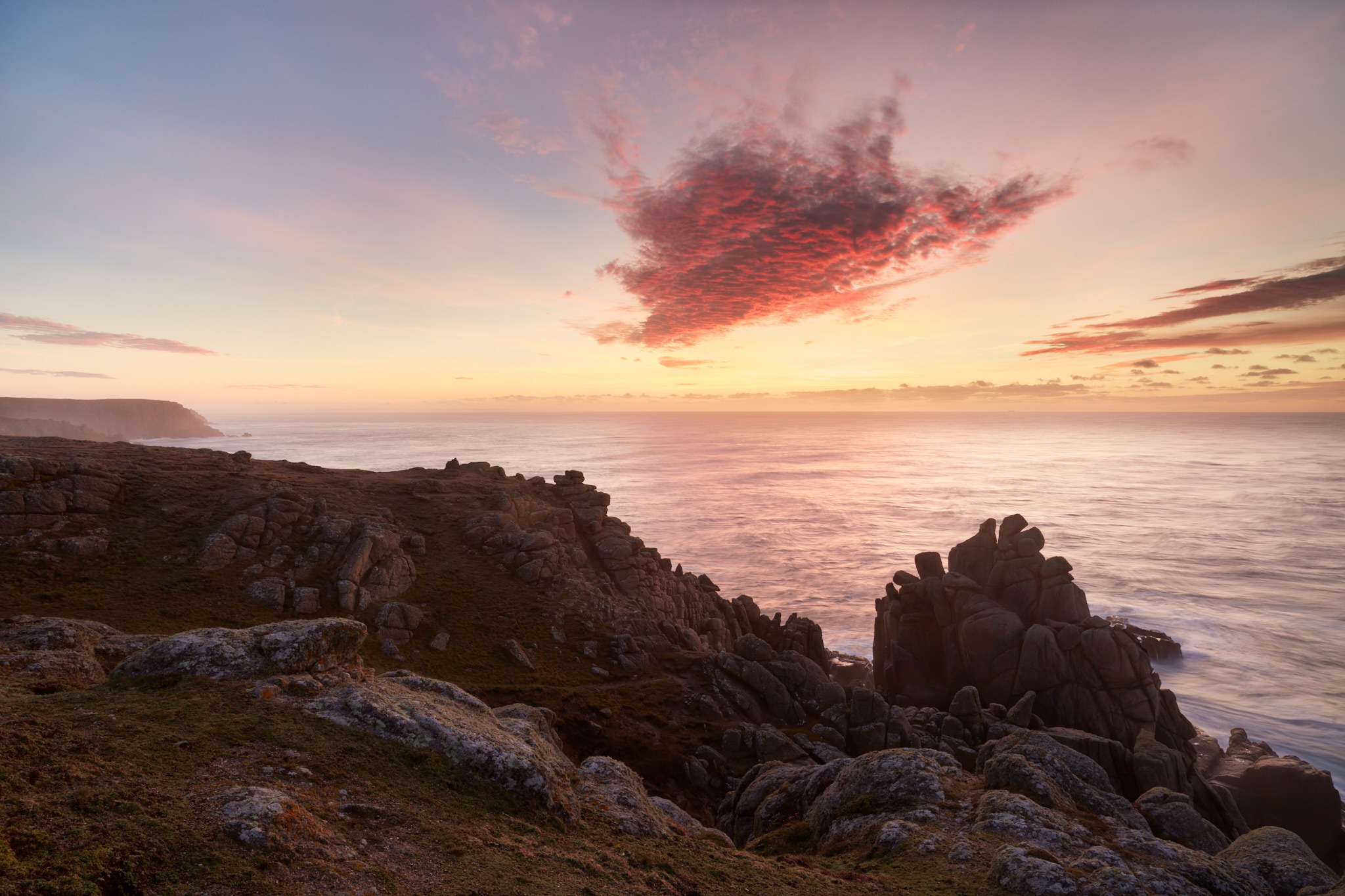
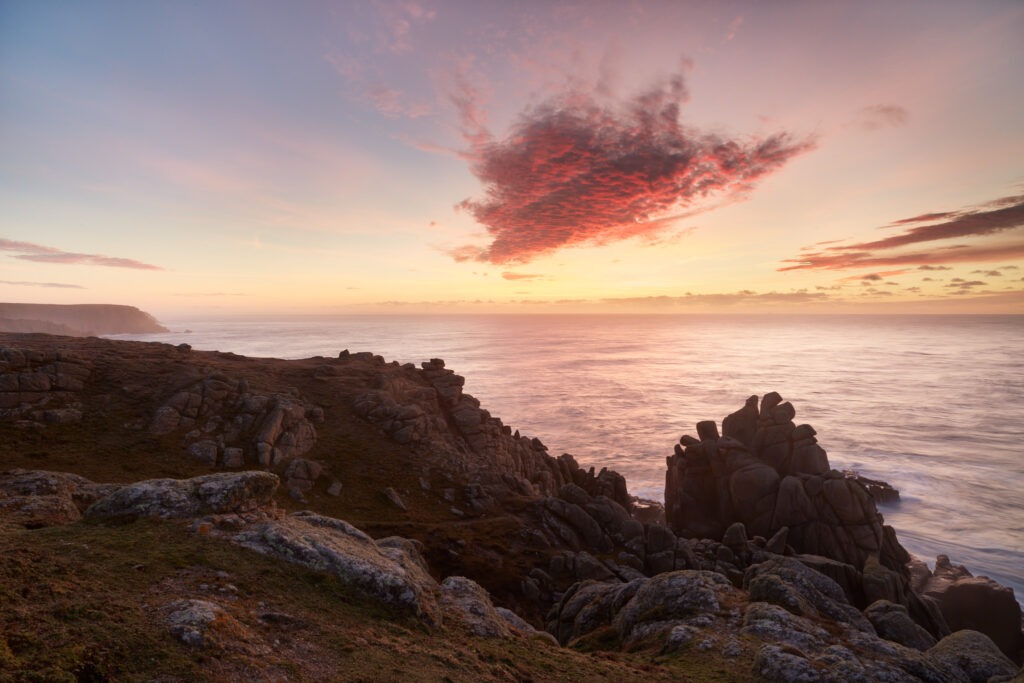
As the sun got closer to the horizon the sky became visible and I could see what looked like a massive triangular space ship hanging in the sky! At that time it was still just grey cloud but as the sun got closer to the horizon it lit it’s underside in beautiful orange/pink/red light which was also reflected down onto the land and ocean. It was fabulous 🙂
Porthgwarra sunrise. No. 2
My earlier visit had also identified a potential location just off to the right. By the time I moved position most of the dramatic lighting had faded but over the distant horizon there was still plenty of colour and that cloud, although somewhat dispersed, still had a great shape. If anything I thought it now looked more like a Phoenix flying headlong towards the burning sun! Ah what the mind sees in the clouds 🙂
Not long after making the above photograph a pod of eight or nine dolphins swam around the rocky point doing a spot of morning fishing I guess. All in, it was a fabulous start to Christmas day 🙂
I must admit that the plan when setting out that morning was to walk slightly further around the coast but with a dark sky I couldn’t be sure which location best suited the conditions. I chose to stop at the location that required least walking and wait until I could see the sky. When the sun did provide sufficient lighting I recognised the potential I stayed put. Of course that means I’ve another location awaiting a subsequent trip ;-); something I’d like to address in the not too distant future. Perhaps the weather will be equally gracious. We shall see 🙂
Andy
All images are Copyright Andy Gawthrope Photography
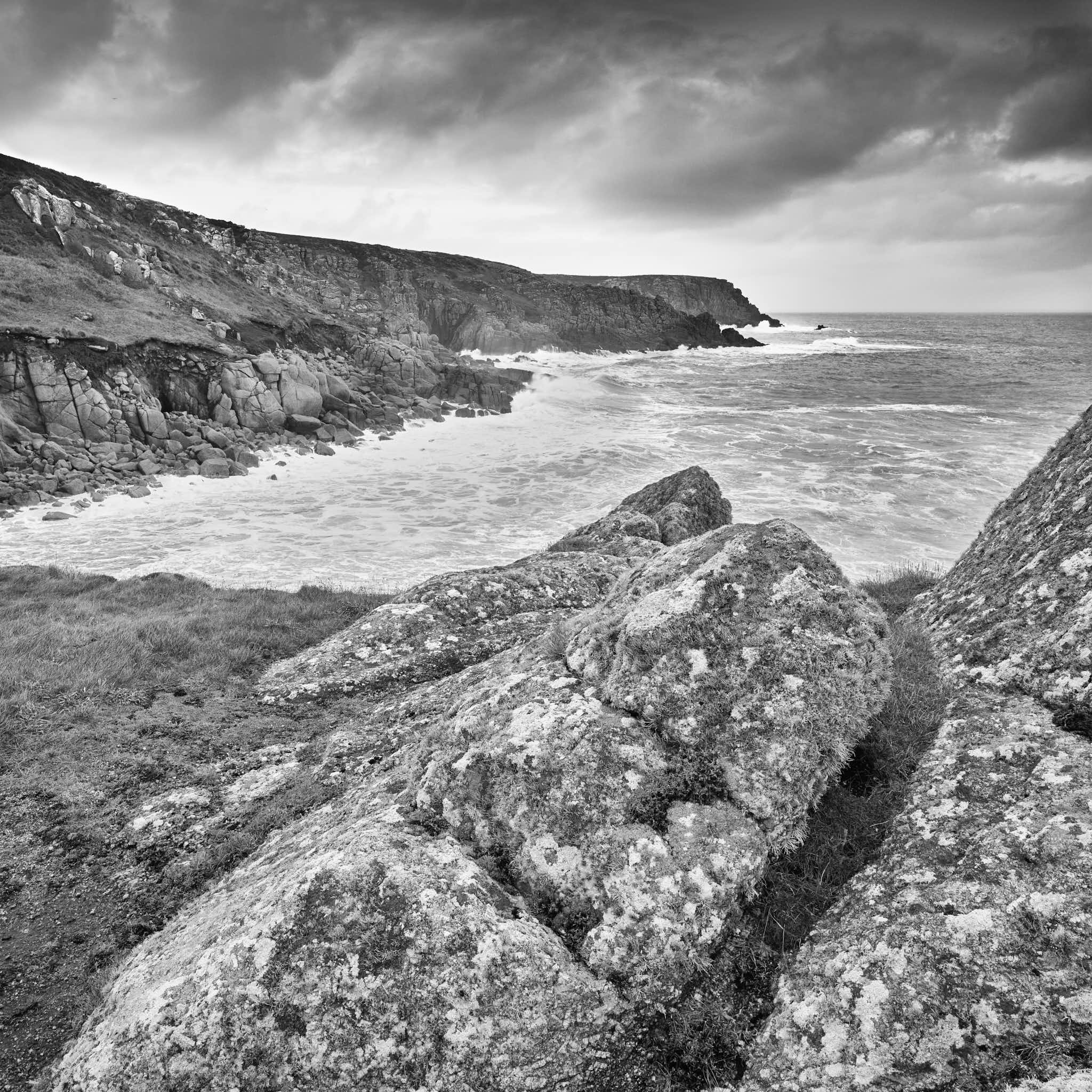
Continuing the recent post about my Christmas in Cornwall I thought I’d post a couple of black & white photographs from a tiny cove just to the South of Lands End called Porthgwarra.
Porthgwarra has a great little shop which does amazing tea and cake in the summer but, sadly, it’s closed over the winter months. Quite understandable as Cornwall is beautifully quiet in mid-winter with none of the maddening tourists!
The photograph above was taken on a windy afternoon with heavy, grey clouds skimming across the sky and waves being blown against the shore by the strong wind. I took several images at ISO 400 trying to catch a lull in the wind; fortunately one was sharp 🙂 It’s one of those photographs that works well large as there is huge detail in the lichen, the moss and foreground rocks.
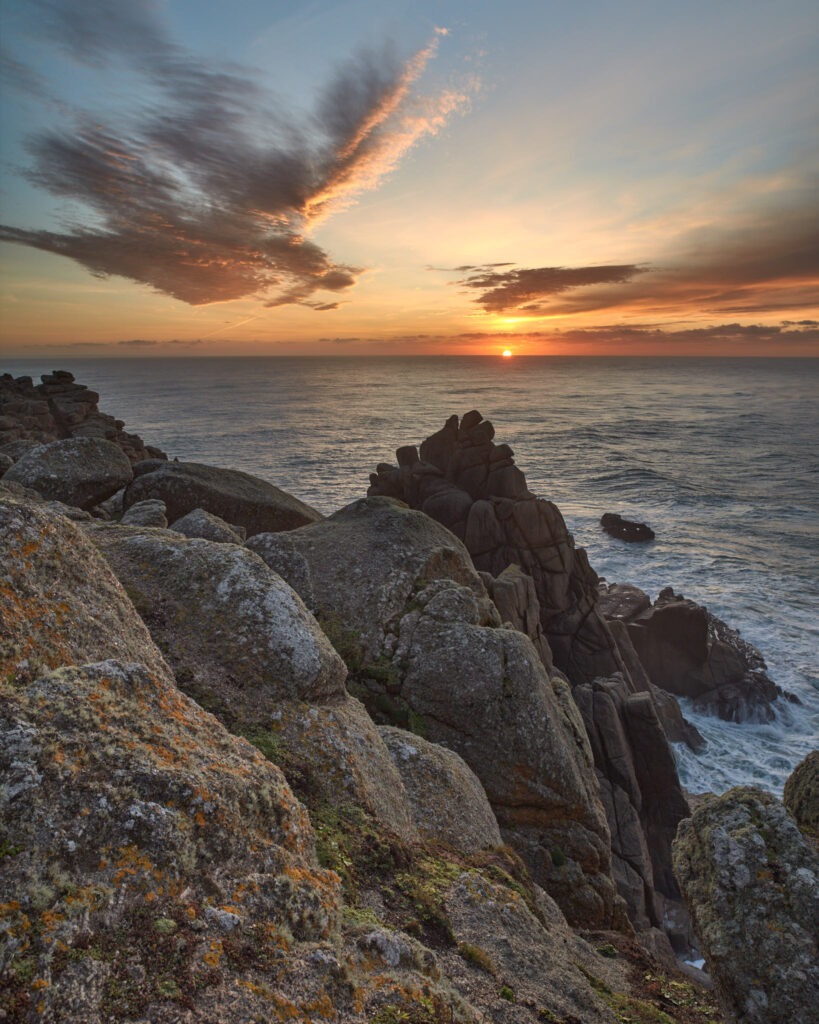
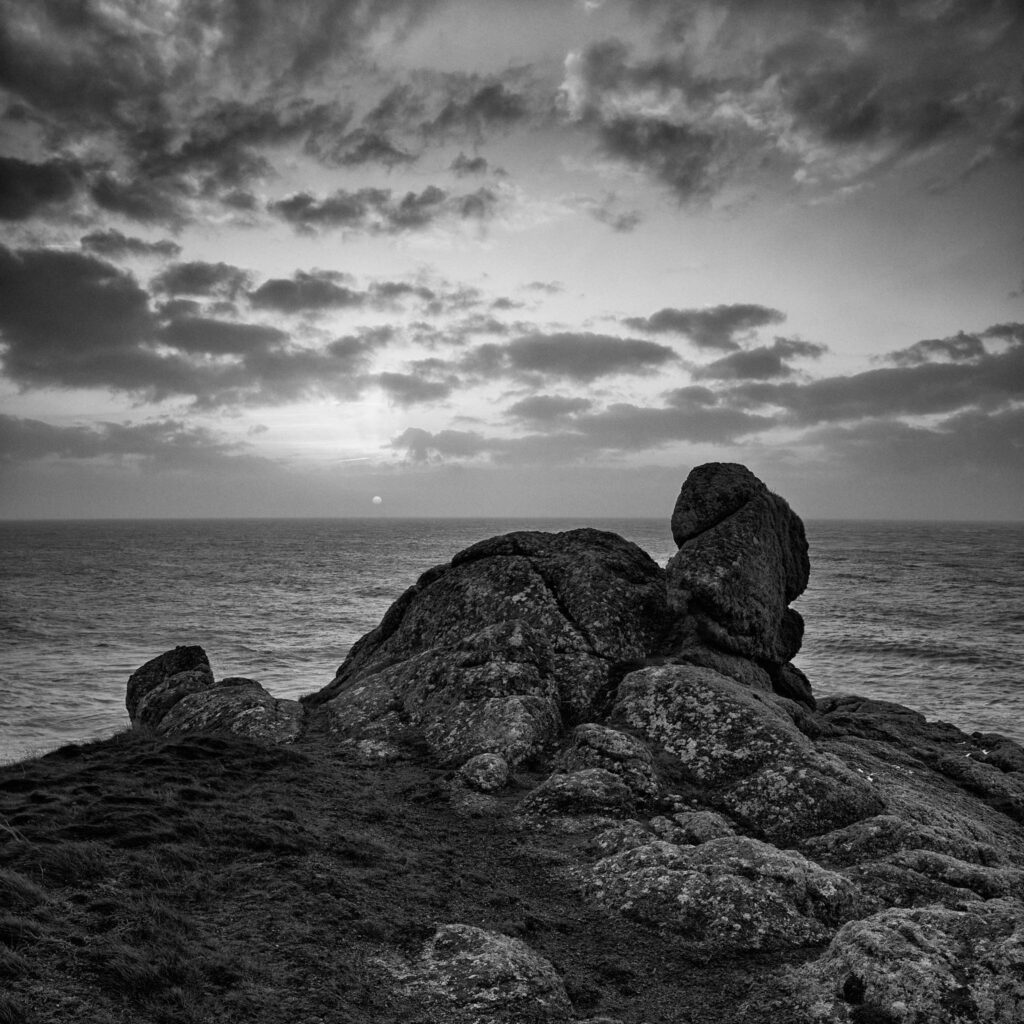
The second photograph is a little different. To my mind it’s a sunrise machine; some long forgotten machine left behind by aliens to control the sun! Well, ok, perhaps not but that’s what I was thinking as I stood there waiting for the sun to rise from behind those two great protruberences!
Porthgwarra sunrise
Whilst exploring the area the preceding afternoon I noted the great shape and immediately thought it could work as a black and white. After a quick check of PhotoPills and The Photographers Ephemeris (TPE) – I can’t decide which I prefer – I knew the sun would rise at just the right position on the horizon too. The following morning I got lucky as the sun rose through a bank of cloud whilst illuminating the more broken clouds above. I have a colour edit of the same image with great colours in the sky, but I prefer the simplicity of the black and white.
Christmas day 2019 was the best day of the entire Christmas week in Cornwall. The strong, gusty winds had stopped and there was a bright, diffuse light thanks to some thin cloud. The day had started early with a successful trip to Porthgwarra for sunrise – more on that in a later post – followed by a lazy hotel breakfast and planning for the rest of the day. Given the bright, diffuse lighting I thought Sennen beach would be good for some intimate landscapes.
I’d heard the beach would be busy and busy it was. The Eastern end of the beach was packed with lots of people in swimwear and santa suits going for a dip in the ocean! Or at least a screaming, running dash into and out of the water! No wetsuits allowed! Fortunetly, the Western end was quiet with just a few dog walkers.
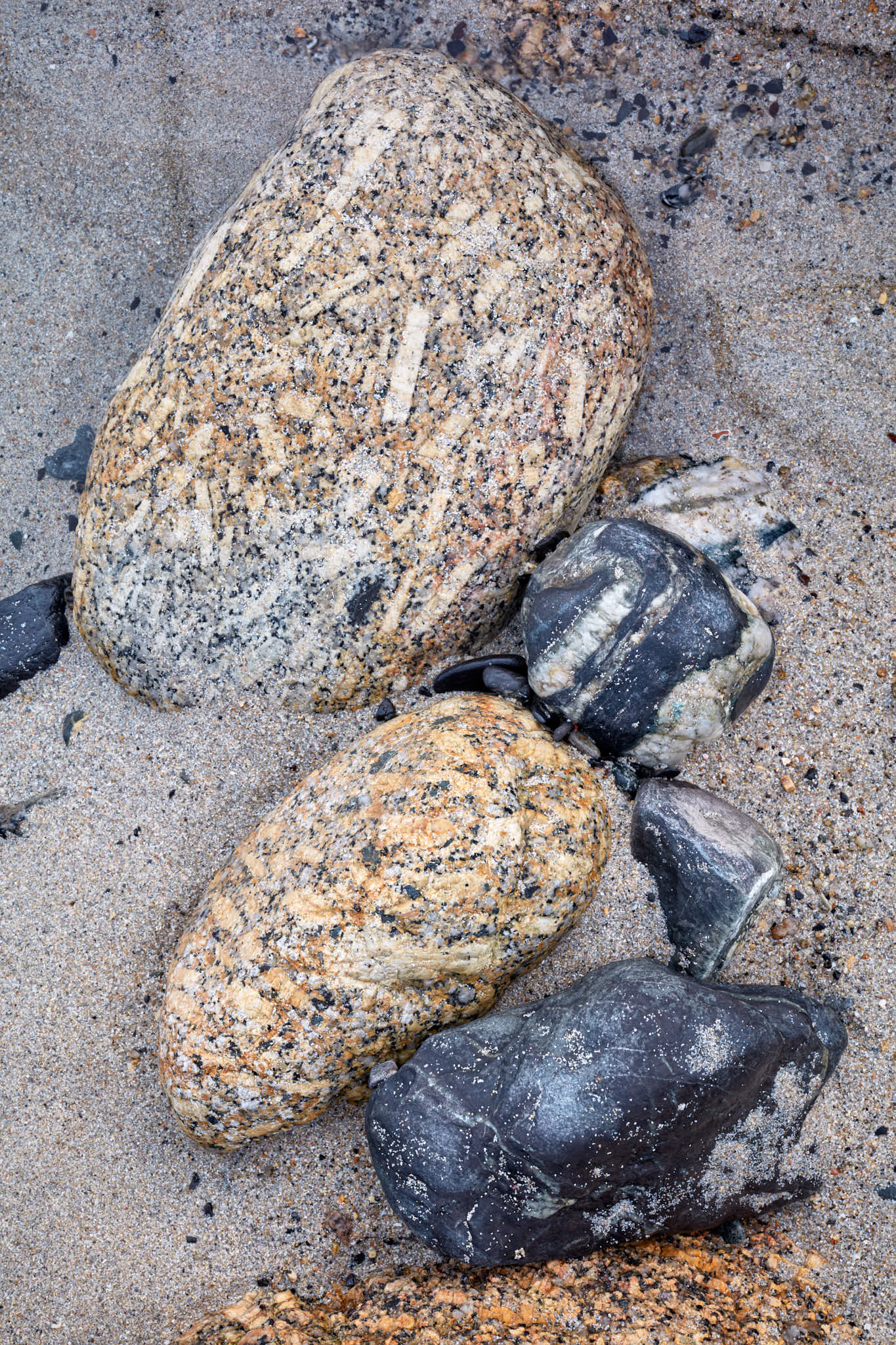
I’m no geologist but Cornish granite seems very distinctive. It is a mixture of small white/cream, black, brown stone infulsed with large rectangular flecks of a whiteish stone. Rooting around the beach I searched for a collection of stones that worked as a photograph. There were lots of rocks but nothing seemed to work as a photograph. Finally after much searching the closest I got was the above photograph.
Seaweed
By the time I’d finished the Granite on the Beach photograph the tide was starting to move back up the beach with speed.
A lesson: Whilst photographing on a beach it’s important to remain aware of what’s going on around you. On an incoming tide the sea can creep silently up the beach and the result of not paying attention is wet feet or worse, wet gear if the camera bag isn’t on your back! Never put a camera bag on a beach unless you are very sure it’s well outside the reach of Neptune!
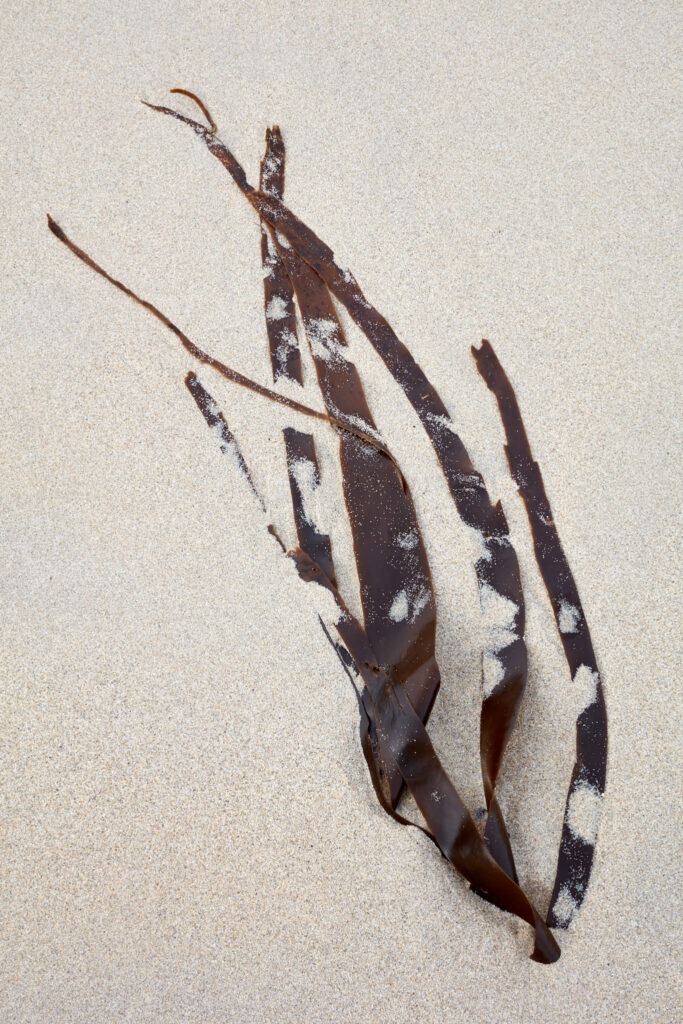
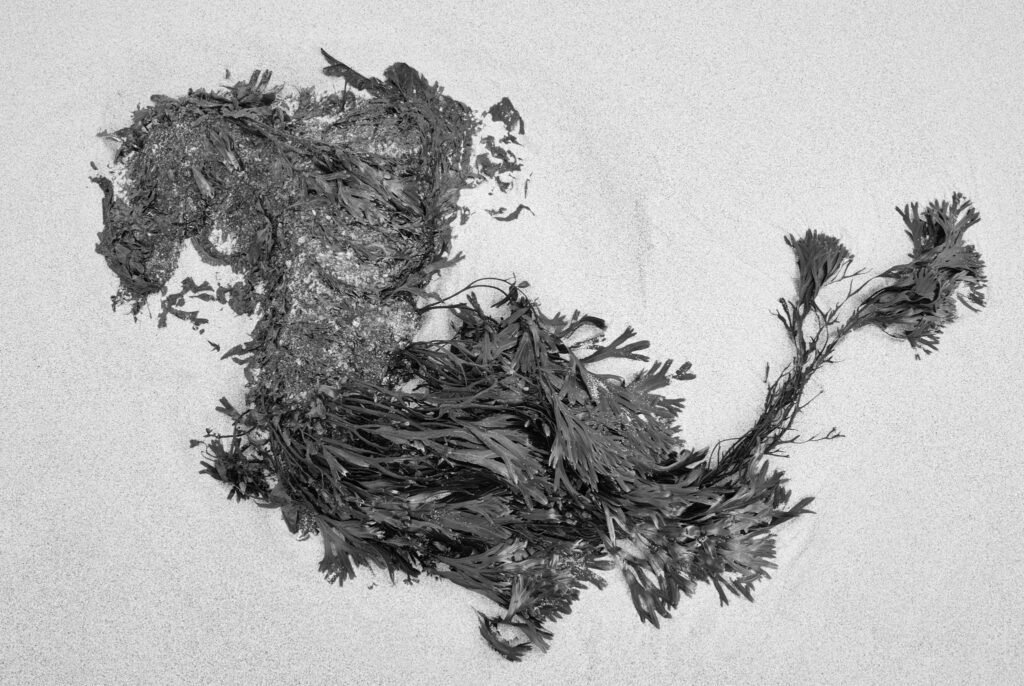
After a little more exploration I spotted this lovely piece of brown/black seaweed lying in an undistrubed area of sand. I was immedietly attracted to the shape, the curving limbs and delicate ends covered, in places, with a scattering of white sand. In post I’ve tried a black and white as it’s such a simple photograph, however, the subtle colours of the sand and browns are lost. Colour just works much better for this.
Not far from the Seaweed on the Beach I spotted an amazing site but the tide was getting very close by this time and it would have taken just one larger wave to have washed over the subject, ruining the intended photograph. Speed was of the essence!
Seahorse
What had caught my eye was the classical Seahorse shape formed by tendris of seaweed clinging to a small rock. Sweet. 🙂 I took the above photograph and a few others like it then moved the tripod and started to setup for a different angle but whilst doing that a wave washed in totally distroying the shape and I had to grab the tripod and run… 🙁