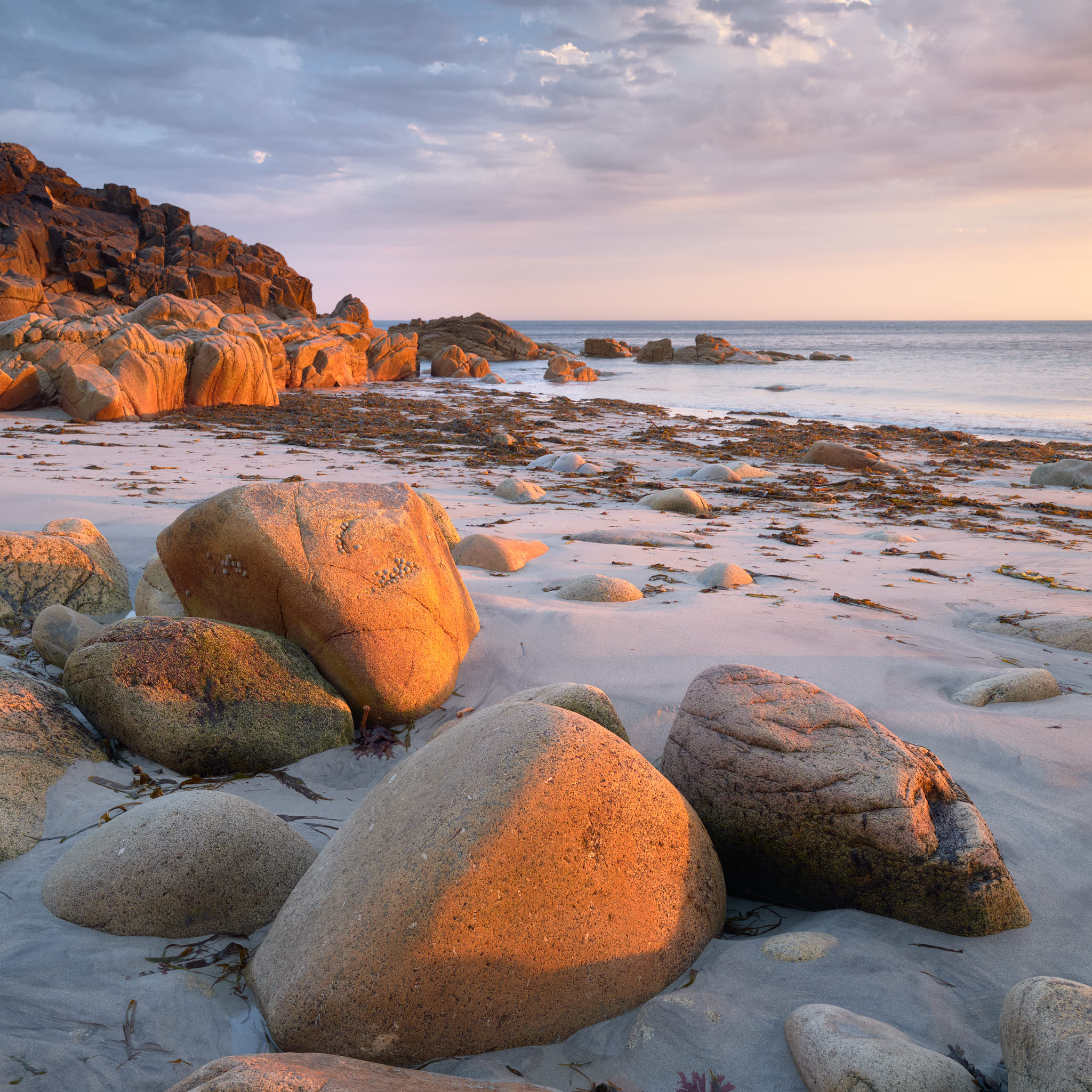
Cornish beaches at sunset can be magical places. As English beaches go, they are instantly recognisable with a beautiful mix of white sand, large colourful shapely boulders interspersed with golden-brown seaweed and, of course, gorgeous aqua-marine blue waters. Who couldn’t love that!
Of course not all Cornish beaches are so great but there are some real gems especially away from the the larger holiday beaches. The small rocky coves of the North coast can be especially great in the evening.
The image above was made earlier this week at Porth Nanven, a great little cove I’ve visited several times before and one which usually does not disappoint. On this occasion the tide was retreating removing all foot/paw prints from the sand and the sun popped out below some high-cloud thirty minutes before hitting the distant horizon. The result, a swath of lovely colourful, soft, low-angled light illuminating the rocks on the beach.
I’d got there early, a little too early, a short time after high tide and whilst the beach was still under water hoping the slow-moving clouds would not get in the way and that the tide would retreat sufficiently to access to beach. In that time I met a couple from Penzance by their van, chatted away the hour or so and was repeatedly told to have confidence as it was going to turn out great. It did too! So many thanks to those two lovely people, you were excellent company and made for a memorable end to the day.
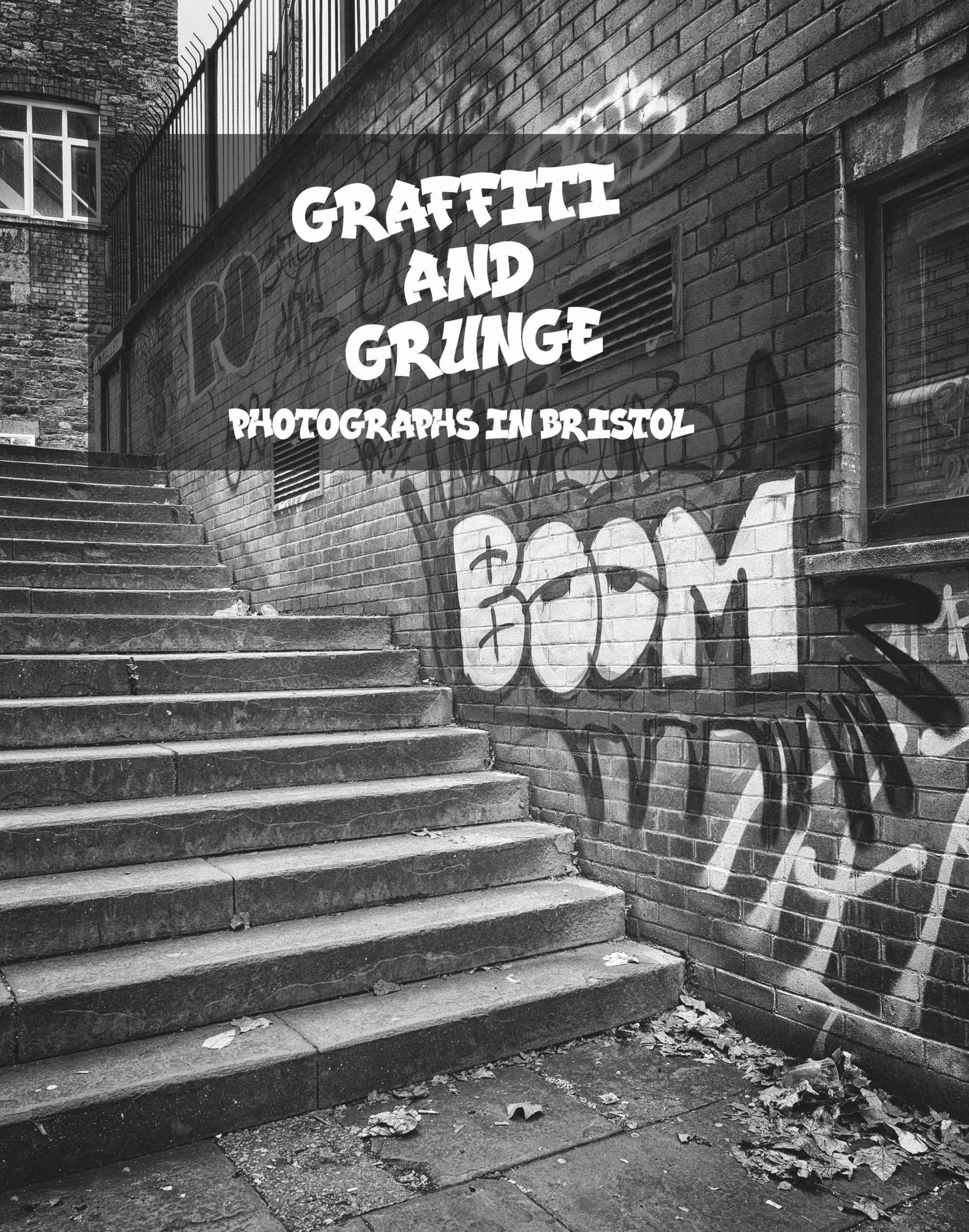
I am pleased to announce the release of my new book, “Graffiti and Grunge – Photographs in Bristol.” It captures the raw atmosphere of Bristol, showcasing the city’s unique urban landscape through striking photography.
Featuring stunning images that highlight the creative expressions found throughout the city, each photograph tells a story, reflecting the dynamic spirit of Bristol and its artistic community.
Whether you are an art enthusiast, a Bristol native, or simply appreciate urban photography, “Graffiti and Grunge” is a valuable addition to your collection.
Available now, this book makes a perfect gift for anyone who loves the urban aesthetic. Secure your copy today and explore the vivid narratives captured within its pages.
“Graffiti and Grunge” is available direct from myself or, if you are in Bristol, at the Arnolfini bookshop on the harbourside.
21st April 2025 – Andy Gawthrope Photography is excited to announce the upcoming release of a new book, showcasing an exquisite collection of photography that captures urban scenes of Bristol during 2019 – 2025.
Scheduled for release on 1st May 2025, the book, titled “Graffiti and Grunge – Photographs in Bristol”, features over 60 stunning black and white images made across the electoral wards of Hotwells & Harbourside, Central, Ashley, Lawrence Hill and Easton. It is a visual record of run-down area’s and the graffiti they contain.
Suitable for both photography enthusiasts and those with an interest in Bristol, “Graffiti and Grunge – Photographs in Bristol” invites readers to explore some of Bristol’s less well-known areas.
Pre-orders will begin on 1st May 2025. For further announcements please stay tuned to our website.
For media inquiries or for more information about the book, please contact:
It’s said that ‘you don’t know what you have until it’s gone’. This year a spinal injury forced an overnight transition from being very active to almost housebound for several months. All photography had to be curtailed and mentally that’s been tough. It’s also said that ’with absence the heart grows fonder’. I now, more than ever, recognise that being outdoors photographing our beautiful landscape is a passion of mine. So, it’s been a joy these last few weeks to again be outdoors with a camera and, fingers crossed, on a return to health.
Maybe it’s an idea that’s been growing subconsciously during those darker days when I really didn’t know if I’d be carrying camera and tripod again but I currently seem to have an elevated liking for the dark, black and white style commonly known as Film noir. It’s a visual style should be familiar to most people, even if not by name. Think moody, dramatically shadowed, 1940/50s black and white movies with a private detective and femme fatale. Looking back now, I see it’s a style I’ve explored before with Cornish Tin mines and, whilst not so much Film noir, contrasty black and white’s of the Neolithic stones at Avebury.
Route
The route should be easily identifiable from the photographs by those familiar with the area. It went along Brook Way to the Aldi roundabout, detoured to Tesco Extra before passing through the nature reserve down to the duck ponds and then under the road bridge before rejoining Brook Way at the Sherbourne’s Brake roundabout. It’s about 5km and so isn’t a major undertaking.
So, with camera in-hand and set to black and white mode I set off around my local area with only a mid-range zoom deciding to leave camera bag and tripod at home. In mind was the idea of a warts and all, slightly grungy feel to any images, something that should work well in a Film noir style.
Wonky
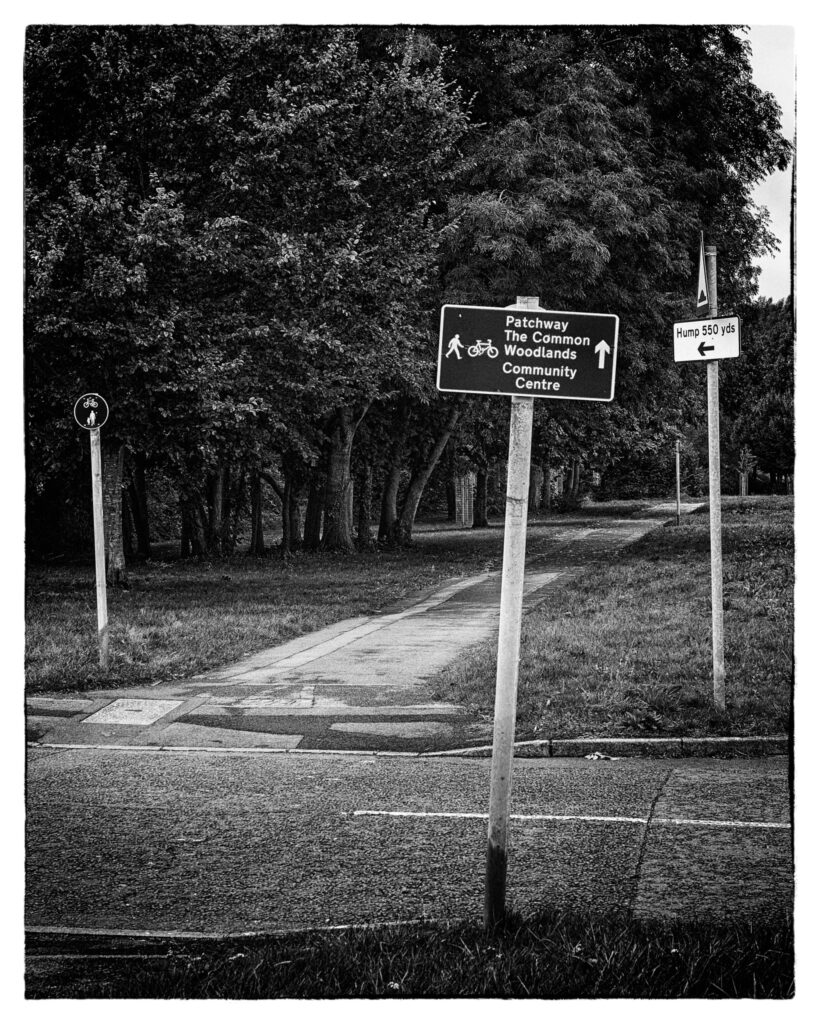
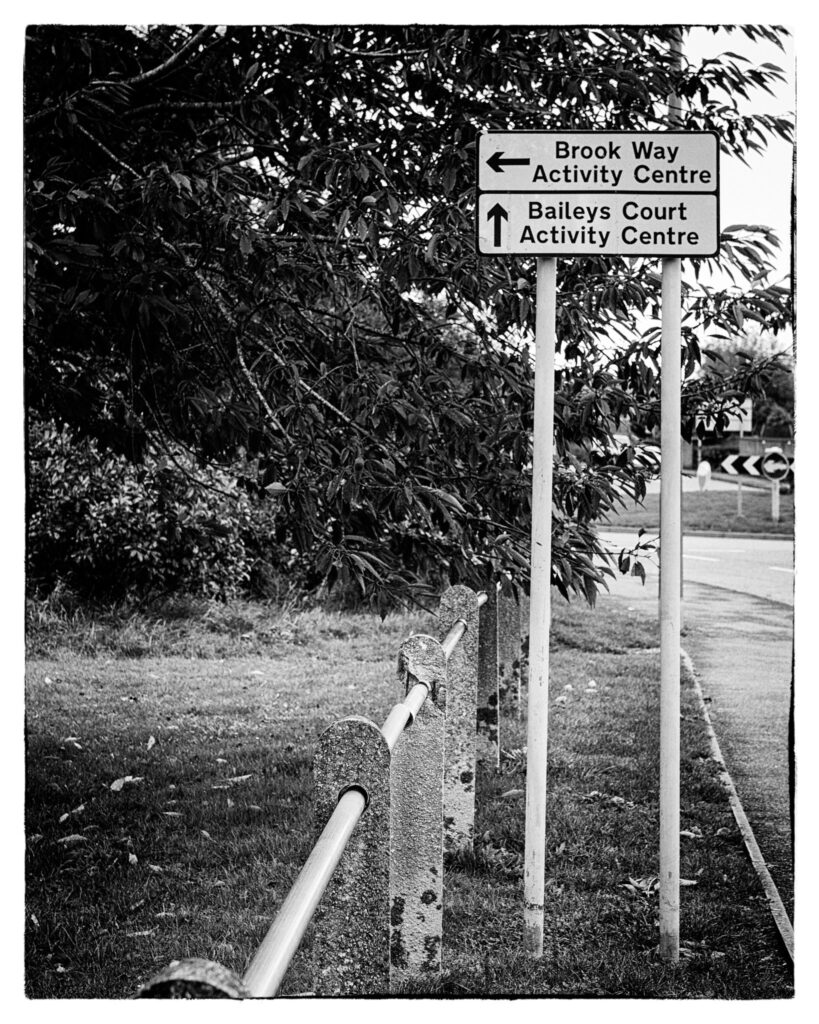
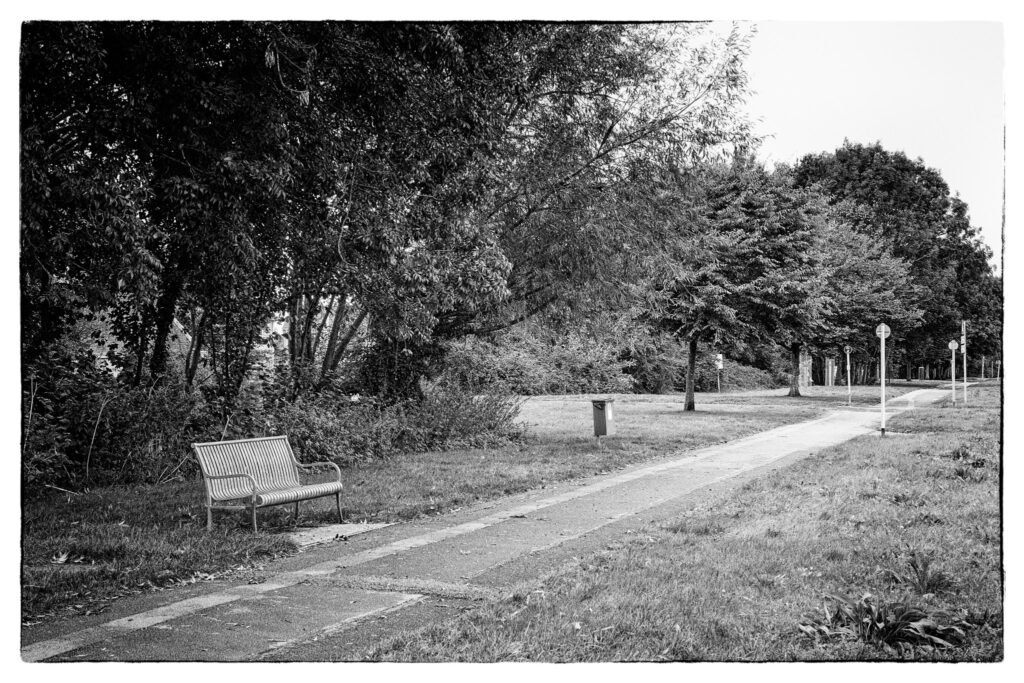
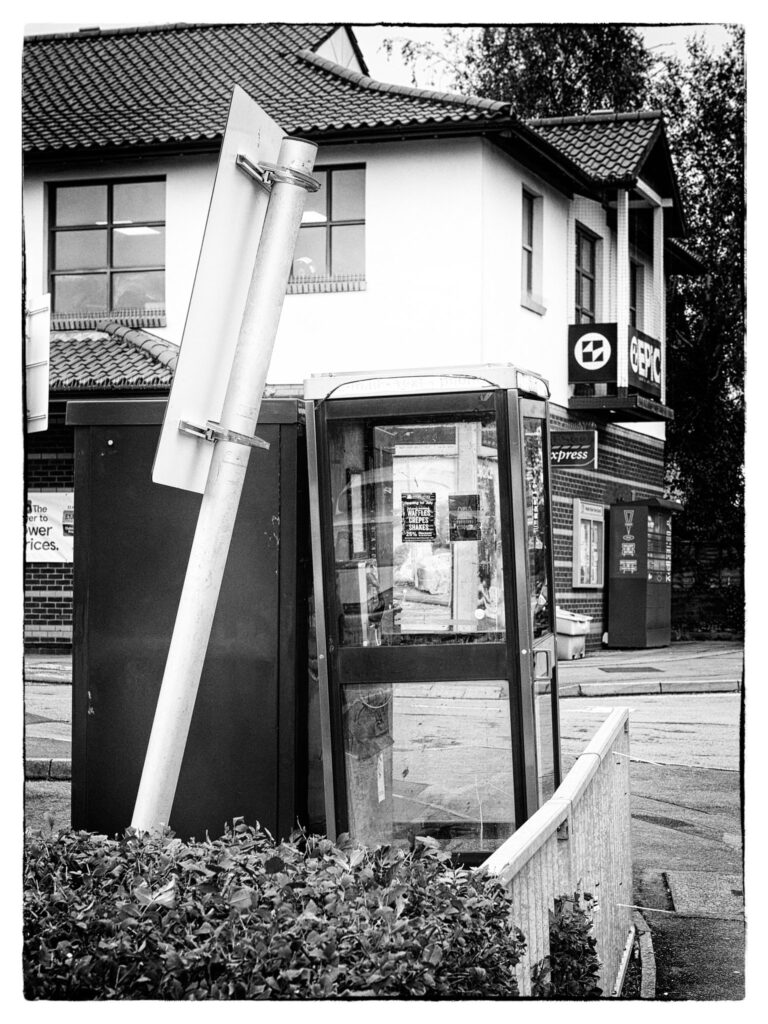
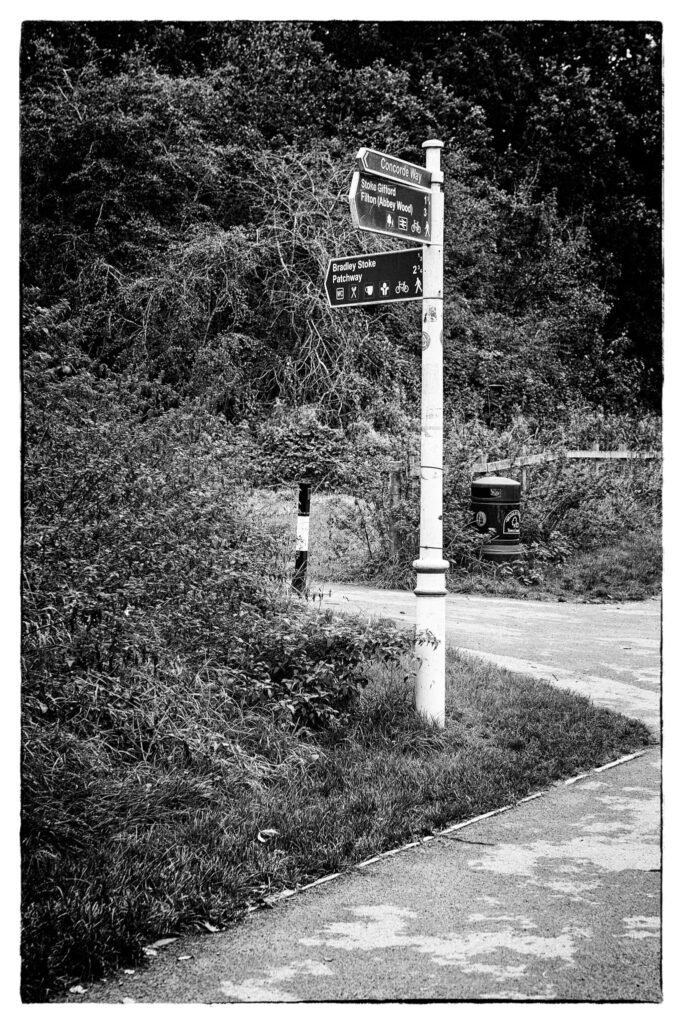
I’ve walked the route countless times over the years but on this occasion, for some reason, I was greatly amused by the sheer number of signposts many of which lean slightly one way or another. With their text, arrows or coloured symbols they stand atop short grey rusting poles littering the landscape with no apparent regard to their aesthetic or visual impact. Along Brook Way they seem to outnumber the trees!
Wonky signage
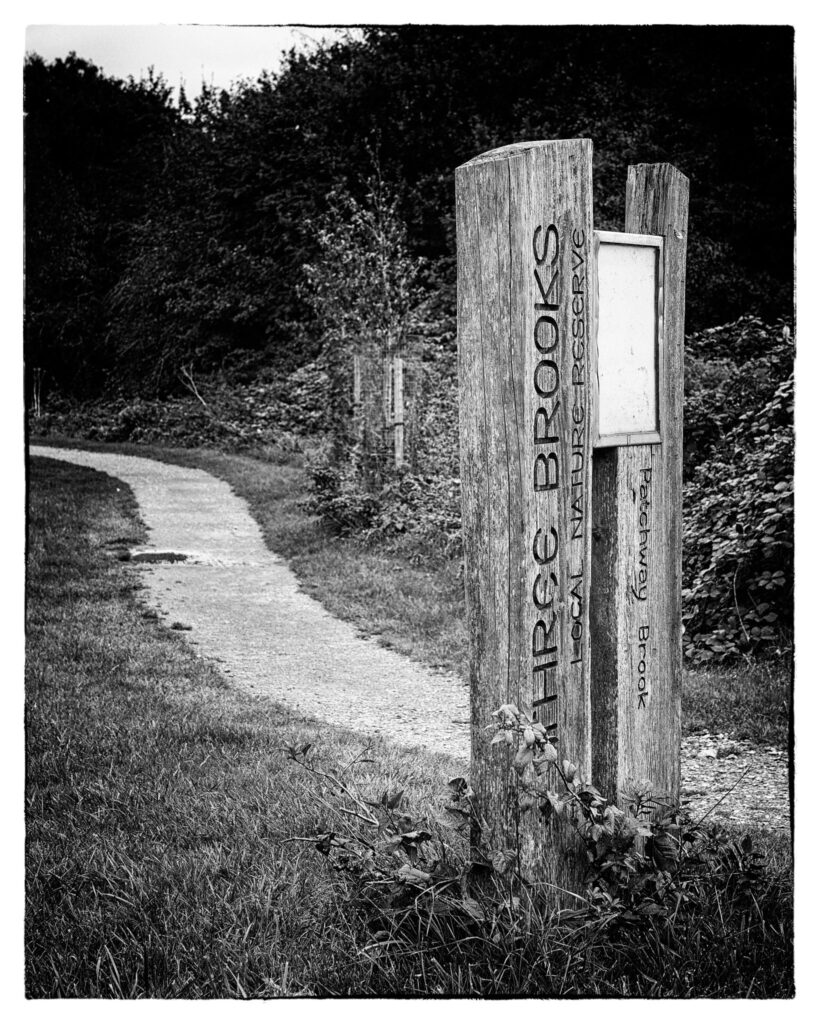
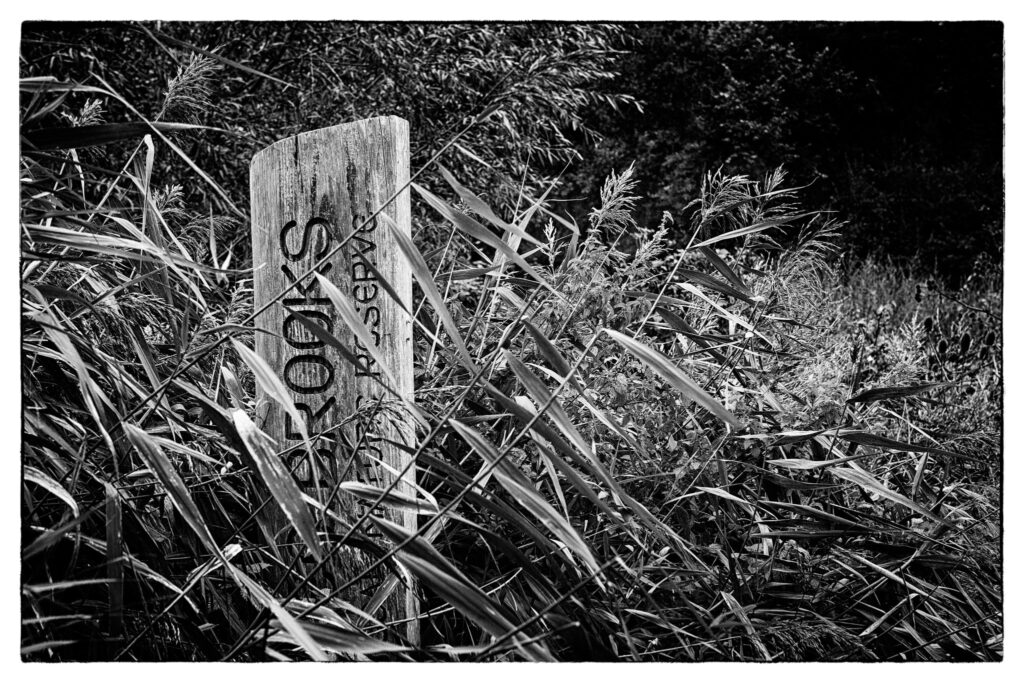
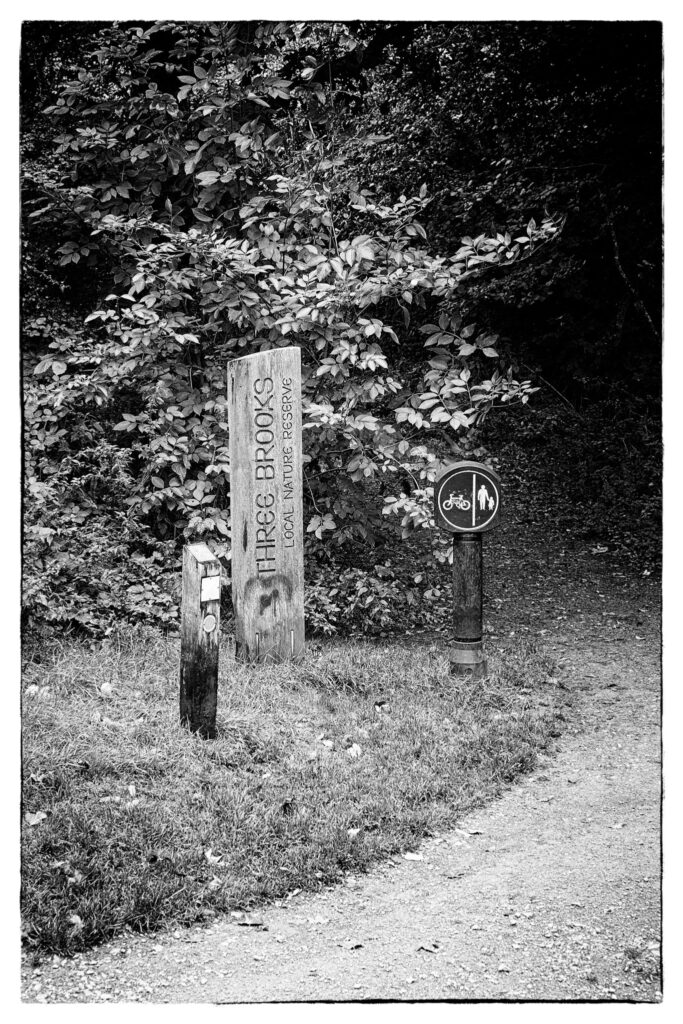
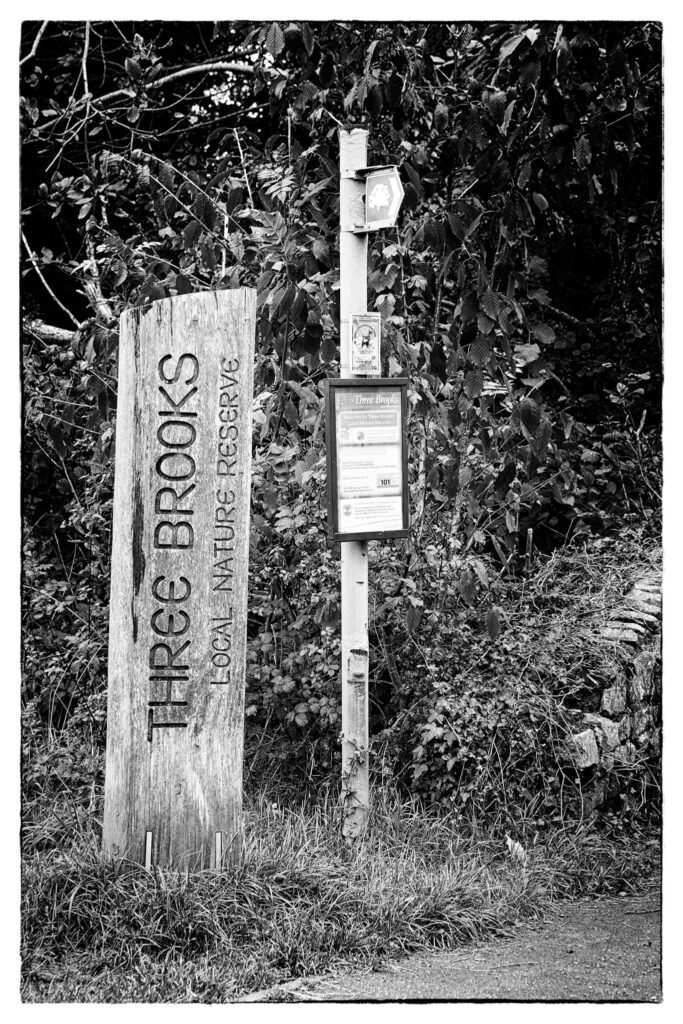
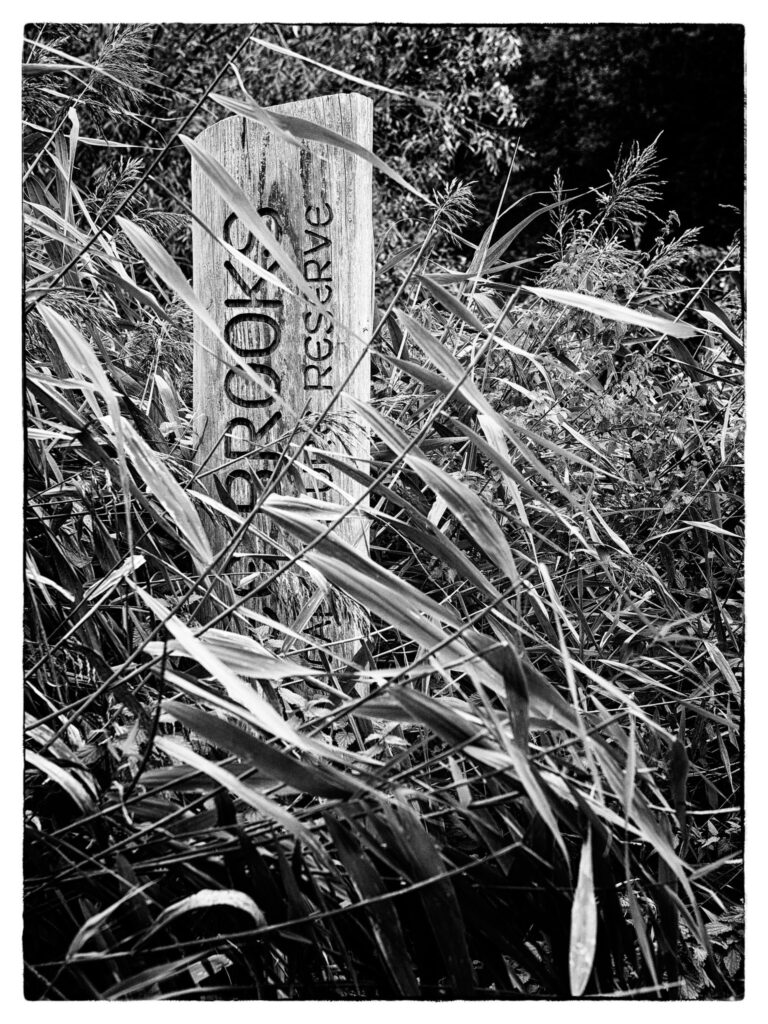
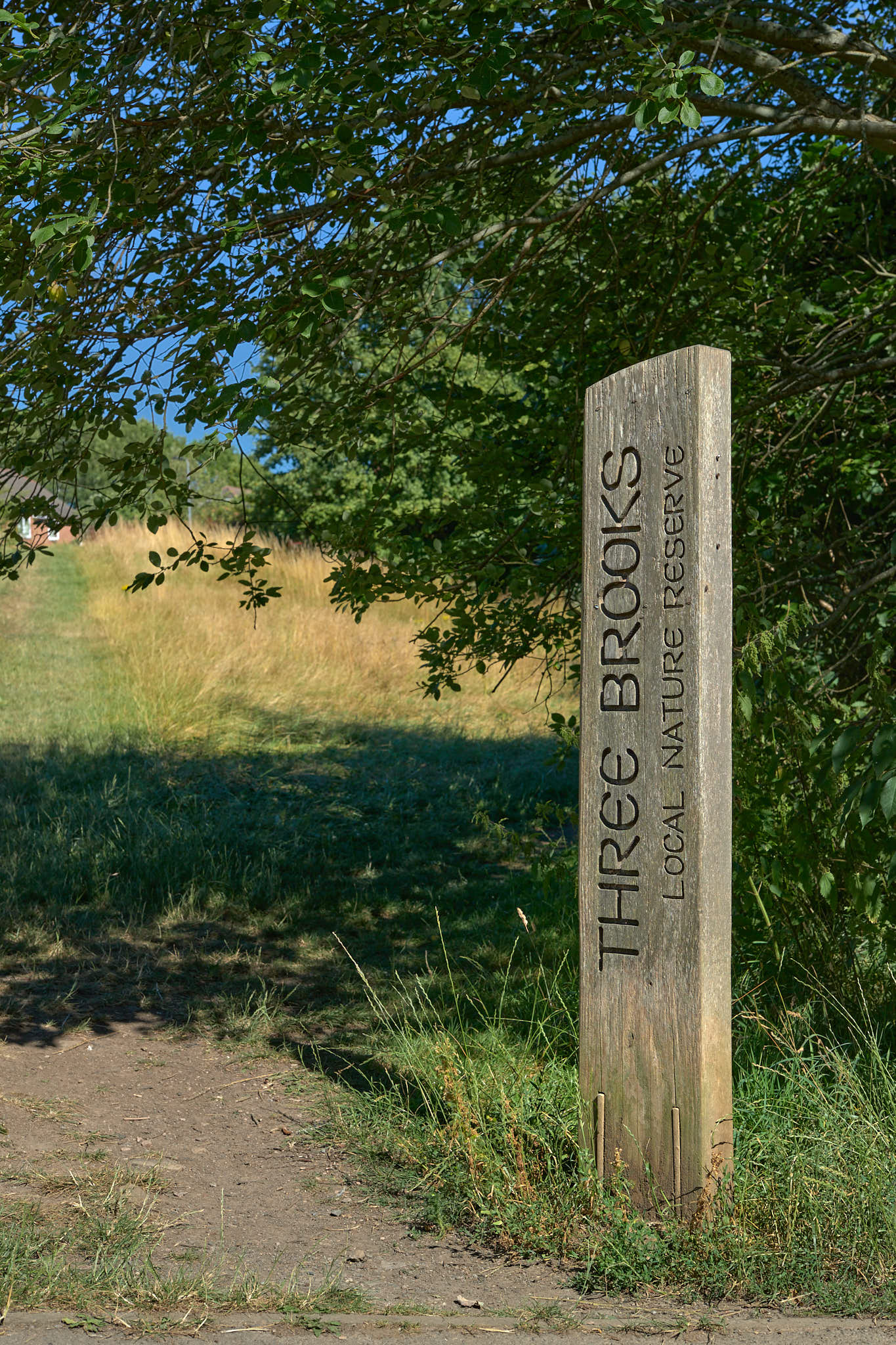
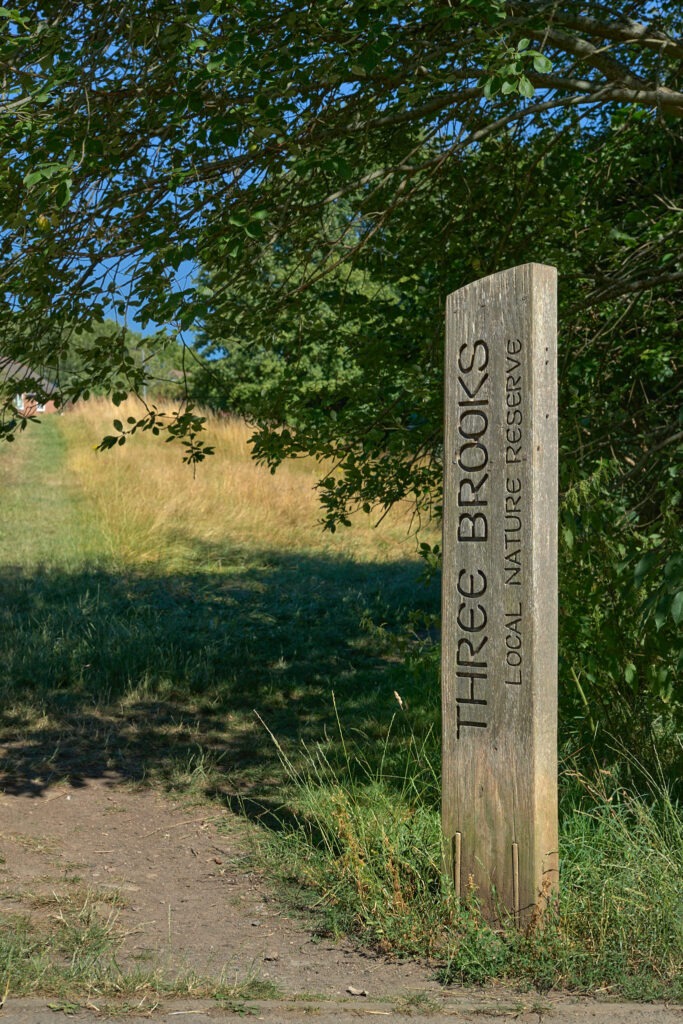
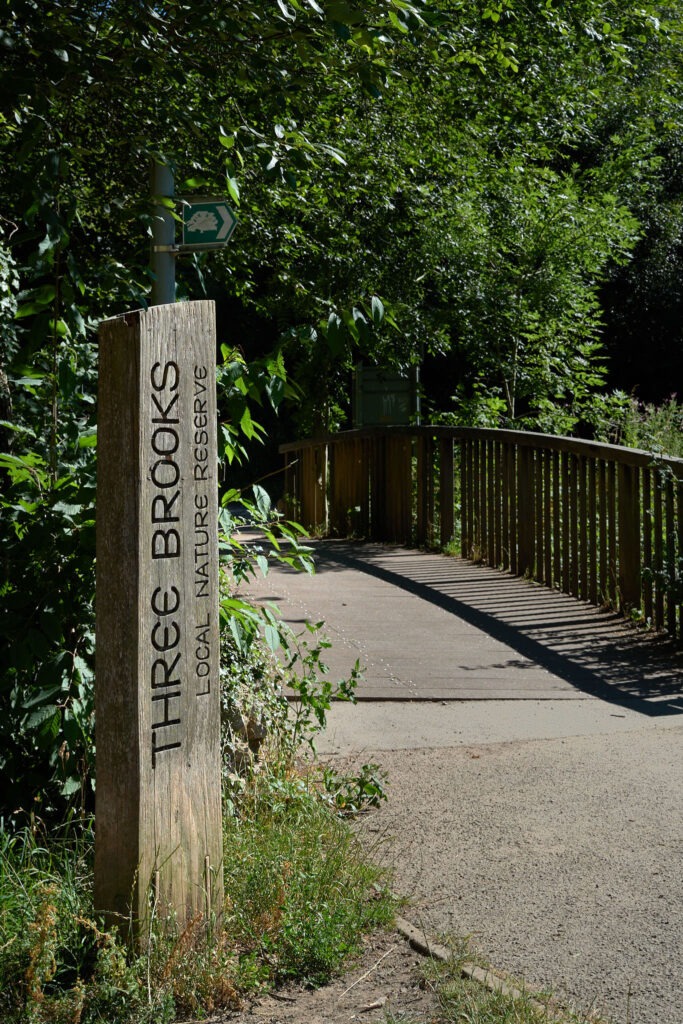
I’m glad to write that some signage, specifically that for the ‘Three Brooks local nature reserve’ has clearly been given greater thought with its lettering elegantly carved into large timbers. But, disappointingly, planted alongside these nice signs are ugly, plastic footpath/cycle-path signage and yet more of the ubiquitous grey poles. Yes, I’m having a moan but is all this ugly signage really necessary?
At the top of the route near the Aldi roundabout are some shops and a telephone box. The box is of a generation prior to deregulation when British Telecom managed the UK telephone system as opposed to the more well known, red coloured, traditional Post Office telephone boxes. Again I found myself having a giggle as it, together with adjacent signage and fencing, was so off-level that it was a struggle to know just what was level!
Three Brooks Nature Reserve
Three Brooks local nature reserve
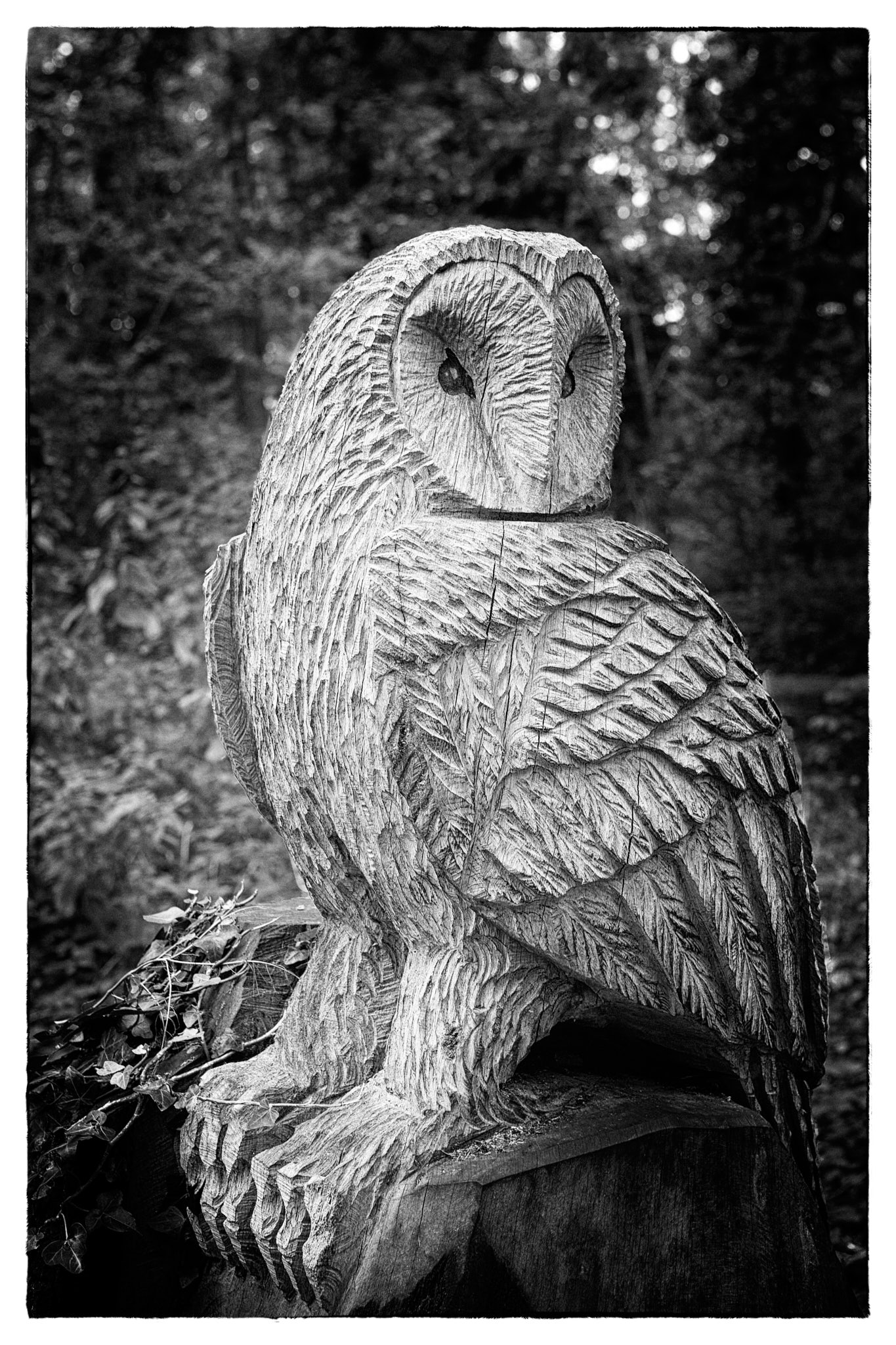
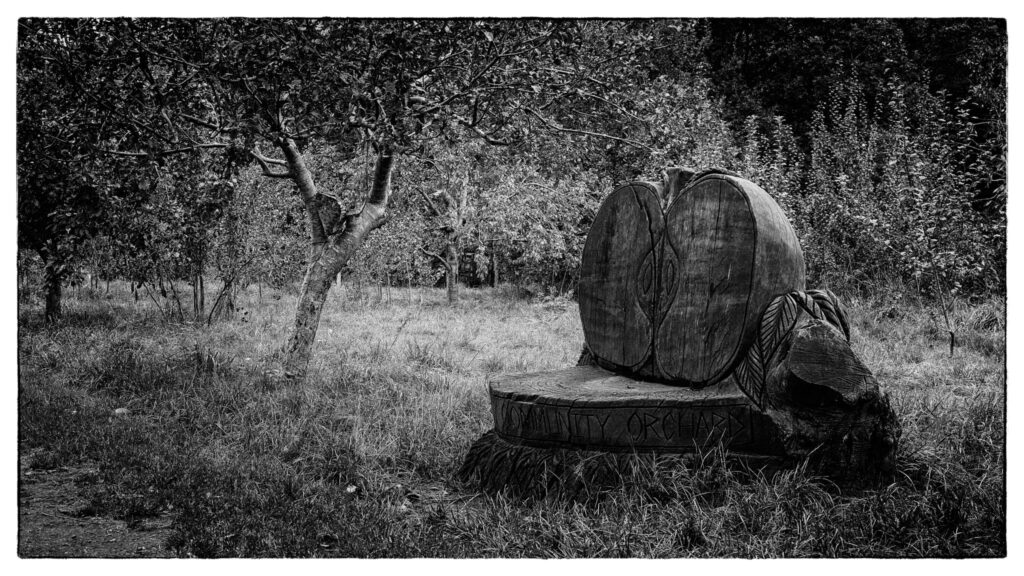
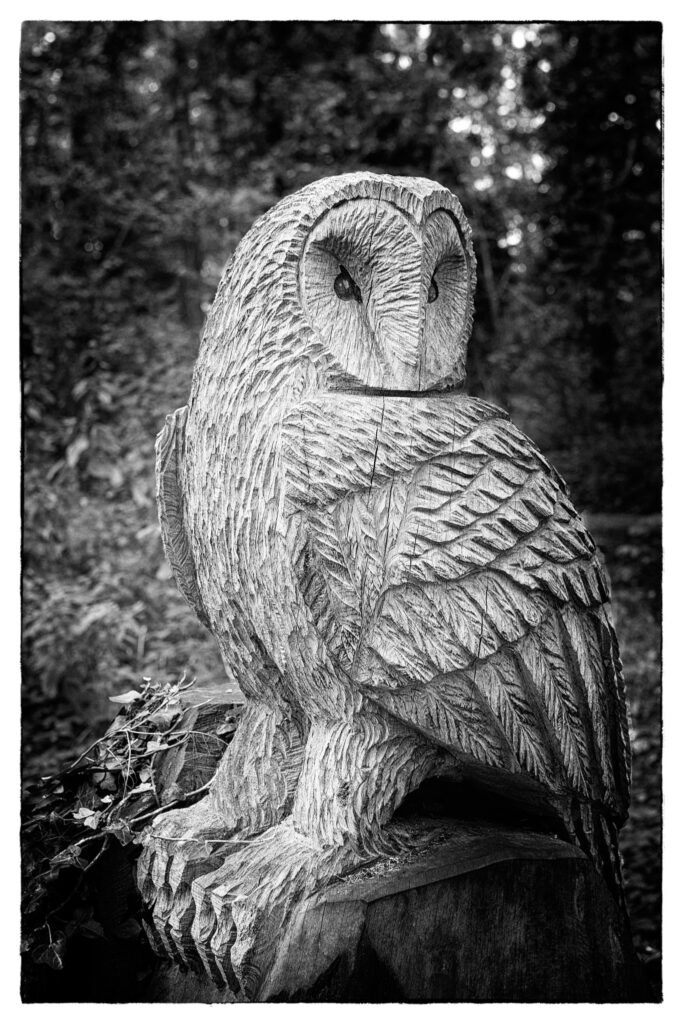
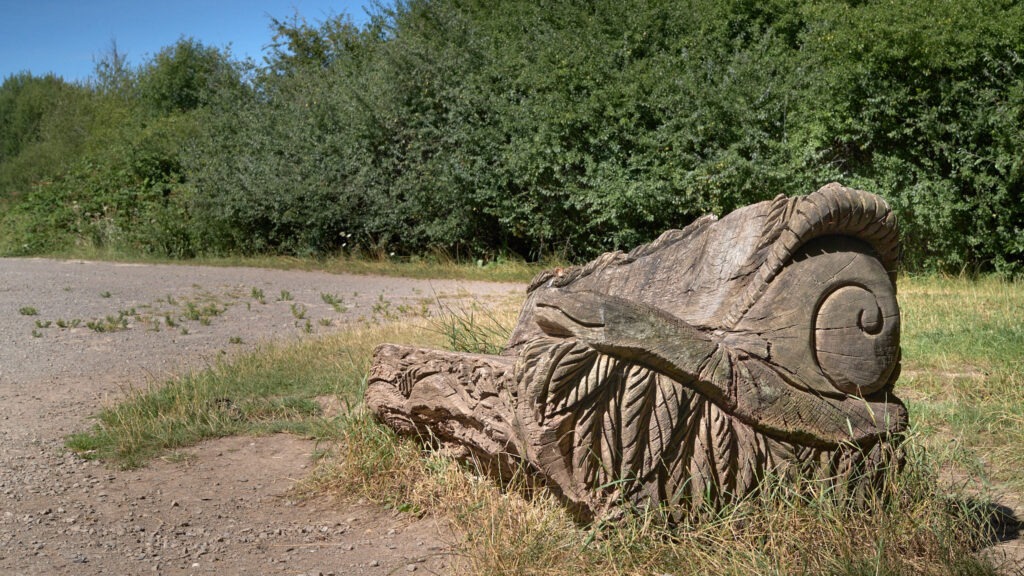
Walking through the nature reserve the scenery changed from urban clutter to something more natural and pleasing to the eye. Alongside the main track running through the reserve are three wooden benches hewn from the trunks of trees presumably cut when, or soon after, the reserve was created. Wood ages beautifully and these benches are no exception. Although their once fresh, elaborate carvings have softened with age they are still great features adding character to the reserve. It’s also great to see that new carvings are still being created. During 2023 in woodland behind the sports centre an Owl was carved by artist Andy O’Neil. This beautiful creation sits at eye level atop its wooden stump and looks incredibly realistic!
Sometimes when walking through the reserve small groups from the Three Brooks Nature Conservation Group are encountered. If you see them, stop and say ‘hello’ as they are all volunteers and doing a wonderful job at looking after the reserve for us all. On a different but recent walk I stopped and had a most enjoyable chat with Sara who was incredibly knowledgeable and keen to talk about the flora, fauna and the work of volunteers.
Wrap-up
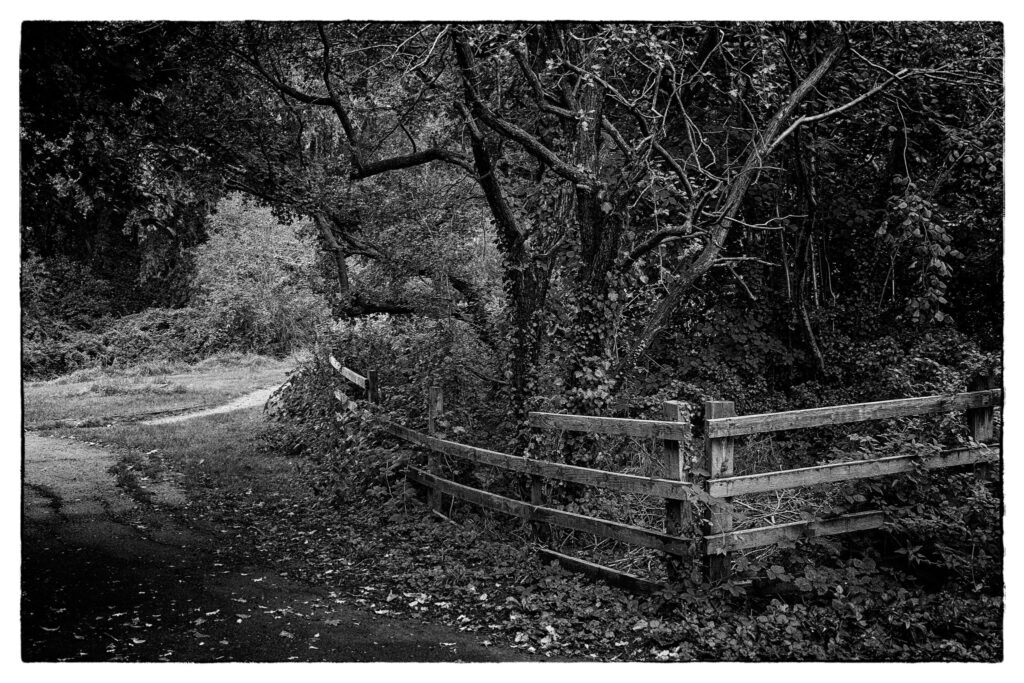
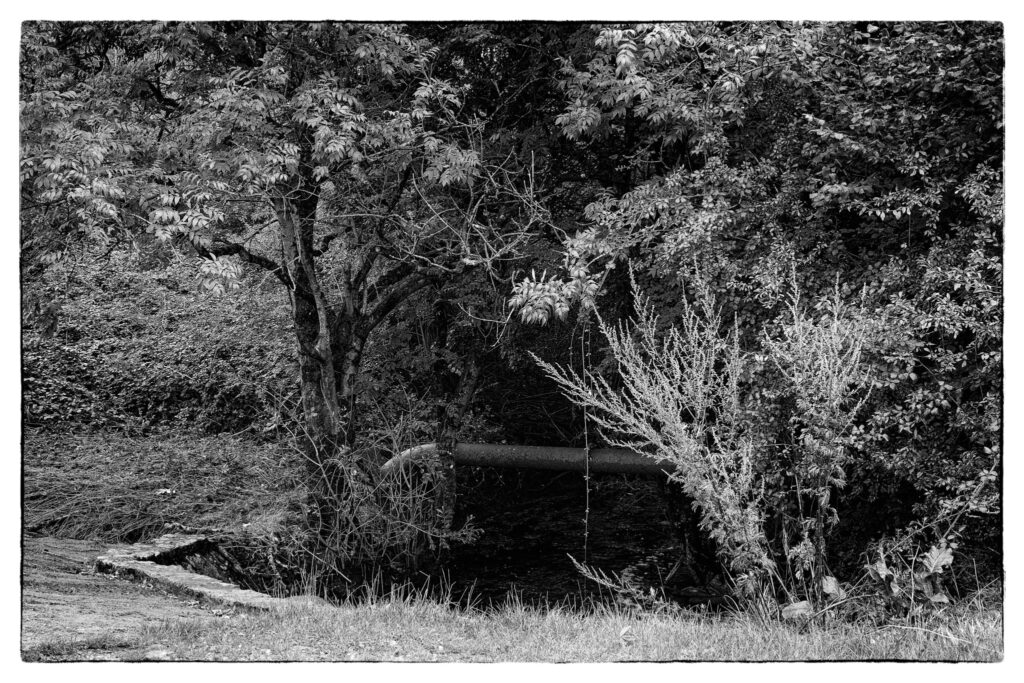
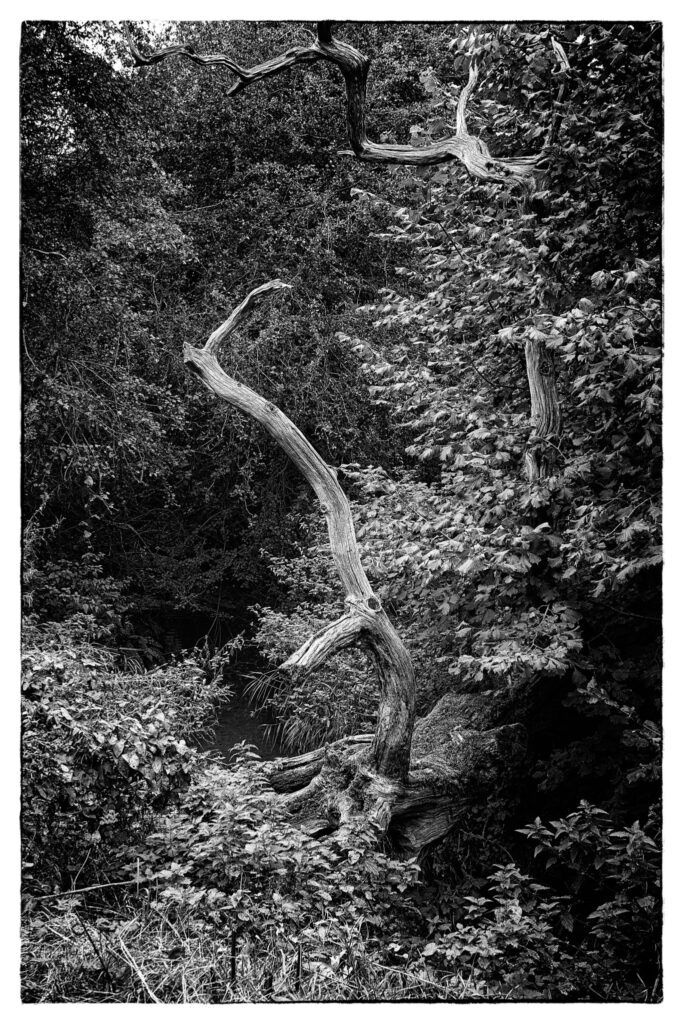
Back in the office the images were uploaded, developed and Film noir styled using Capture One and Silver Effects from DxO. Looking at them now, as a collection, I quite like the Film noir styling; it’s helped add a little drama to what could otherwise be some quite mundane images. I especially like the resulting detail on the Three Brooks signage, fence and dead tree.
The full collection of images from the walk are below.
Andy
My previous posts regarding Bradley Stoke and the Three Brooks nature reserve are available to read at:
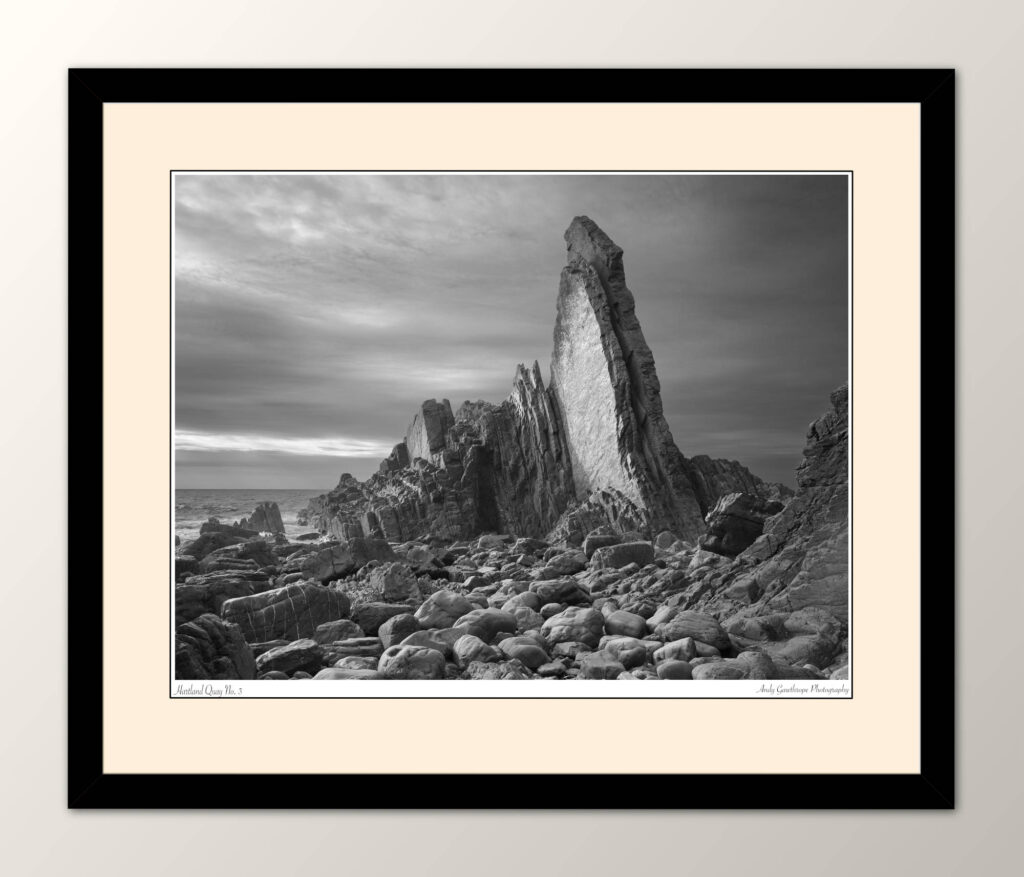
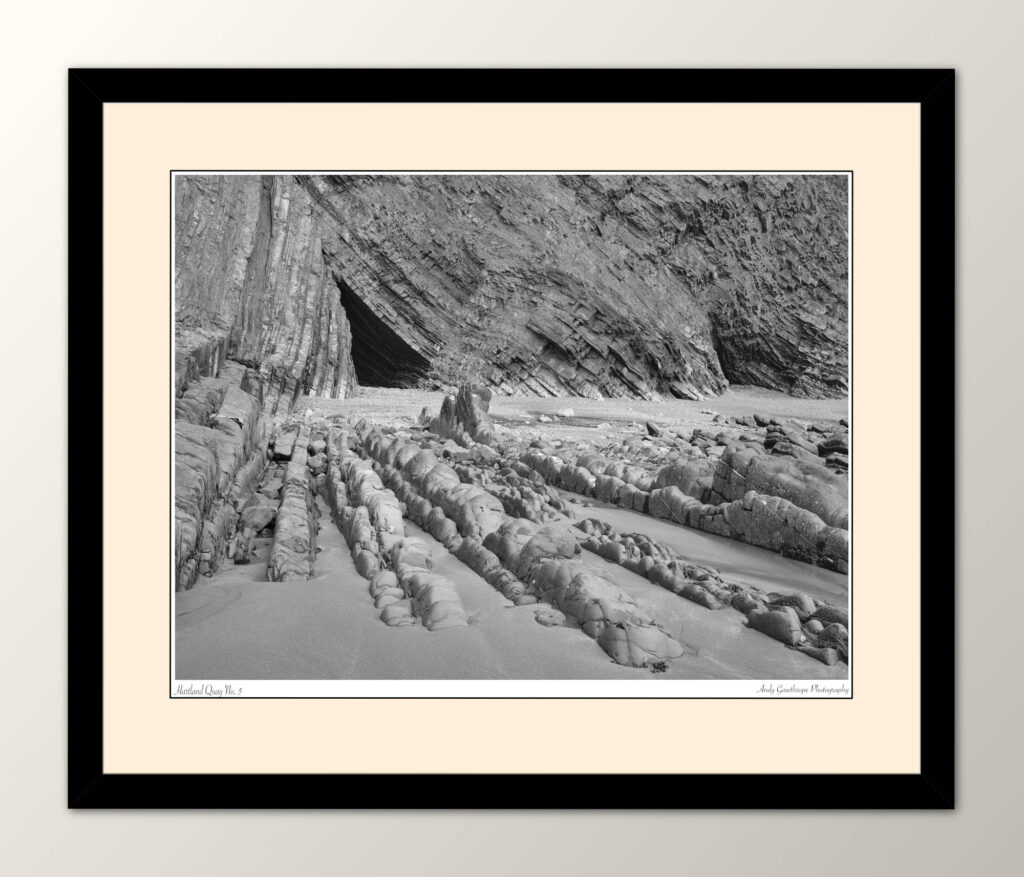
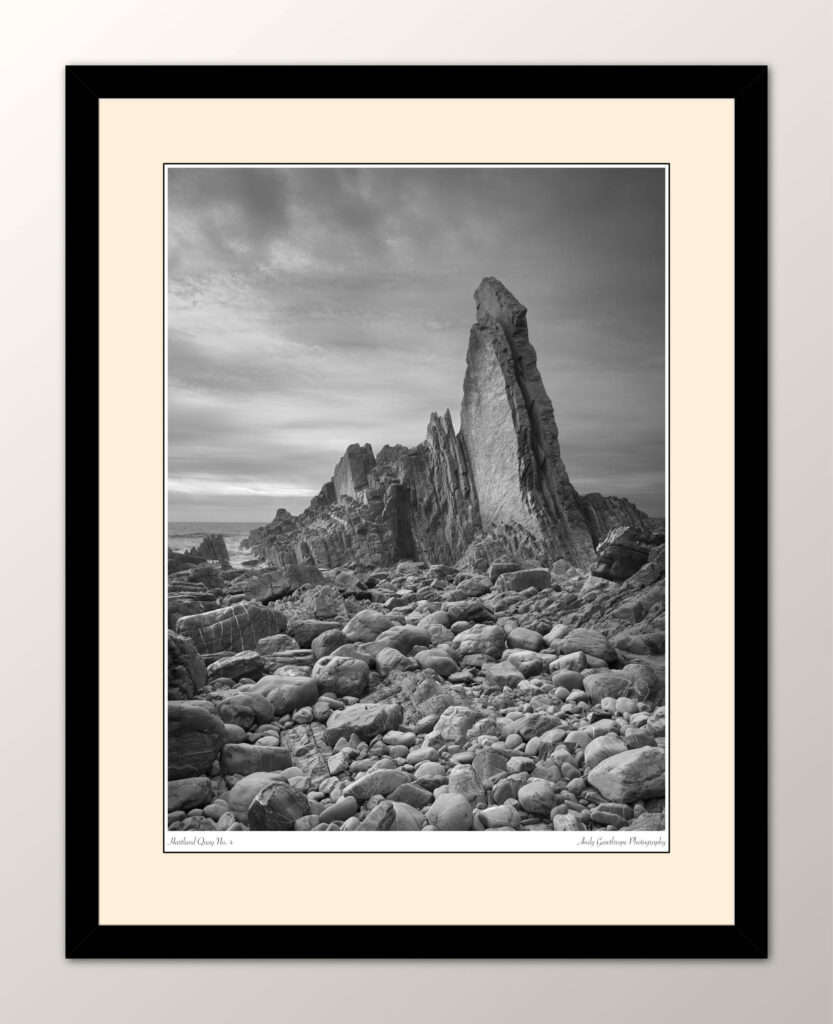
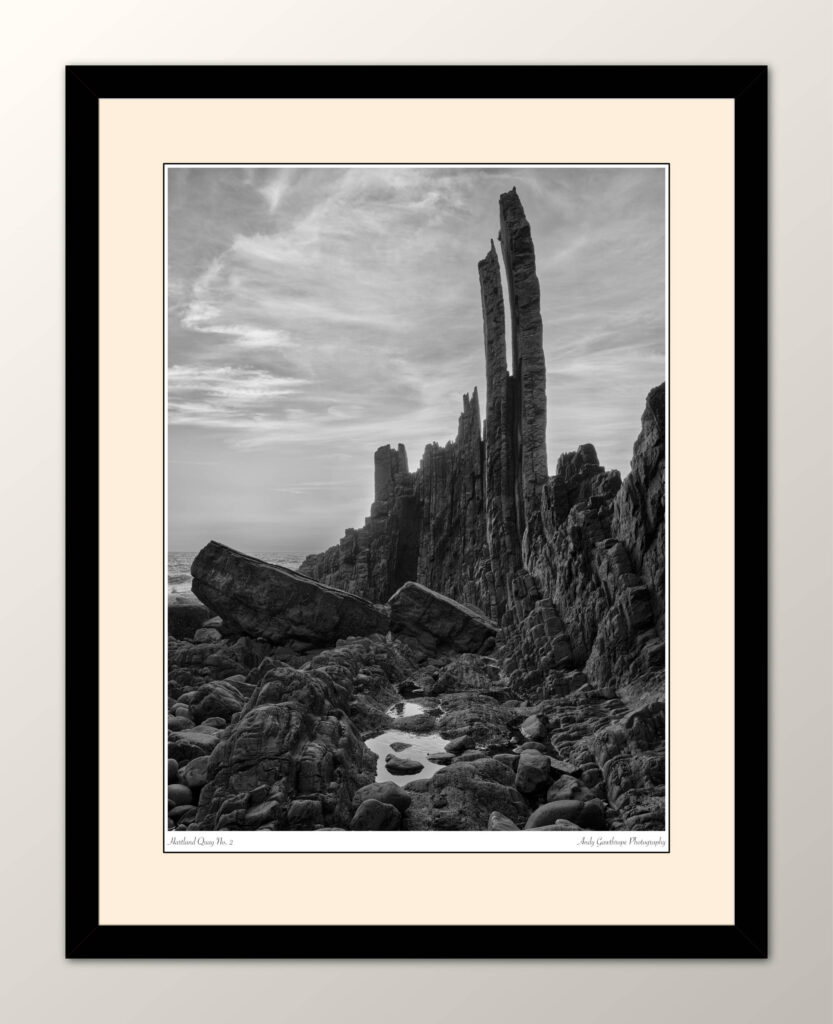
In early 2017 after a week in Lofoten with Tom Mackie I was poring over Ordnance Survey maps of the English, South West coastline seeking potential locations for coastal photography. I spotted Hartland Quay; Situated on the coast with a hotel and a campsite not too far inland it appeared to have potential as a photographic location. After some online research I decided it was worth exploring and so chose to stay at the hotel in March of that year for a couple of days. Whilst I recall the weather not being great with wind rattling aging sash hotel windows, I do recall being captivated by the sea cliffs and the rocky/sandy beaches. Back then, Hartland Quay got recorded in my log as a place with potential and worth revisiting.
It was in late summer this year that I returned for a weekend with friends and was reminded of its potential and my earlier log entry. So, after some further research including the selection of a week compatible with tide heights/times I returned in October this year, choosing to stay at the near-by Stoke Barton campsite for a week.
Top-tip. I highly recommend keeping a log; It’s somewhere to record ideas and places that peek interest. Once recorded, entries are not forgotten and what’s more they can be researched, developed and then associated information recorded for future use. Information such as when is the best time to visit? Is the location best at high tide, at low tide or what height tide is desired for a photograph? Keeping a paper log is an approach and may be appropriate for some but I propose paper is less durable, less portable and would get messy very quickly as ideas are researched and information revised. My log is electronic. Just recently it moved from an application called Evernote to Apple Notes due to concerns about the stability of the company behind Evernote. But the application is actually not that important as such note taking applications are available for all mainstream compute platforms be it Windows, Mac, Linux, Apple IOS, Android etc. Electronic form is very portable, doesn’t get messy – if maintained – and can be content rich. For example, my note about Hartland Quay includes contact information and web links for the hotel, the campsite, text and thumbnail images about possible photographs, text identifying at what tide height exit across the beach is cut-off etc. In electronic form it’s possible to always carry the log so if your plans change whilst on location you stand a good chance of having the information needed.
Earth’s Forces Unveiled
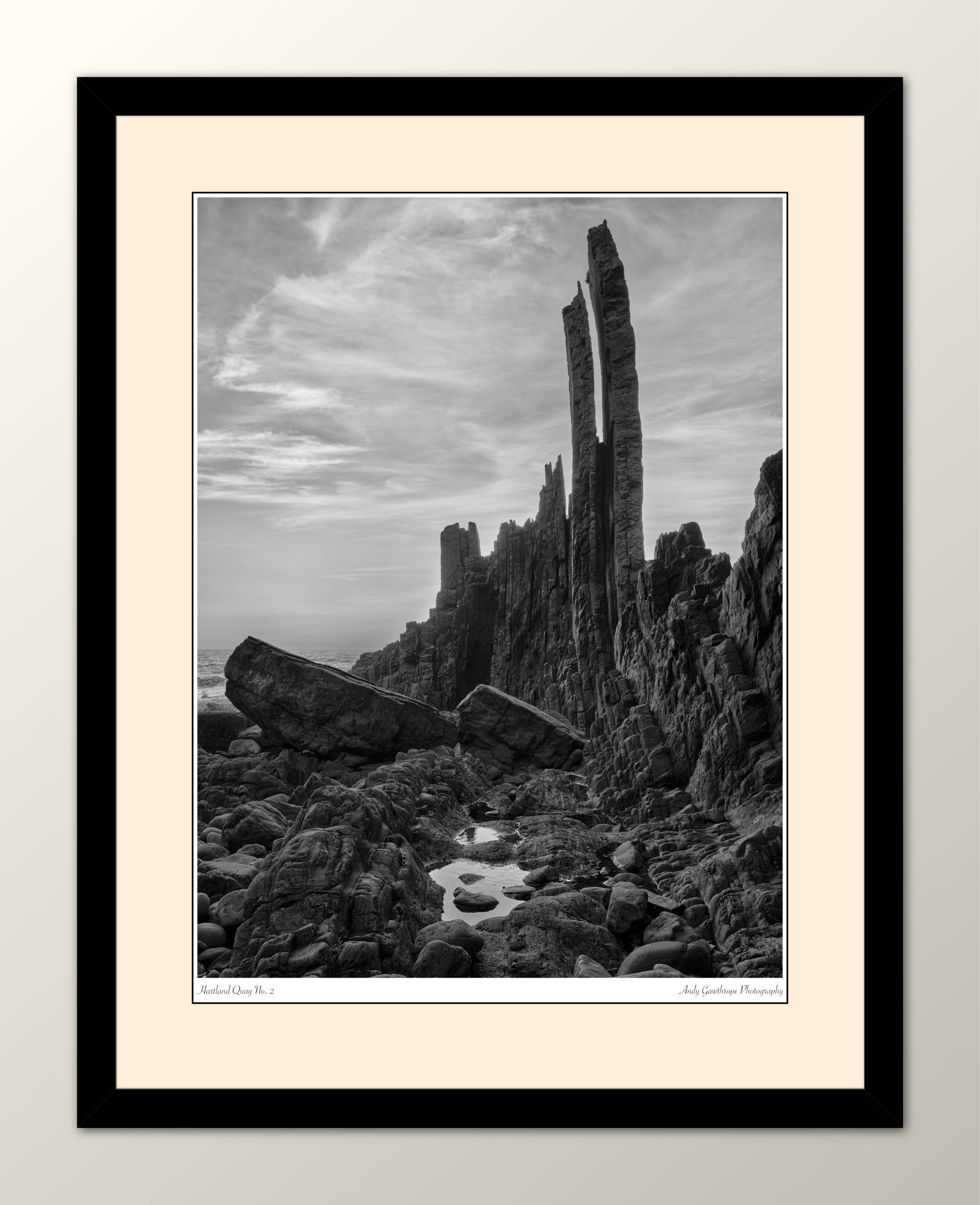
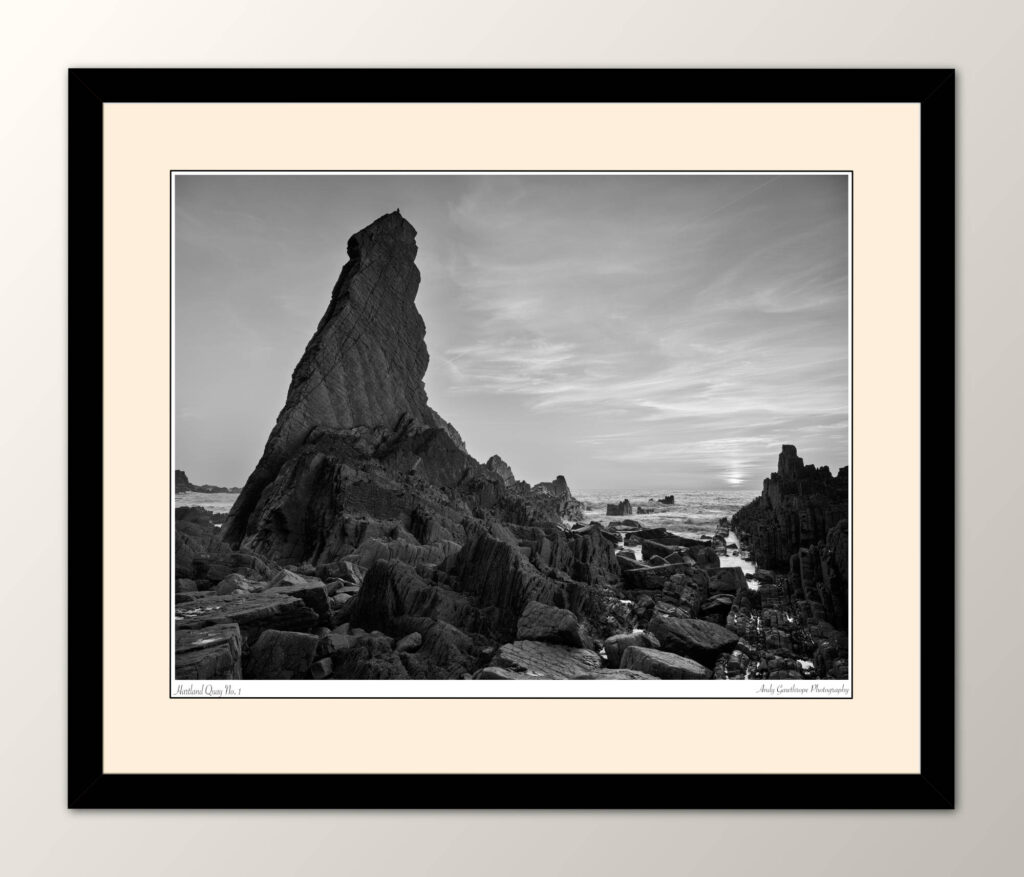
At Hartland Quay and the surrounding area it’s the sea cliffs and their eroded remains protruding from the sandy beach like the skeletons of long dead leviathan’s that I find most interesting. I’m no geologist but the rocks are truly impressive. They were laid-down as sediments in a shallow tropical sea, rich in marine life during the geological Carboniferous period and have been compressed and transformed into alternating layers of sandstone, shale and limestone during the intervening millennia. Today they are not just the edge between the North Atlantic Ocean and the Devon countryside but are a story of geological forces etched into the very fabric of the landscape. I find the dramatic cliffs and skeleton-like rocks a captivating photographic subject as it’s possible to make photographs that freeze moments in time and capture the essence of a place where the past and the present coalesce.
Shipwrecks and Trade
While the geology of Hartland Quay provides a geological narrative spanning eons, the human history is equally compelling. The harbour was initially constructed in the 16th century in the reign of Henry VIII and the pier/quay followed some time later. The harbour has now gone with the pier succumbing to the North Atlantic Ocean in 1887. The anchorage provided by the rocky cove made Hartland Quay a strategic location for maritime trade and the transportation of goods. During its heyday Hartland Quay bustled with activity. Cargo vessels laden with goods ranging from slate to grain anchored in the sheltered harbour waters, ready to unload their precious cargo. The quay facilitated the export of local products and the import of essential goods, becoming a vital hub for the economic life of the region.
However, the unforgiving nature of the North Atlantic took its toll on many vessels attempting to navigate the treacherous waters. The coastline on which Hartland Quay sits became notorious for shipwrecks, with the remnants of stranded vessels becoming a haunting reminder of the challenges faced by mariners. The area is dotted with wrecks each telling a story of perilous journeys and the indomitable power of the sea. A recent shipwreck associated with this part of the Devon coastline is that of the Johanna, a Panamanian-flagged Dutch coaster that ran aground a little to the North at Hartland Point at the end of 1982. Although now almost completely gone, some remnants can still be seen at low tide.
The Wrecker’s Retreat
Clearly I’m not the first stills photographer to have discovered Hartland Quay; It’s also been used as a movie location several times. This is evidenced by a visit to the hotel bar, “The Wrecker’s Retreat”, whose walls are adorned with photographs of the rocks, of the quay and of the many wrecked ships. A visit is well worthwhile to see what others have done and thus what to avoid and to see the historic photographs of the quay and wrecked ships as they form a historical record capturing moments in time. I feel that landscape photographs are important too as the coast is a dynamic environment changing a little every day as erosion takes its toll.
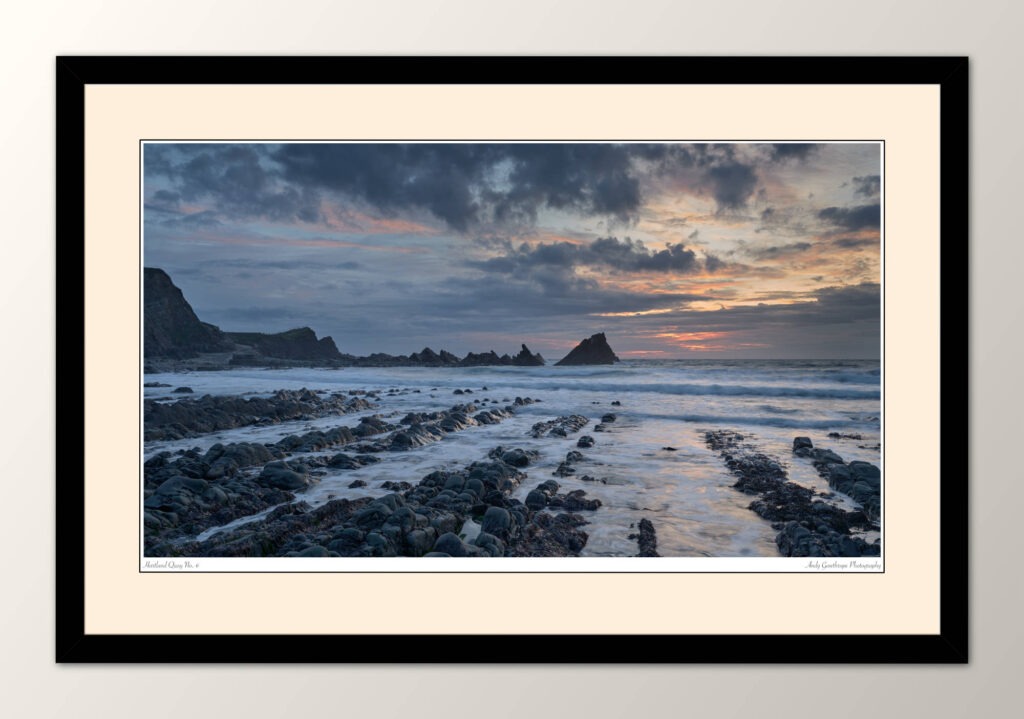
Hartland Quay No. 6
Tides, Safety and Dynamic Conditions
Photographing around Hartland Quay comes with challenges common to coastal photography, primarily the dynamic conditions of a coastal environment. Tide height is pivotal, not only does it dictate the visible elements of a photograph but it also constrains access to the beach/coast. It’s important to know whether the tide is heading out or coming in and at what tide height the lowest part of your access route becomes cut-off. This is especially important on a rising tide when it’s not possible to see your entire access route which can be the case at Hartland Quay. Don’t rely on finding a way up the cliffs either, they are high and constituted of loose/crumbly rock and grasses. Something I’ve seen many times on beaches and which, quite frankly, scares me silly is people sunbathing, sitting, playing etc right at the bottom of sea cliffs with seamless disregard to the tons of loose rocks immediately above them. Even a single, small rock is going to cause injury. So please be careful.
The unpredictable weather of the Atlantic adds an element of spontaneity to photography sessions. During my week at Hartland Quay the weather had many characteristics; some days were cloudless with strong late-summer sunshine, other days were cloudy and one day very, very foggy! So foggy that you couldn’t see more than 5-6m! That fog was too dense to be photographically useful and when it did clear in the late afternoon it revealed cloudless skies. Fortunately the sea was never stormy but there was usually an onshore wind which drove spray towards the beach/rocks and was a constant source of work as the exposed front-surface of lenses or filters were quickly covered in a briny layer which constantly needed to be removed. This leads to some more of my top coastal photography tips:
1. Carry plenty and probably more than at first seems reasonable, lens cleaning cloths / liquids. Once cloths are contaminated with, even a small amount of, sea spray they just smudge and smear. I carry several large micro-fibre cloths but primarily many single use lens wipes. These are small and lightweight so it’s easy to pack many and on use each is uncontaminated by spray.
2. Keep you camera bag close and if a rucksack then preferably on your back. If its on the ground ensure it can’t be reached by that errant higher wave…
3. Keep your camera bag closed so spray doesn’t get inside an onto your equipment
4. Check and if necessary, clean your lens prior to every exposure.
5. Clean all gear at the end of the day or as soon afterwards as possible.
A Visual Symphony of Earth and Time
Photographing the geology of Hartland Quay is a journey into time and something which I greatly enjoyed. The sculpted cliffs and the dynamic conditions converge to capture the essence of a place where the Earth’s history is etched into every rock. It’s a place that has huge potential and to which I’m sure I’ll return.
Andy
All images are copyright Andy Gawthrope Photography.
The long, often blue sky days of summer are a photographically challenging time but this year I wanted to make the most of them by doing something different and pushing my photography into an area not previously explored. My photographs are typically of the classic landscape / grand vista style and include land, sky and if possible, water. I needed a project concentrating on much smaller, simpler subjects that would, hopefully, lend themselves to summer conditions.
Please see the gallery at the bottom of this post for the full collection of photographs. Each may be enlarged by its selection.
After much deliberation two ideas remained. The use of colour, patterns, shapes and textures as a primary subject with images bias towards simplicity and the second idea was to photograph people rock climbing. I like the idea of photographing people in seemingly gravity defying positions high above the ground surrounded by hard unforgiving rock. There is a certain sense of tension and of drama.
At some point I realised that photographing climbers was going to be hard, very hard in fact, despite having over a decade of climbing experience myself but the idea of rock somehow stuck and fused with the first idea. So I had a project, but where to go?
Location
The English Lake District has a long history of rock climbing but also of quarrying for stone. That is no different from many other areas of the UK such as Snowdonia but I hadn’t been to the ‘lakes’ for a few years and felt it was time for another visit. Borrowdale is my favourite Lake District valley. It’s a wide crescent shape with Keswick at the top and Seatoller at the bottom. It’s green and a beautiful mix of small farms, trees and water surrounded by hills and sheep. And, of course, no description of Borrowdale can omit the magnificent Castle Crag which sits in the middle of the valley just below the Southern end of Derwent water. Seen from the North its imposing shape can’t be mistaken. Borrowdale also makes a great location as it has the friendly campsite of Hollows Farm at Grange. This nestles just below the Northern slopes of Castle Crag and thus most locations are within walking distance. It was, therefore, the easy choice as I knew the area had several quarries from previous climbing and photography trips.
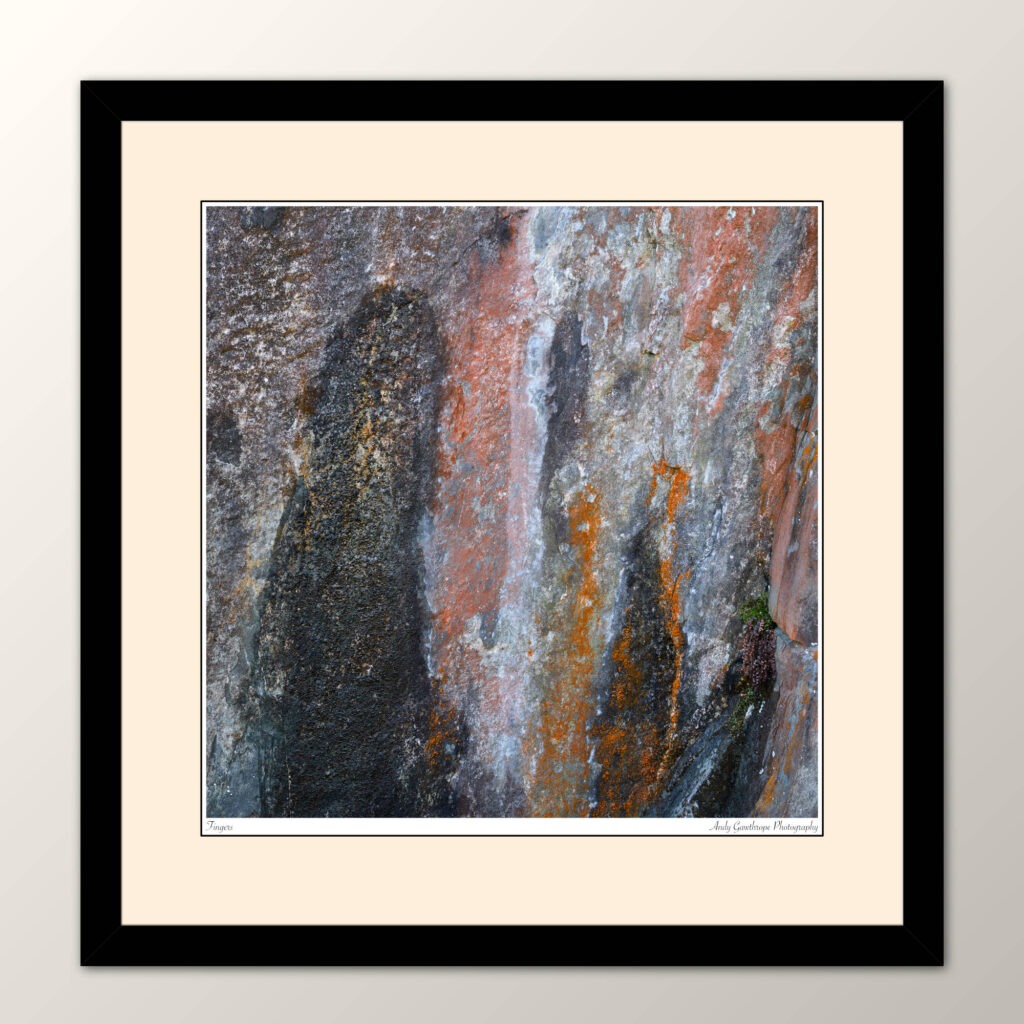
Fingers
I must stress that it’s necessary to be very, very careful when photographing in quarries. Rocks can and do fall from above unexpectedly; They don’t have to be large to cause serious injury to body or equipment. They are dislodged by many factors not just humans.
Before visiting, rooting through the Internet and my book collection identified that others had photographed in some of the area’s I was considering before. But the English Lake District is one of the most popular destinations in the UK and it’s almost impossible to photograph something completely original. In particular I was inspired by photographs in Landscape of the imagination by Angie and David Unsworth, ISBN 978-0-9565798-0-5, Greenburn Publishing 2010. Sadly, this excellent collection of work appears to be now out of print.
Equipment
The equipment used for the project was the medium format GFX100s from Fujifilm with either a GF32-64mm, GF45-100mm or GF100-200mm lens and it was usually necessary to work close-up to subjects using longer focal lengths to fill the frame. Focus, sharpness and depth of field were paramount so many of the images were made using wider apertures for later focus-stacking. The Fujinon lenses are very sharp especially at F8 but diffraction does start to soften from somewhere between F11 and F14 and is definitely noticeable by F16. For all photographs the camera was tripod mounted to ensure sharpness but positioning was often complicated as the ground was strewn with boulders and slippery, damp vegetation.
Photography
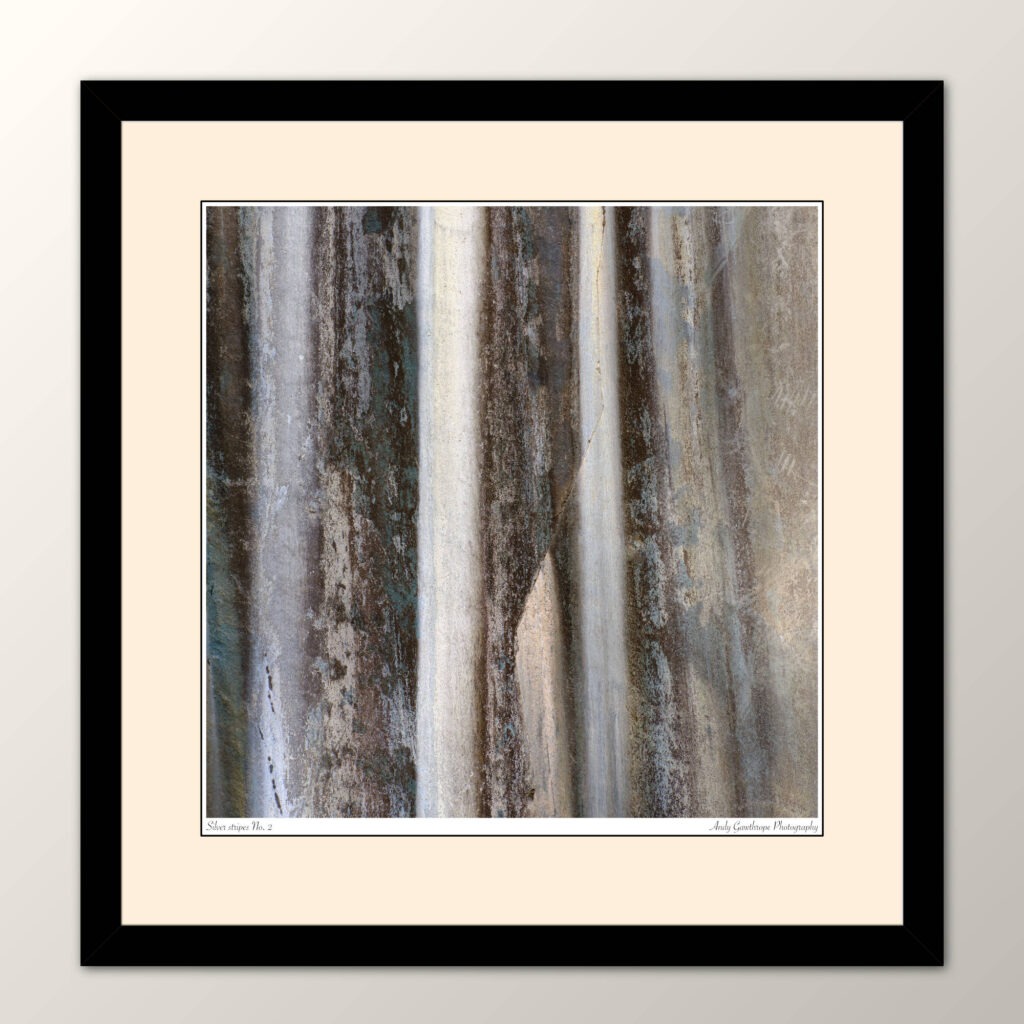
Silver stripes No. 2
Typically my photographs are made to stand alone being intended for wall display either in a domestic or commercial environment. I felt from the outset that the photographs intended for this project would probably work best as a collection and should therefore share, for the most part, a common aspect ratio. The GFX100s has a native 4:3 aspect ratio but in the field I often found myself using the 1:1 (square) preview so it wasn’t a surprise that on returning that I quickly settled on a 1:1 aspect ratio for all photographs.
I was fortunate that on each visit to the Lakes the weather was dry and bright, perhaps sometimes a little too bright but at least not dull and wet. Overcast but bright days were best, deep shadows were avoided and there remained sufficient, softer light to bring-out the colours. Although clear-sky days or days with direct light gave well saturated colours and shorter exposures there was also a tendency for shadows from surrounding trees and their leaves to be deeper and more noticeable. When these shadows moved between images focus-stacking became problematic and required extra work to ensue specific area’s were selected from one image over that in another. The best tool I’ve found for focus stacking is Helicon Focus because of the manual interventions and editing it supports during the stacking process.
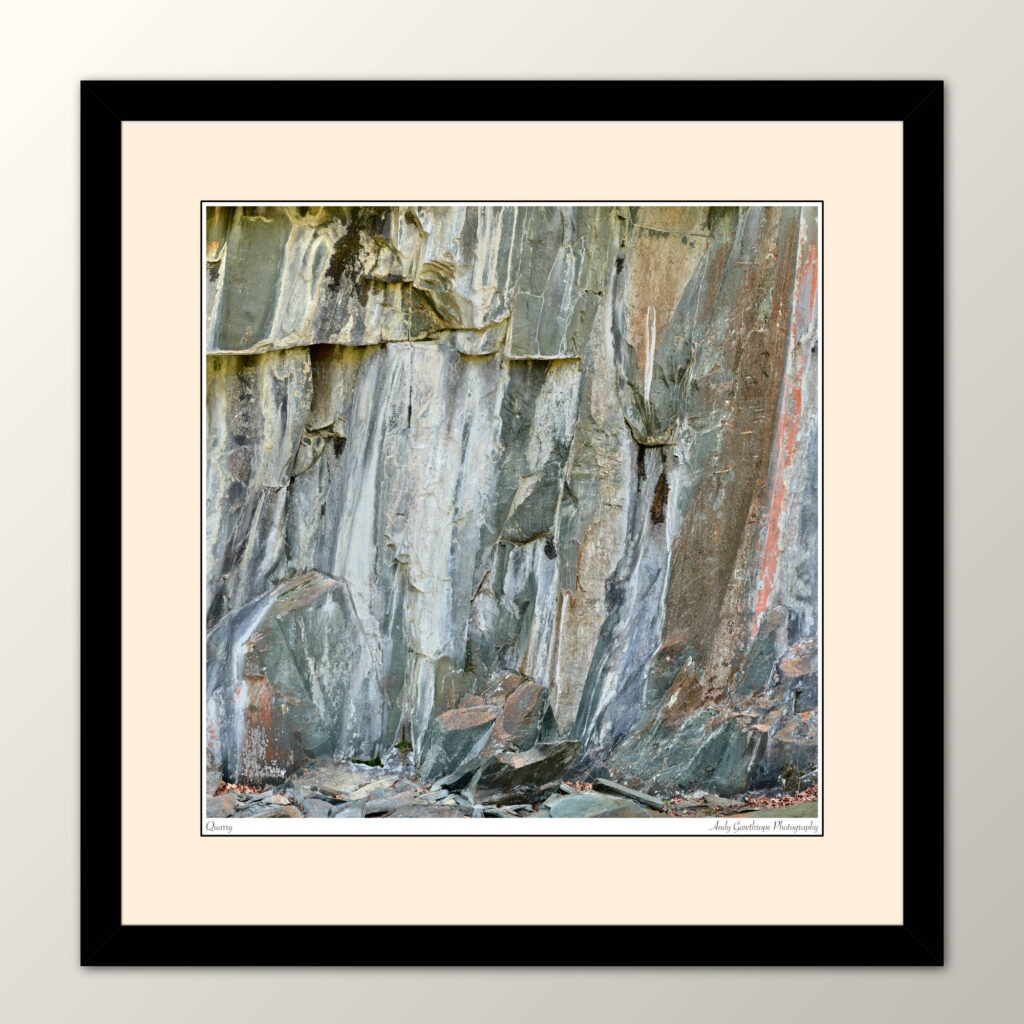
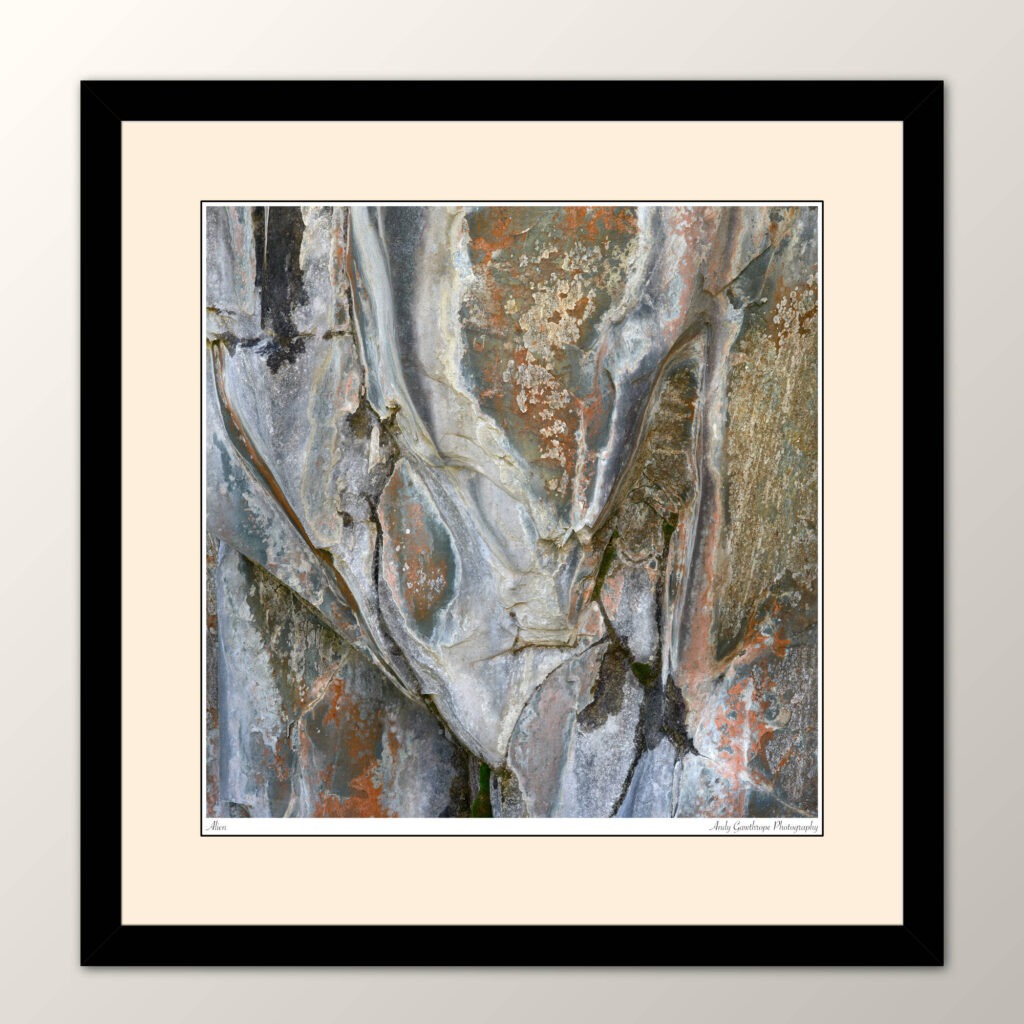
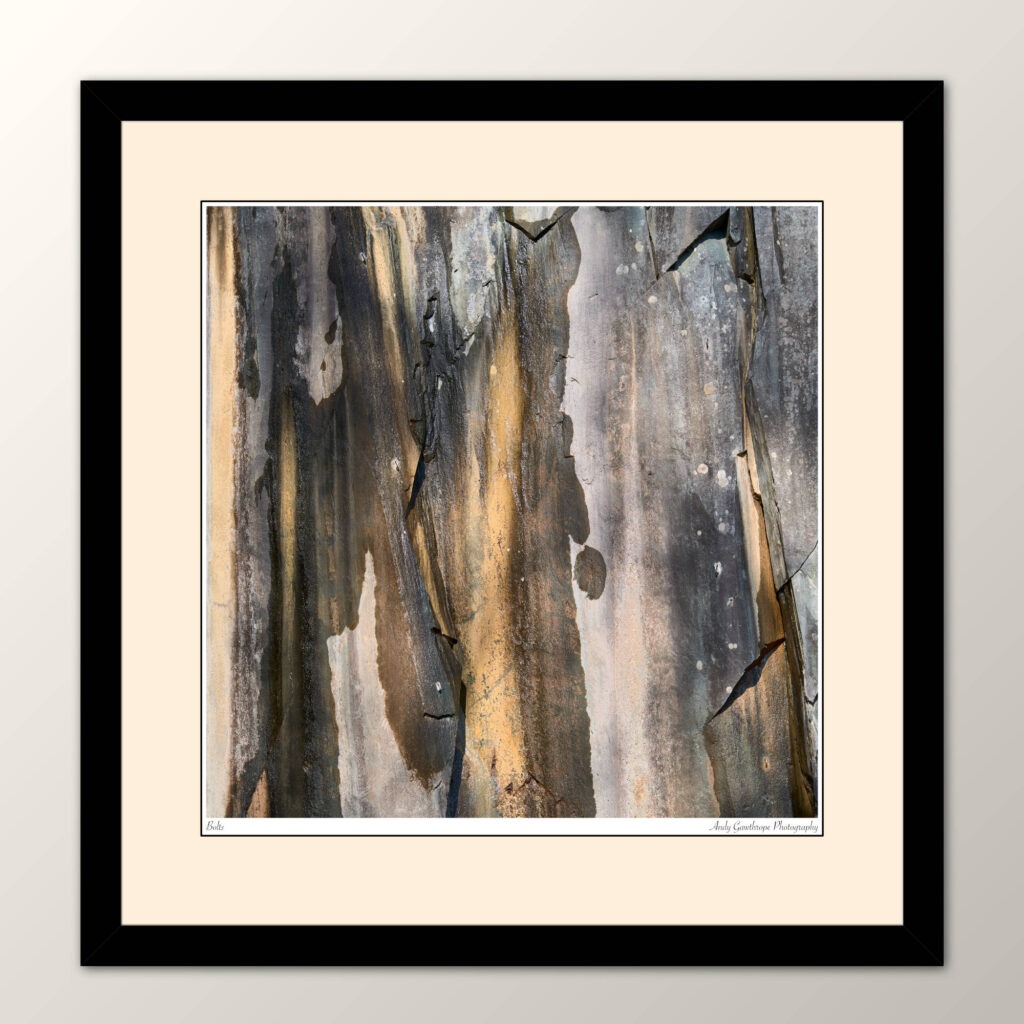
Whilst making the photographs but more so after returning I became aware that there were two clear groupings; The close-up, abstract ones and those including features more identifiable such as the ground or grasses and thus non-abstract. Initially this was a concern as I couldn’t decide whether I liked the unbalance, the contradiction within the same collection. However, ultimately I feel more comfortable with both being together as they contrast and the non-abstract photographs help set the context of the others.
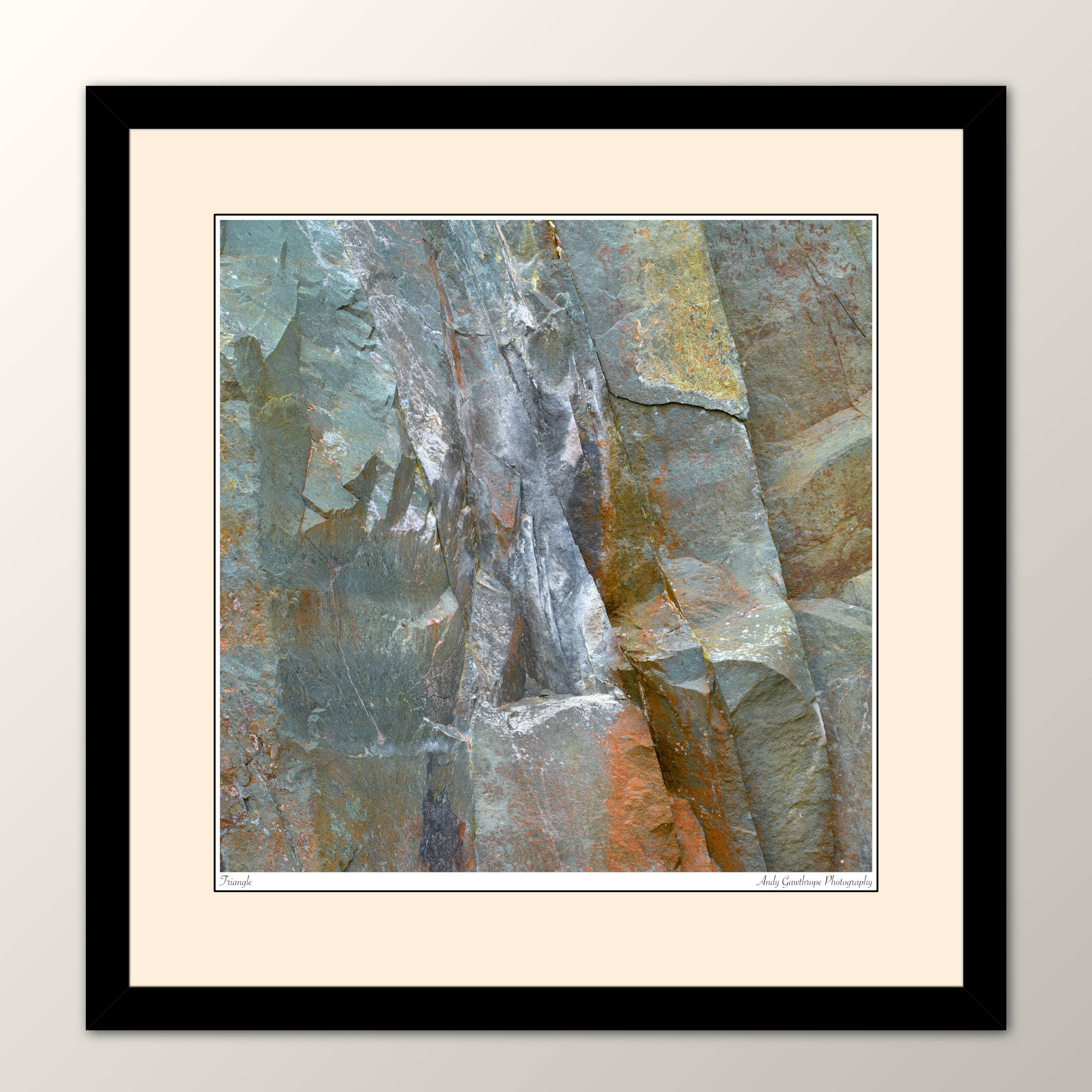
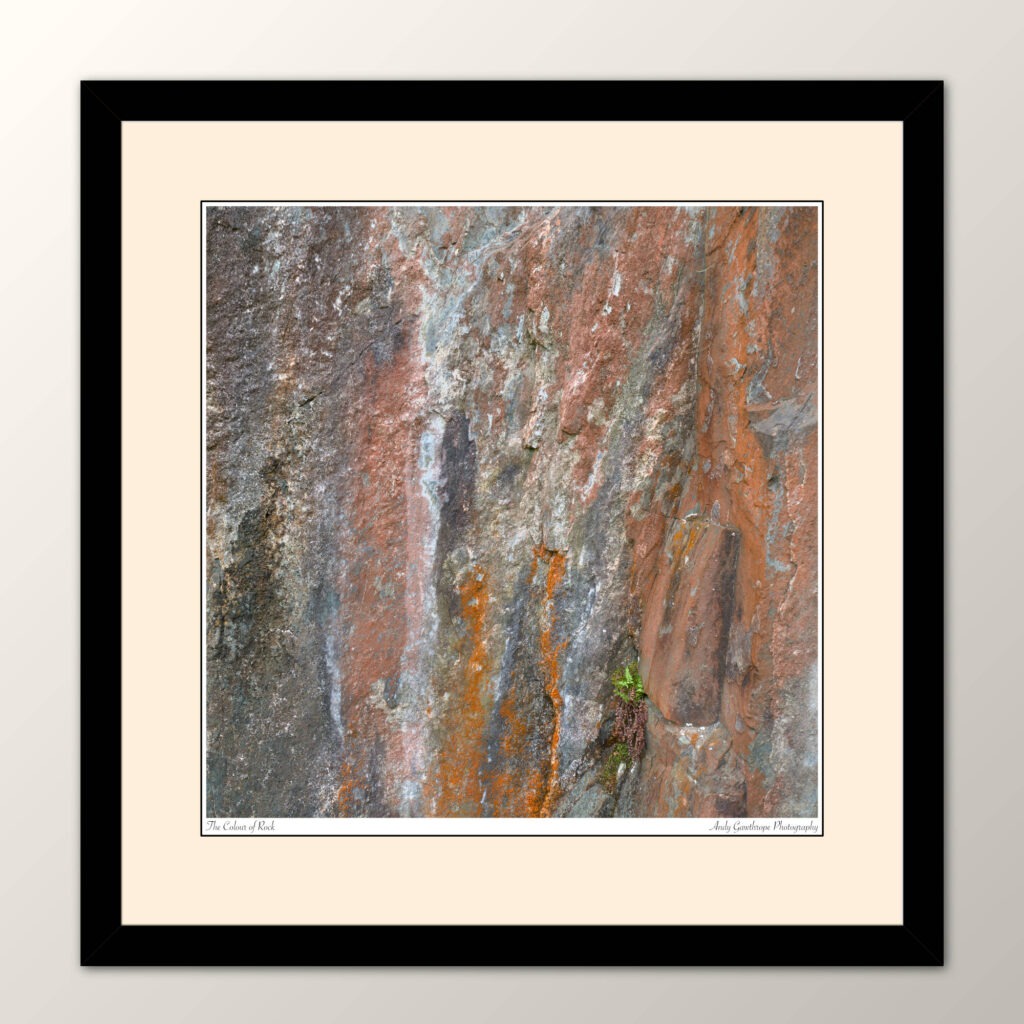
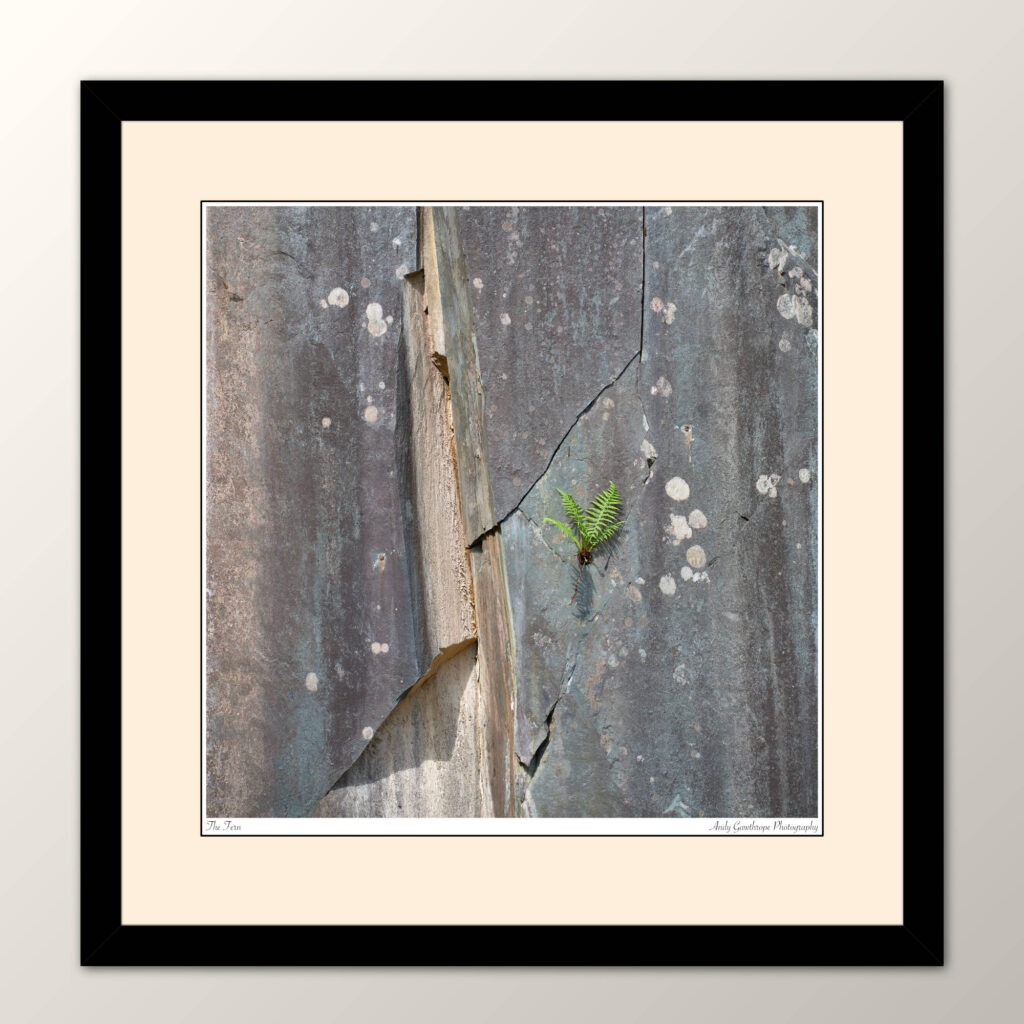
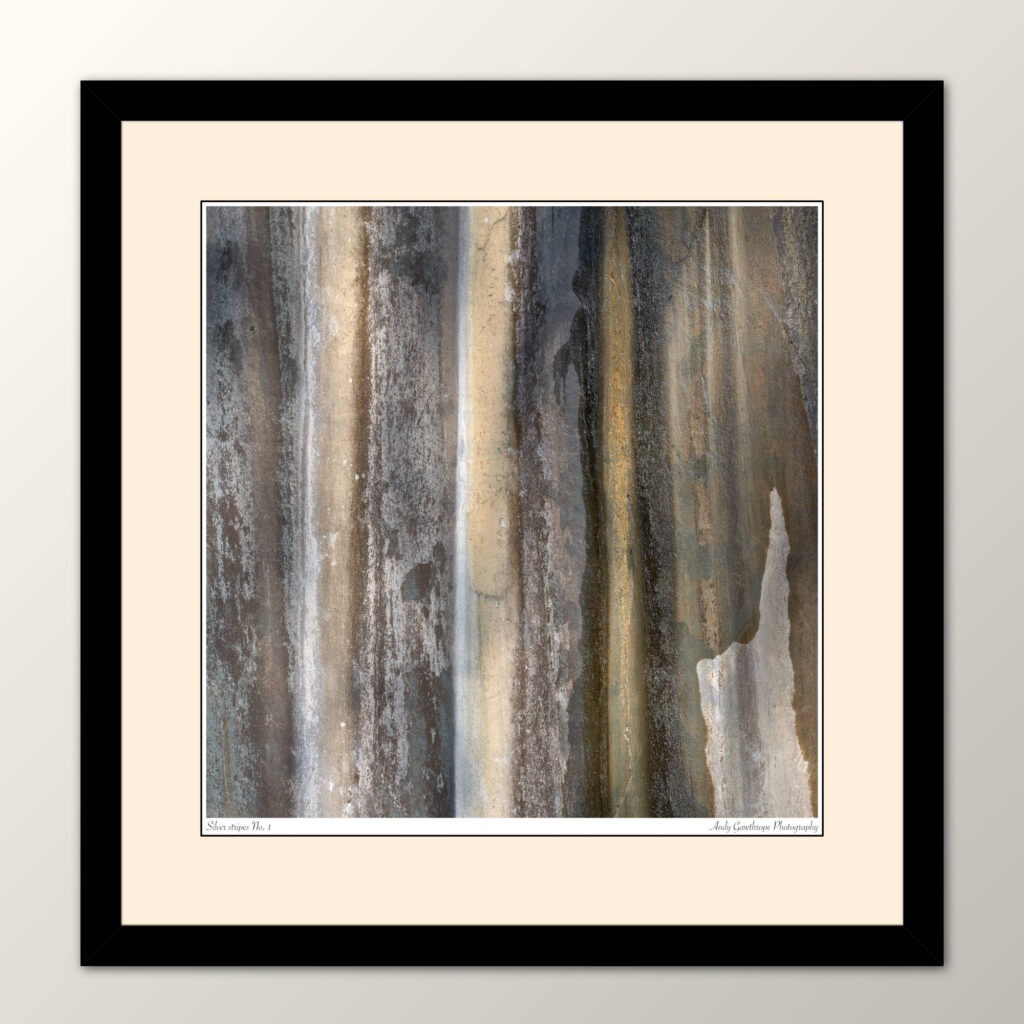
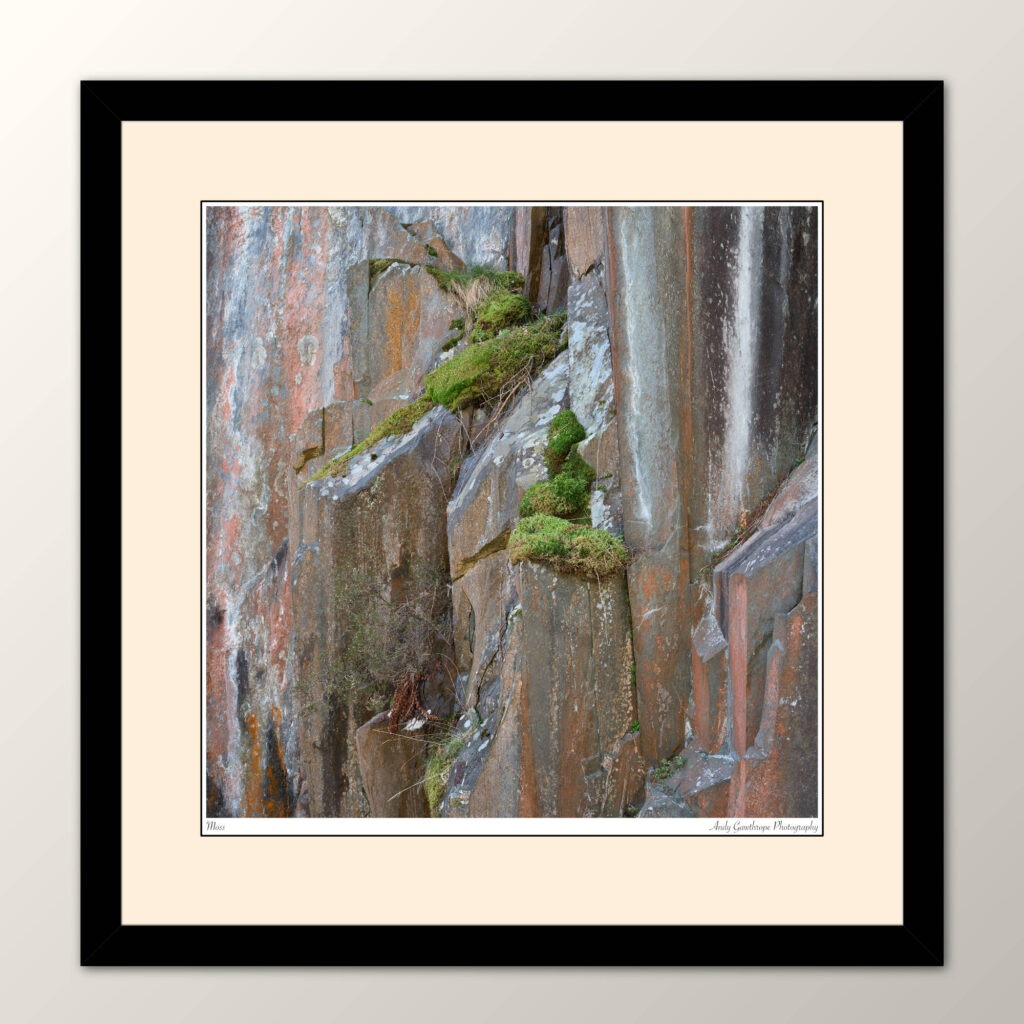
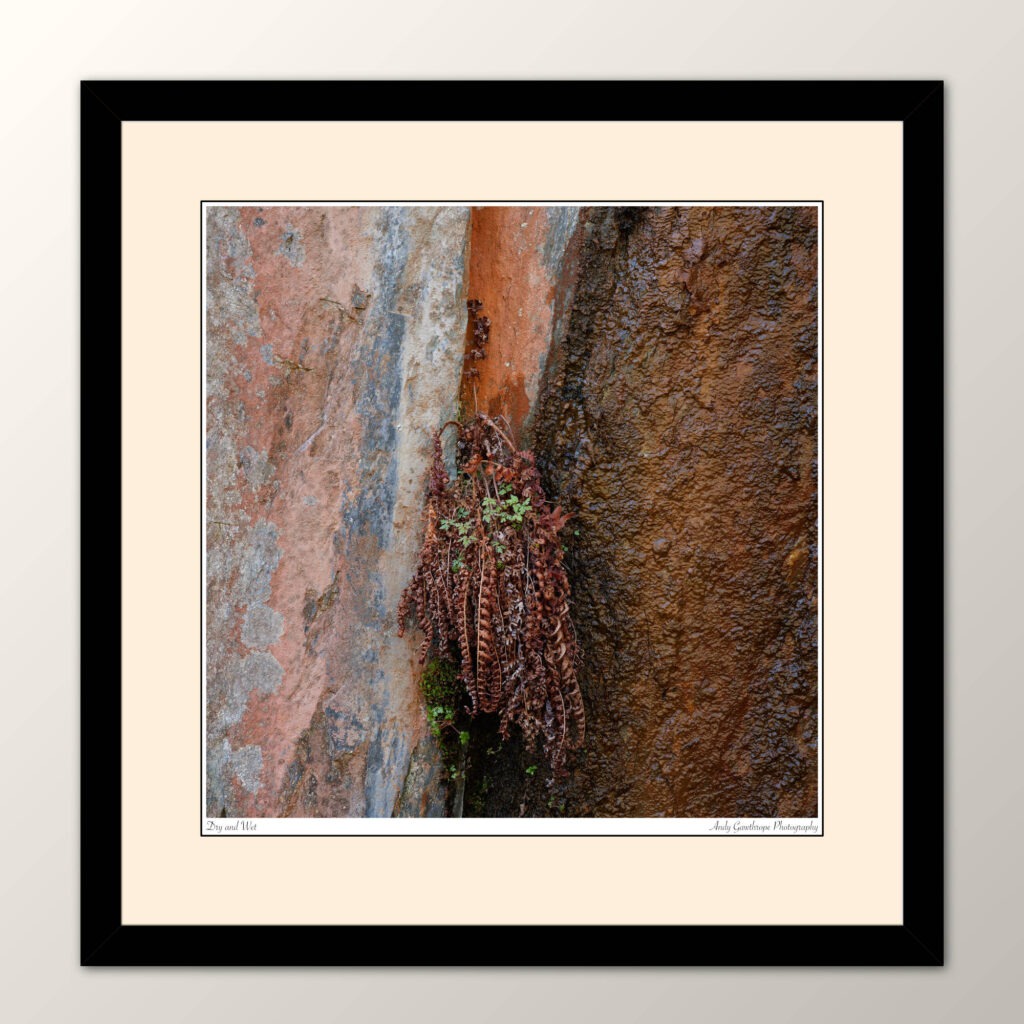
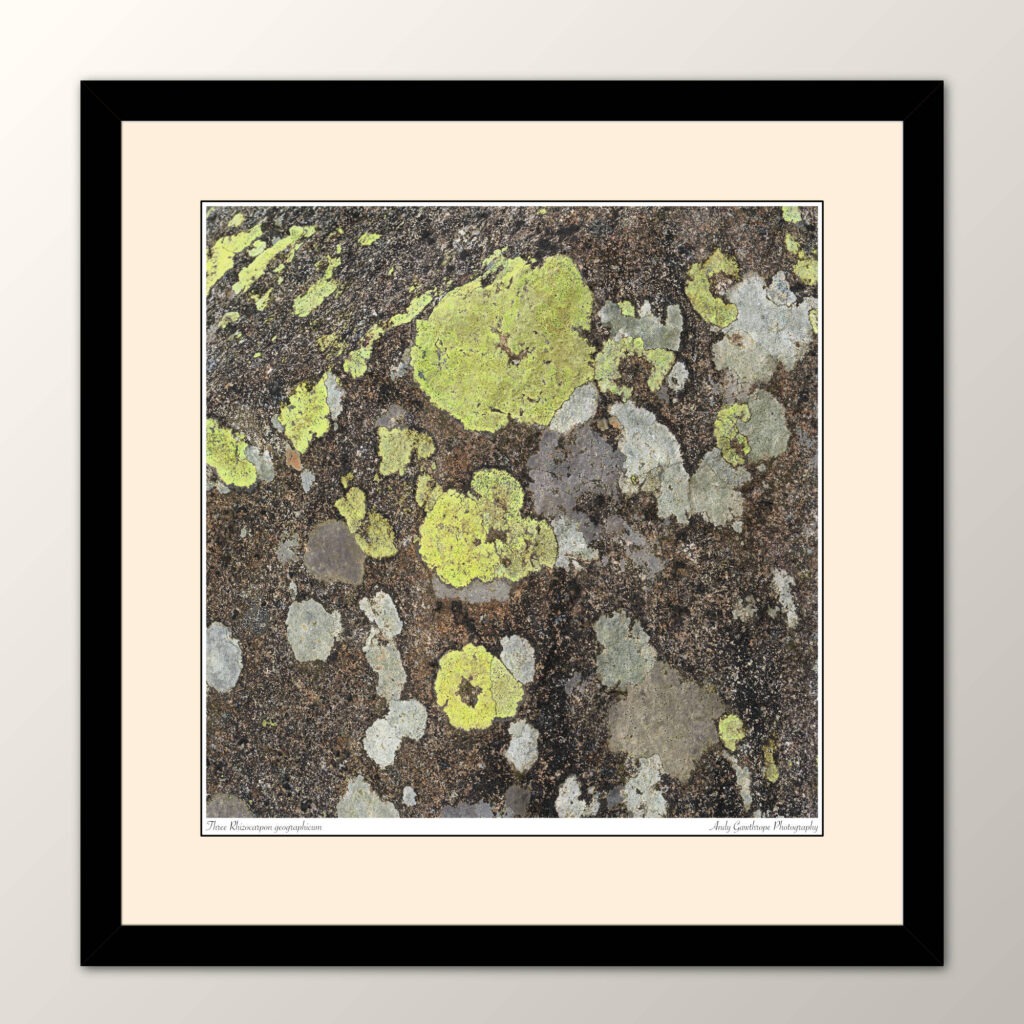
At the risk of upsetting many geologists, I suggest rock is commonly considered as dull and almost uniformly grey! What this project shows is that rock can be many different colours depending on its mineral composition and is certainly not a boring uniform grey! Some of my favourite images from the project are the parallel, vertical silver stripes. Not only are they a bold pattern but they are very simple with lots of detail and the square composition adds that little extra tension. I like the questions that come to mind. Just what are those stripes and where do they go? What am I looking at? I also like those with blocks of orange, pink, black and brown colours. Again I’m drawn to the images and forced to question what I see. These are the abstract images. With other images the subject is clear, such as the tiny green fern growing in a pocket on an otherwise clean, grey rock-wall. It’s so incongruous that I instantly knew it had to be in a photograph. For that and a few others, I felt context was important and chose to include a greater amount of rock.
Conclusion
This project deliberately constrained itself to a few places in Borrowdale so as to be manageable and not open-ended. But I’m of the mind that it could be extended to other area’s and could grow in coming years. Stylistically it’s been very different and a refreshing change.
Many of the photographs in this post will soon be available as individual prints or sets of prints on the Andy Gawthrope Photography website.
I do hope you’ve enjoyed reading this and seeing the images from the project. Please leave a comment below.
All images are copyright Andy Gawthrope Photography.
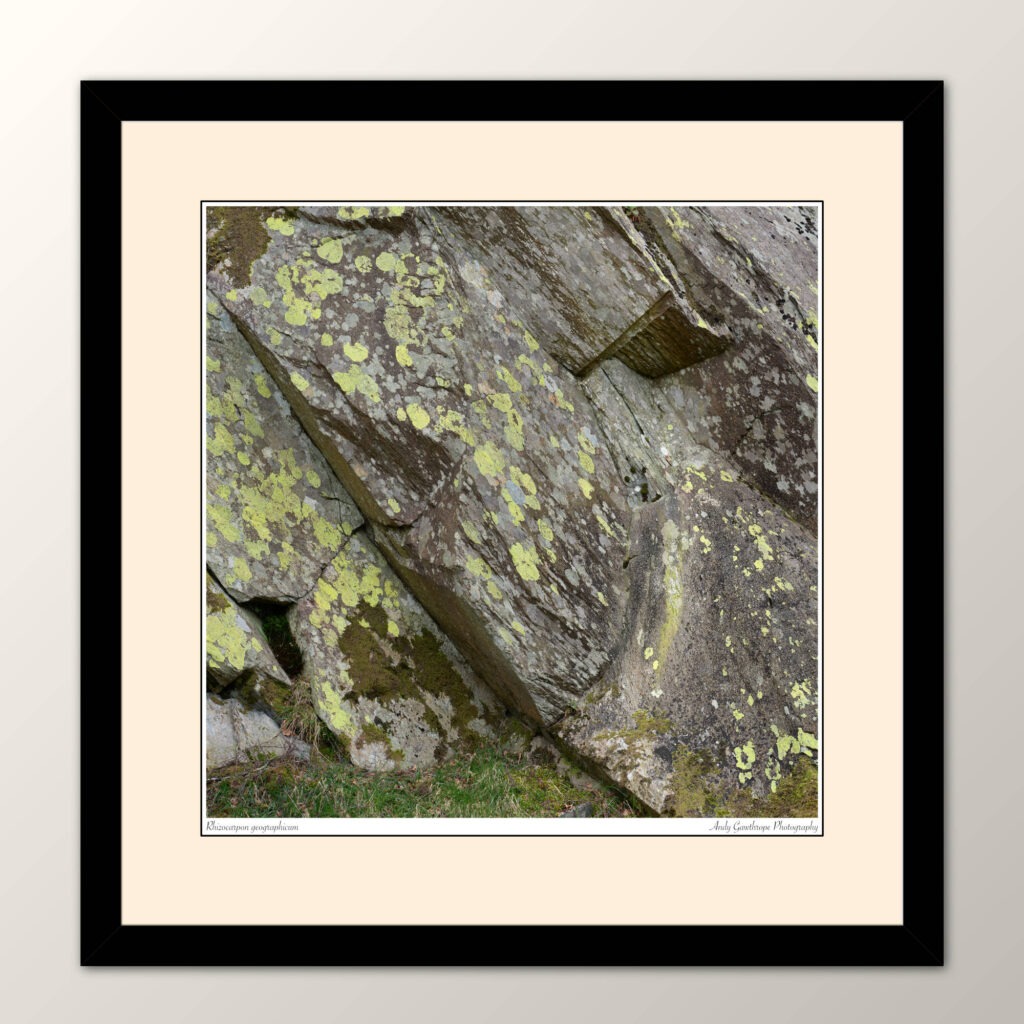
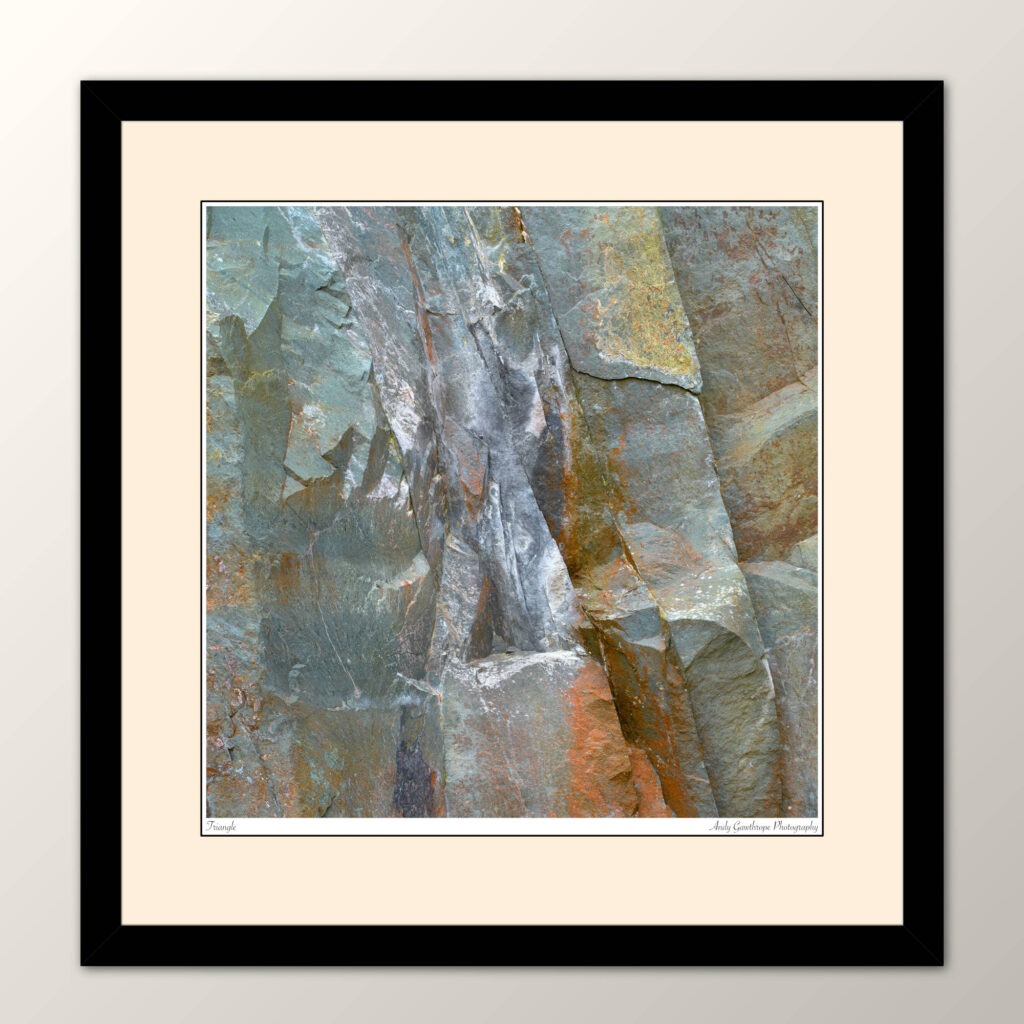
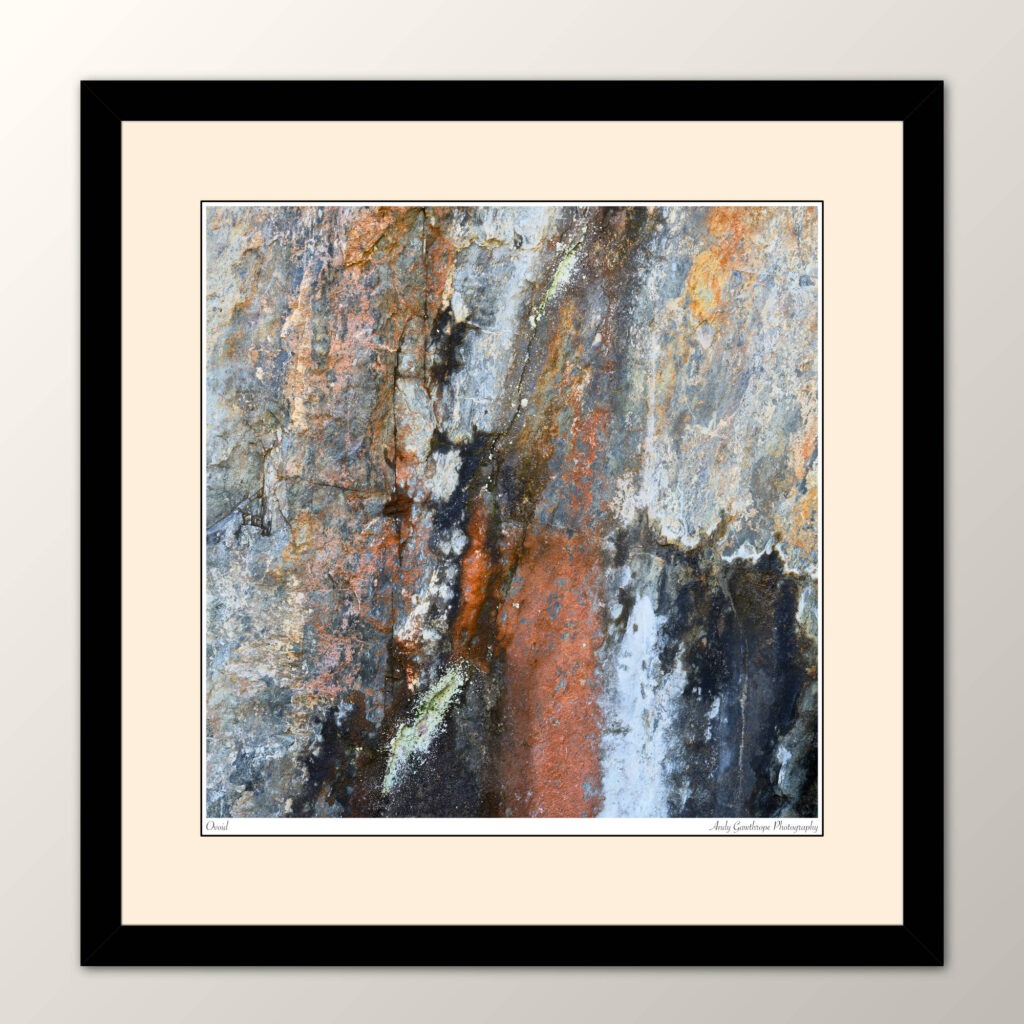
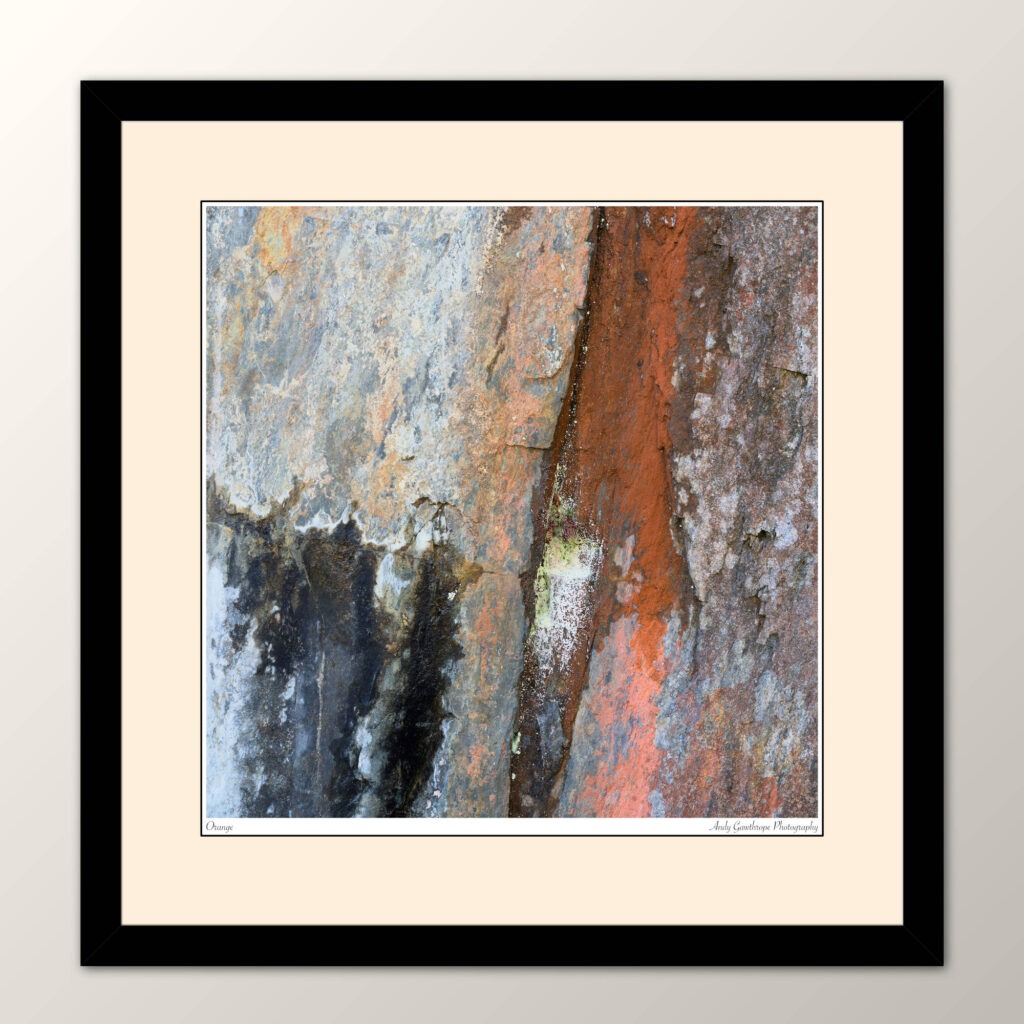
The colour of rockThe FernSilver stripes No. 2QuarryAlienBoltsSilver stripes No. 1FingersMossDry and WetThree Rhizocarpon geographicumRhizocarpon geographicumTriangleOvoidOrange
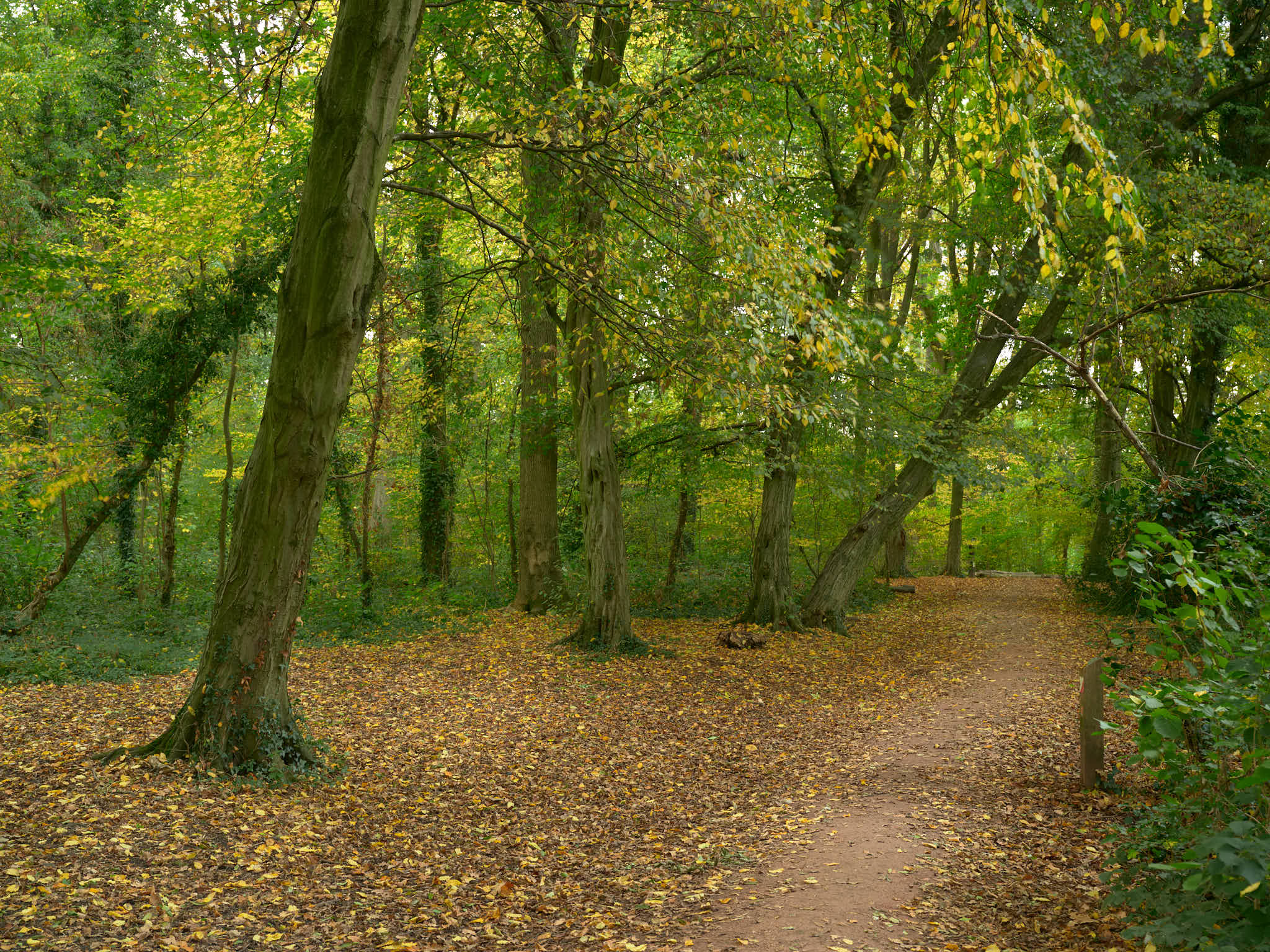
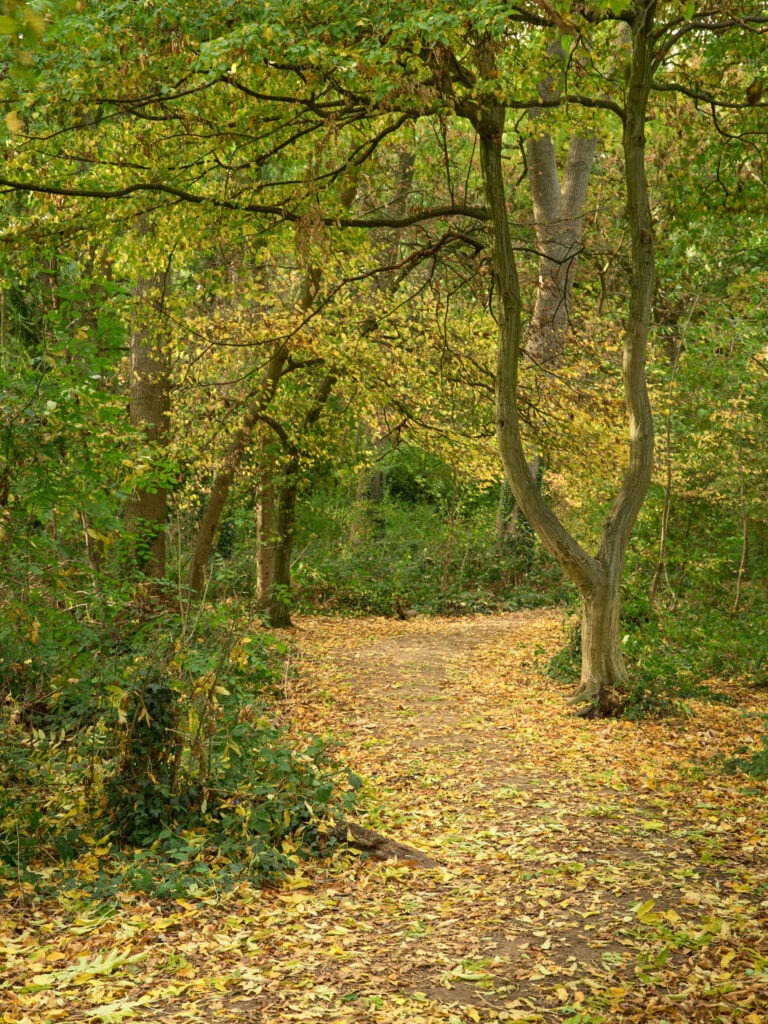
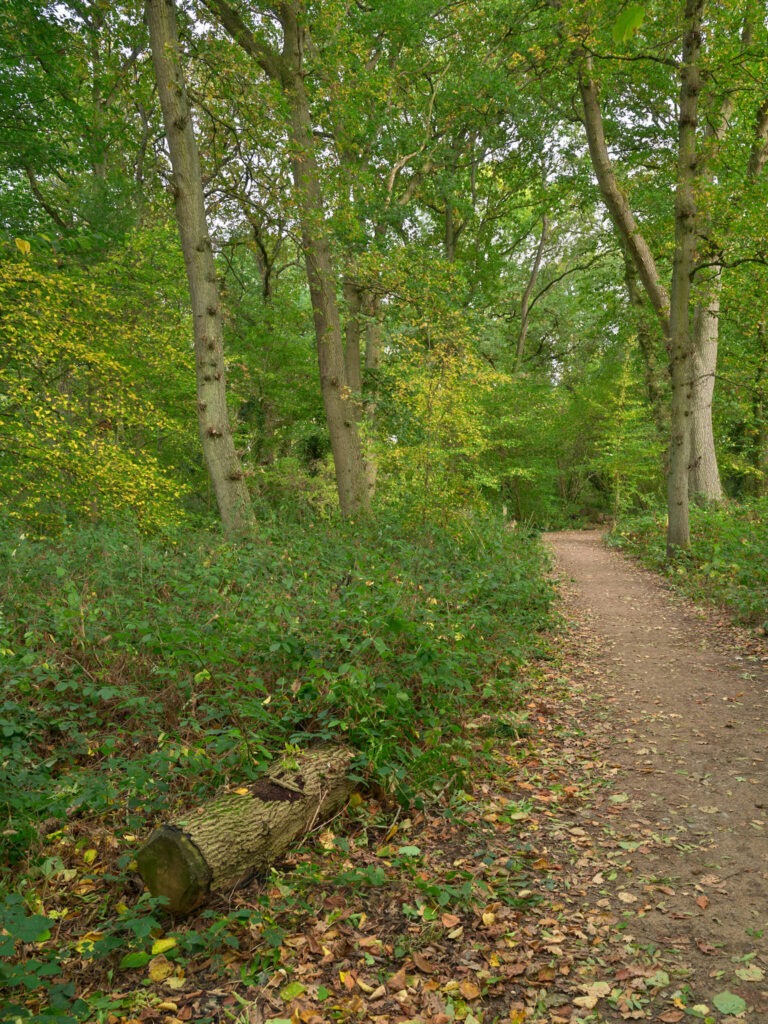
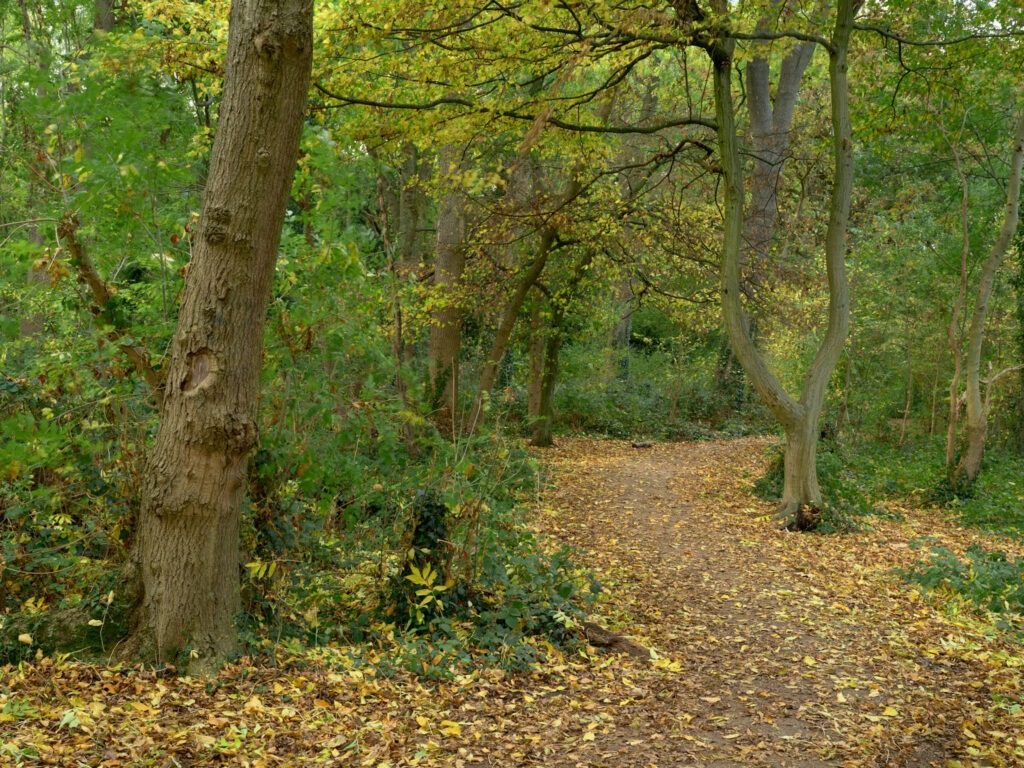
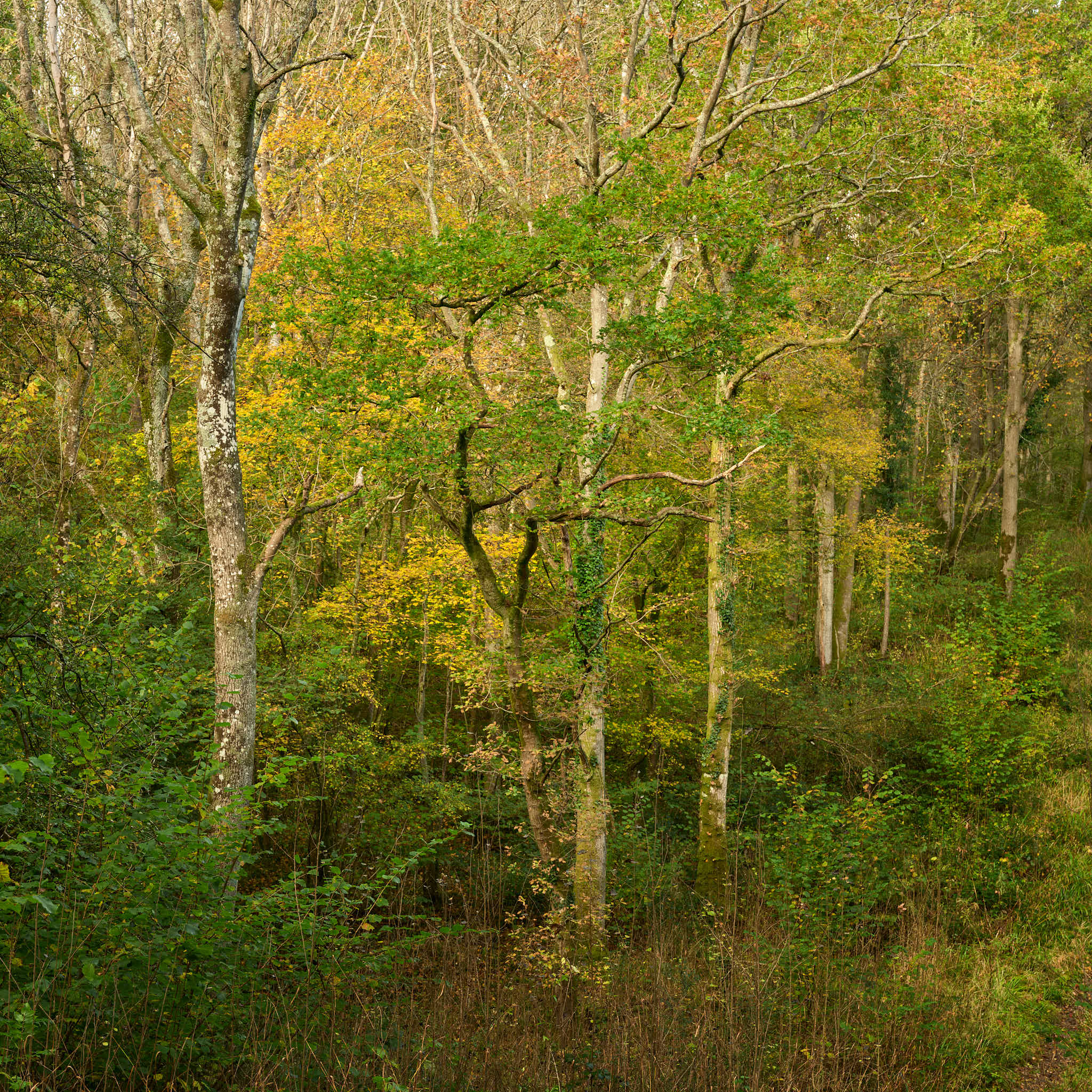
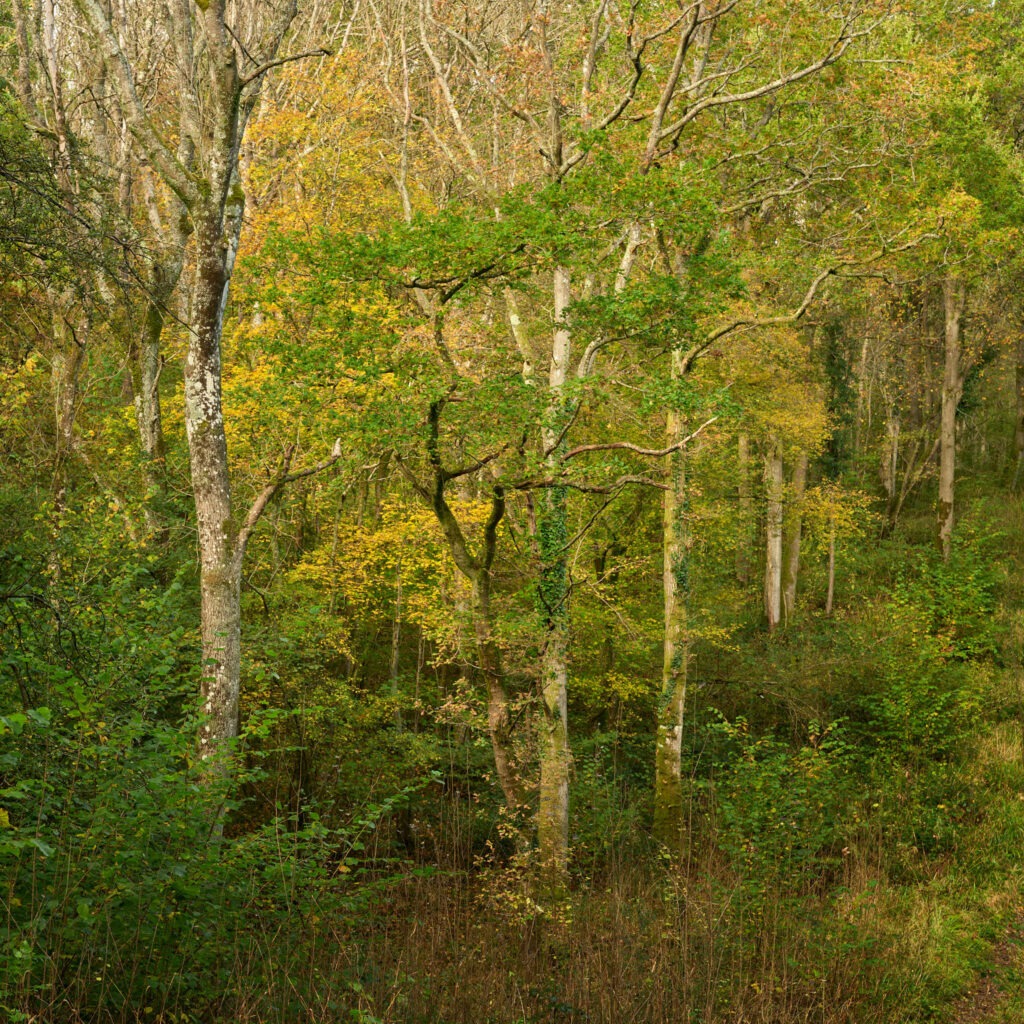
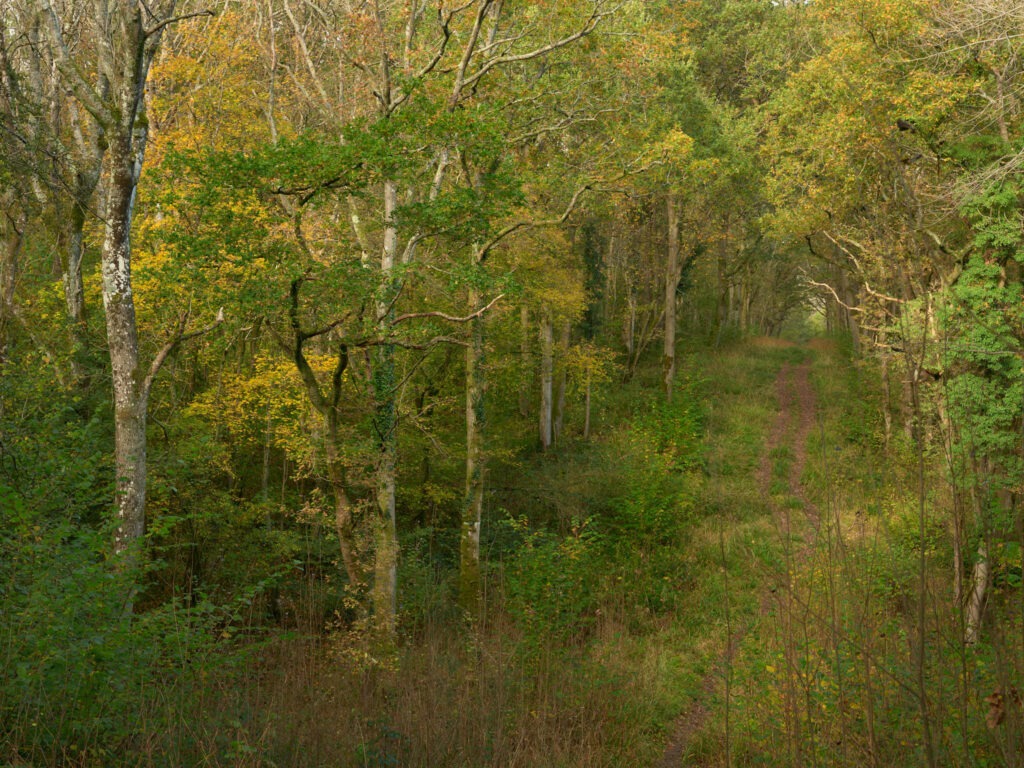
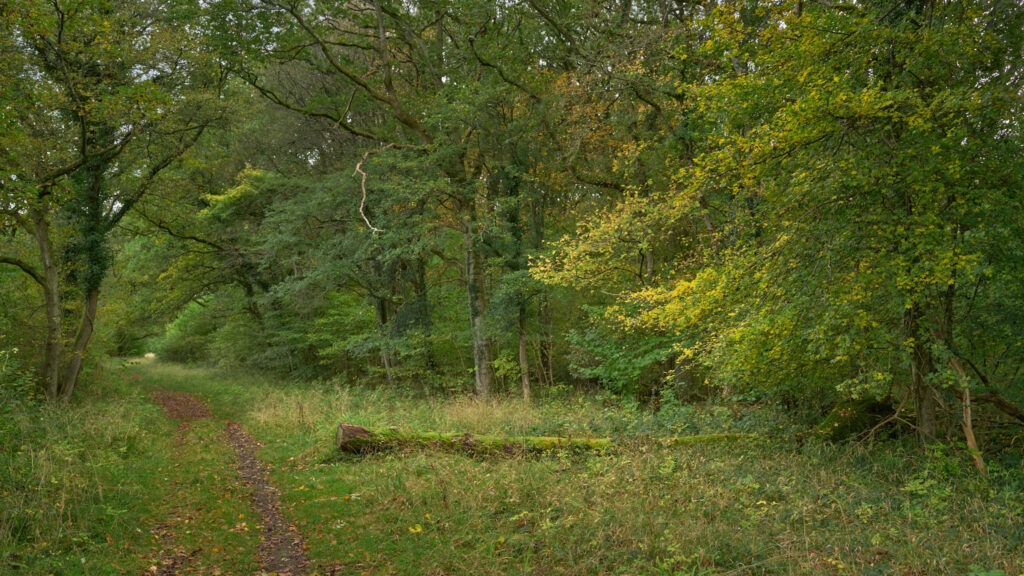
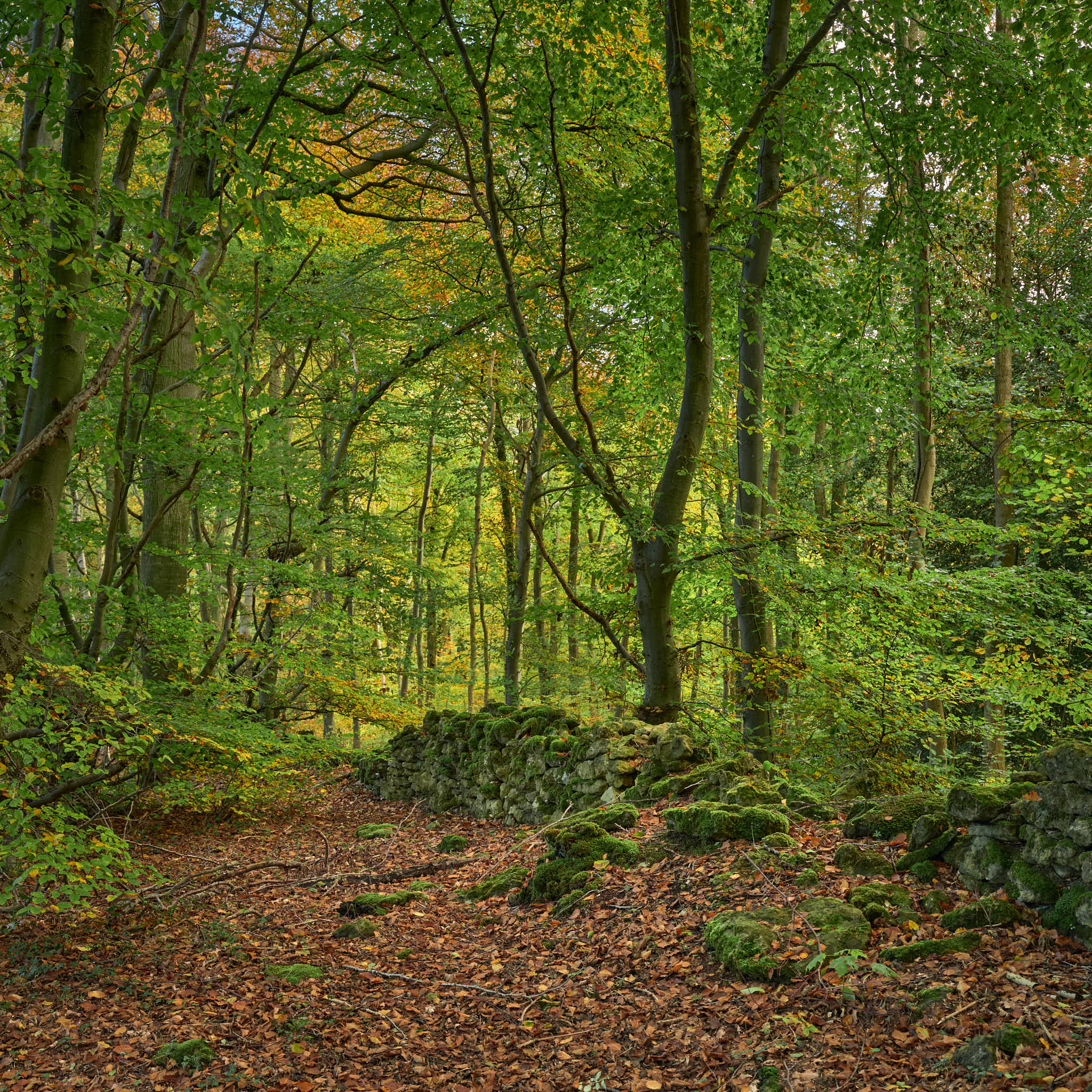
As readers of my previous post will know, Savages Wood is a small woodland in the Three Brooks Nature Reserve. It’s my closest woodland and I spent a little time walking its numerous paths amongst trips to more extensive but distant woodland and forests this Autumn.
First a little lesson. Healthy tree leaves produce a substance called chlorophyll; chlorophyll absorbs all but green light hence leaves typically appear green! But, when the chlorophyll content reduces other colours, especially yellows, become visible. This reduction in chlorophyll occurs when the amount of sunlight reduces and temperatures start to decline. We know this time as Autumn.
The main factors contributing to the intensity of non-green colours are the tree species, the temperature over time profile, the amount of light and the moisture content of the soil. With so many factors it’s not surprising that the same tree can look very different from year to year! These factors also highlight why, for example, trees in Northern England generally change colour and drop their leaves before trees in Southern England or why the change may appear as several waves over a few weeks.
Anyway, lesson over. Autumn in Savages Wood appeared to peak during the third-week of October and pretty much to schedule – perhaps early by a week or two at most. Considering the dry and at times very hot weather that shouldn’t have been a surprise but through September and early October I did feel somewhat unclear what Autumn would look like and when it would occur this year.
The walking of dogs is very popular and based on my experience it’s probably what brings most people into the wood. Making photographs with a large camera and tripod takes time and the process is very different to taking quick snaps. So, it was a pleasure to meet and say ‘hello’ to some lovely dogs and their owners who passed by once, twice or more times whilst I was waiting on the light to change and/or the wind to drop.
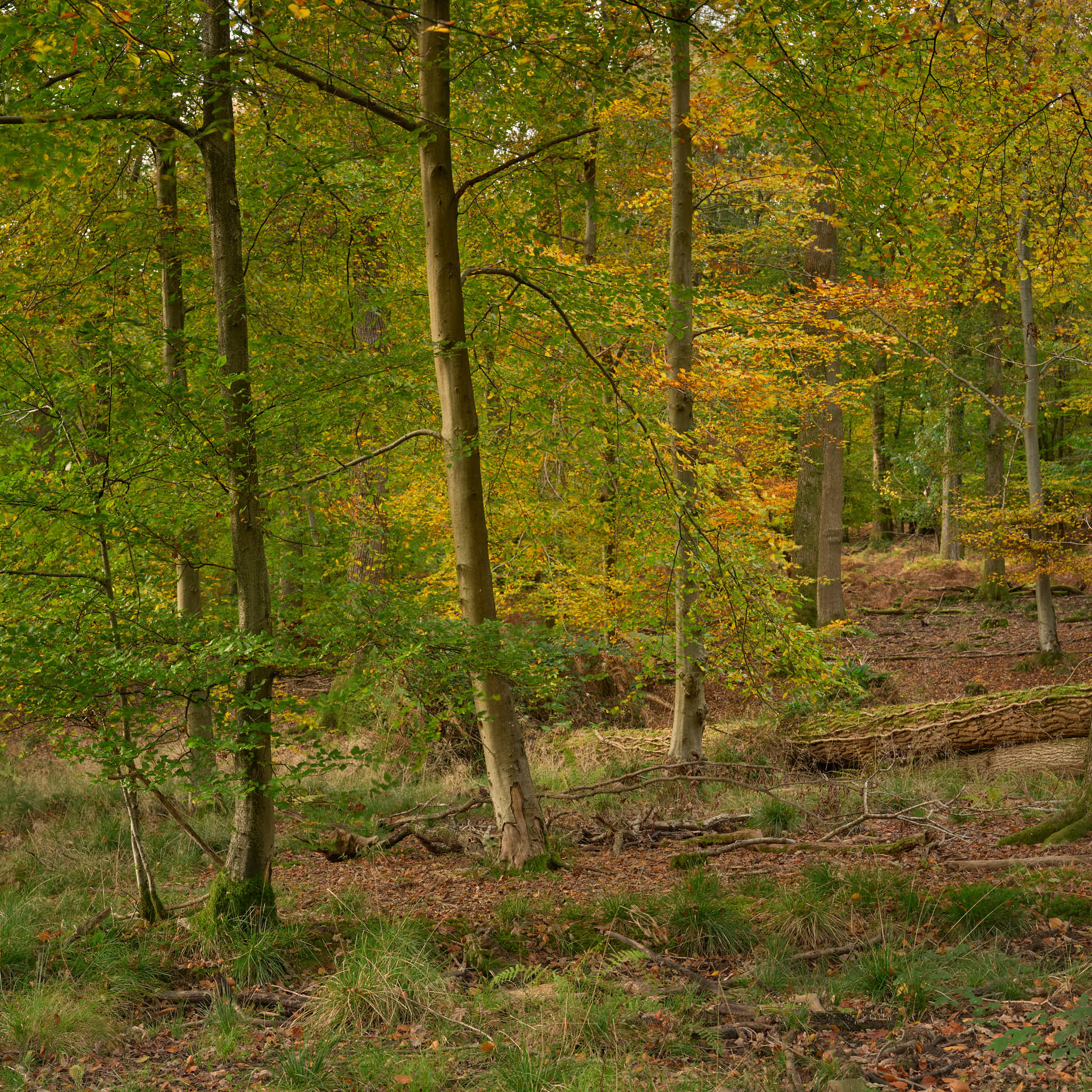
Below are a few photographs of Savages Wood this Autumn. For those that know the woodland well you may spot that whilst developing I’ve removed the graffiti from the tree I call the ‘Tuning fork’. Unfortunelty, this was only possible on the photograph!
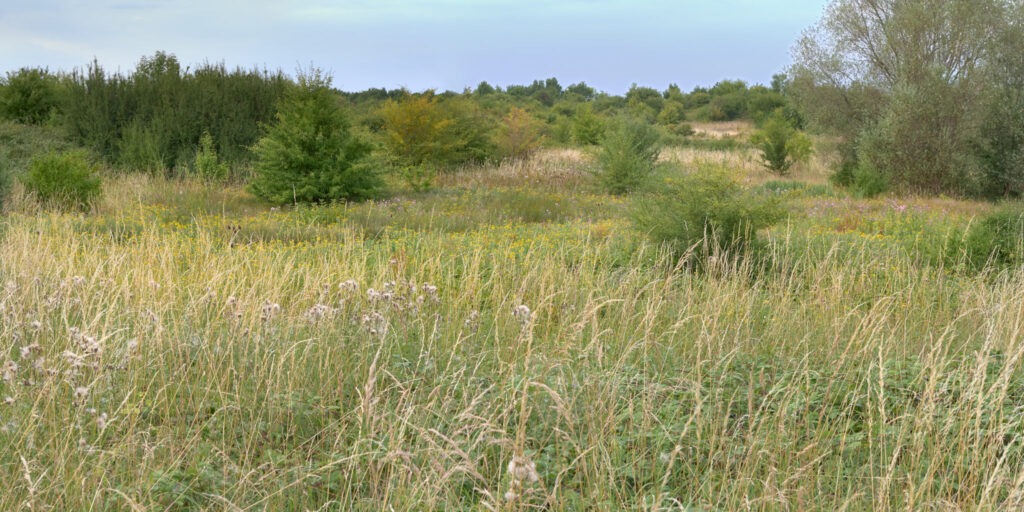
The Three Brooks Nature Reserve is the gem of Bradley Stoke. At 110 acres (roughly 62 football pitches) it provides a biologically diverse, green space for the community. The history of the reserve may be less well-known and I for one originally assumed it was contemporary with the 1980’s commencement of home building. Whilst that’s true, the reserve does enclose areas with much longer histories.
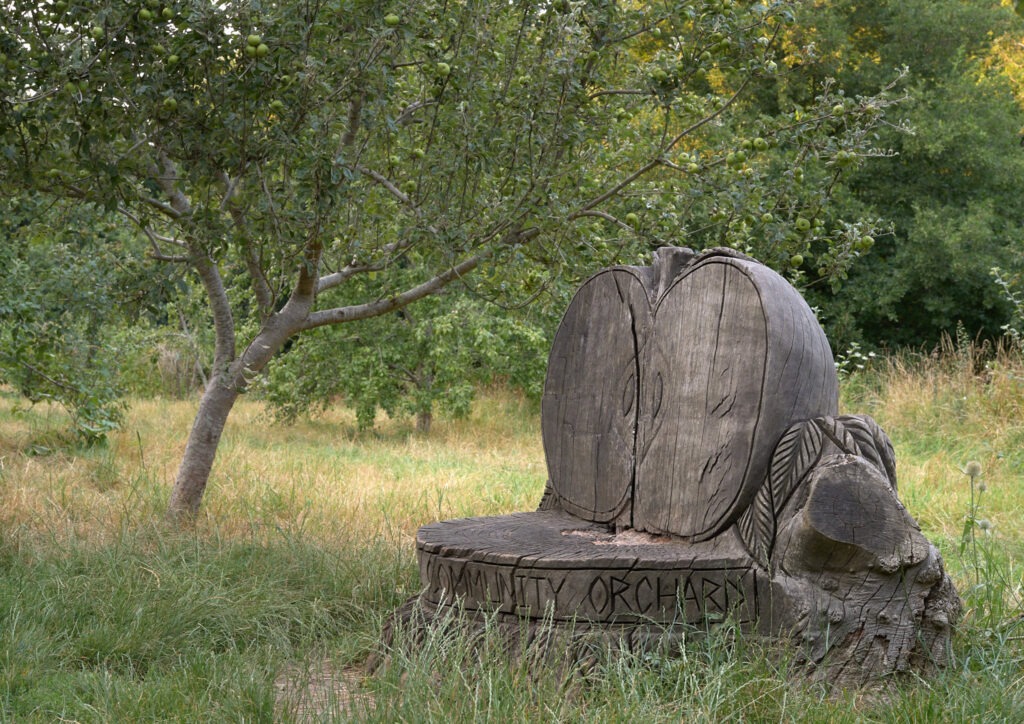
Is three the magic number? As its name suggests the reserve includes three brooks – Patchway Brook, Bradley Brook and Stoke Brook – but also three woods: Webb’s Wood, Savage’s Wood and Sherborne’s Brake. The name Four Brooks Nature Reserve is, perhaps, more appropriate though as the Southern end of what is today Patchway Brook was once called Hortham Brook. In 2007 a small Community Orchard was also planted; located in the heart of the reserve and just to the East of Bradley Stoke Community School. So, technically, the magic number is four!
Webb’s Wood is on the North side of Stoke Brook near the lake and is probably the oldest wood within the reserve. Sherbourne’s Brake sits at the South Western edge of the reserve near the junction between Braydon Avenue, Brook Way and Orpheus Avenue and is considered to be roughly 200 years old. Today Savage’s Wood covers the largest area, contains a small pond and the tallest trees.
The National Library of Scotland has an excellent website that allows maps from different times to be overlaid and their transparency adjusted to enable easy comparison. Comparing a modern map against, for example, the an Ordnance Survey Six inch map from 1888 – 1913 identifies just how much has changed and, very surprisingly, how much has remained the same with many old field boundaries still delineating either housing developments or modern roads. Be warned tho. Comparing current-day features with a previous era is a wonderfully engrossing journey into history!
Apple bench
As a UK landscape/nature photographer who has lived in Bradley Stoke for 20+ years the reserve provides me with a local space that is easily accessible were I can relax, exercise and just be outdoors. Certainly, during the last couple of years and the various pandemic restrictions its been a great resource which I know is appreciated by many more in the community than it was prior to 2020. Sometime in the summer of 2020 I recall speaking to someone who confessed, that although she knew the lake and reserve existed, she had never before visited. Perhaps that’s a benefit of the pandemic, we were all forced to explore our local communities a little more.
The Tump
One of my favourite parts of the reserve is the Tump. It’s a man-made hill created from the spoil of the second Severn crossing, now known as The Prince of Wales bridge. From the surrounding area it’s an unassuming little hillock, something you hardly notice but climb to the top and you get some great and quite different views across Bradley Stoke and Gloucestershire over to the Southern edge of the Cotswolds. A little height makes a big difference!
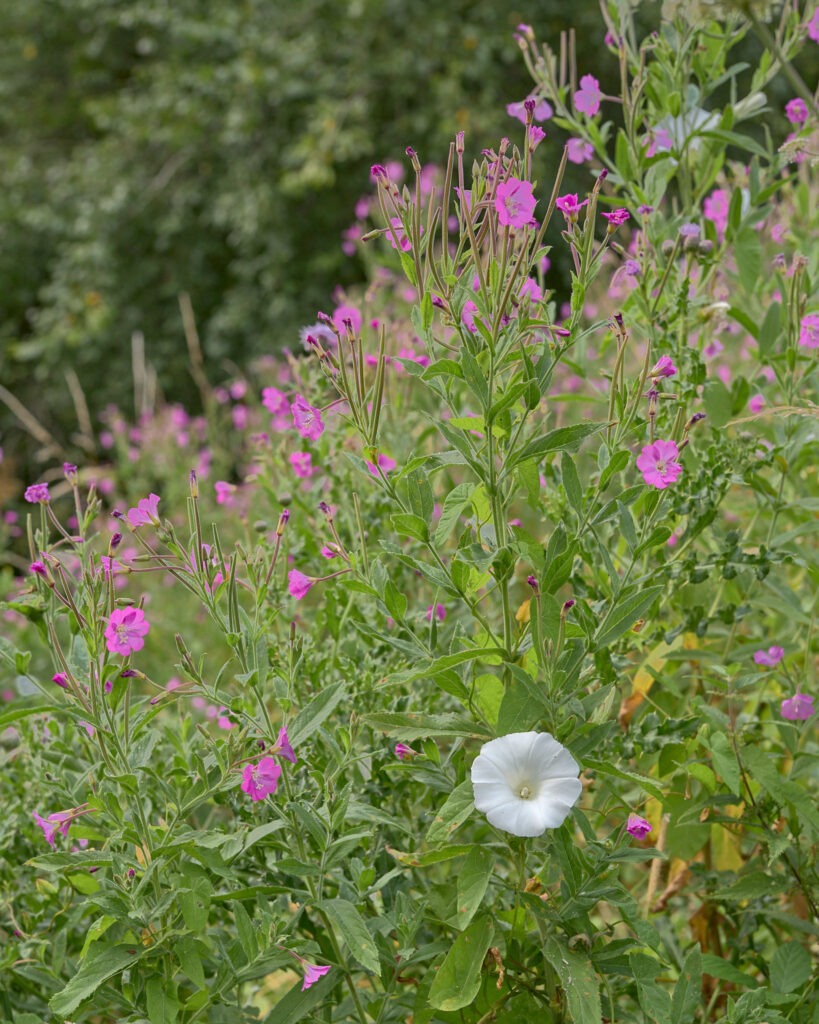
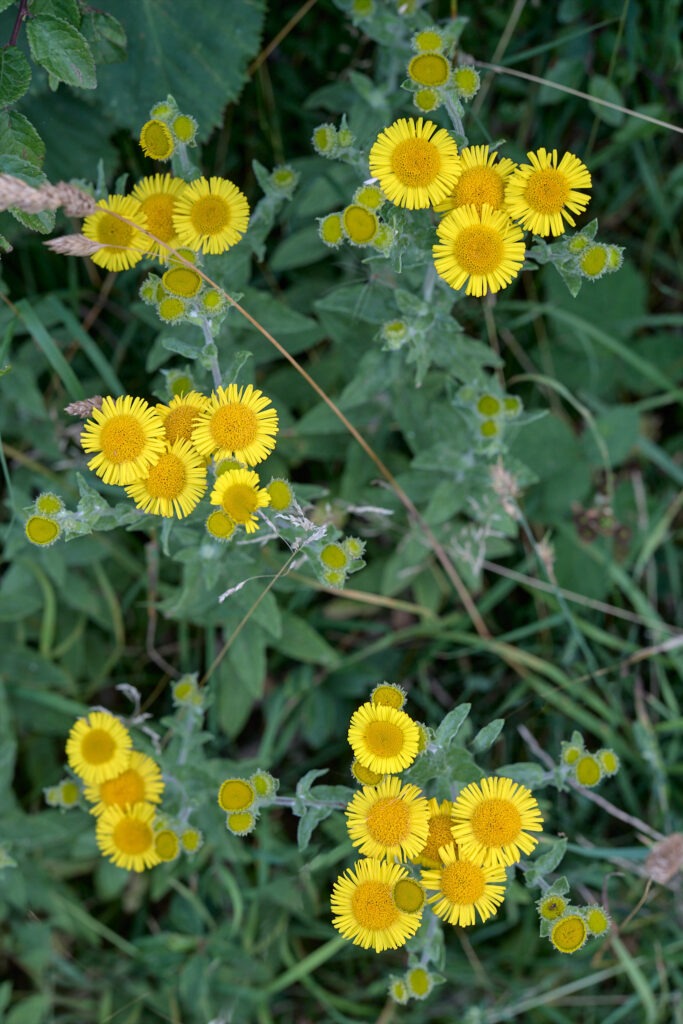
Walking on the Tump is always interesting. In places, due to weather and human activity its surface is gradually eroding and, as it does, objects are starting to surface. I’ve certainly noticed a small vehicle tyre emerging from the ground a little more as each year passes and there are also items I don’t quite yet recognise! There is something that looks like the top – perhaps a rocker cover – of an engine as well as more identifiable objects such as stone piping and bricks. Please don’t get the impression it looks like a rubbish tip tho; it has been left alone and its top is now a grassland home to wildlife comprising a few trees and lots of wild flowers – Red Campion, Wood Anemone and Ragwort to name a few.
White flower
In addition to the main path on its Western side, there is a small path from its North-East corner. This path winds its way North through the woods between the M4 motorway and Patchway Brook passing the junction with Hortham Brook before finally emerging at the stone bridge crossing Patchway Brook. It’s a less trodden and probably lesser known path but a great path nonetheless as it provides a wonderful alternative to the well-trodden, motorway that is the main stoney path to its West.
Webb’s Wood is another of my favourite spots; perhaps because the bluebells were in full-swing when I first visited, perhaps because its so easily missed when passing along the well-worn track to/from the lake. On casual glance it appears to be no more than a few trees by the side of Stoke Brook but force yourself off the track and into the wood and you’ll discover a really pretty little wood with some of the best bluebells in the reserve. Continue through the wood to it’s East-side and you find a hidden, almost secret little clearing.
Looking after our reserve is the Three Brooks Nature Conservation Group and their working-parties are sometimes seen managing the reserve. If you would like to assist I’m sure they would be grateful. See links below.
I’ve illustrated this article with photographs captured during the last few years in the reserve. The image grid below contains the images used above plus others which didn’t fit within the text. Click on images to see the full-size version. To see my photographic work from around the UK please visit Andy Gawthrope Photography.
Andy
All images are Copyright Andy Gawthrope Photography.
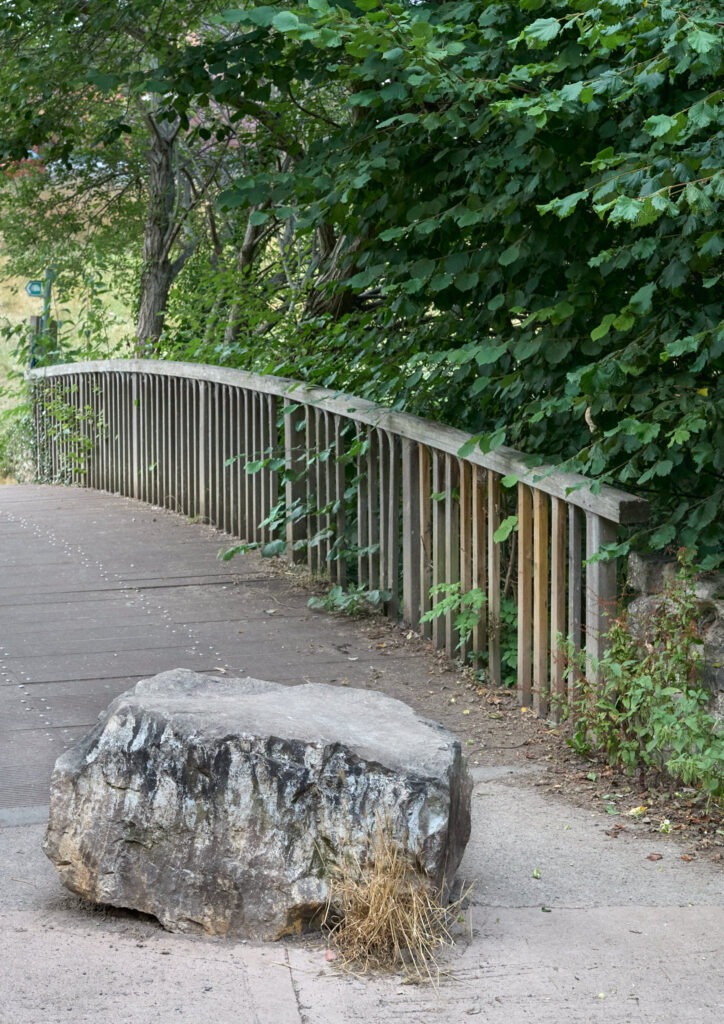
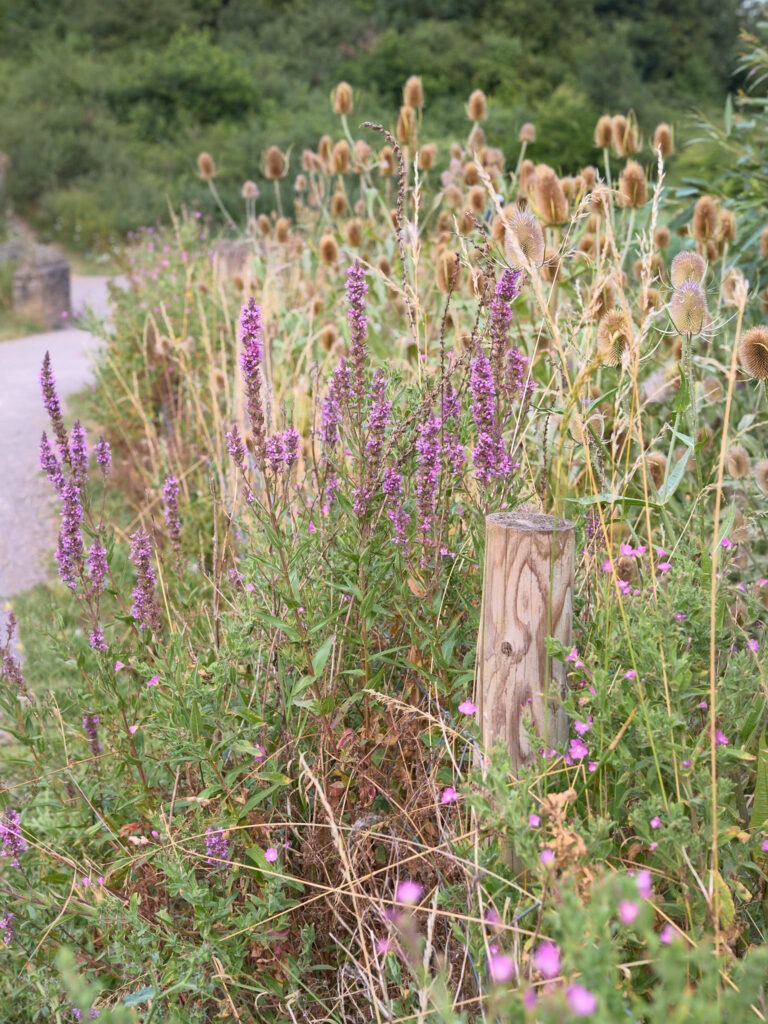
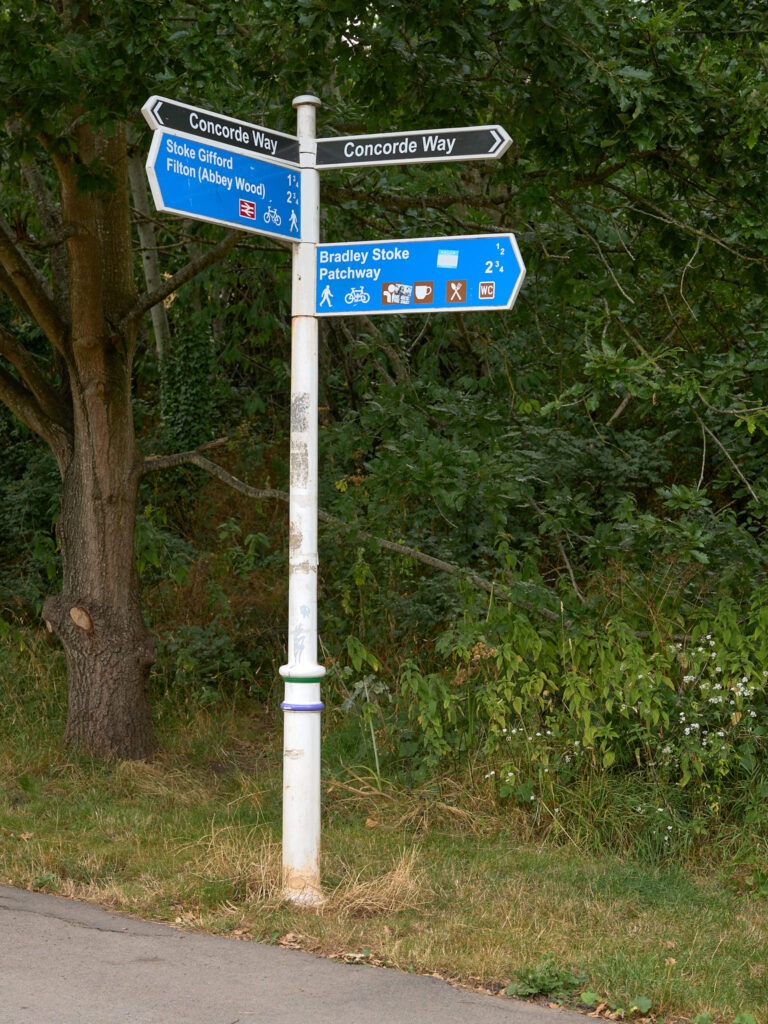
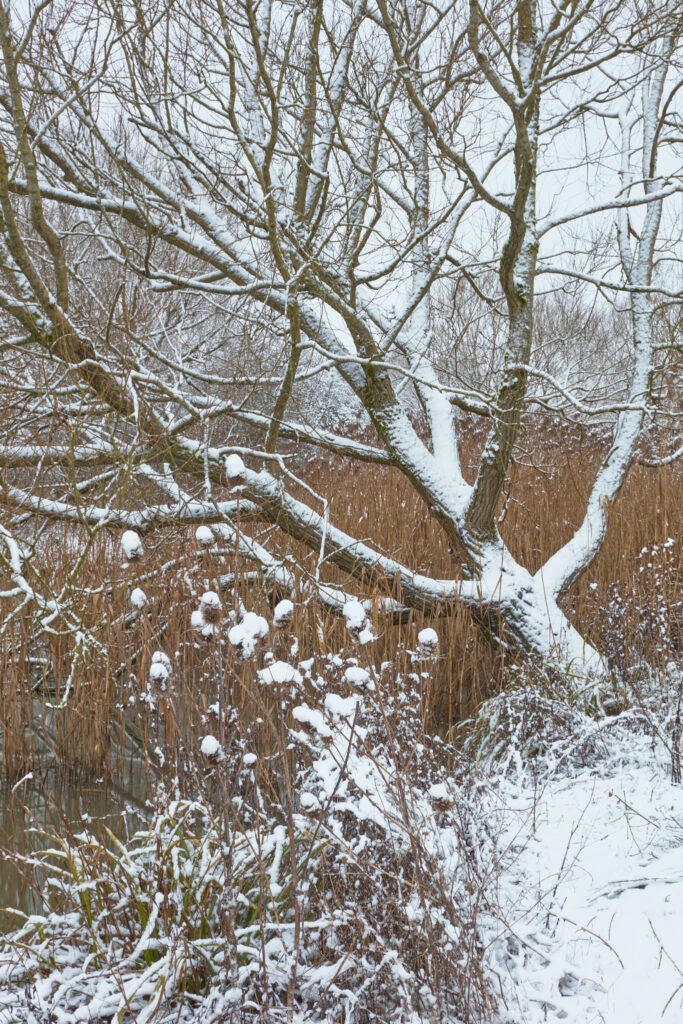
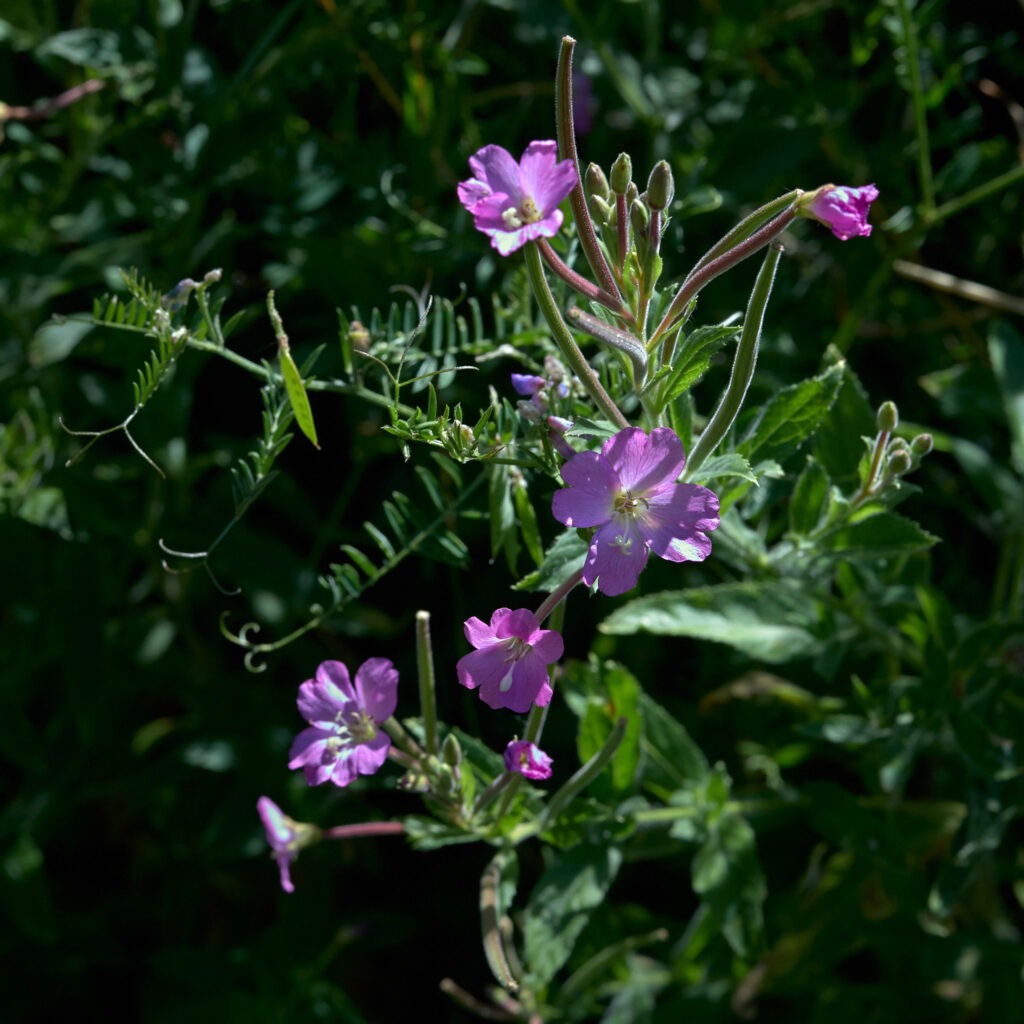
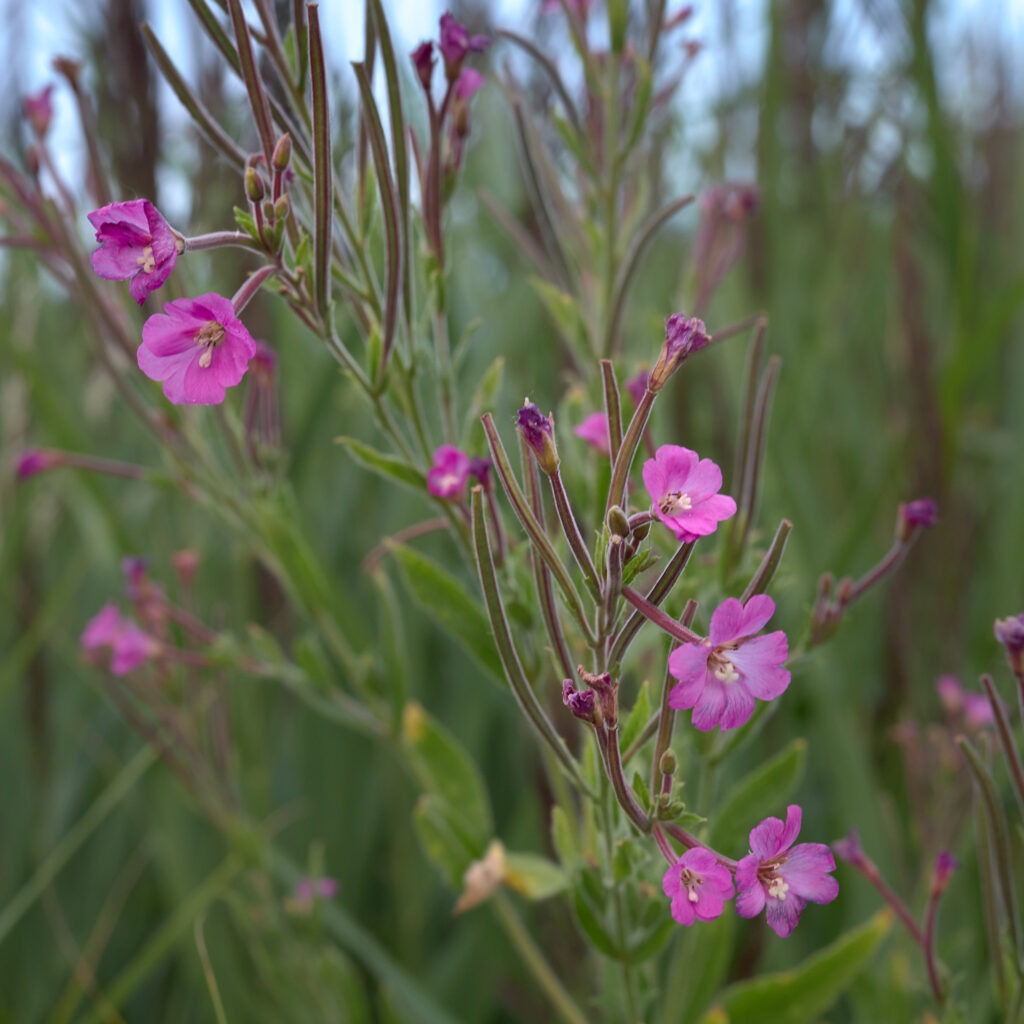
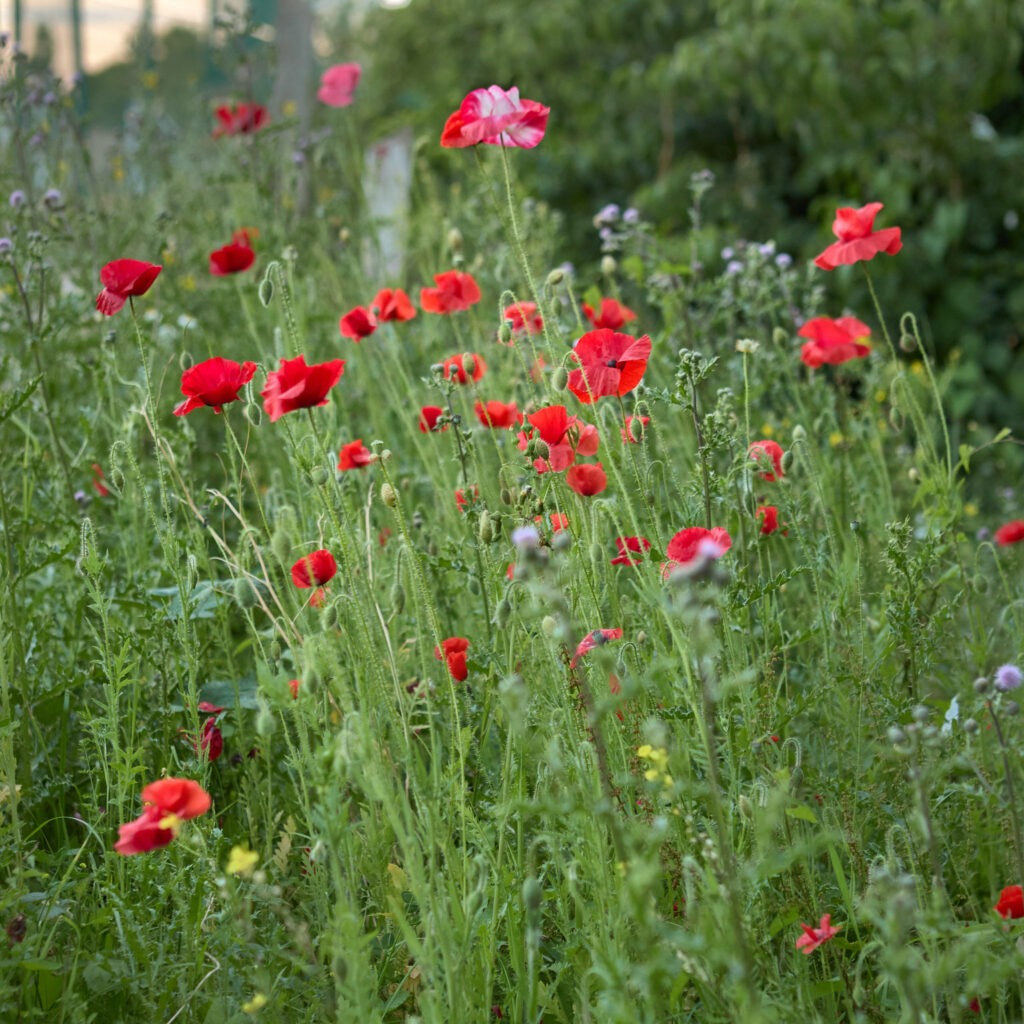
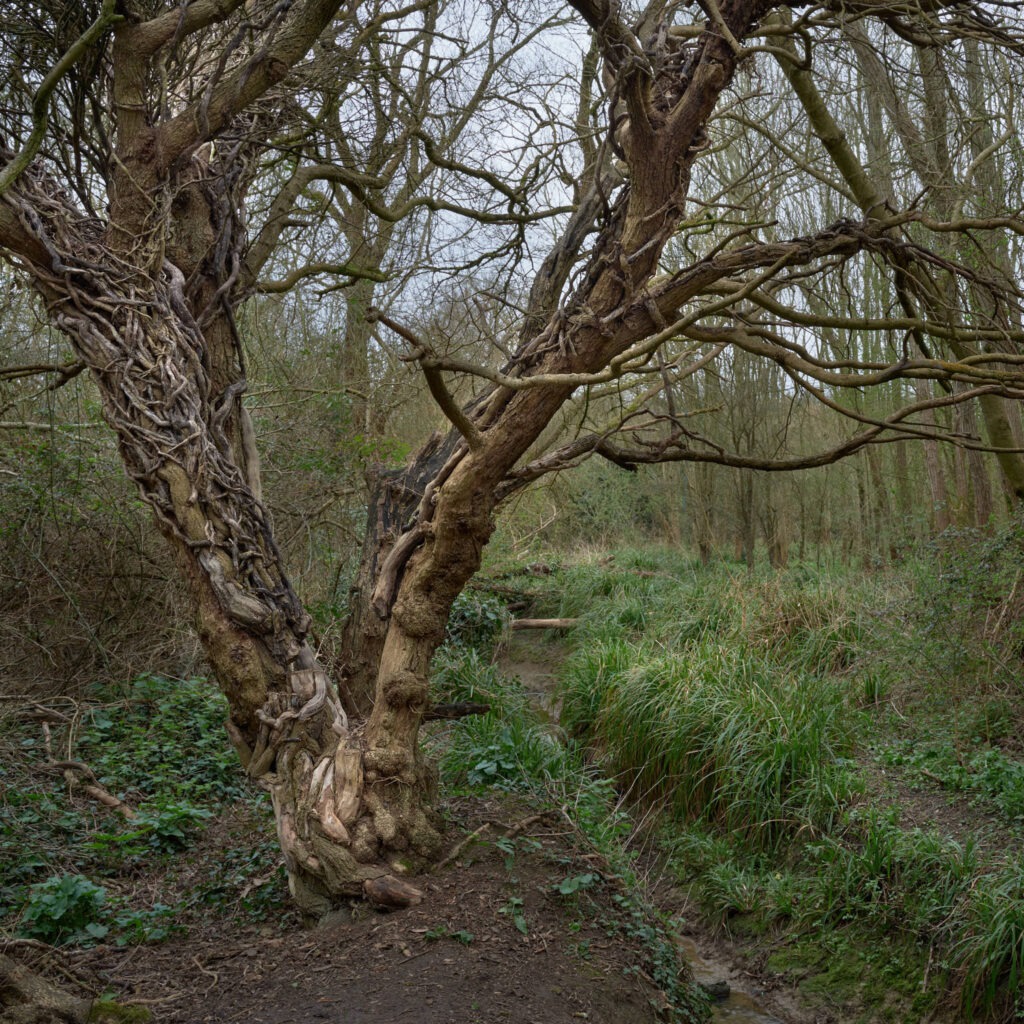
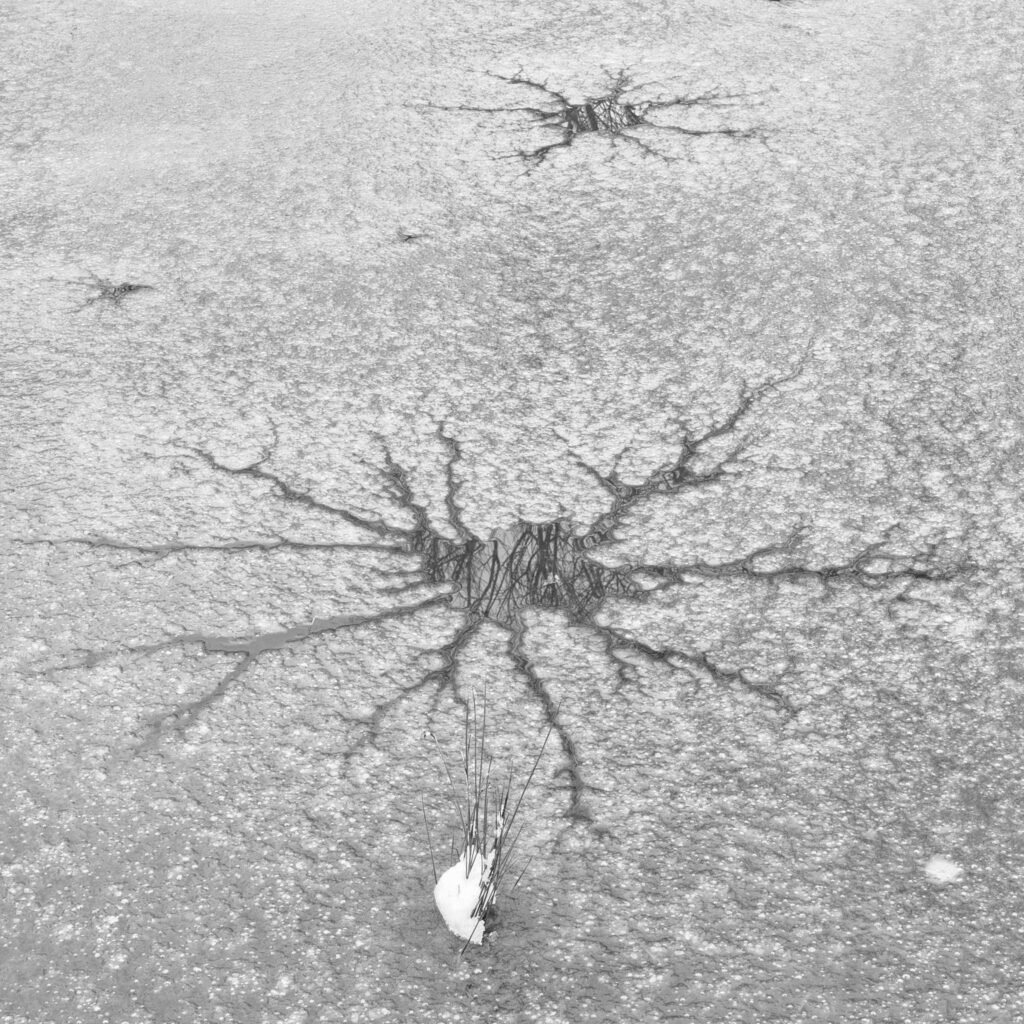
Three Brooks signageThree Brooks signageYellow flowersFoot bridgeCracksWhite flowerHedgeConcorde Way signageWinter at the pondPurple flowersPurple flowersPoppiesSpooky treeIceWinter in Savages WoodApple benchSnail benchThe Tump
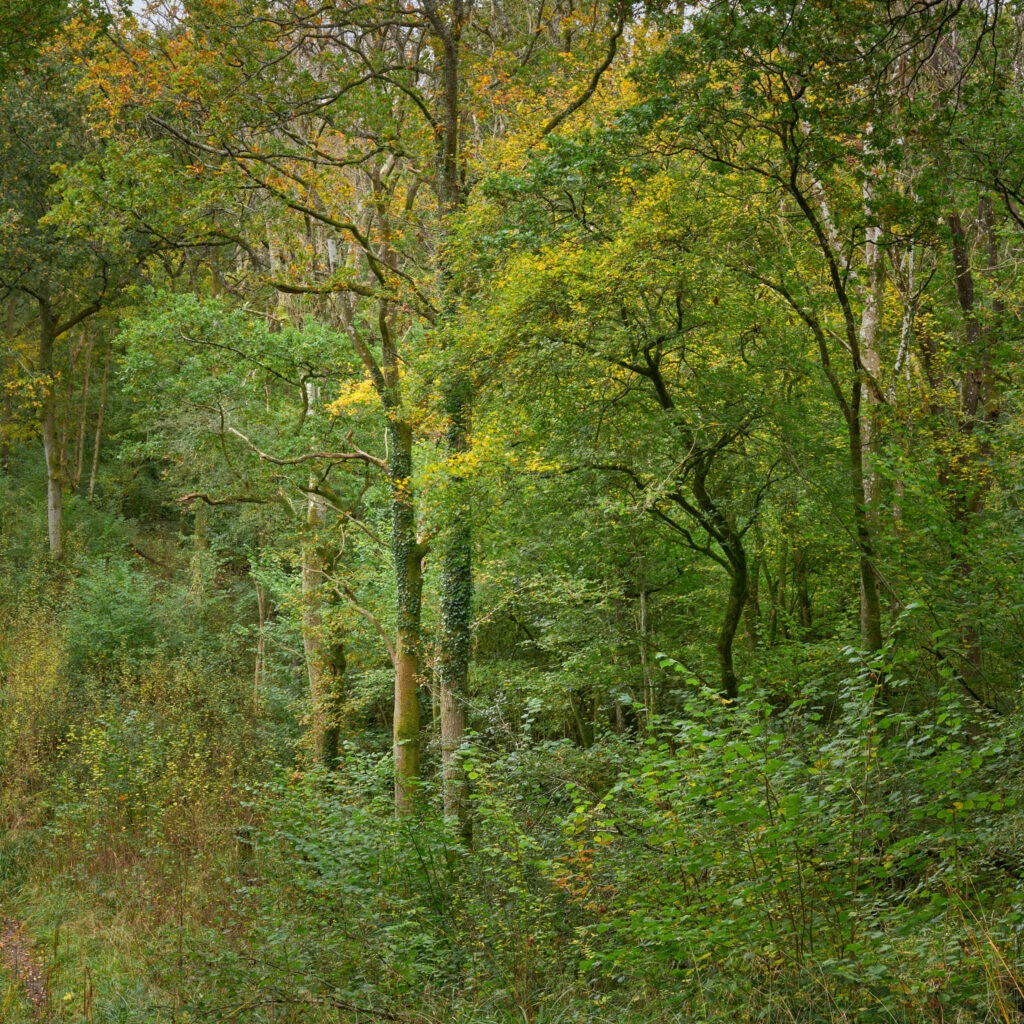
According to Wikipedia the Forest of Dean or just ‘The Forest’ to locals is approximately 42 square miles of mixed woodland. Wikipedia is a little ambiguous but suggests it’s an ancient woodland. Maybe my expectation is misplaced but I expect an ancient woodland to contain at least some ancient/old trees but those I’ve seen all look pretty young. Where are those trees with large diameter trunks and that have been gnarled by the passage of time? If you know, please drop me a message 🙂 🙂
Like any ‘working’ forest large swathes are planted to maximise timber. In these places the trees are often packed together making it hard to pull photographs from the resulting complexity. Early this year I found a small deciduous tree growing on the edge of some evergreens and made a note to return in the Autumn as I thought it had potential. In late summer I returned only to find the area ‘devastated’ by logging activity. Many of the evergreens were just stumps and the ground was a mass of deep vehicle tracks. The deciduous tree was still there but it was a shadow of its former self with many limbs ripped away and branches broken.
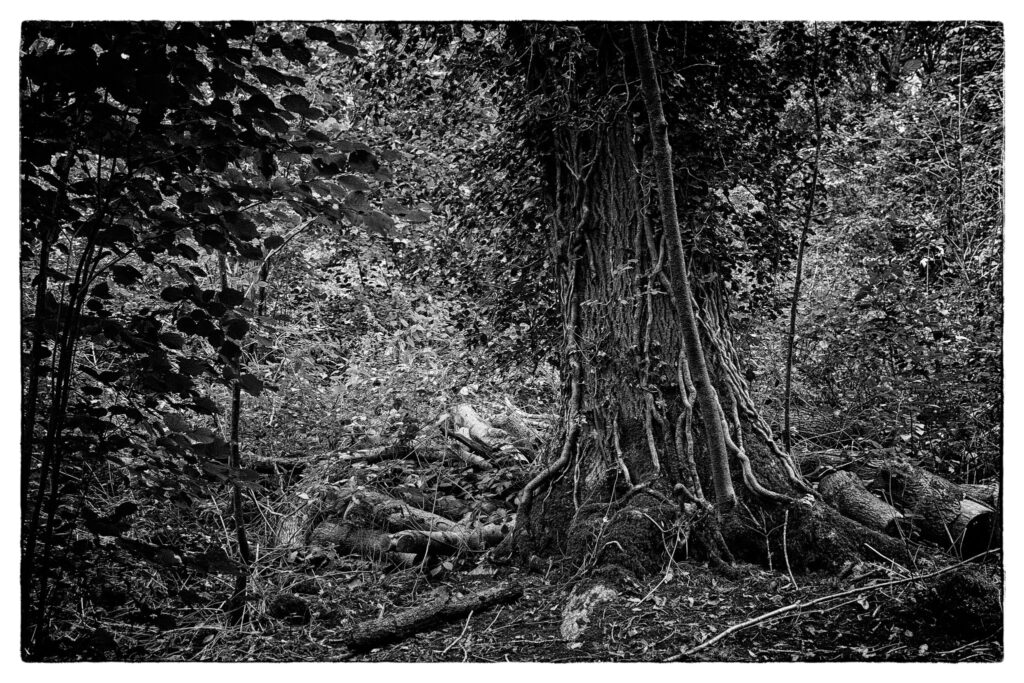
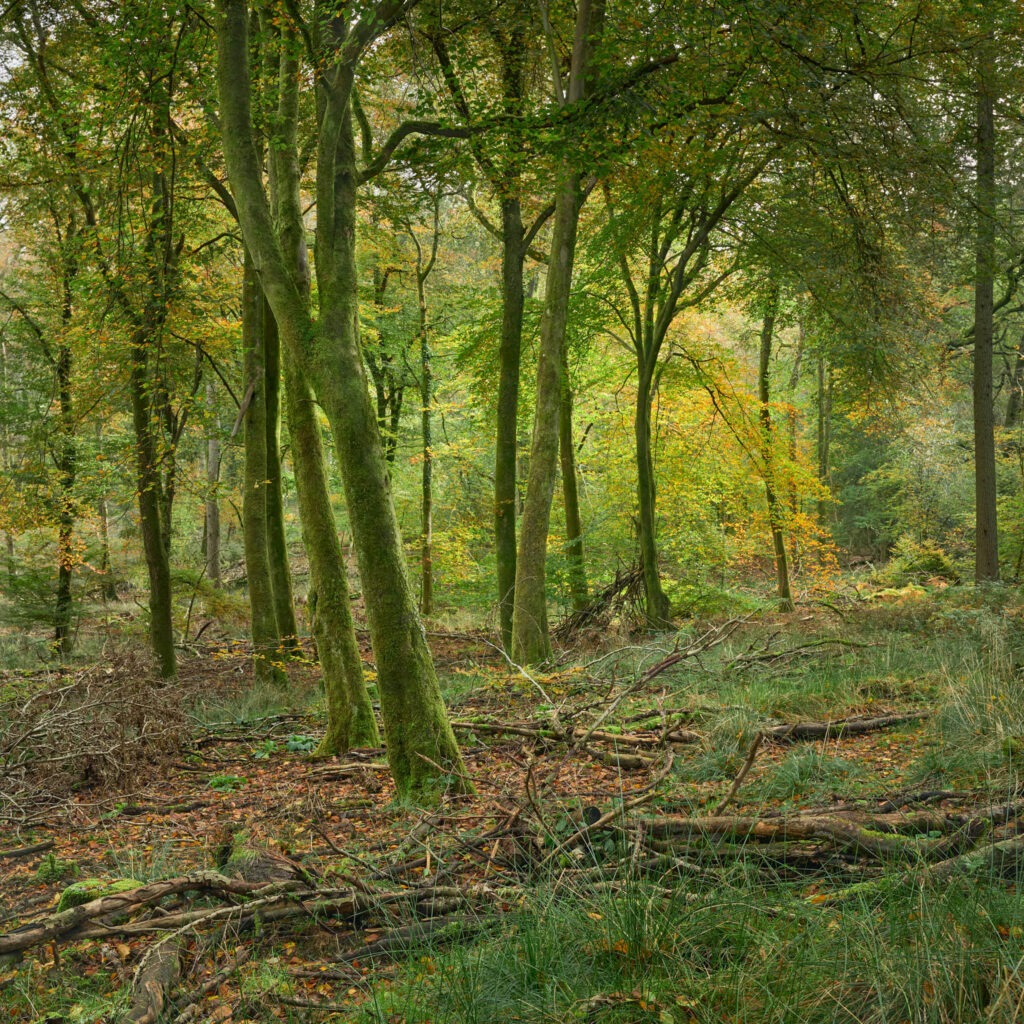
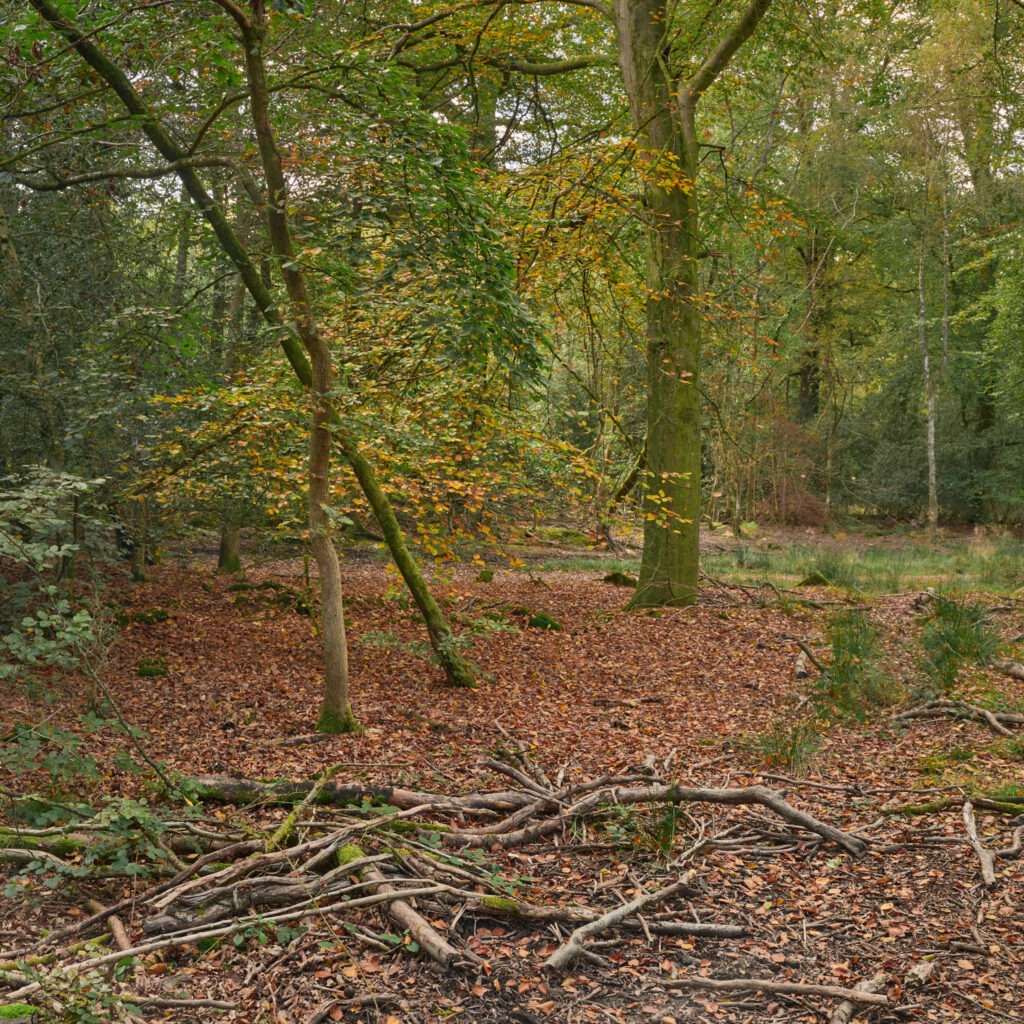
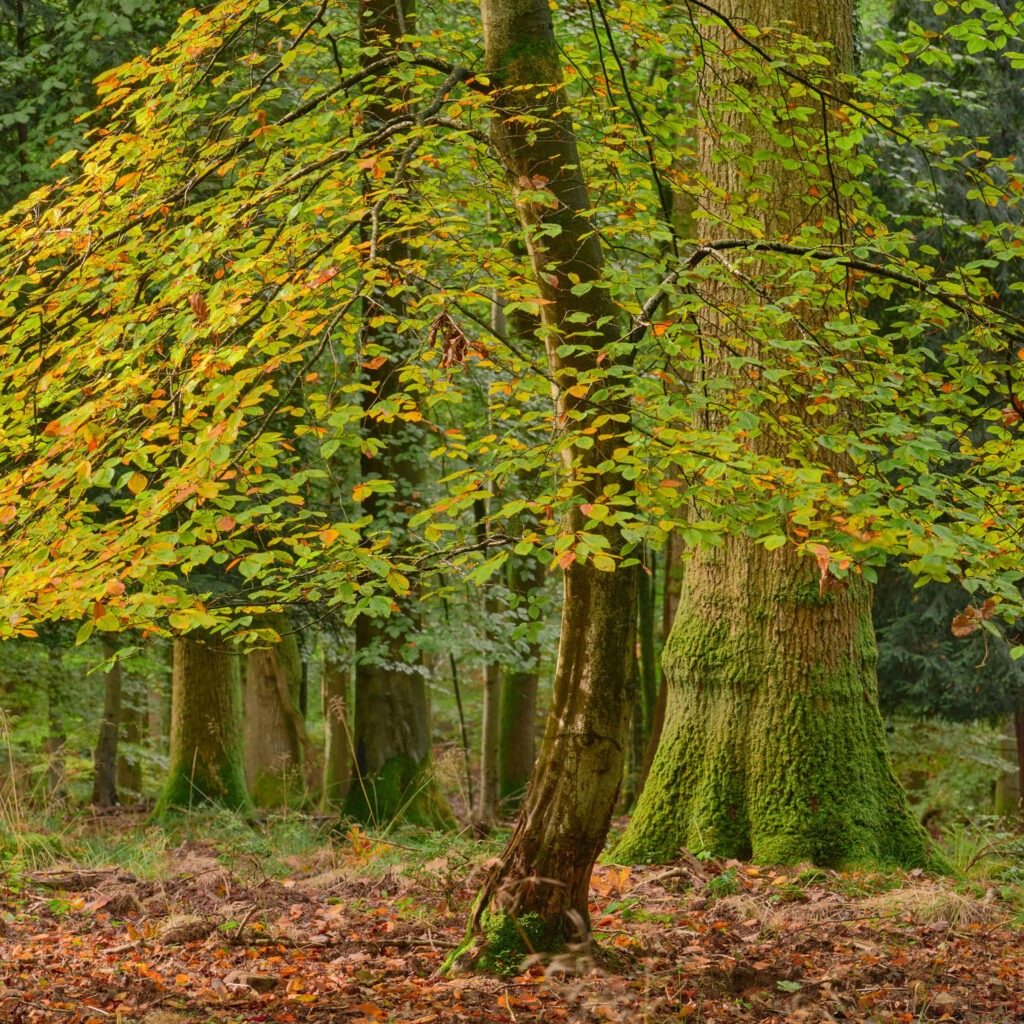
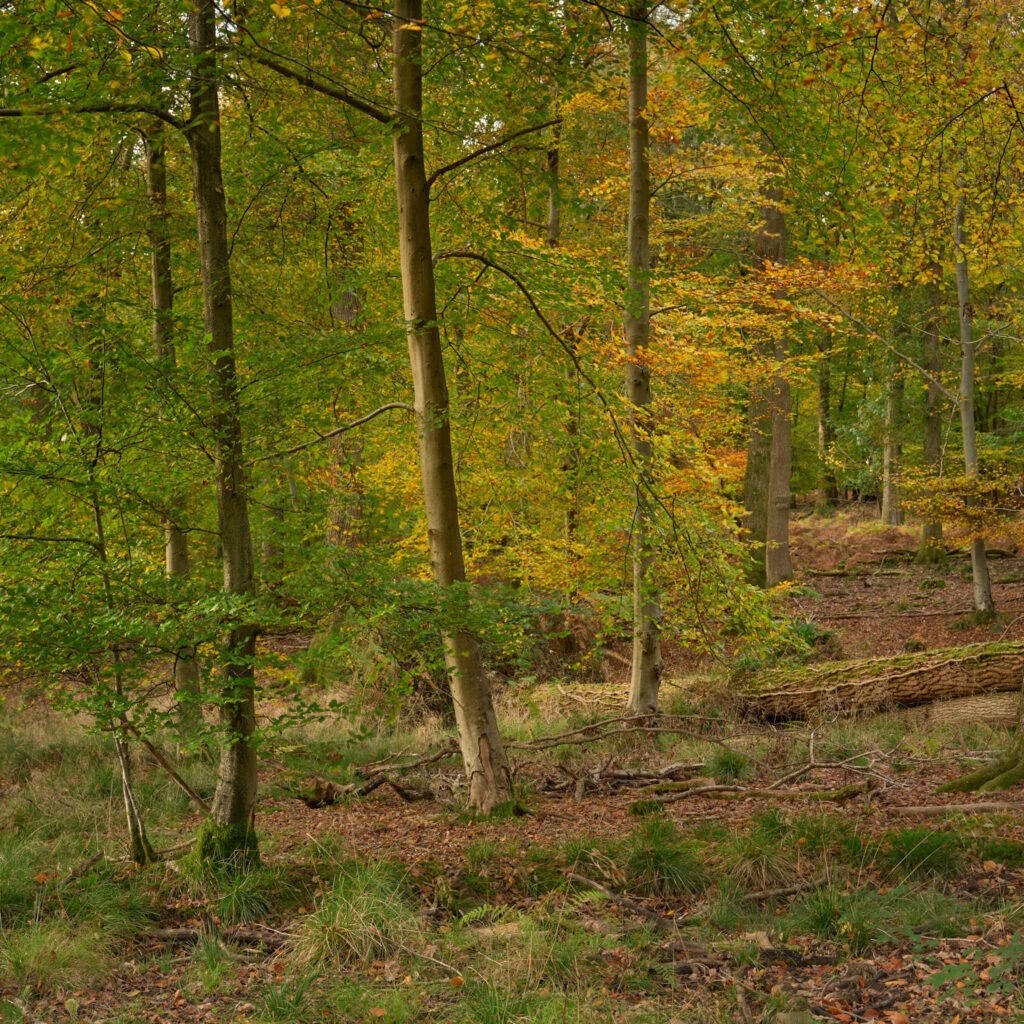
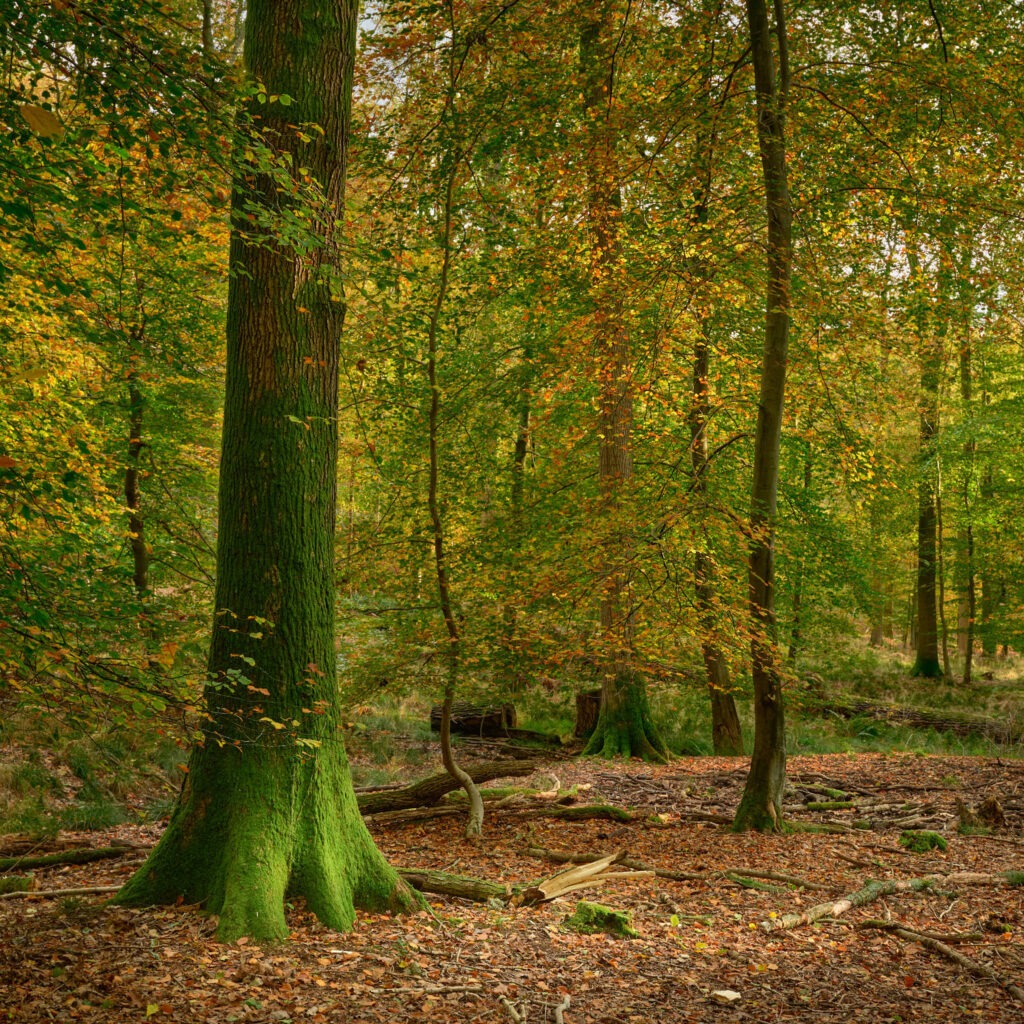
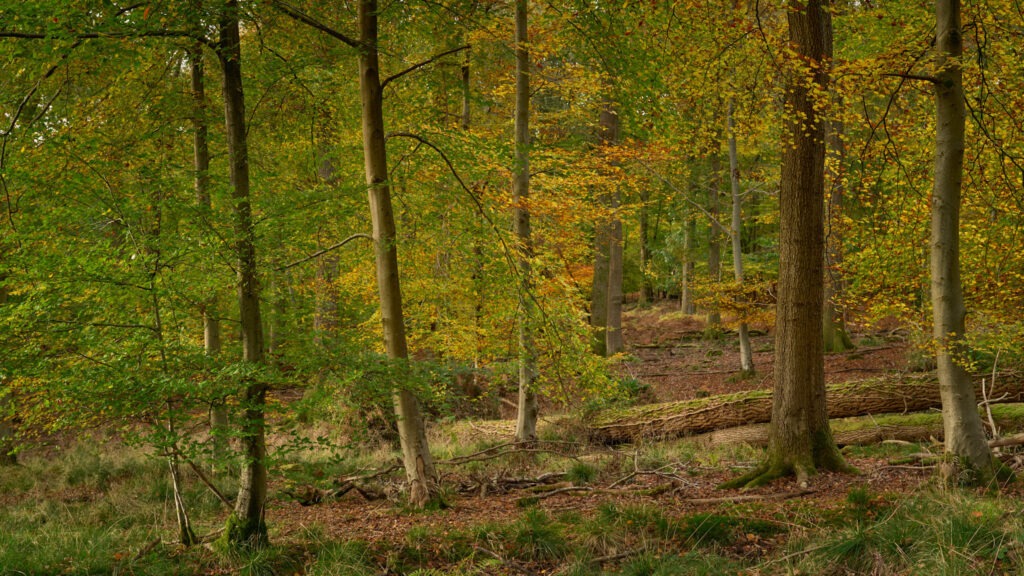
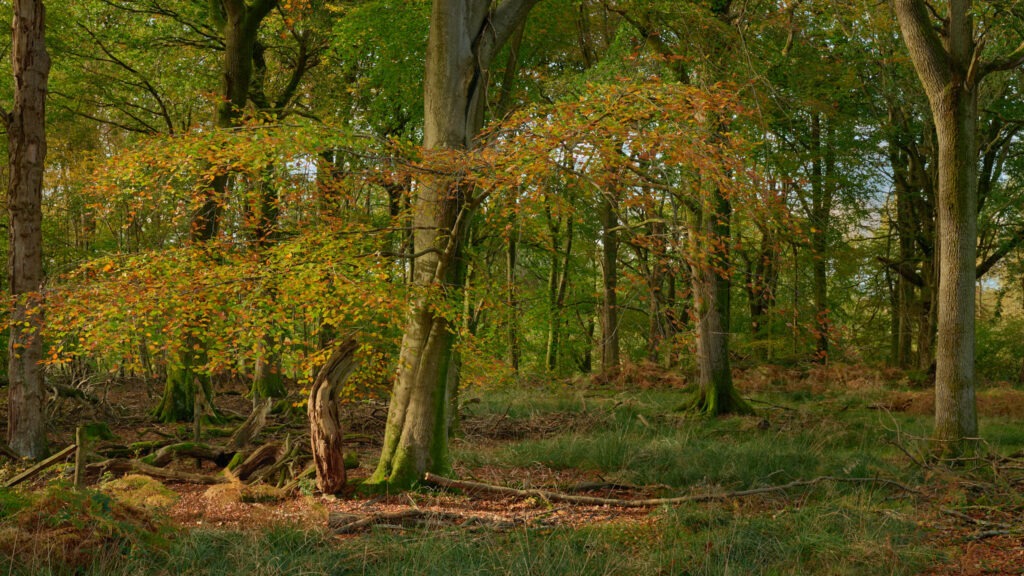
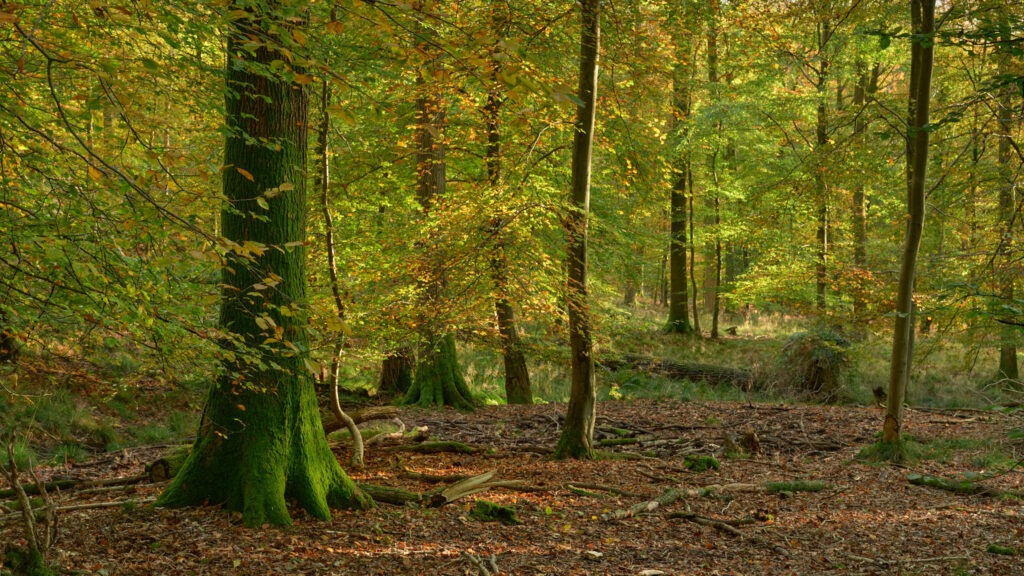
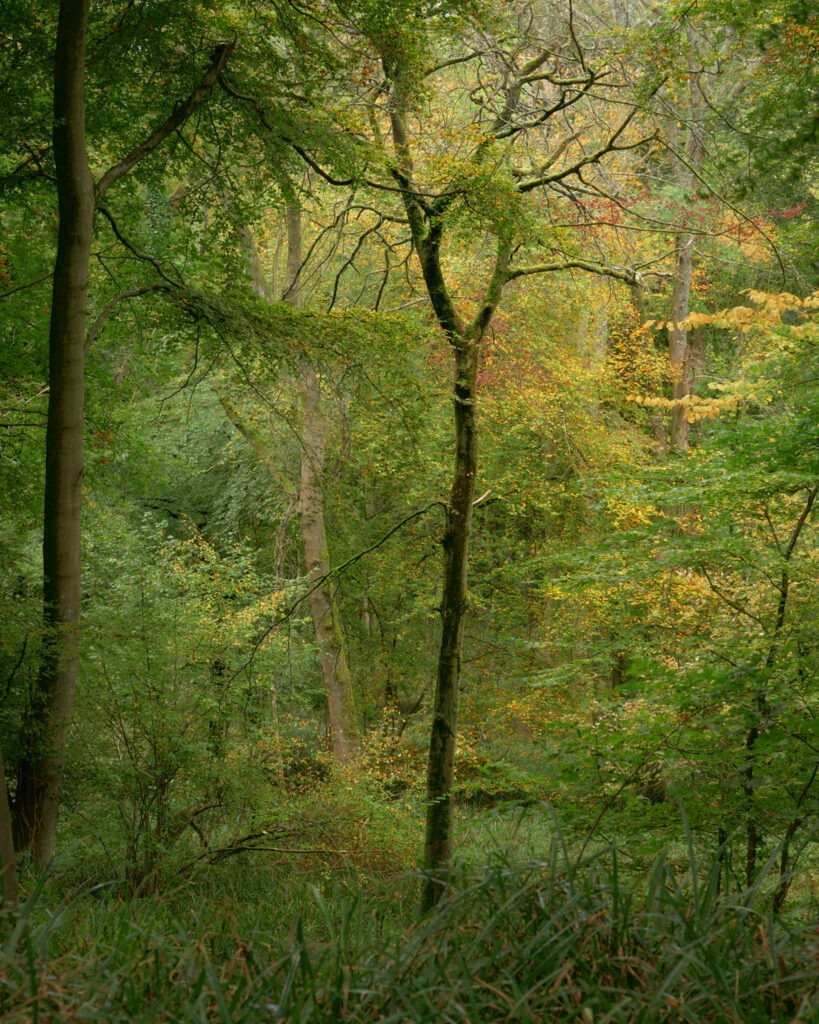
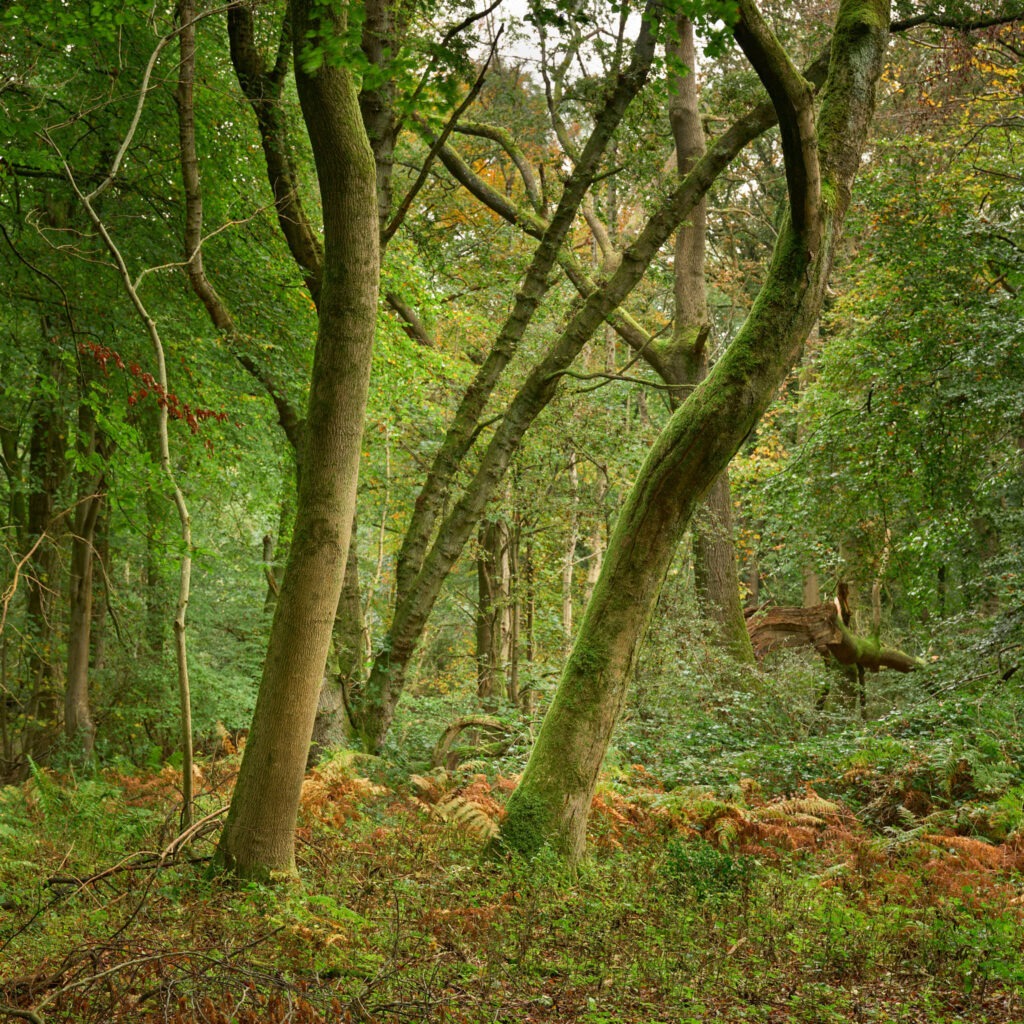
But I don’t want to be overly negative about The Forest as there are many places, see the photographs in this post, where the trees are more separated and where the ground has been ‘tidied’ by the indigenous population of wild boar. The boar almost continually disturb the ground whilst rooting for food which keeps the smaller vegetation down and results in more open spaces. They also seem to push the fallen branches into clumps, presumably to root in the ground below. From a photography perspective both these outcomes are good news 🙂 One of these days I’d like to see the boar – from a distance 😉 – just confirm what I take to be their activity but I’ve not seen any and suspect they sleep in quieter corners of the forest by day. But walking through the forest away from human tracks I’m always a little mindful of them…
Natural woodland
Similar to my experience of scouting woodland near Wickwar, scouting identified areas in which to concentrate and areas to avoid. It didn’t really identify potential compositions for Autumn due to the masking effect of green foliage. Come Autumn, once the veil of green foliage has thinned, there are yellow and red leaves, the skeleton of the tree exposed, the overall composition looks very, very different. My take away here is to not try and find compositions during the summer but just identify broad areas with potential.
You may have noticed that many of my recent woodland photographs are cropped to a square. This crop and a panoramic 16:9 crop seem to work well for woodland photography as they can omit distractions such as sky, nearby trees etc. One of the benefits I’ve realised with a Medium Format 4:3 ratio camera is that there is less pixel wastage when cropping to a square than with a Full Frame 3:2 ratio. This has to be good news when making large prints as I want the majority of pixels, of information in the actual photograph. I do find myself increasing thinking about cameras with a 1:1 aspect ratio. In the digital world those are well outside my budget but film… Mmm, that’s a possibility and a whole different post 🙂
Andy
All images are copyright, Andy Gawthrope Photography.
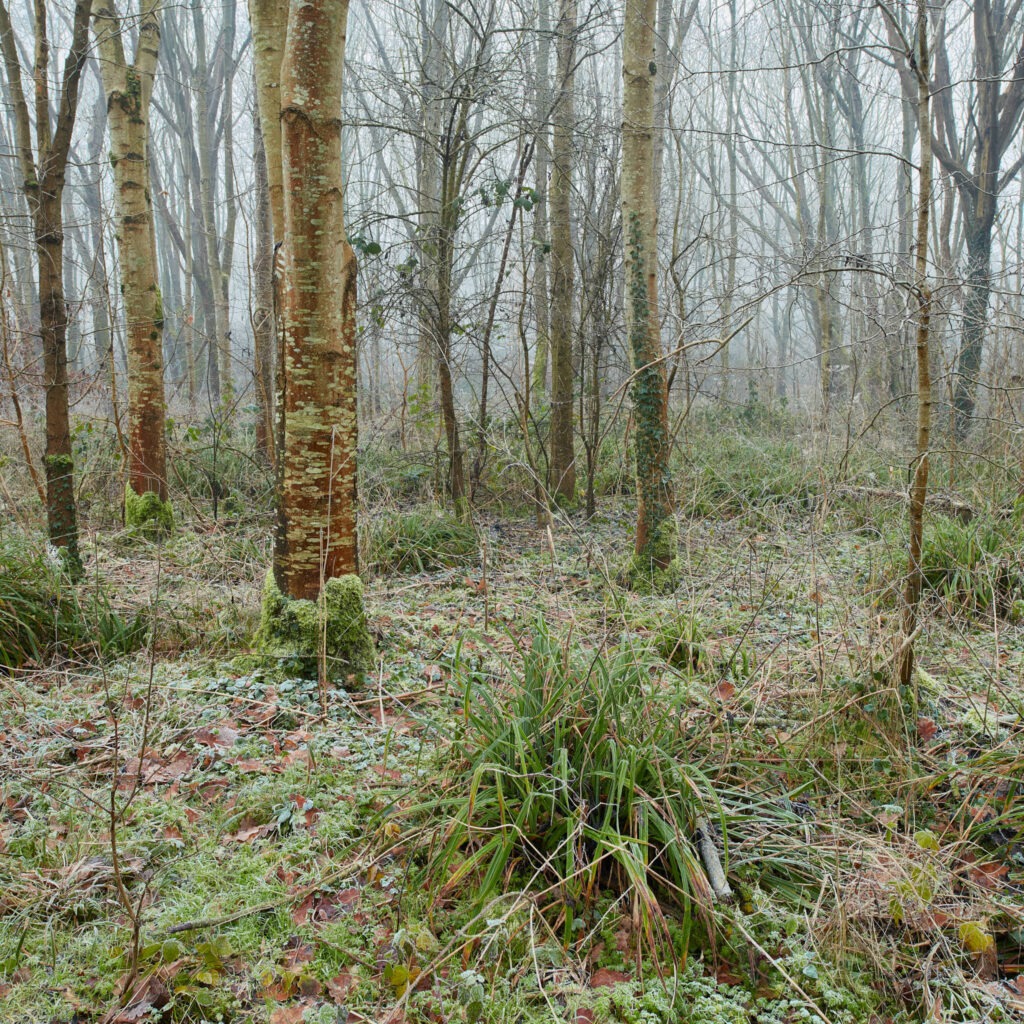
Autumn is comingNatural woodlandCurvesWoodland colours No. 1Tall and MightyWoodland colours No. 2The old and the newStory of life
At the South Western edge of the Cotswolds, not far from either the M4 or M5 motorways is the old market town of Wickwar. To its East, nestled below the Cotswold edge are several small woods.
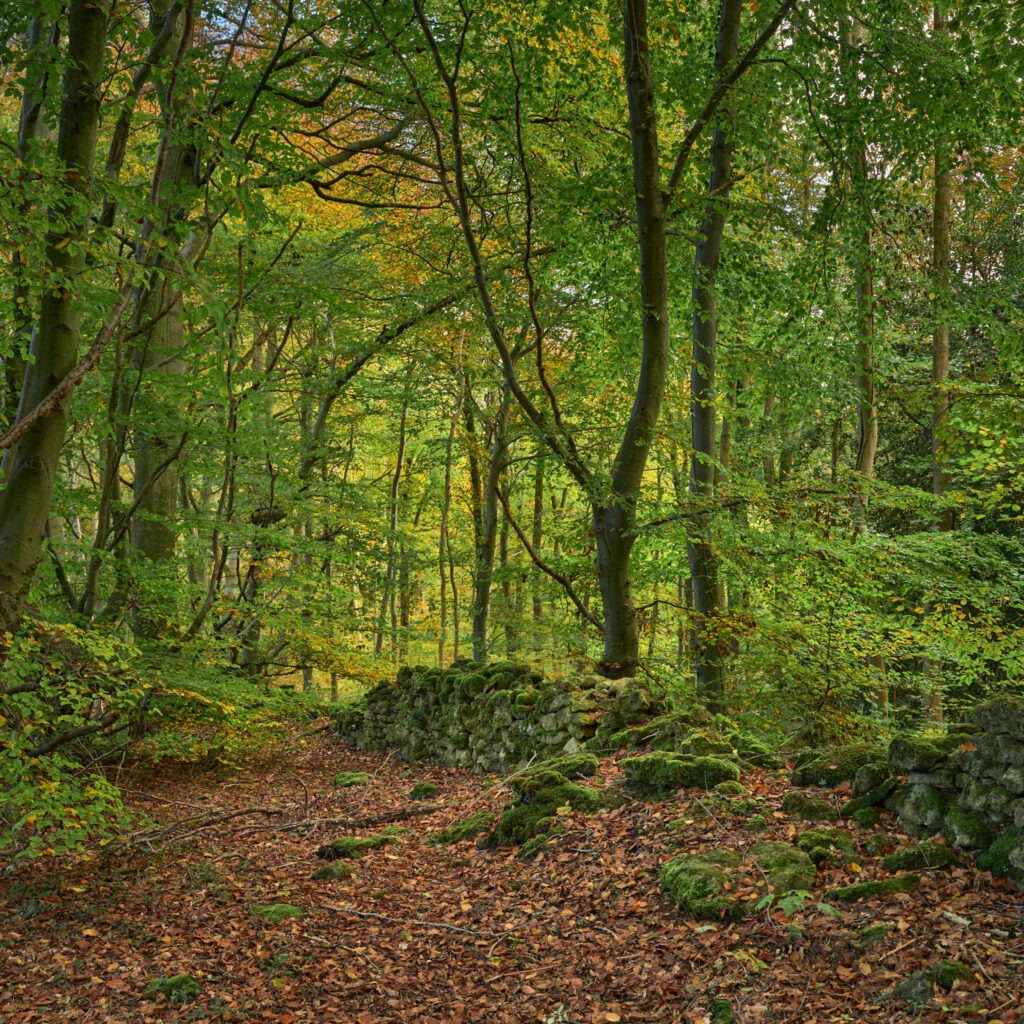
With a plan to make the most of Autumn I visited several times during the summer with the intention of identifying possible compositions. Whilst I’d love to say that it was successful, it wasn’t. With the trees swathed in a cloak of green it was too difficult to pre-visualise how they may look come Autumn. But it was far from worthless, it did give a good understanding of the layout, the paths and areas that definitely wouldn’t work. e.g. the small pockets of evergreens. This knowledge was valuable and saved much time once Autumn arrived.
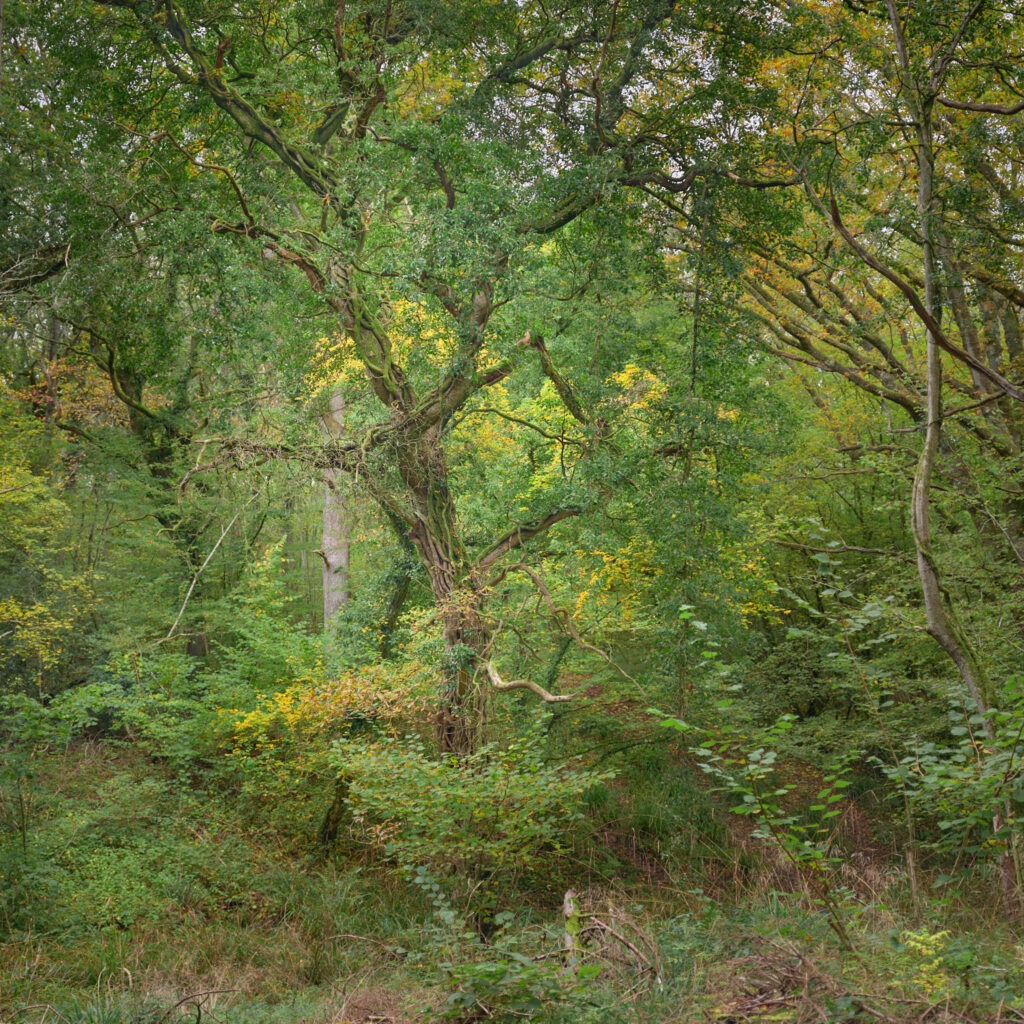
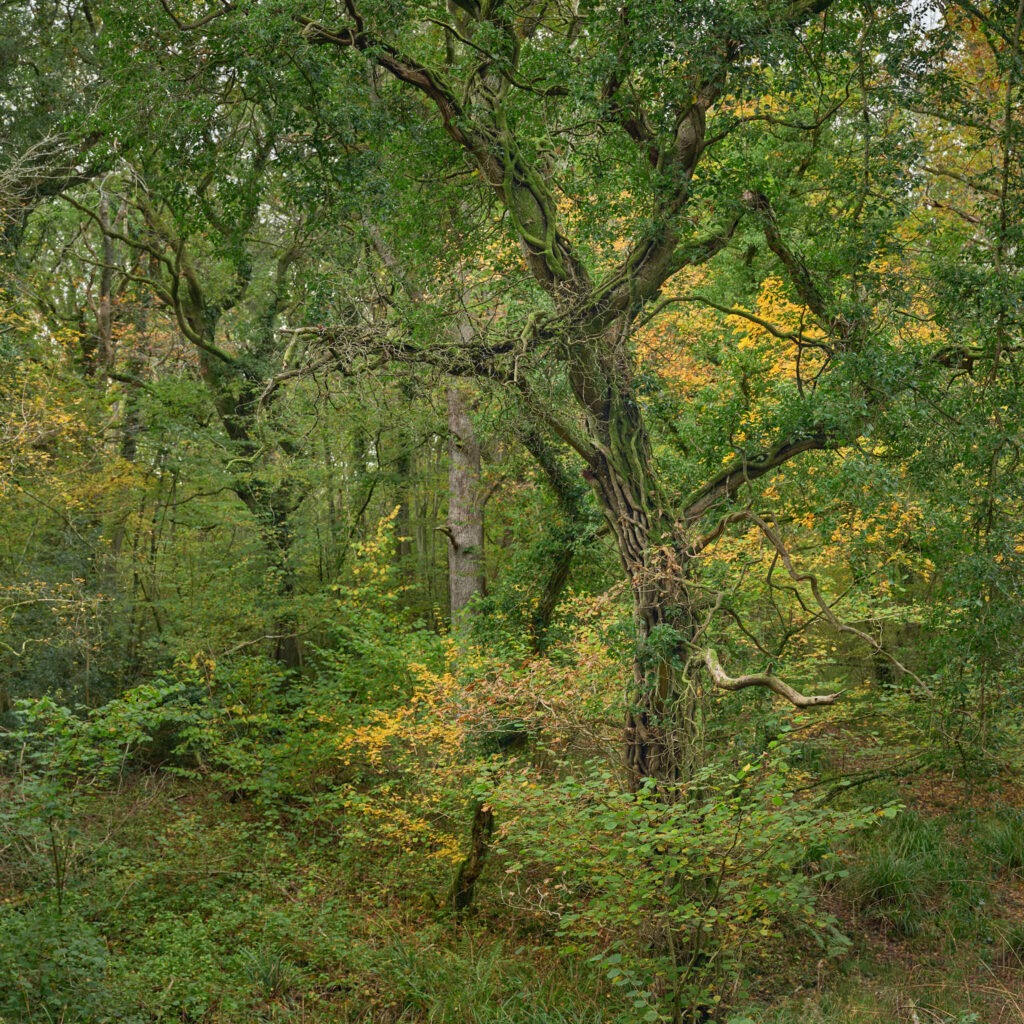
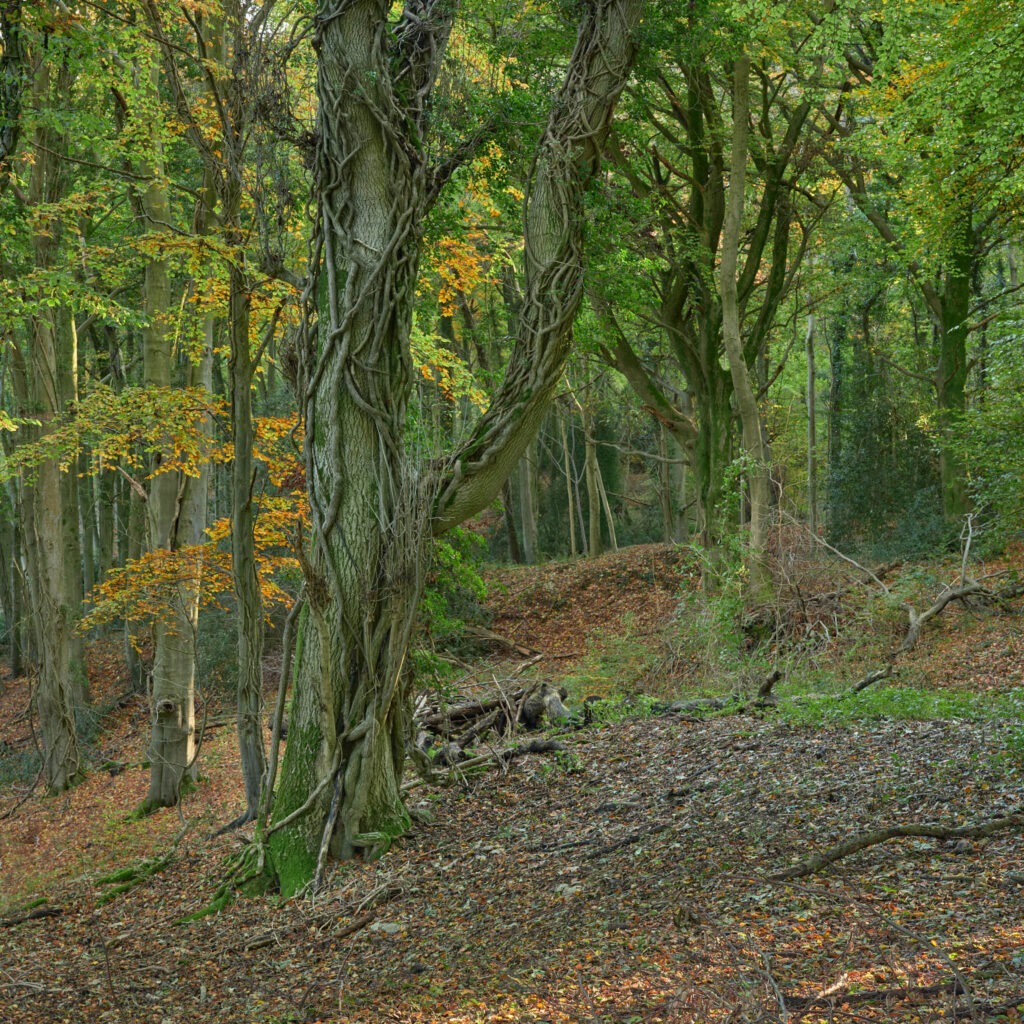
Most of the trees are deciduous, relatively young and very straight but tucked away amongst them are a few more shapely trees! Its those trees that interest me; they contrast wonderfully against the uniform straightness of their neighbours and its easy to project character onto them. Add a splash of Autumn colour and increased visual depth due to less leaves and the results can be very nice.
My woodland photography this year has used a subtle look; Not the punchy, ‘smack it to em’, heavily saturated colours associated with social media. I wanted something more realistic, something softer if you like. I hope I’ve managed to achieve that with the photographs this year and with those in this post 🙂 Please leave a comment below.
Straight and Curvey trees
This year I’ve been using a Medium format camera system instead of the trusty old EOS 5DSr. The results are just fantastic with increased dynamic range, reduced noise at higher ISO’s and simply better image quality. Due to the different sensor size there is a difference in Depth of Field and its this that has proven the hardest to master. Without knowing it, at Full Frame, I’d become very good at choosing an appropriate aperture for a desired Depth of Field. It’s only with the change to Medium Format that I realised this and as a consequence I’m having to adjust to the difference. But the pain of adjusting is definitely worth it as the resulting images are so good. The detail captured by the larger sensor is amazing but, I fear, lost on small-sized images presented on Social Media and even this web site. But print them and wow they look good!
For me, photography is about making beautiful prints that can be enjoyed over time. Seeing a photograph printed is just so, so much better than seeing it on a computer display. I’ve often thought about why as computer displays are pretty good these days. Anything presented on a computer screen must be transitory as the display is a shared resource. Display something else or switch-off the computer and it’s gone – its too transitory for my liking. Once printed using high-quality inks and paper a photograph becomes a living, physical object. That object can be shared; it can be touched and consumed by people over the long-term perhaps as a framed photograph hung on a living-room wall or in a public space. Suffice to say several of the photographs from this year will soon be available as high-quality prints and greeting cards 🙂
Andy
All images are Copyright Andy Gawthrope Photography.
Exoskeleton. No. 1Exoskeleton. No. 2Straight and Curvey treesI’m not going yellowThe way out…Woodland path
It’s hard to convey the feelings of peace and tranquility experienced when stood quietly and still in woodland under a canopy of trees on a windless day. The only sound to break silence is that of squirrels busily preparing for Winter. Initially they scurry to cover but after a few minutes return to their activities. It a beautiful and calming feeling.
There were days this Autumn when I saw no-one else all day, not even the usual dog walkers. Sometimes I just stood there surrounded by trees absorbing the beauty of nature. Even photography was pushed to second place – and that takes some doing!
I had hoped for some misty/foggy mornings to bring a little mystery, emotion and separation to the woodland but it wasn’t to happen for me this year. The weather has been very warm and as I write this in mid-November its still 13 degrees Celsius outside. Autumn this year has been a slow ‘burn’; it’s not over yet although leaves are now dropping rapidly. Another week and the show will be over for another year.
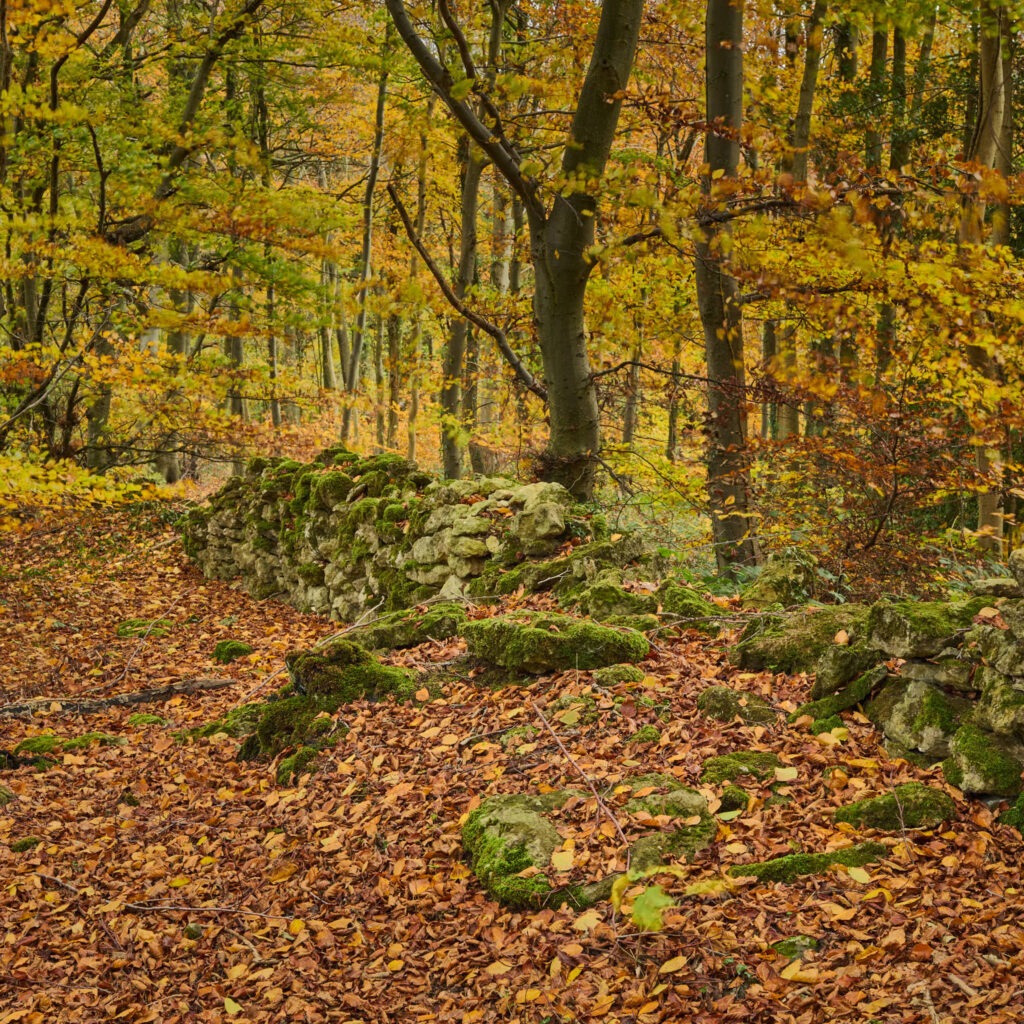
The photograph above was made with the Medium Format camera and the one below entitled ‘The Lost Wall’ with the Full Frame EOS 5DSr. These were taken 9 days apart and very clearly record the progression of Autumn. Unfortunately I wasn’t able to match the focal length of the lens so the latter used a slightly longer (50mm) lens. The Medium Format image used a 48mm (approx 39mm equivalent) lens. This change in camera was due to a problem with the Medium Format lens which is now being repaired.
Peeking through the trees
‘Peeking Through the Woods’ was made through a gap in the trees with a long lens. The distant trees were set slightly back from the main canopy and were just catching a little late afternoon light that penetrated thinner cloud. It was just enough to lift the yellows and reds and give the appearance of a halo surrounding the tree. It looked wonderful 🙂 I particularly liked the lighter coloured tree in the background that leans to the left – it added depth and character to the photograph. The tree on the far left is compositionally interesting; my initial thought was to remove it as it was too dominant, however, this wasn’t possible without upsetting the balance of the photograph. So it was included with the intention to remove it in post production. In post production, however, the tighter crop necessary to remove it from the frame upset the balance and, actually, I decided I quite liked it! Try covering it with your hand – the photograph isn’t as strong; it seems to act as an anchor and helps with a sense of depth.
I’d love to hear what you think about these posts and the photographs so, please leave a comment below.
Andy
All images are copyright Andy Gawthrope Photography.
Select an image from the gallery to enlarge.
Lost wall. No. 1Lost wall. No. 2TreesDeep in the woodsPeeking through the trees
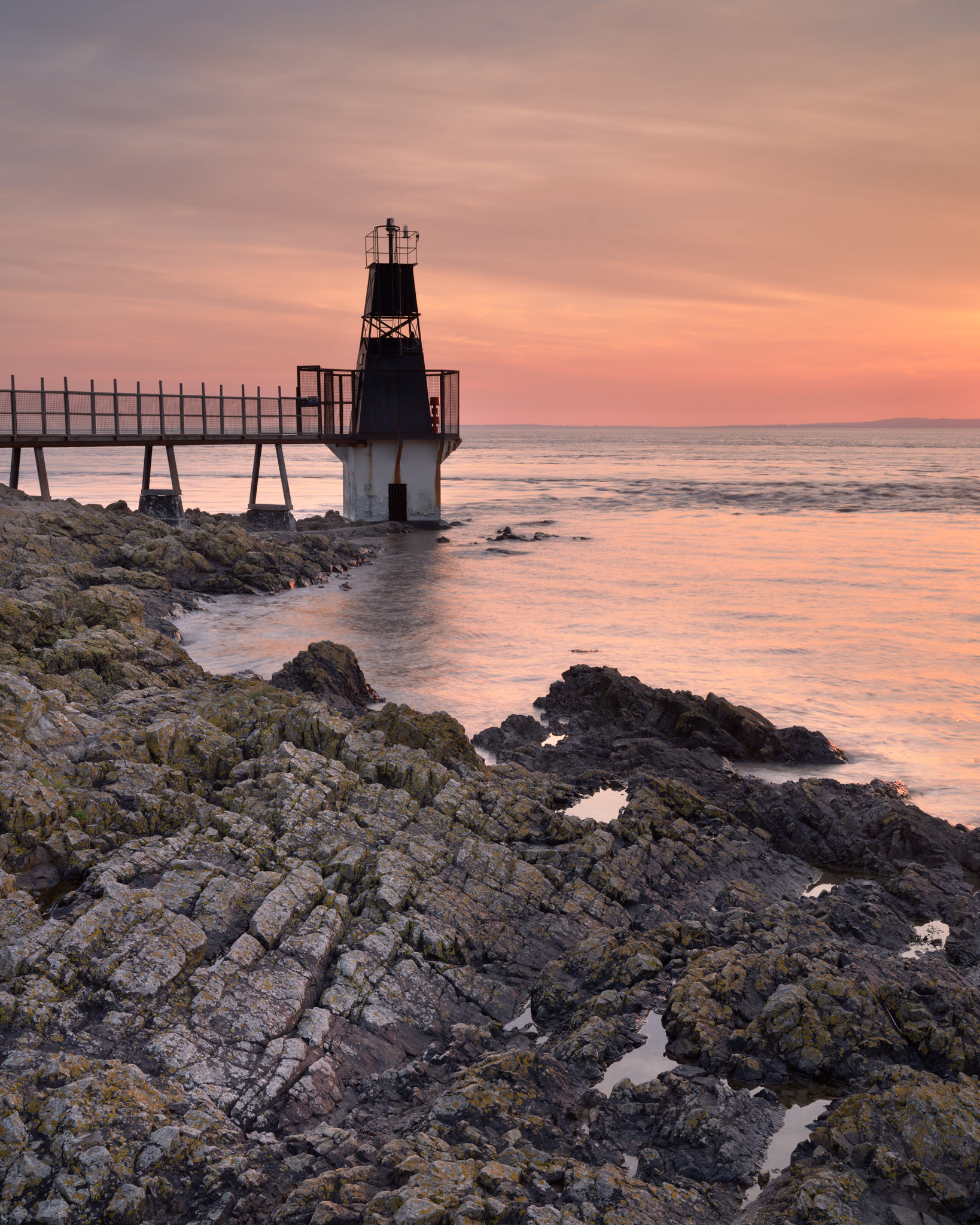
Battery Point at Portishead is one of those places I’ve known about for years but never actually photographed as its so close to home. Partly due to Covid travel restrictions I made it a bit of a mission recently.
For those not familiar; Portishead, not to be confused with the 90’s/naughties music band – of whom I’m a great fan :-), sits on the coast just South of the entrance to the Avonmouth / Bristol docks. Battery Point is a channel / navigation marker for the ships, which are pretty large, entering and departing the docks. As the tidal range is large the sea height can vary from well below or totally surrounding its lower parts.
As any landscape photographer will know, a good photograph often requires many visits to a location before light and conditions align with the minds eye. The photograph above is no exception; I’d been at least five times previously, coming away with ok images but not what I was looking for. On this particular occasion I very nearly didn’t visit as the clouds looked a little heavy at home and I thought the tide may be a little high. But I did go and conditions were just about perfect! Persistence, pays 🙂
But there is more at Portishead than just Battery Point and I’ve now got a couple of other ideas on the go. I’m now waiting for the gods to smile again.