It’s been a strange year. Covid-19 Lock-downs didn’t really come to an end until July by which time the great clouds and light associated with Winter and Spring had passed. Summer is not my favourite season and not the favourite season of many landscape photographers due to the often harsh light, the ridiculously early starts and the late finishes necessary to capture the early/late light. But summer has now passed and Autumn with its shorter days is very much here. Trees are loosing their green’s and starting to reveal their yellow. As it’s been a dry year we may not get the orange colours that sometimes follow but the next few weeks will tell. Fingers crossed!
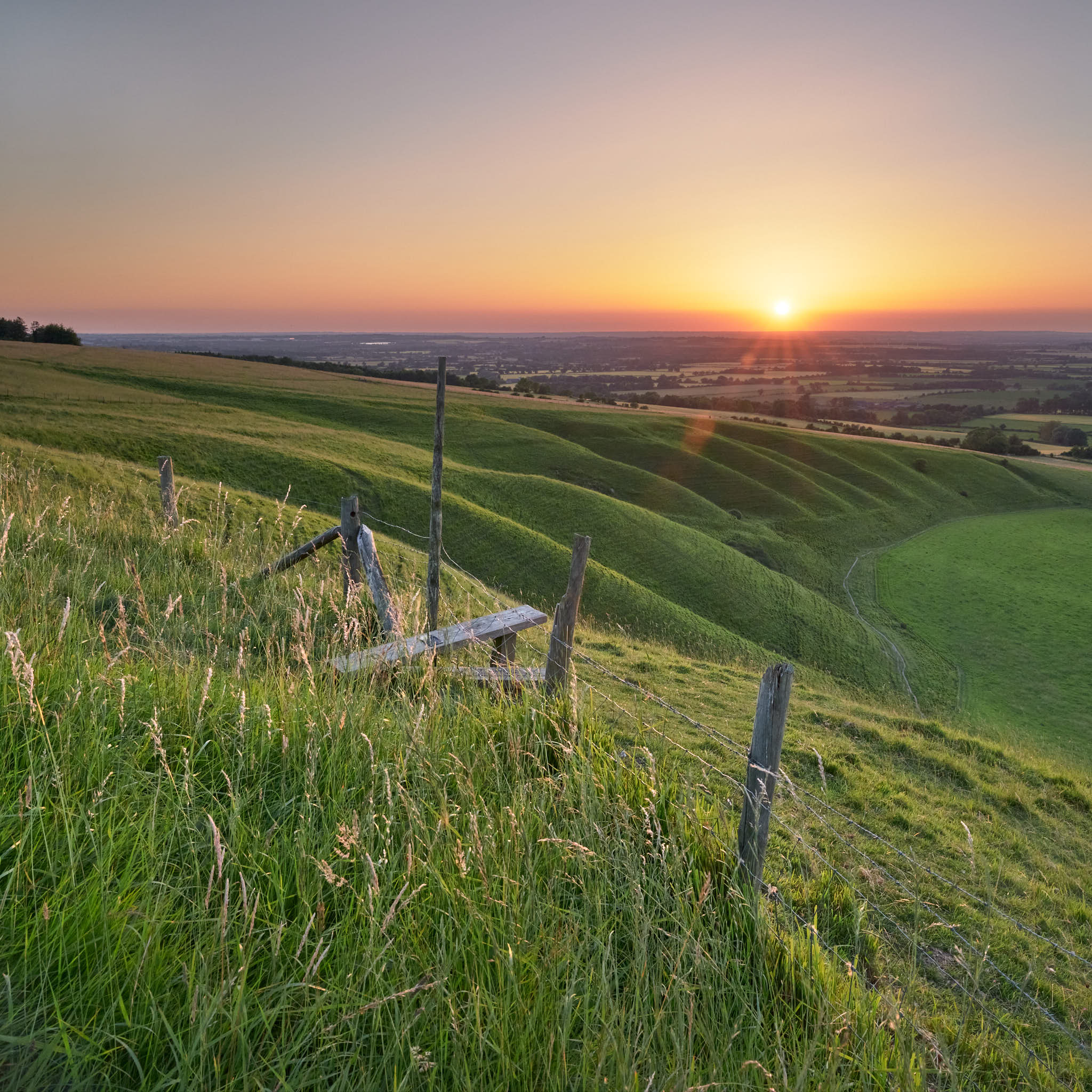
The Wiltshire Downs are known for their white horses; not the living, breathing type but those carved into the chalky hillsides. One of the famous horses is near Uffington on White Horse Hill. The horse is carved high on a hillside and is best photographed from the air. What drew me to the location one July evening was the feature called The Manger just below the horse. It’s a steep sided, elongated valley that cuts into the chalky hillside. In days past the hillside was the location of a Cheese rolling competition something that possibly still only continues at Coopers Hill in Gloucestershire.
Leaving home there was a little high-level cloud that could have made a nice sunset, however, The Manger is just over an hour’s drive East and inland from Bristol where the weather can often be different. It was on this occasion; clear blue skies with distant cloud towards the horizon and a light breeze moving the grasses. Not what I hoped for! Not awful though!
This was one of the early outings this year with the new Fujifilm GFX100S. Using greater than ISO 400 on my previous landscape camera would have resulted in significant noise, however, the GFX100S is a monster. The above photograph was made at ISO 1250 and has little noise. Its Dynamic range is also significantly wider making this high contrast image possible with a single exposure.
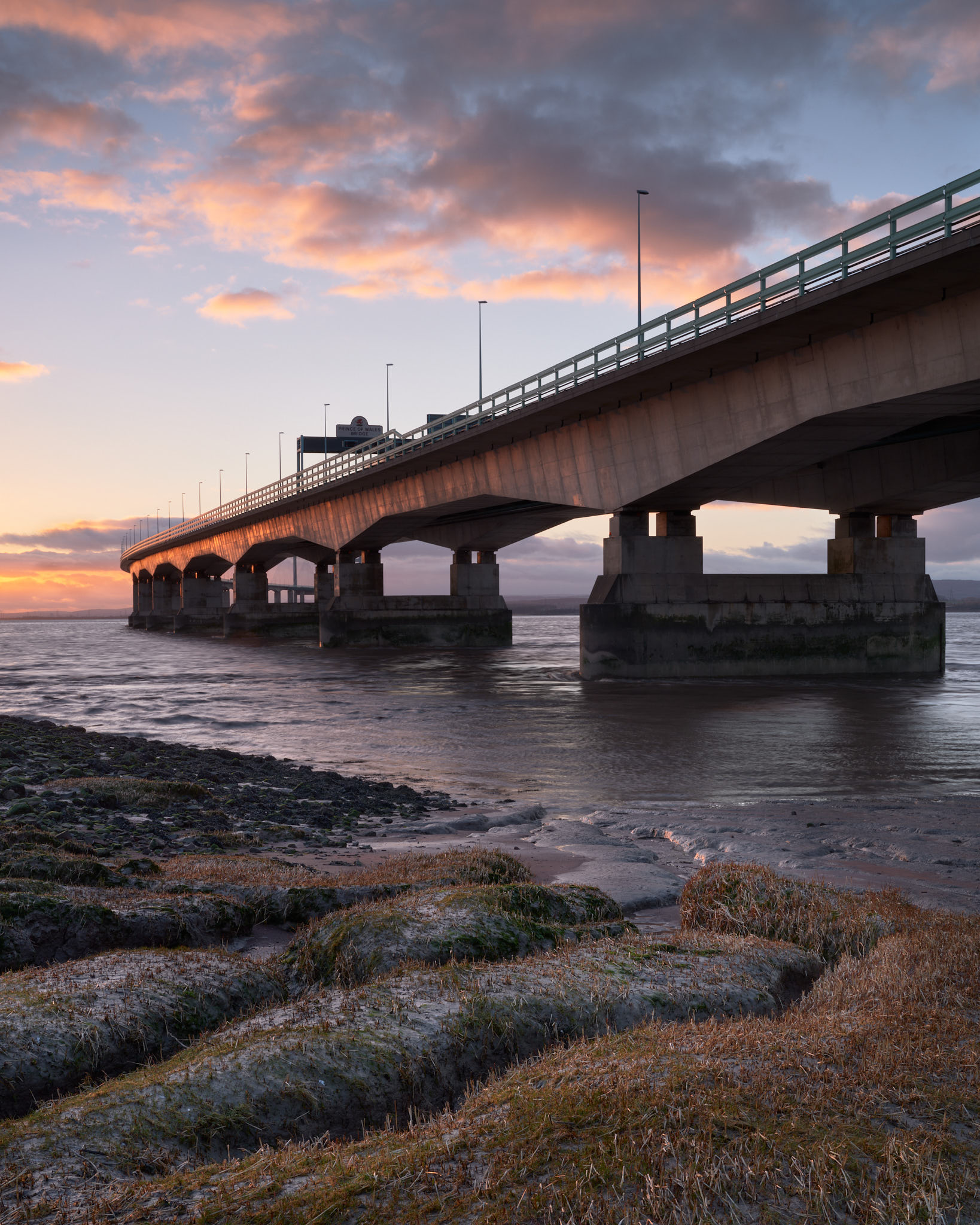
A quick check of tides and a peek out the window identified yesterday as a great evening to be at my favourite local location. Yes, you got it, full-marks; its the Prince of Wales bridge aka the Second Severn Crossing.
In an age where image manipulation is so prevalent the statement ‘A photograph never lies’ has, unfortunetly, lost its meaning. But whilst this photograph is pretty much how it was, I can tell you that those nice warm colours lie! They really don’t convey how cold it felt! The air temperature was about 7 Celsius with a gusty 20MPH wind coming from the direction of the sun. So, actually it felt about 3 to 4 Celsius!
Yesterday I was reading about ‘skills fade’ in ‘Summit’ the magazine of the British Mountaineering Council. The message was that climbers/mountaineers shouldn’t just assume they are as skilled in their sport as they were prior to the coronavirus lockdowns. Basically, their skills are likely to have got ‘rusty’ or faded through lack of use. Having fumbled-about making this photograph I can absolutely confirm I’m suffering from a photographic skills fade! There were times when I felt like a complete noob! Skills that seem to have faded are ‘seeing’ – that ability to compose photographs in the mind – and just basic workflow stuff. Stuff that used to be second-nature; stuff I wasn’t even aware I was doing. I’m sure those skills will grow again but it was a bit depressing. Despite that I’m pretty happy with the result 🙂
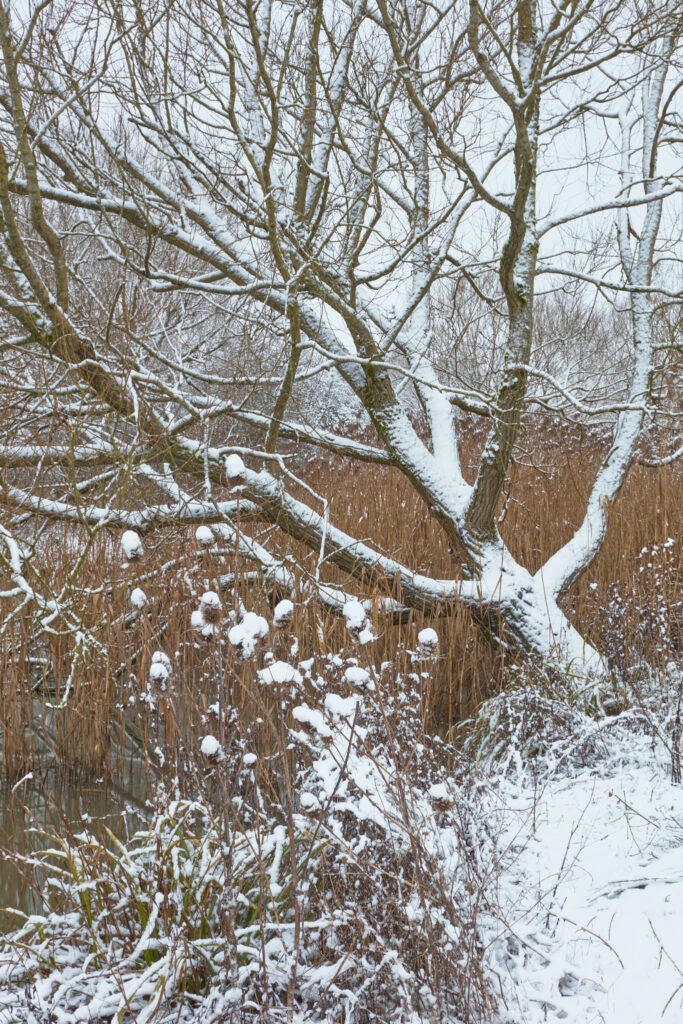
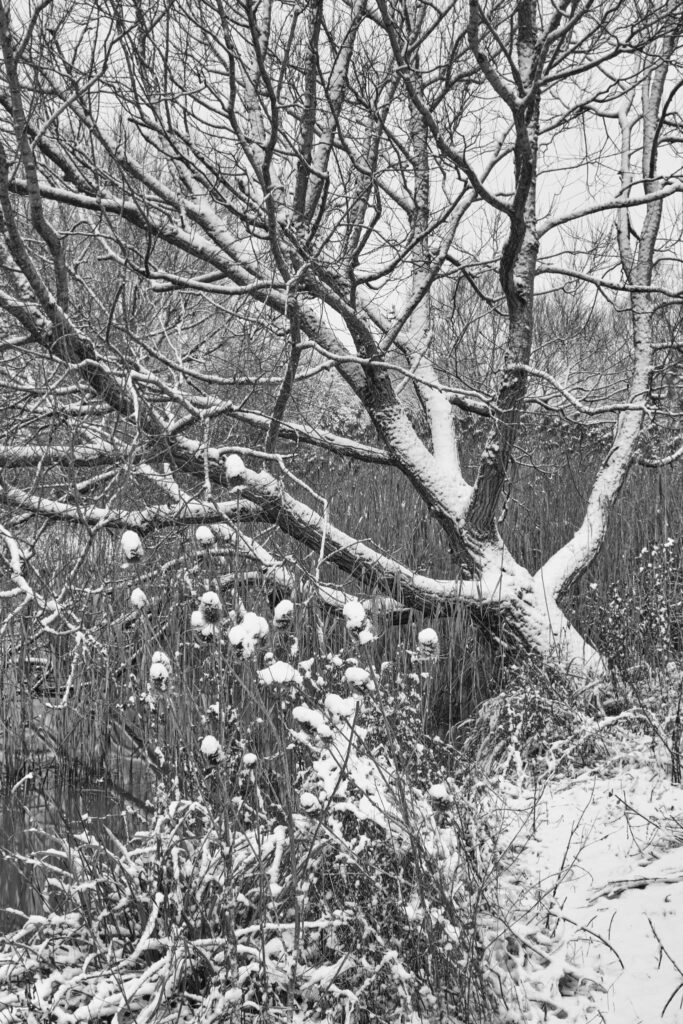
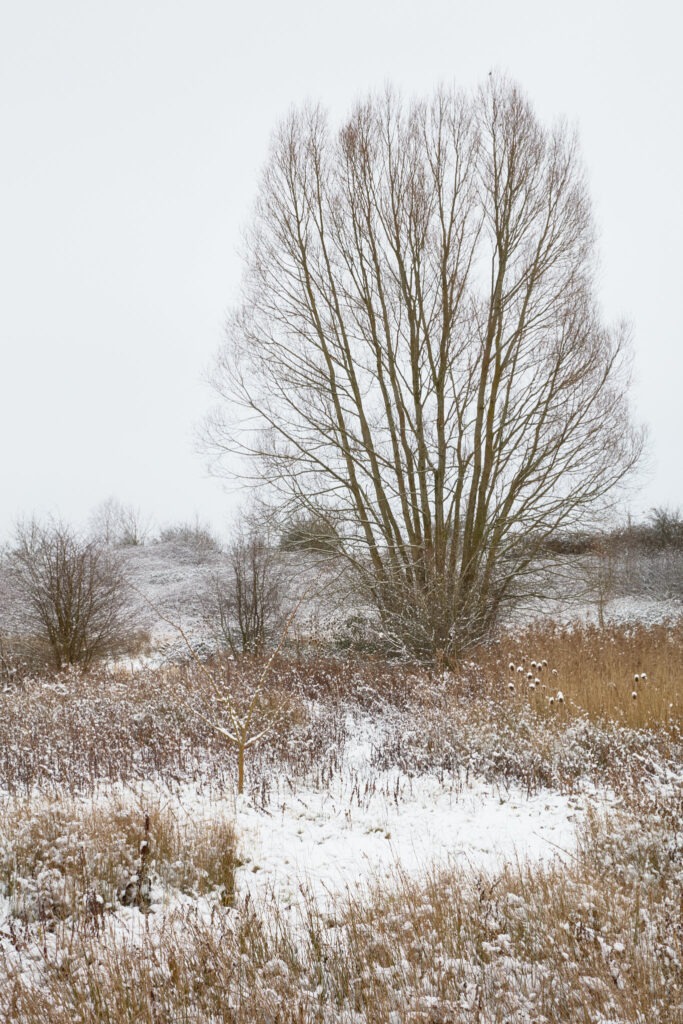
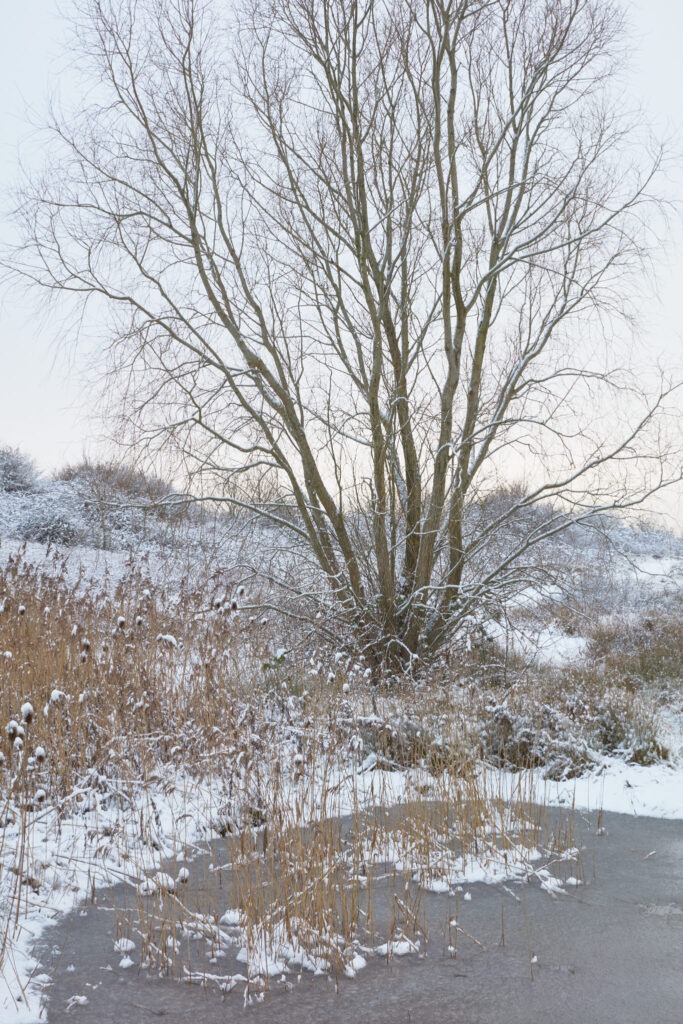
It’s not often it snows at home and thanks to the COVID-19 pandemic we currently are not allow to travel outside our local area here in England. In more normal times I would have travelled to other, more interesting, locations such as Dartmoor. But, this opportunity couldn’t be ignored so, my local woodland area was what it had to be.
There is a lot to be said for local photography especially in Winter. The sun doesn’t rise until 0800hrs and its quick and easy to roll out of bed, breakfast and arrive on-location in plenty of time. I arrived at my first location, before sunrise and, importantly, before anyone else came to see and play in the fresh snow. 🙂
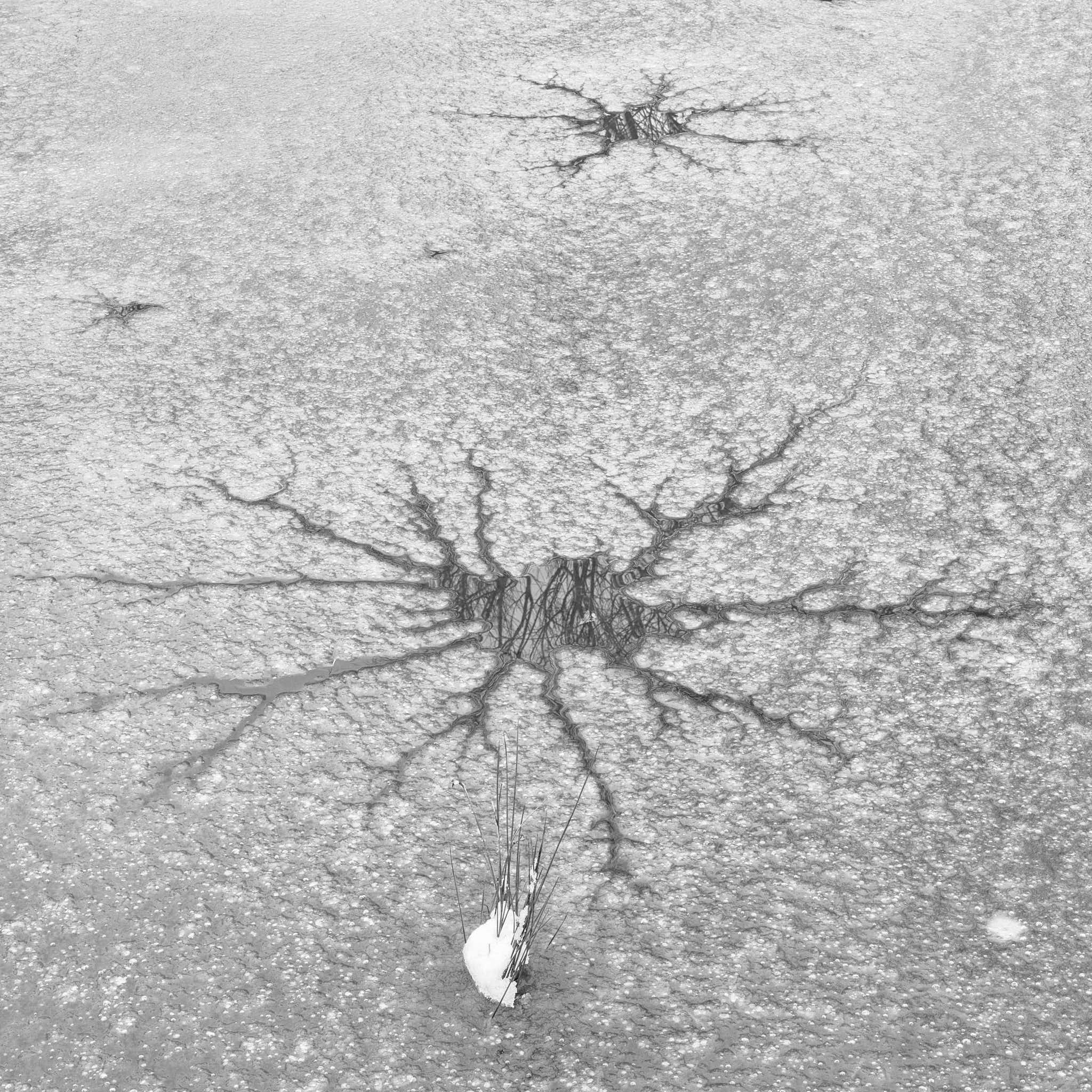
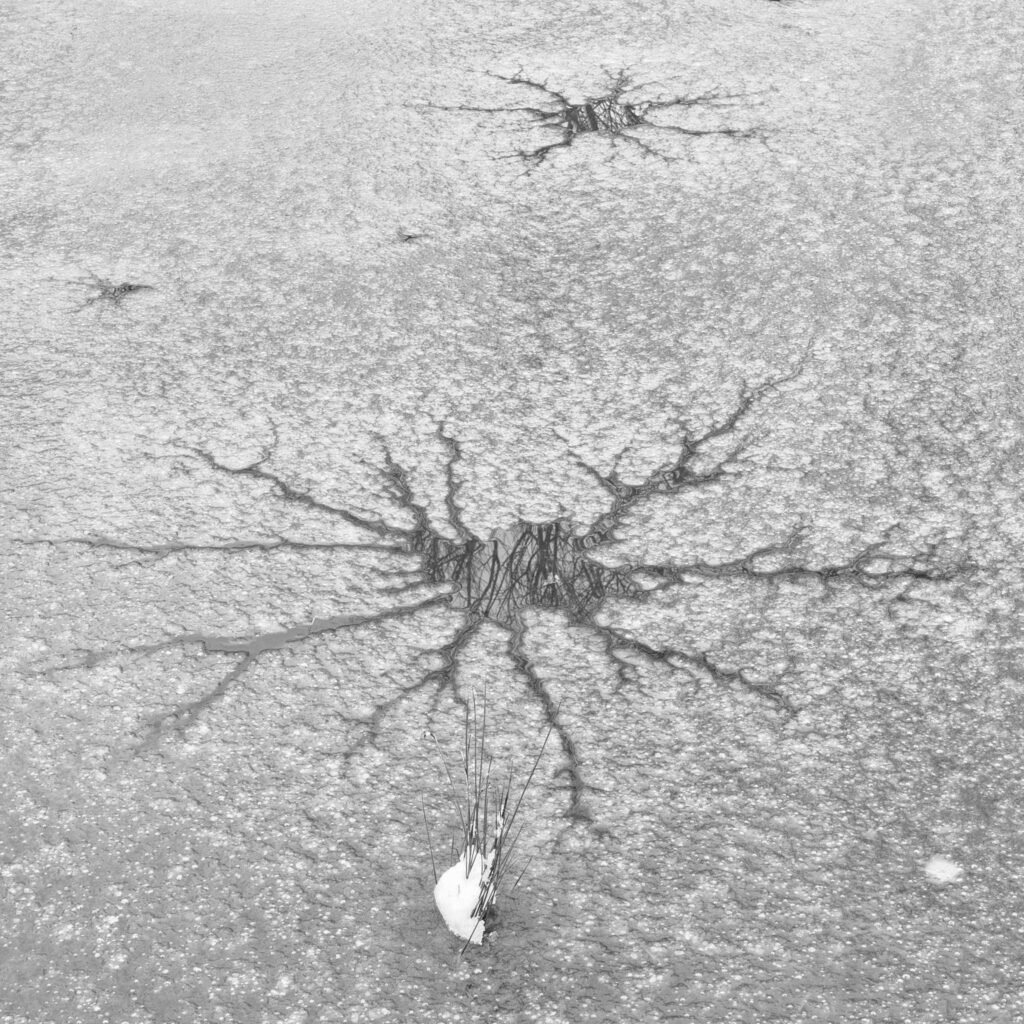
Beneth some trees was a small patch of ice containing shapes which immedietly made me think: virus. Sad that it was the first thought that crossed my mind, but I guess, given the pandemic is shouldn’t have been a surprise. I could imagine them silently multiplying until they had consumed the ice like tiny preditors. The largest one seemed poised to devour a little patch of grass and snow near the base of the photograph.
Three hours later and the snow was well trodden, sledged and melting fast. But I had managed to get out and make some nice photographs. My favourites are below. Click on them to enlarge.
Andy
All images are Copyright Andy Gawthrope Photography.
Winter at the pondTree over the pondTree on the TumpIce and TreeIce
It seems an indeterminate time ago now – its early December 2020 as I write this – but over the Christmas 2019 period I spent a week near Lands End in Cornwall and returned with some nice colourful sunrise photographs. However, there were also some typically Cornish days when the fog rolled in from the sea. Some of the photographs from that trip can be found here.
Returning in September I expected different weather, weather that was warmer, drier and that produced more colourful sunsets. Mmm, let’s just say I was a little disappointed… There was, however, a day of fog that made for some interesting images – absolutely not what I’d expected to capture. I’ll also note that the temperature in that fog wasn’t much warner that it had been back in December/January. Chilly and wet.
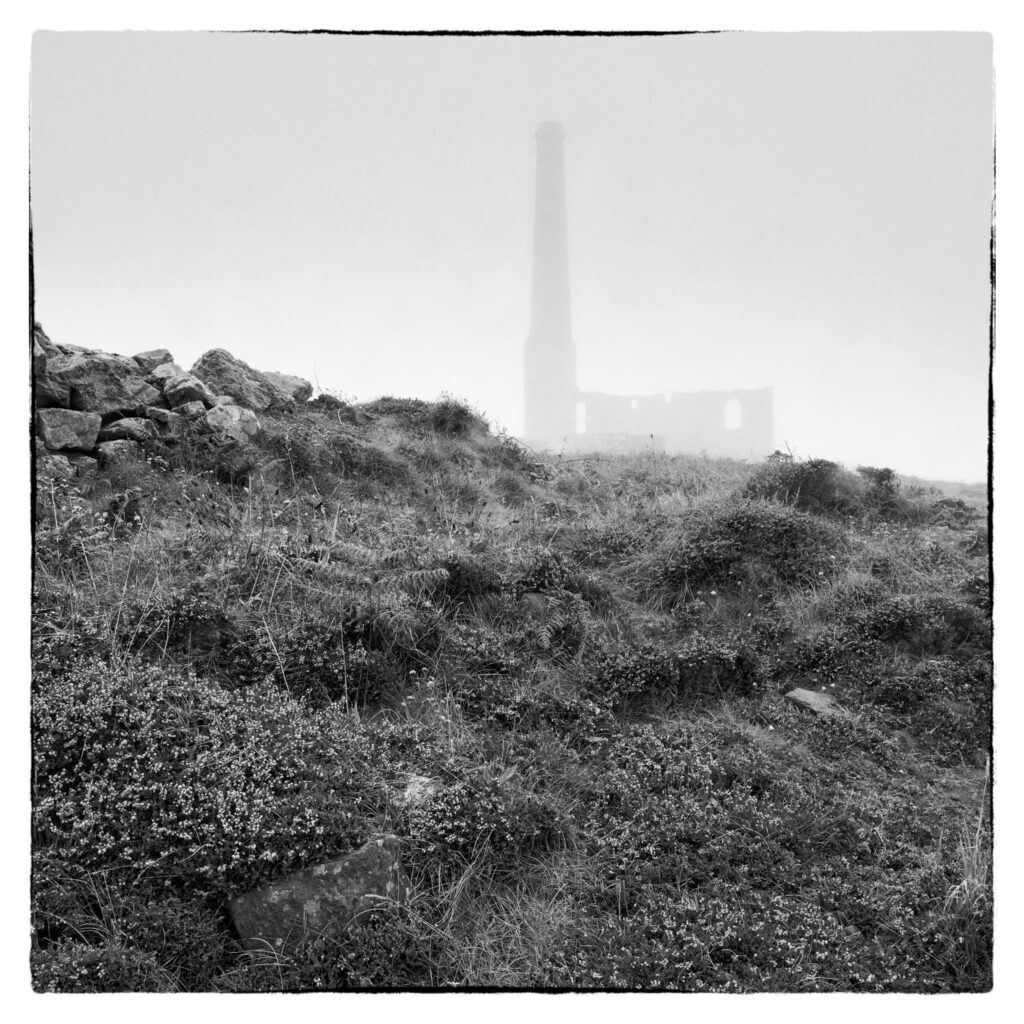
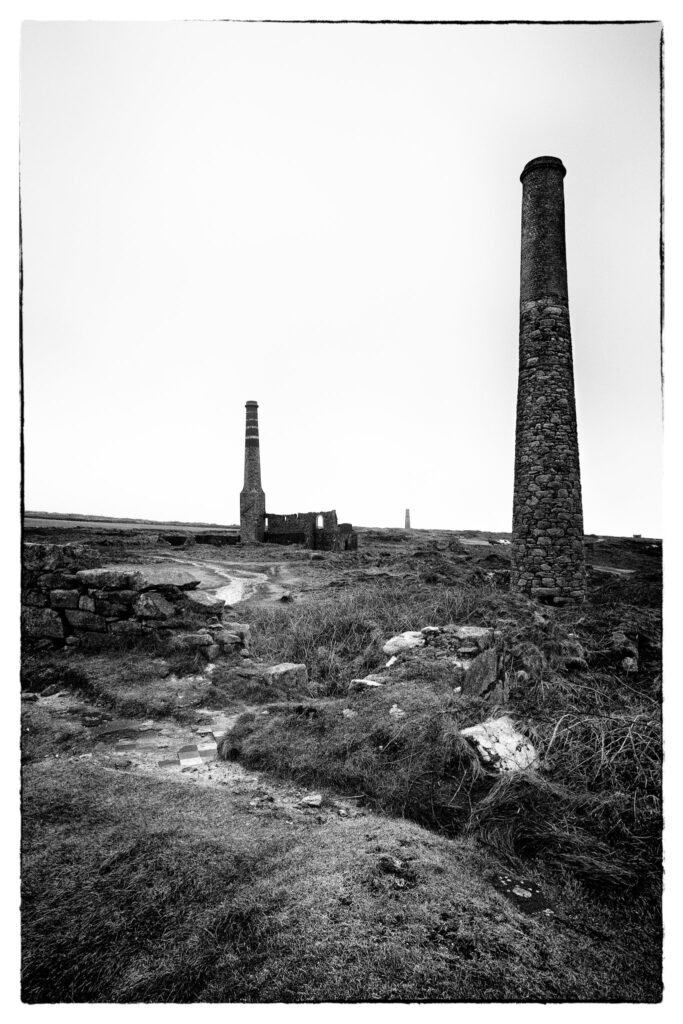
The ground was much more alive with small red/purple flowers than it had been on my previous visit but the fog muted all colour and everything looked very flat in colour images. With the muted colours, shapes became the dominant feature and the just visible outline of the old chimney and ruined power house seemed to scream Cornwall!
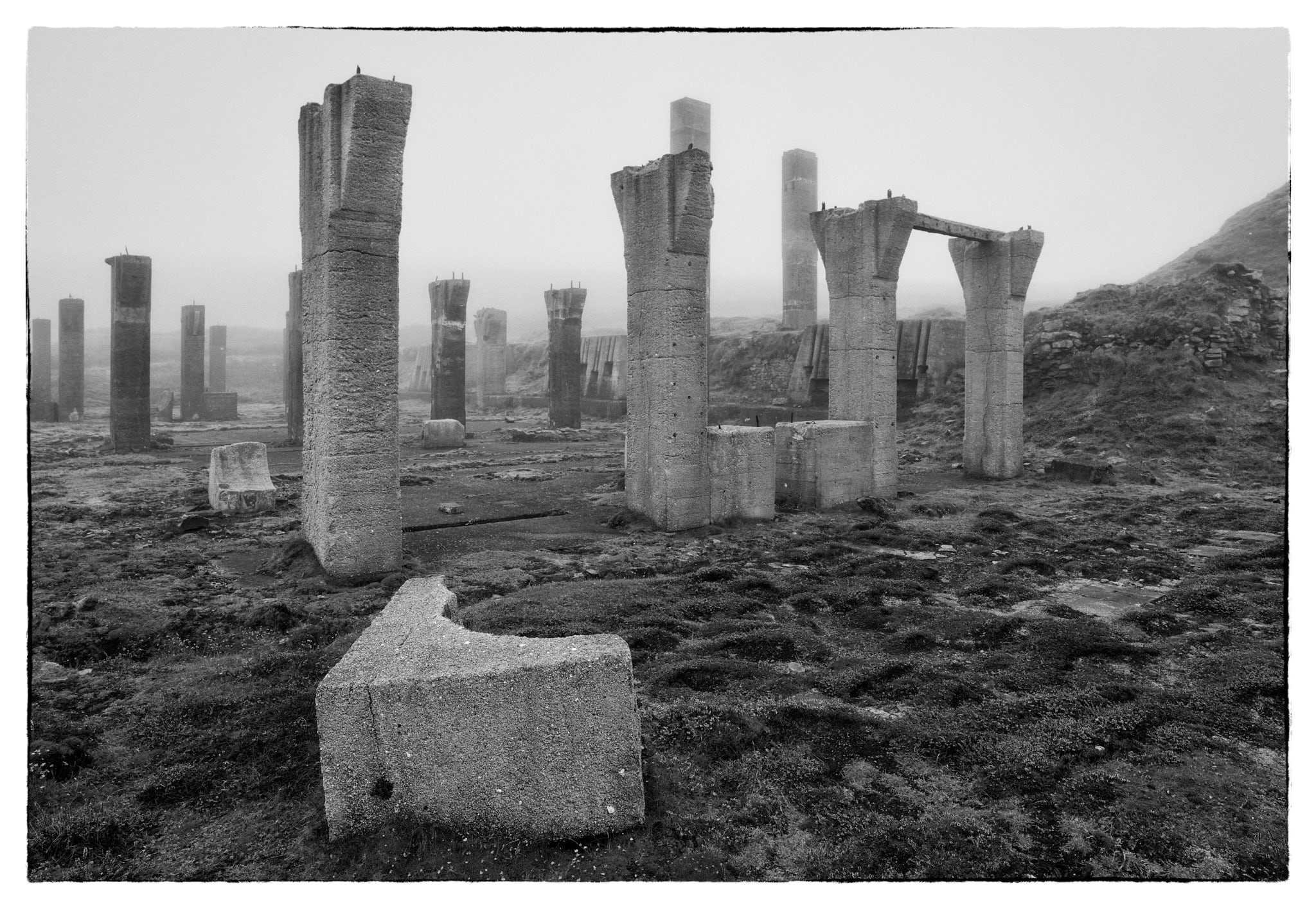
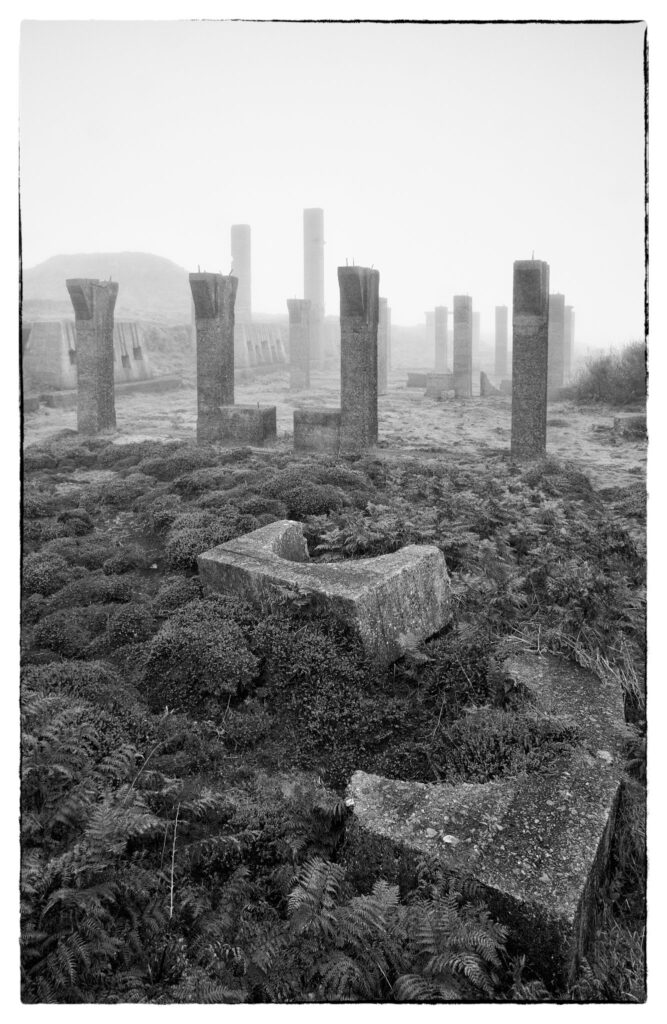
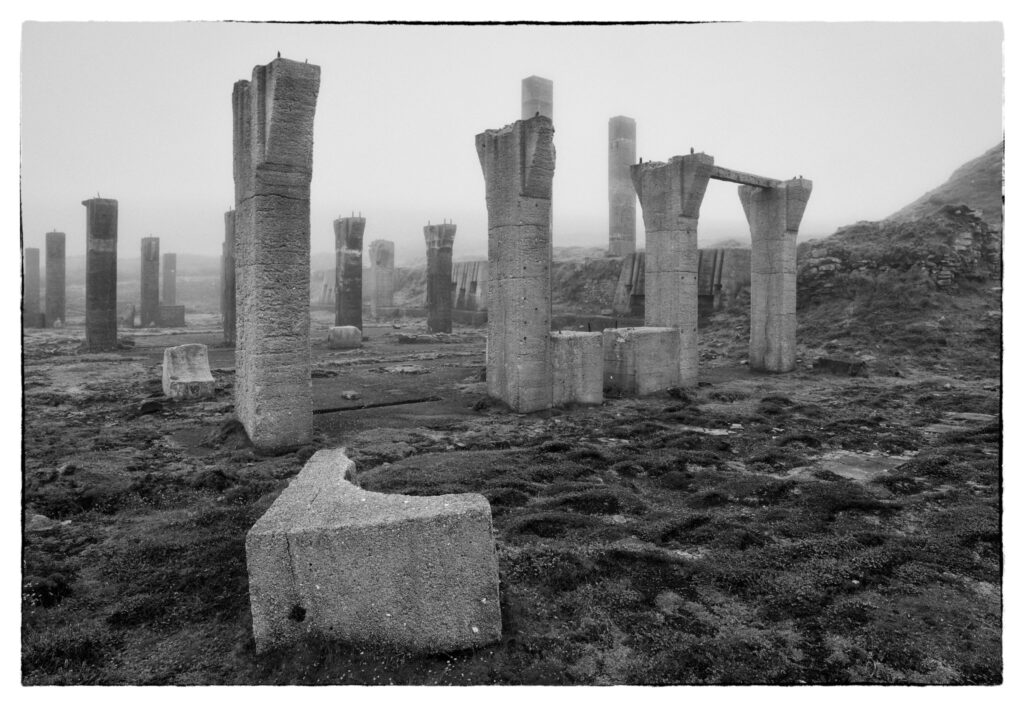
Not far away is a derelict structure whose purpose is a mystery to me. It clearly required massive concrete columns to support something and had big concrete blocks surrounding circular shaped objects. Anyone know what this was? Please leave a message below.
What caught my eye was the regular shapes of the columns all reaching upwards into the fog and how they appeared to stand in isolation like the megaliths of a long forgotten stone age monument.
Andy
All images are Copyright Andy Gawthrope Photography
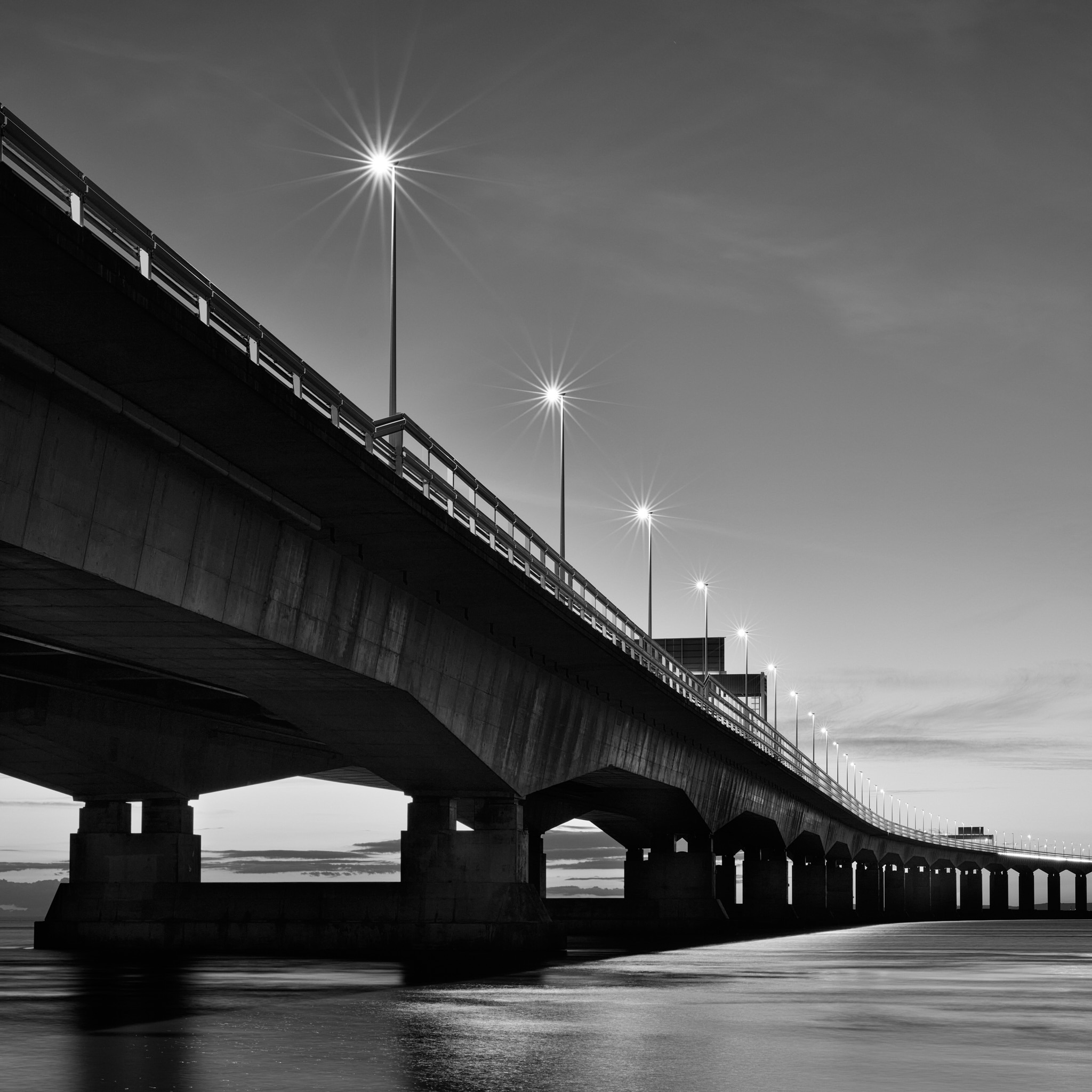
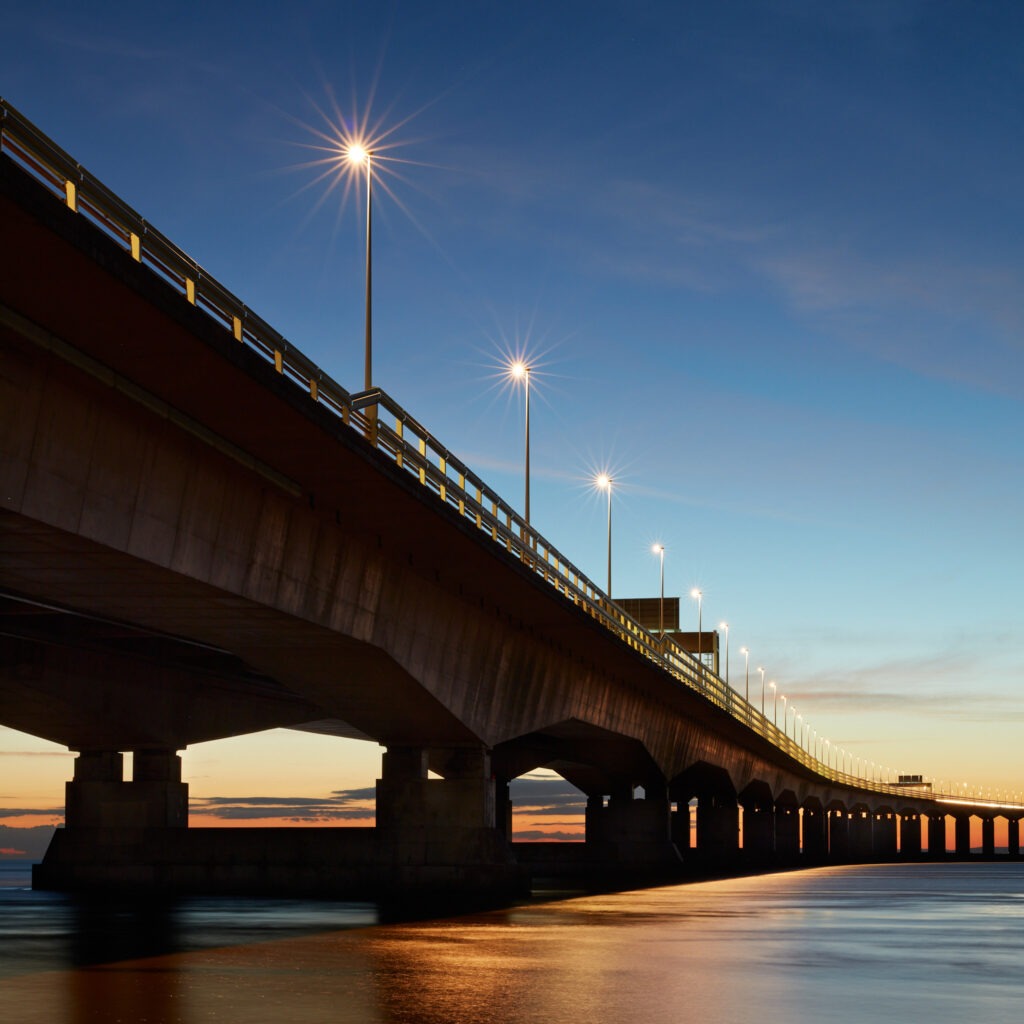
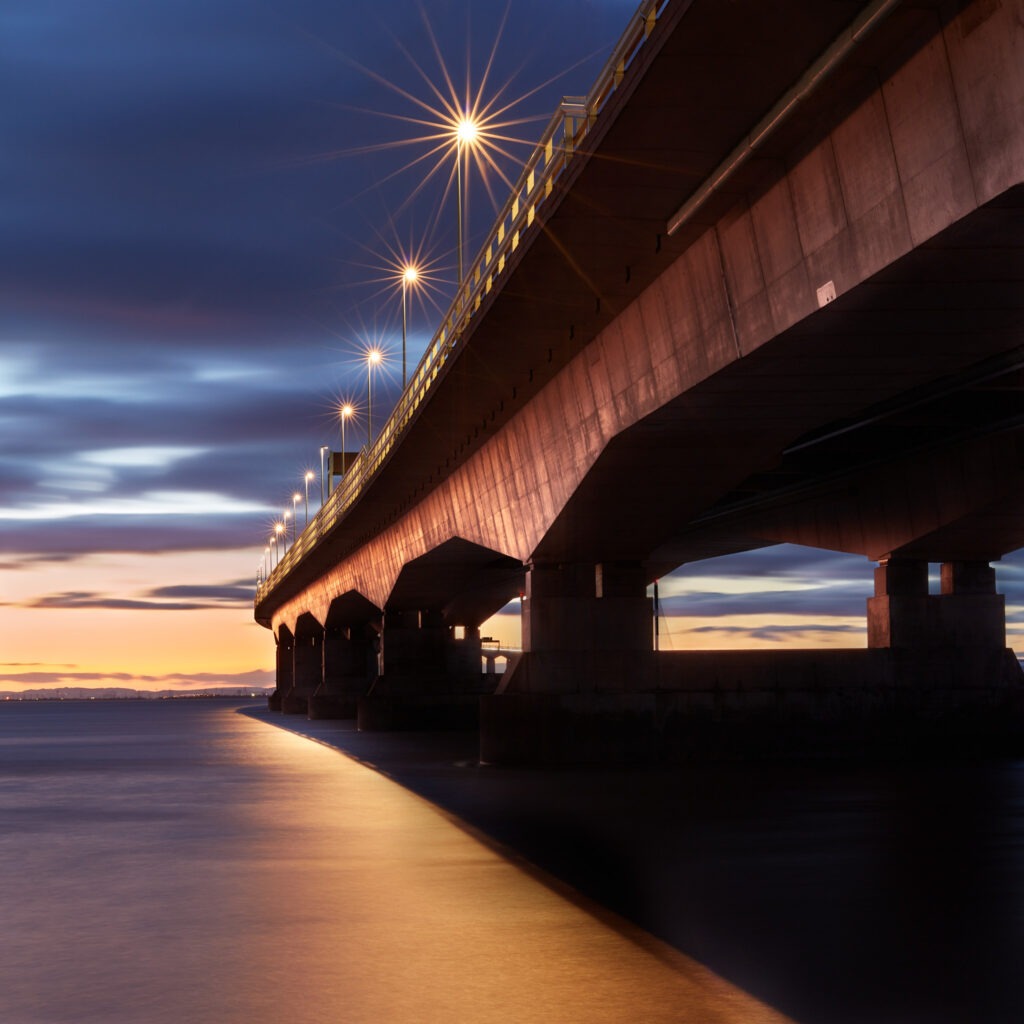
I’m aware a reoccurring subject in my photography is what is now named The Prince of Wales bridge otherwise and more commonly known as, the new Severn bridge or the Second Severn Crossing. In February 2019 I made one of my favourite square photographs but a few months ago I thought I’d have another go but from the opposite side (the North side).
The photograph was pre-visualised as colour and deliberately styled to match my earlier 2019 photograph and side-by-side they make a nice pair. But whilst the colour version is good I really like this black and white version as there are no colour distractions leaving the eye to absorb the bridge and its wonderful, bold shapes.
Below are the colour versions. The first from 2019 and the second from 2020. Clicking an image will open a larger version.
After the doldrums of Summer and its seemingly endless days we have the shorter, cooler and sometimes annoyingly wetter days of Autumn. It’s not just the time when nature again bursts into colour but the change also heralds a return to more variable weather. And here in the UK that equates to a more interesting time for landscape photography.
Now, if I’m honest I find Autumnal photography difficult. Partially as the weather can’t make up its mind what it should be doing, it can be very changeable, but also because I just never seem to be in the right place at the right time to capture those iconic Autumn landscapes that others seem to find so easily. This year I am more minded than ever that Autumn photography or to be a little more precise, Autumn woodland photography is hard and its really important to know of nearby locations.
Now, I like my work to be original; I like to avoid repeating what others have done. Yes, sometimes I have taken that classic but I’ve always tried to do something a little different and to not copy. So, whilst I know that arboretums around the country will have wonderfully colourful Maples I just don’t want to photograph what someone else has done that day, the day before and so on. Any quick look on social media will find literally hundreds of near identical photographs of the same tree from the same position. I need something more original, something a bit more wild! To me photographing at an arboretum feels…well, how I imagine a wildlife photographer would feel photographing big cats and elephants at a zoo rather than in the wilds of Kenya. I am merely expressing that we, as photographers, need to be cognisant that whilst a local arboretum visit may be quick, easy and result in wonderfully colourful images they are unlikely to be original.
Sticks and Trees
So, avoiding the temptation of arboretums, I made a concerted effort this year to explore somewhere not far away, somewhere I really should know much, much better. The Forest of Dean is about 15 miles away and sits between Chepstow and Ross-on-Wye on the Western side of the river Severn. I’ve been a few times before without success; I always seem to be in dense forest separated by forestry tracks where one can’t get enough distance from a subject and the ground is dark and uninteresting. So this year I started by thinking carefully about why previous trips hadn’t worked and what I could do better. Pretty soon it dawned on me that you have to find the right type of trees! Boom, there you have it!
Maps by the Ordnance Survey identify three different types of woodland: Coniferous wood, Mixed wood and Non-coniferous wood. It’s the latter two which will have nice colourful trees. Obvious really! Those little tree symbols are not just randomly placed on the map either…their spacing can be used to infer the density of the woodland and woodland that isn’t too dense is better I think. 😉 Depending on the age of the map it’s quite possible that what’s actually there and growing doesn’t match the map tho. This risk can be partially mitigated by using recent mapping and cross-checking with satellite imagery tools like Google Earth. But I don’t think you can be sure until you have boots on the ground!
The result of better preparation, was that with the exception of one, all the area’s visited were much more suitable and even had the right type of trees!
Rooted, Tall trees
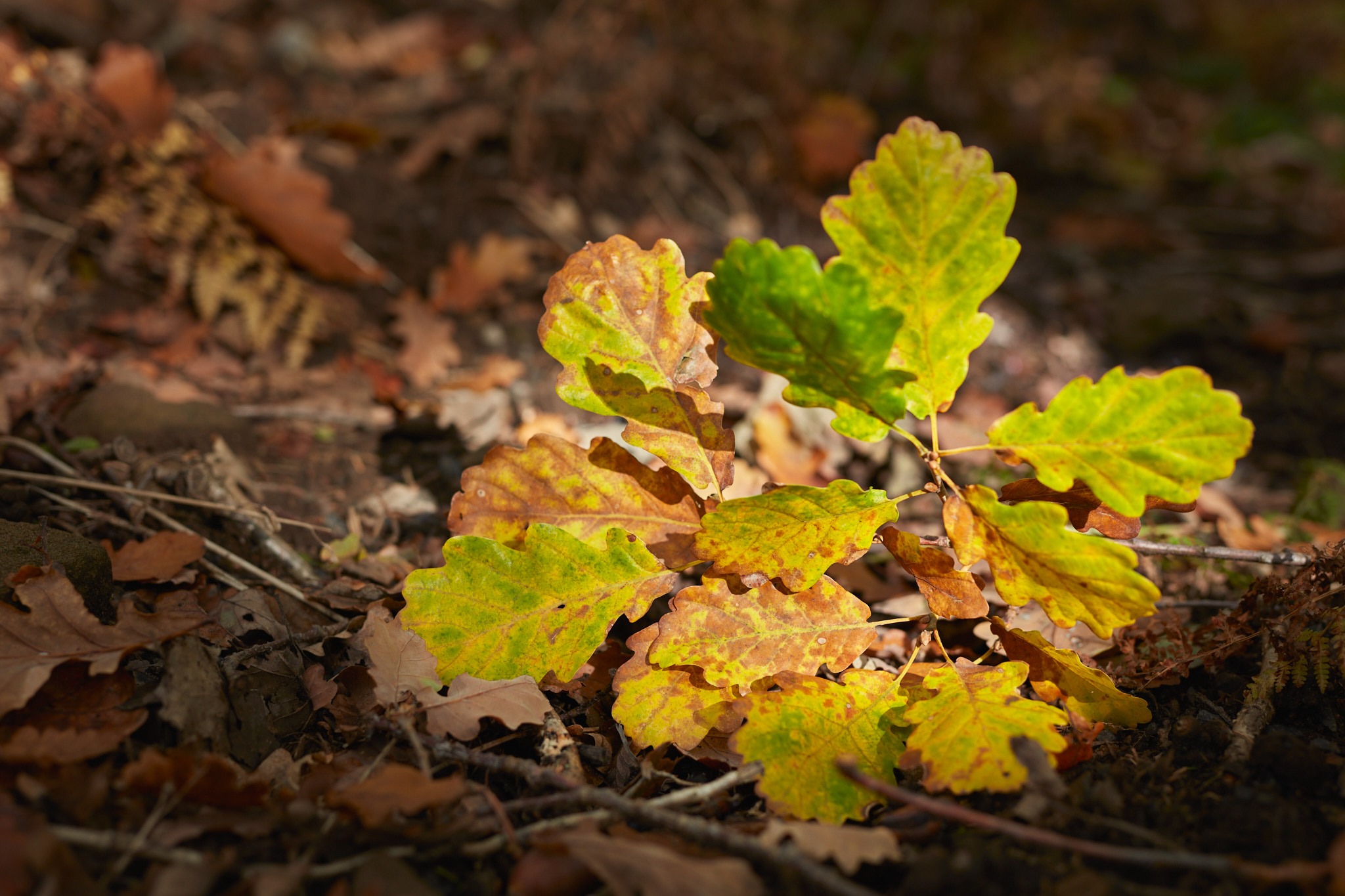
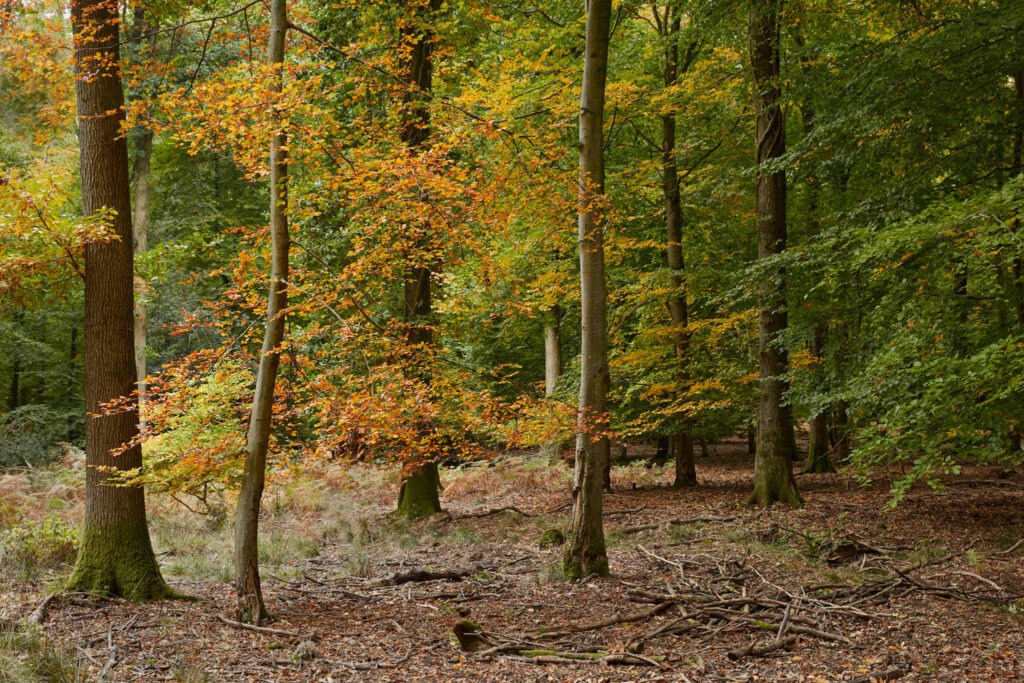
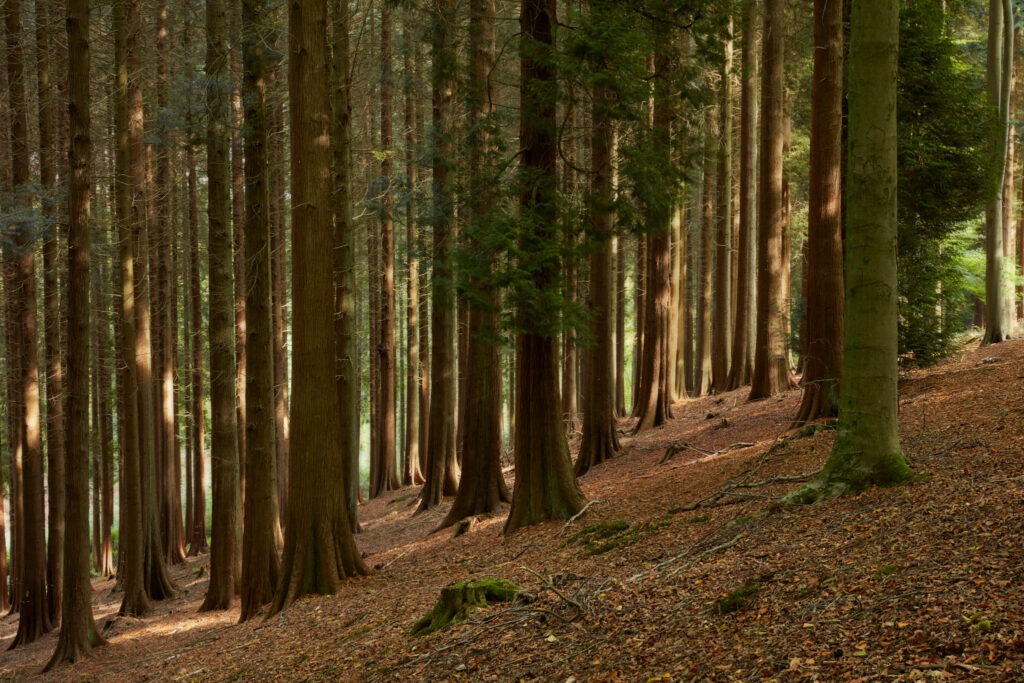
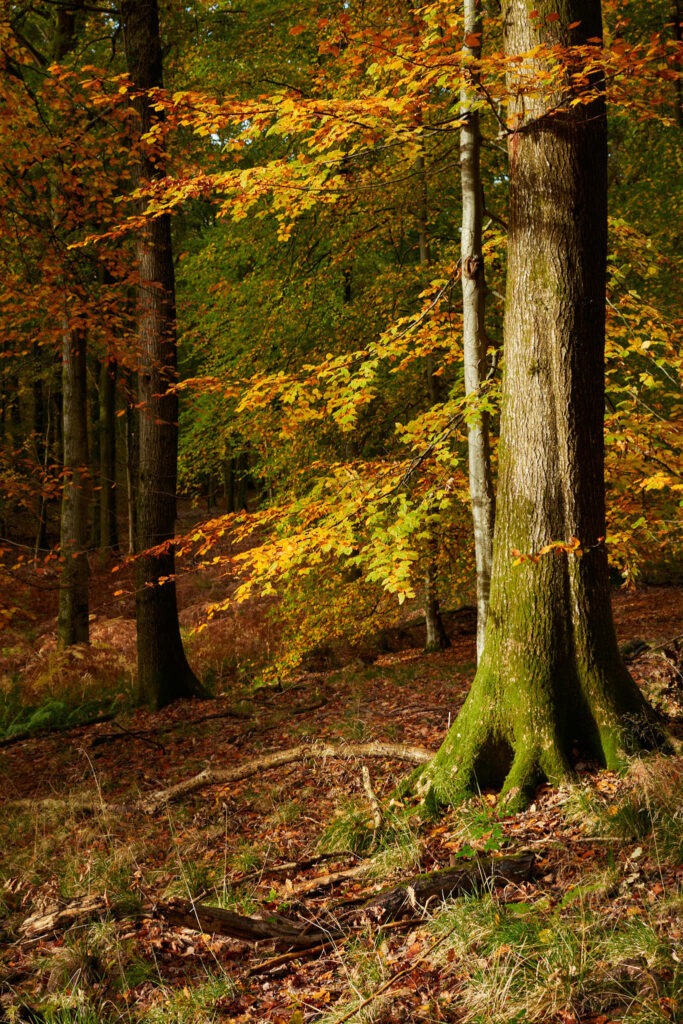
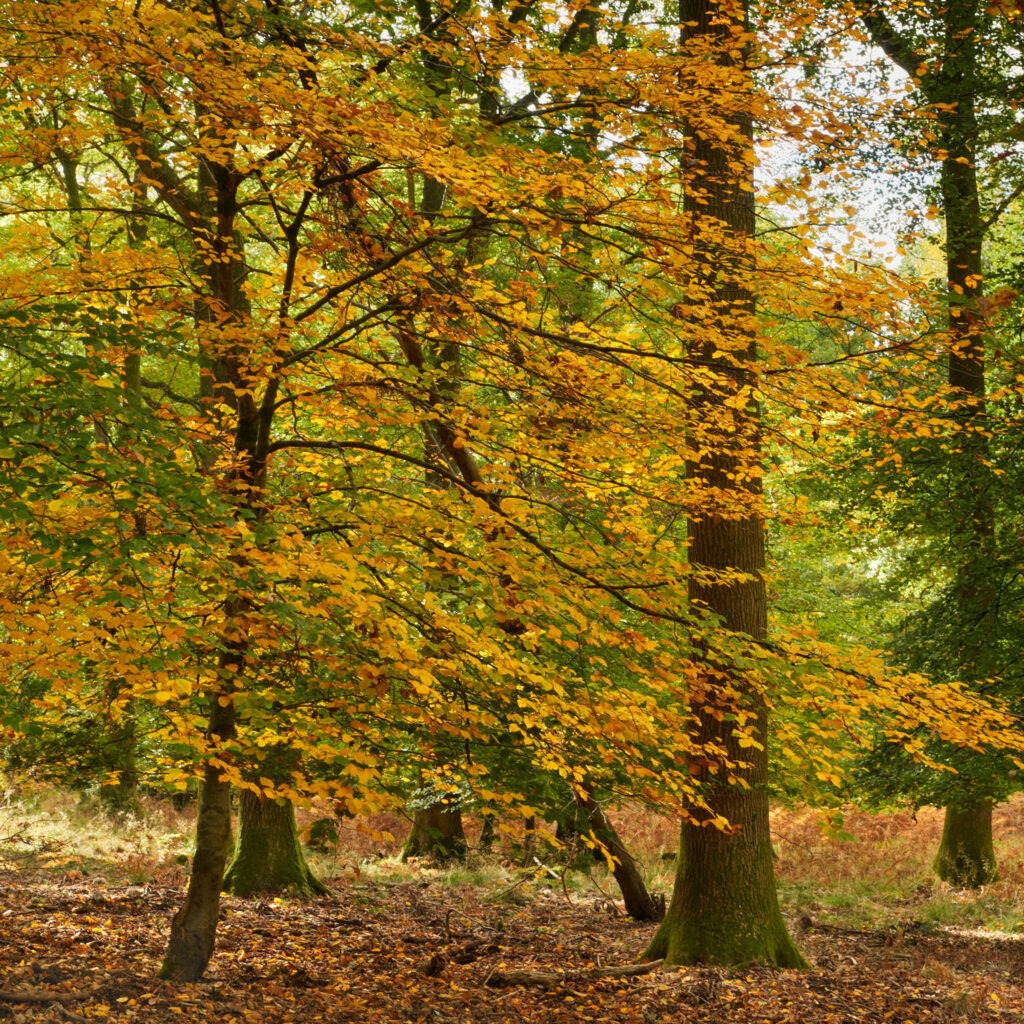
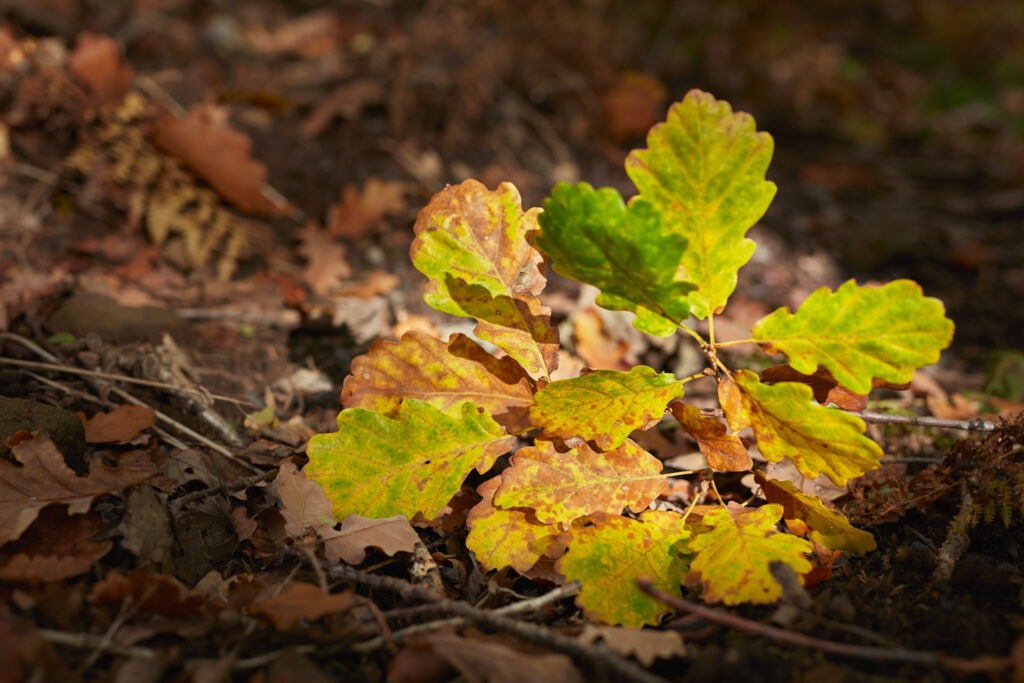
Still, significant exploration was required at each location but the more I explored the more positive I felt and the more I started to see the landscape around me differently. One afternoon I walked to the top of a rise to find a group of uniformly tall, straight trees and the sun streaming in from the side. It was a lovely scene (above). I also found I was seeing the smaller, intimate, landscapes such as the Oak Leaves (top) which were briefly lit by a shaft of sunlight.
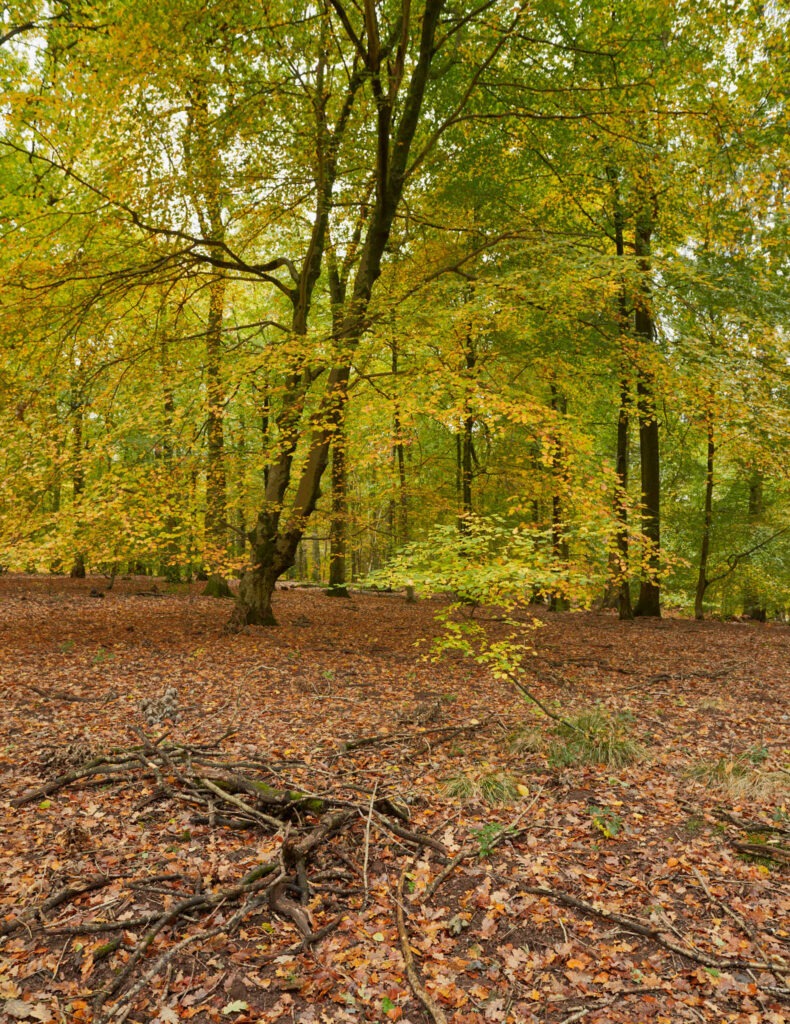
In many places, the forest floor was also interesting and very different to that seen in previous years. It was almost as if the soils had been turned and separated. The ground was pleasant to walk on; it was soft and, well, spongy! In places the fallen branches and sticks where pushed together into what might be described as clusters or groups. It was not orderly enough to be the work of man but something appeared to be lowering the entropy of the forest floor. The area is known for its wild boar and I just wonder if it was them rooting through the soil, pushing sticks aside etc. I never did hear or see any boar tho. 🙁
The Forest of Dean aka The Forest covers a large area and I visited less than a handful of locations this Autumn, some locations a couple of times. The work to identify further locations can be done throughout the year, perhaps in the summer months when things are traditionally quiet. So, roll on Autumn 2021. I know where you are and I’ll be back 🙂
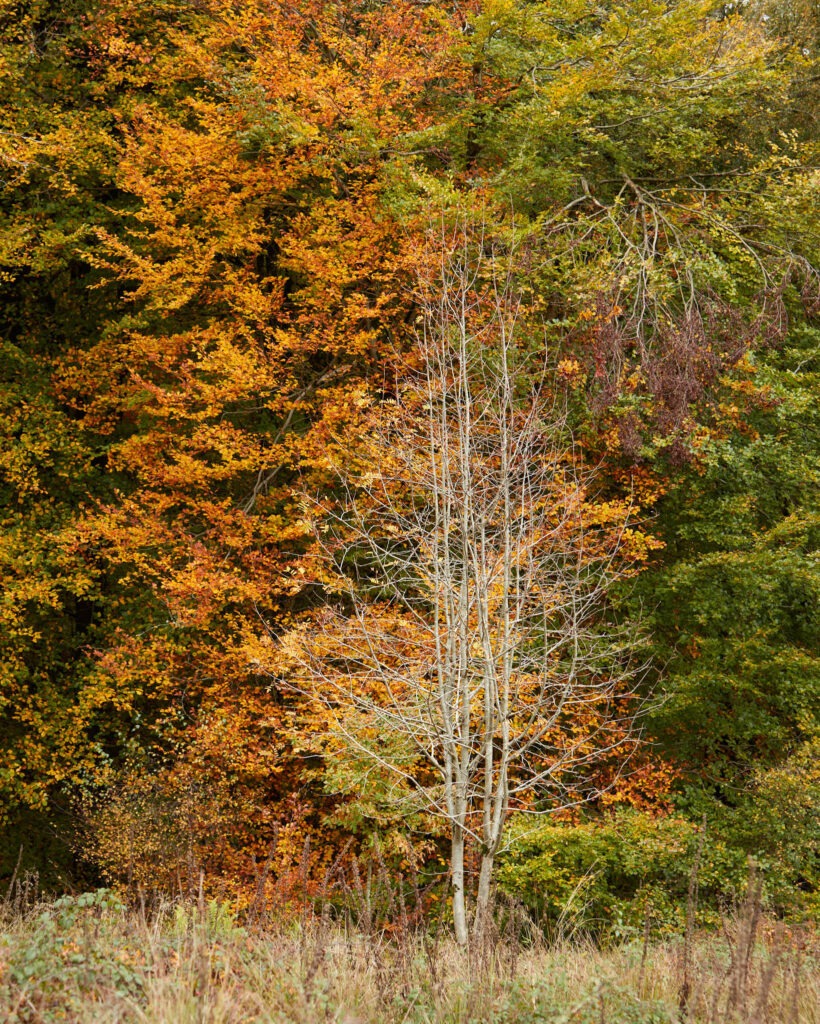
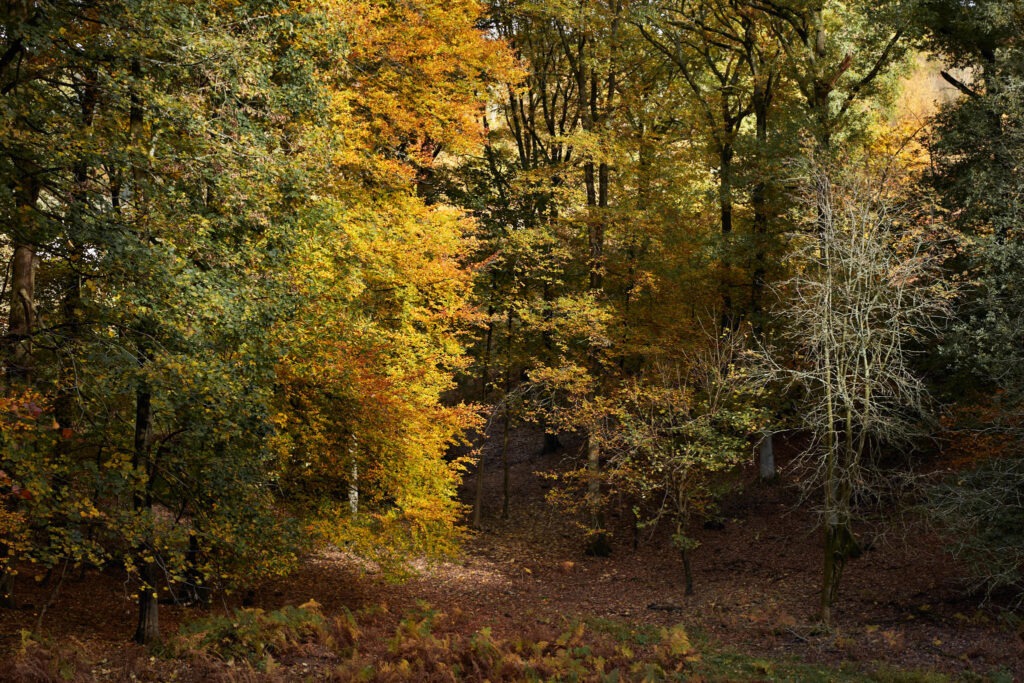
Below are eight photographs from the Forest of Dean this Autumn. Click on an image for a larger version.
All images are Copyright Andy Gawthrope Photography
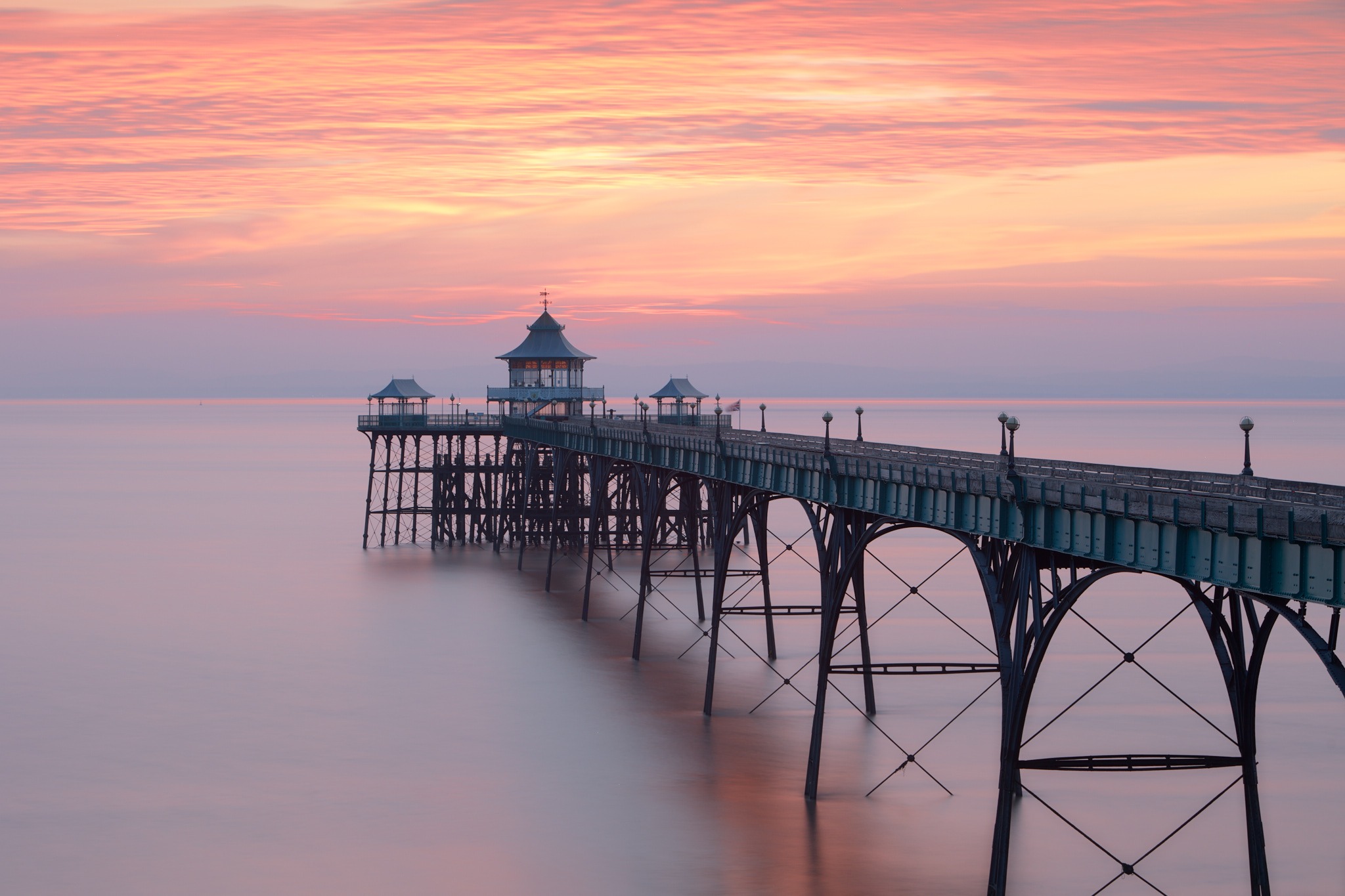
It had been a stinkingly hot early August Sunday with temperatures in the low to mid 30’s with little wind at home. Hot weather indeed for the UK 🙂 That’s the sort of heat that just saps energy so I’d stayed indoors most of the day catching-up with some processing which is where I hatched the plan to retreat to the coast where, hopefully, it would be cooler.
Arriving in Clevedon, a couple of hours before sunset the temperature was still very warm but it was made bearable by a gentle sea breeze. I arrived with lots of time to spare as I wasn’t quite sure what the light would do although I had a strong suspicion that due to the heat and clouds sunset could be nice. About a 1/2 hour before sunset it started to look like something magical might occur, but it was only as the sun approached the horizon that the clouds started to turn a little orange. But over the distant horizon and Wales was a slightly thicker band of cloud – a band reminiscent to that in my previous sunset photograph of the pier. A few minutes after dropping behind that cloud and the horizon the clouds overhead were illuminated from below and turned the most magical yellow/orange colours. It was an awesome sight 🙂
Thanks to the COVID-19 pandemic photography opportunities this year have been limited so it was fantastic to witness such an amazing scene. Its just these sort of events that make Landscape a rewarding photographic genre – all the hard work and lows instantly forgotten! Printed this photograph is glorious. It’s almost minimalist; the soft pastel sea with its hint of orange transitions almost seamlessly into sky and plonked in the middle is the architecturally wonderful pier. I love it and for that reason I’ve made it available in my Limited Edition Prints shop.
Christmas Day 2019 and the weather finally turned nice for a while. The wind dropped and the cloud and sea spray disappeared – it was a joy to be out at first light with the camera. 🙂
Leaving the truck in the little car park behind the tea shop the sky was still dark but with a few stars twinkling overhead I knew it was at least partly clear. So, with a growing sense of anticipation I stumbled up the narrow track to the top of the cliffs.
A few days before I had walked along this stretch of cliff identifying possible locations, checking sunrise and sunset angles and thought this spot may be good. I recall being concerned about the land being too complicated and spoiling the simplicity I sought. But I also thought that the darker land at sunrise would help mask any complexity. Of course that needed the right light!
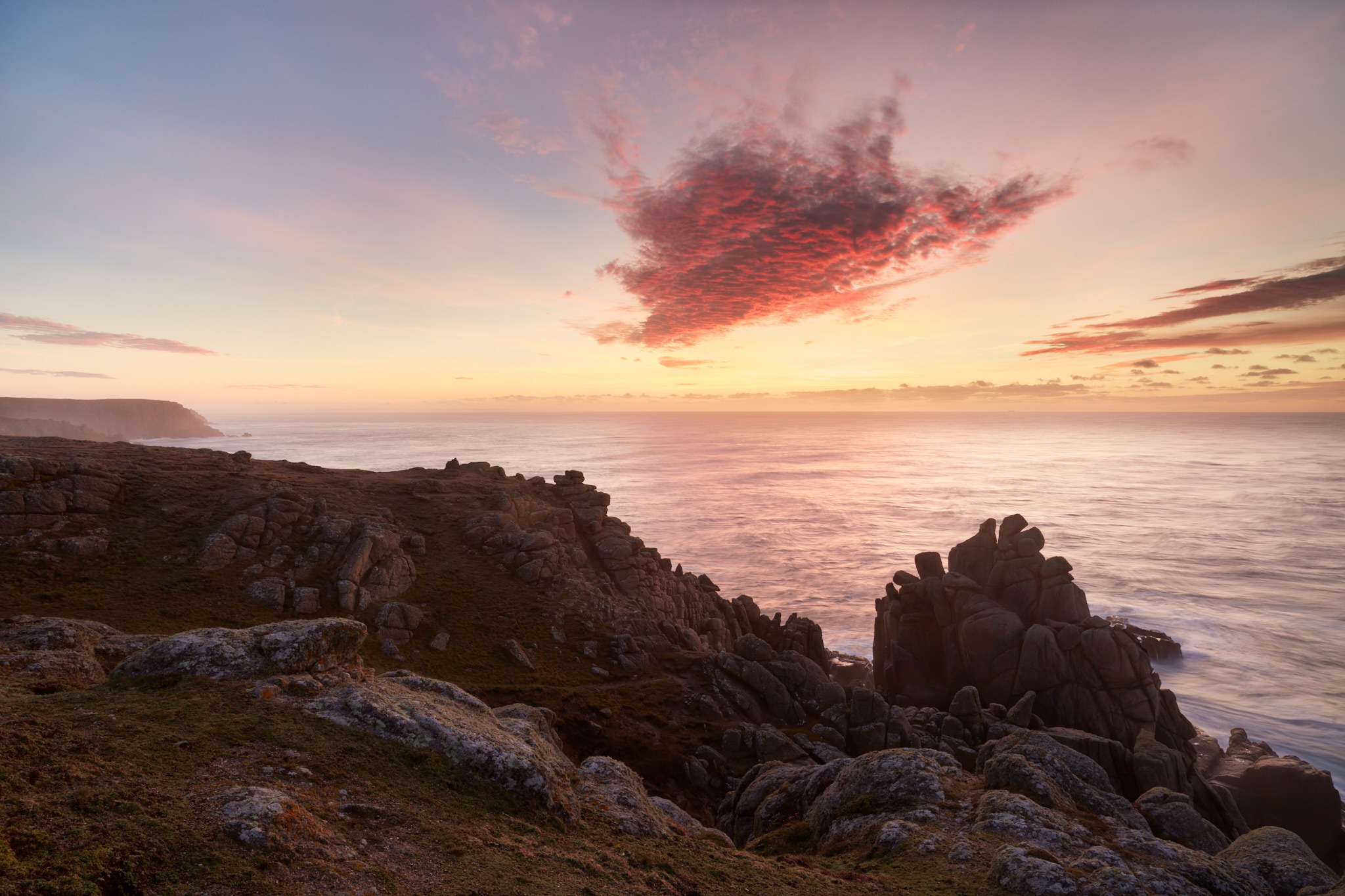
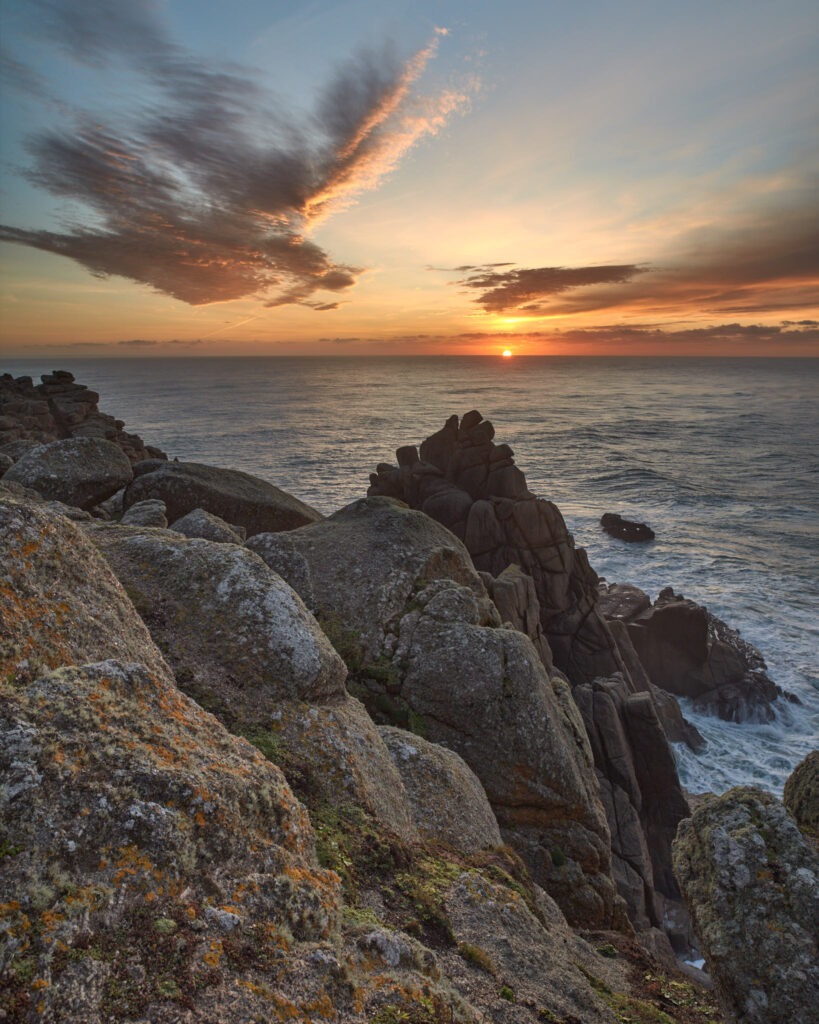
As the sun got closer to the horizon the sky became visible and I could see what looked like a massive triangular space ship hanging in the sky! At that time it was still just grey cloud but as the sun got closer to the horizon it lit it’s underside in beautiful orange/pink/red light which was also reflected down onto the land and ocean. It was fabulous 🙂
Porthgwarra sunrise. No. 2
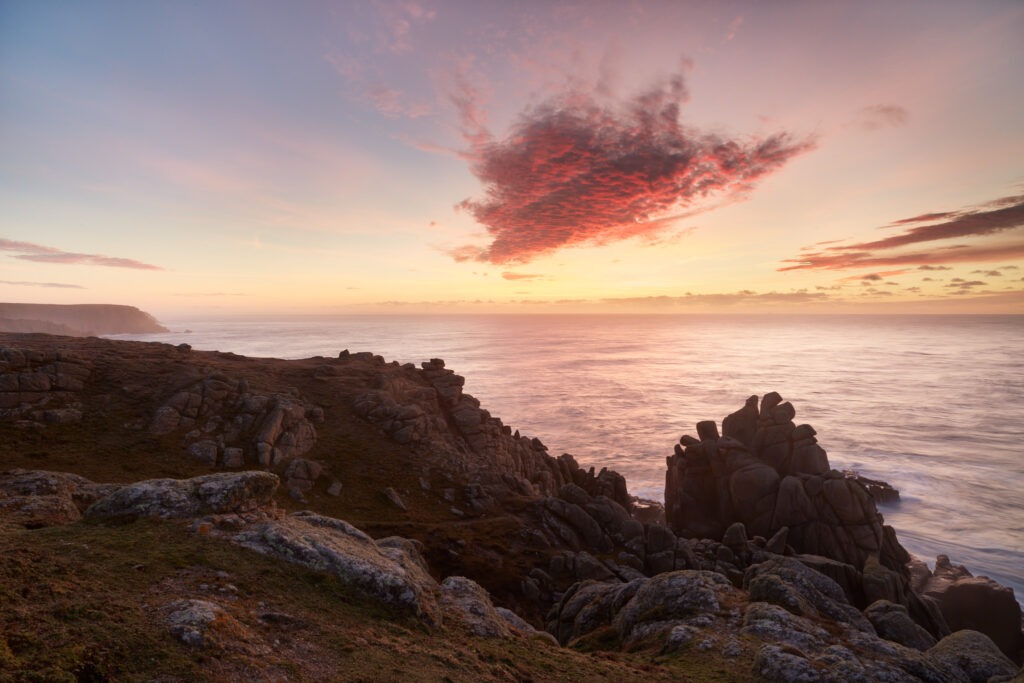
My earlier visit had also identified a potential location just off to the right. By the time I moved position most of the dramatic lighting had faded but over the distant horizon there was still plenty of colour and that cloud, although somewhat dispersed, still had a great shape. If anything I thought it now looked more like a Phoenix flying headlong towards the burning sun! Ah what the mind sees in the clouds 🙂
Not long after making the above photograph a pod of eight or nine dolphins swam around the rocky point doing a spot of morning fishing I guess. All in, it was a fabulous start to Christmas day 🙂
I must admit that the plan when setting out that morning was to walk slightly further around the coast but with a dark sky I couldn’t be sure which location best suited the conditions. I chose to stop at the location that required least walking and wait until I could see the sky. When the sun did provide sufficient lighting I recognised the potential I stayed put. Of course that means I’ve another location awaiting a subsequent trip ;-); something I’d like to address in the not too distant future. Perhaps the weather will be equally gracious. We shall see 🙂
Andy
All images are Copyright Andy Gawthrope Photography
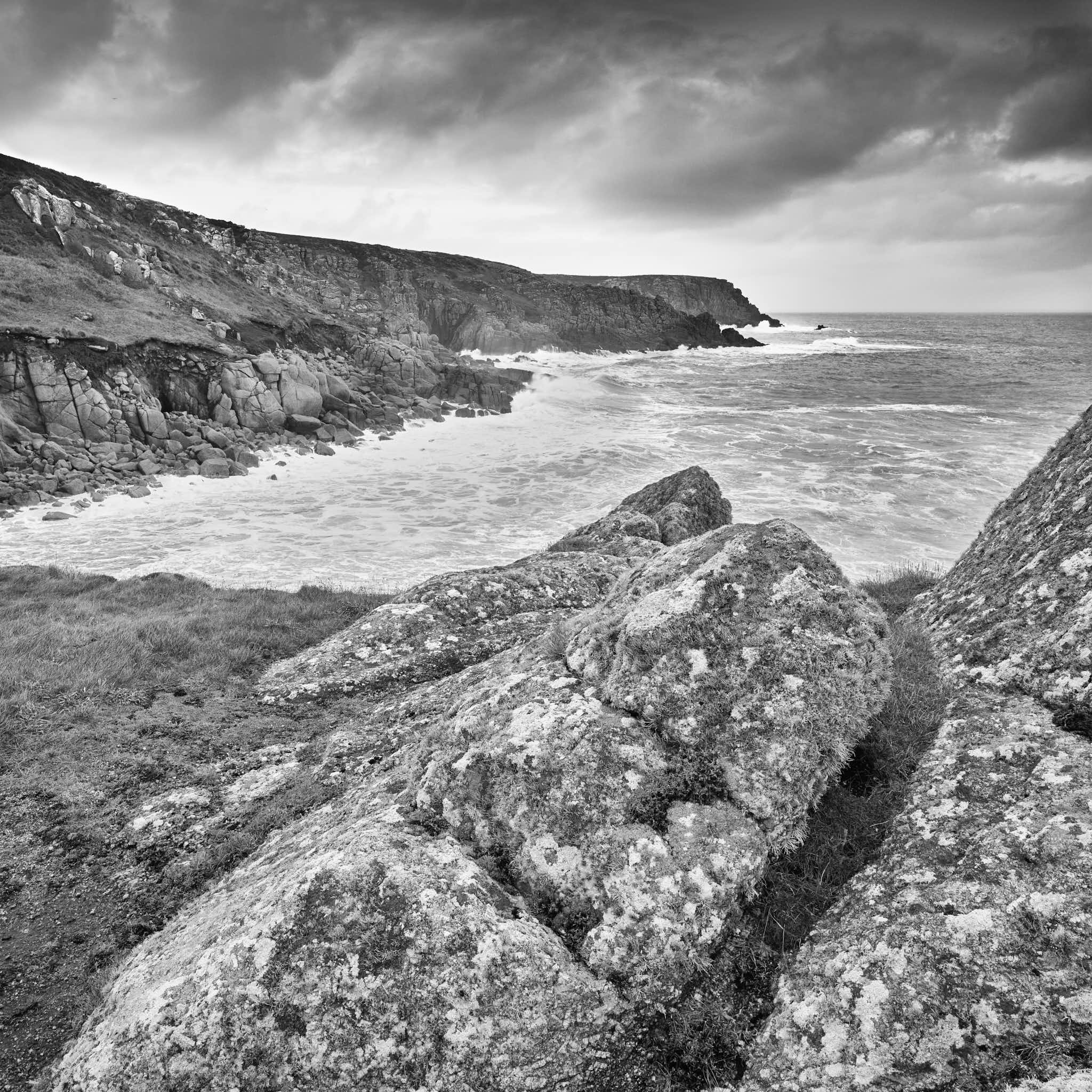
Continuing the recent post about my Christmas in Cornwall I thought I’d post a couple of black & white photographs from a tiny cove just to the South of Lands End called Porthgwarra.
Porthgwarra has a great little shop which does amazing tea and cake in the summer but, sadly, it’s closed over the winter months. Quite understandable as Cornwall is beautifully quiet in mid-winter with none of the maddening tourists!
The photograph above was taken on a windy afternoon with heavy, grey clouds skimming across the sky and waves being blown against the shore by the strong wind. I took several images at ISO 400 trying to catch a lull in the wind; fortunately one was sharp 🙂 It’s one of those photographs that works well large as there is huge detail in the lichen, the moss and foreground rocks.
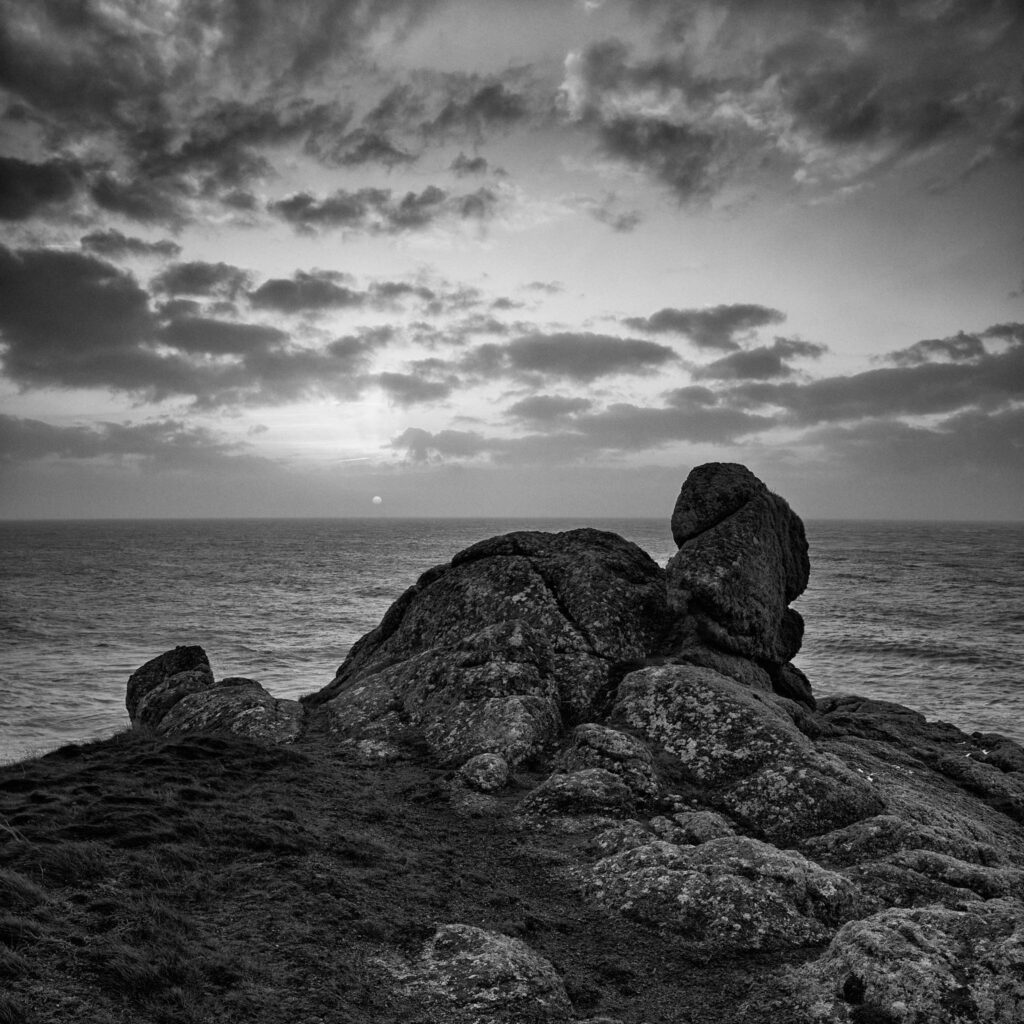
The second photograph is a little different. To my mind it’s a sunrise machine; some long forgotten machine left behind by aliens to control the sun! Well, ok, perhaps not but that’s what I was thinking as I stood there waiting for the sun to rise from behind those two great protruberences!
Porthgwarra sunrise
Whilst exploring the area the preceding afternoon I noted the great shape and immediately thought it could work as a black and white. After a quick check of PhotoPills and The Photographers Ephemeris (TPE) – I can’t decide which I prefer – I knew the sun would rise at just the right position on the horizon too. The following morning I got lucky as the sun rose through a bank of cloud whilst illuminating the more broken clouds above. I have a colour edit of the same image with great colours in the sky, but I prefer the simplicity of the black and white.
Christmas day 2019 was the best day of the entire Christmas week in Cornwall. The strong, gusty winds had stopped and there was a bright, diffuse light thanks to some thin cloud. The day had started early with a successful trip to Porthgwarra for sunrise – more on that in a later post – followed by a lazy hotel breakfast and planning for the rest of the day. Given the bright, diffuse lighting I thought Sennen beach would be good for some intimate landscapes.
I’d heard the beach would be busy and busy it was. The Eastern end of the beach was packed with lots of people in swimwear and santa suits going for a dip in the ocean! Or at least a screaming, running dash into and out of the water! No wetsuits allowed! Fortunetly, the Western end was quiet with just a few dog walkers.
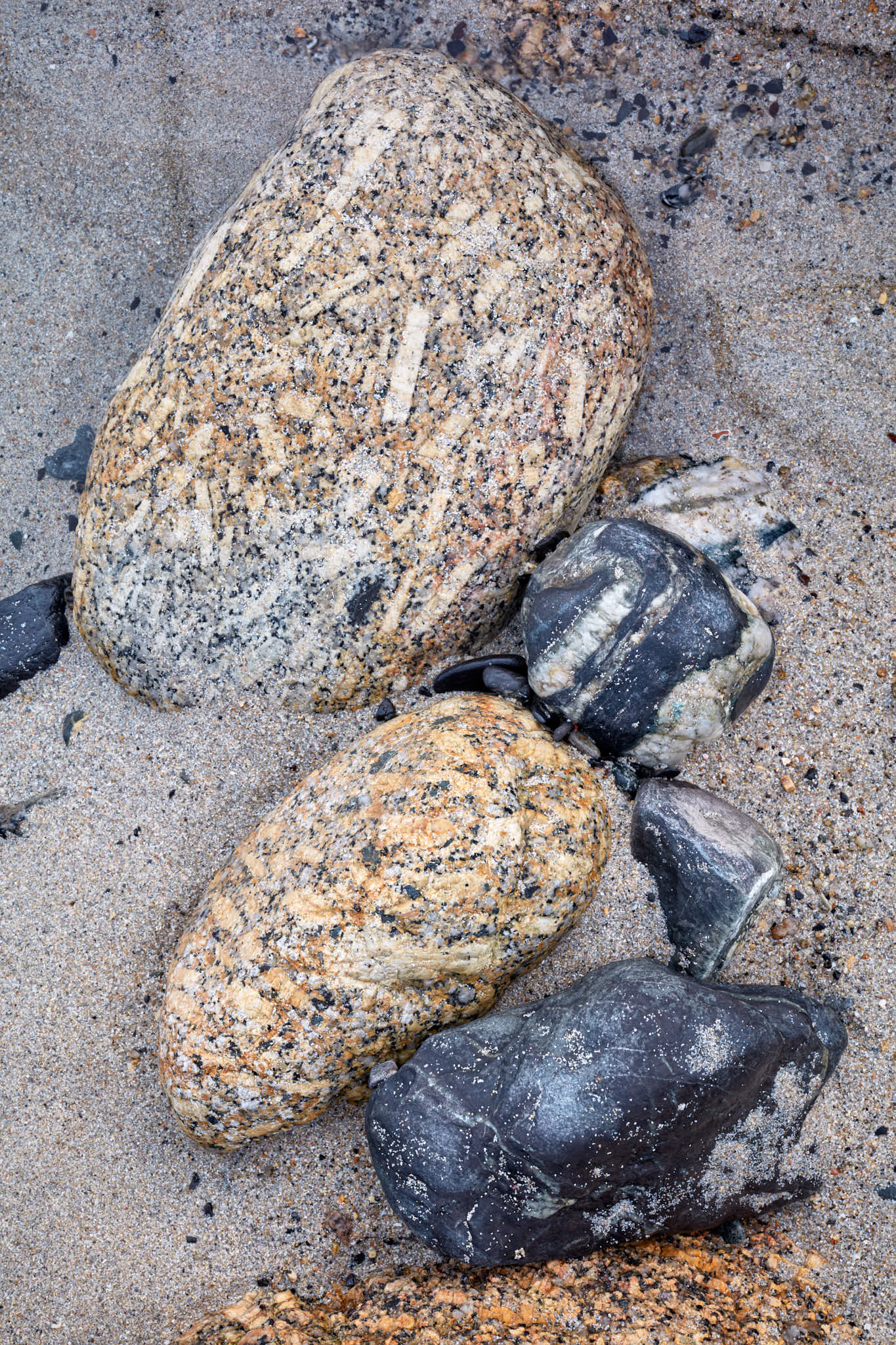
I’m no geologist but Cornish granite seems very distinctive. It is a mixture of small white/cream, black, brown stone infulsed with large rectangular flecks of a whiteish stone. Rooting around the beach I searched for a collection of stones that worked as a photograph. There were lots of rocks but nothing seemed to work as a photograph. Finally after much searching the closest I got was the above photograph.
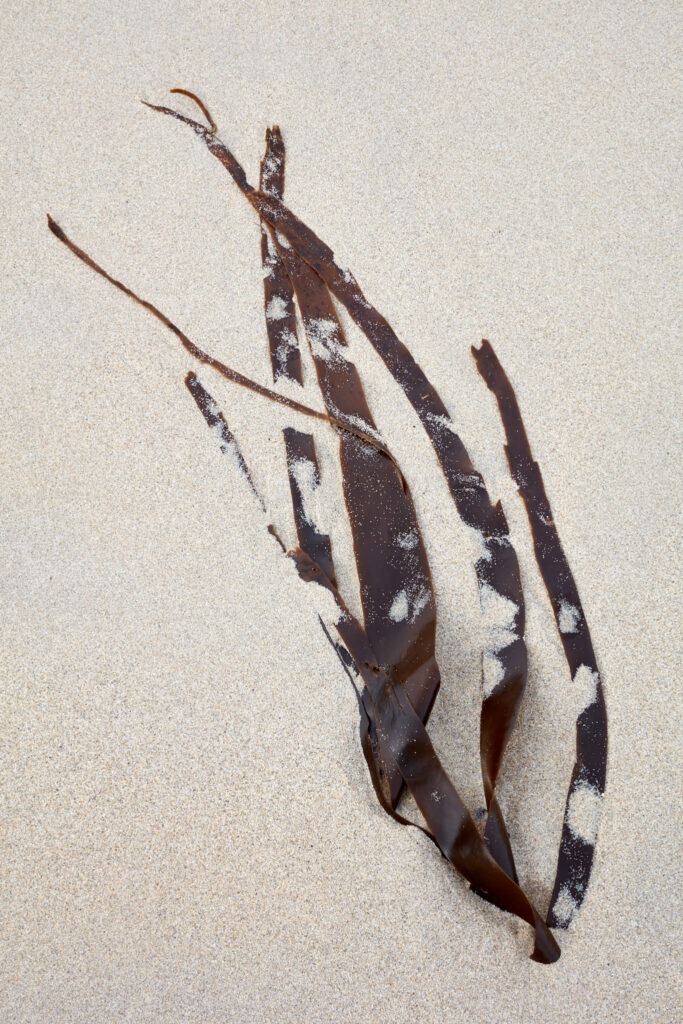
Seaweed
By the time I’d finished the Granite on the Beach photograph the tide was starting to move back up the beach with speed.
A lesson: Whilst photographing on a beach it’s important to remain aware of what’s going on around you. On an incoming tide the sea can creep silently up the beach and the result of not paying attention is wet feet or worse, wet gear if the camera bag isn’t on your back! Never put a camera bag on a beach unless you are very sure it’s well outside the reach of Neptune!
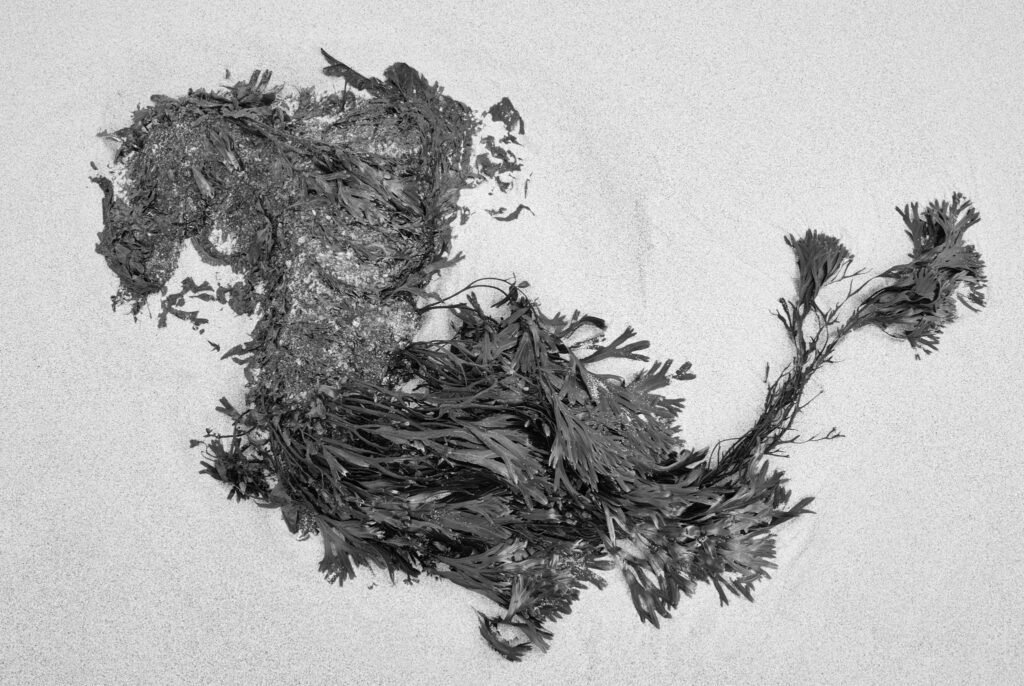
After a little more exploration I spotted this lovely piece of brown/black seaweed lying in an undistrubed area of sand. I was immedietly attracted to the shape, the curving limbs and delicate ends covered, in places, with a scattering of white sand. In post I’ve tried a black and white as it’s such a simple photograph, however, the subtle colours of the sand and browns are lost. Colour just works much better for this.
Not far from the Seaweed on the Beach I spotted an amazing site but the tide was getting very close by this time and it would have taken just one larger wave to have washed over the subject, ruining the intended photograph. Speed was of the essence!
Seahorse
What had caught my eye was the classical Seahorse shape formed by tendris of seaweed clinging to a small rock. Sweet. 🙂 I took the above photograph and a few others like it then moved the tripod and started to setup for a different angle but whilst doing that a wave washed in totally distroying the shape and I had to grab the tripod and run… 🙁
Cornwall. The land of sunshine. Most of my Cornish memories are good ones; long, warm sunny days; lots of climbing on the sea cliffs with friends from Guildford Mountaineering Club; good beer and live music in the evenings at the First and Last or the Old Success.
For me, Cornwall is the very Western tip of the county, the area bounded by Penzance, Porthcurno, Porthgwarra, Lands End, Sennen Cove and St. Just. Rock climbing at Sennen, Chair ladder or Bosigran has given me a feel for the place! The fantastic rocky sea cliffs with coloured rocks, white sandy beaches and turquoise seas – a spectacular place. For all those reasons it’s a busy place in the summer months, but in the middle of Winter – much, much quieter 🙂
With a whole week available over the Christmas I knew I had to go somewhere. First thoughts were for Scotland but Scotland is a long, tiring drive on short winter days. Cornwall however, is but 3.5 hours away and an easy drive nowadays. Decision made. Off to Sennen Cove off I went.
Levant tin. No. 4
Well, what can I say. The week wasn’t blessed by the best weather! In fact with the exception of Christmas day it was mostly windy (25 – 35 MPH) and cloudy but, fortunately, with very little rain. This made for some pretty dramatic waves crashing over the Sennen harbour breakwater but even well away from the sea the amount of moisture in the air was huge! Any exposed lens element quickly got a greasy, salty covering and cleaning Lee filters felt like a never ending task. In fact cleaning filters outside was almost impossible as the salty moisture pervaded everything. Back at the hotel it was noticeable how the tripod, camera, lenses, camera bag, me, everything really had a salty, sticky covering. Yuck! It was unpleasant!
The biggest challenge tho was probably the strong, gusty wind. I had my heaviest tripod and big 3-way tilt head but there was no keeping things steady when the wind blew. Judging the moment when the wind would back-off for just long enough became part of the day-to-day norm.
Levant tin. No. 3
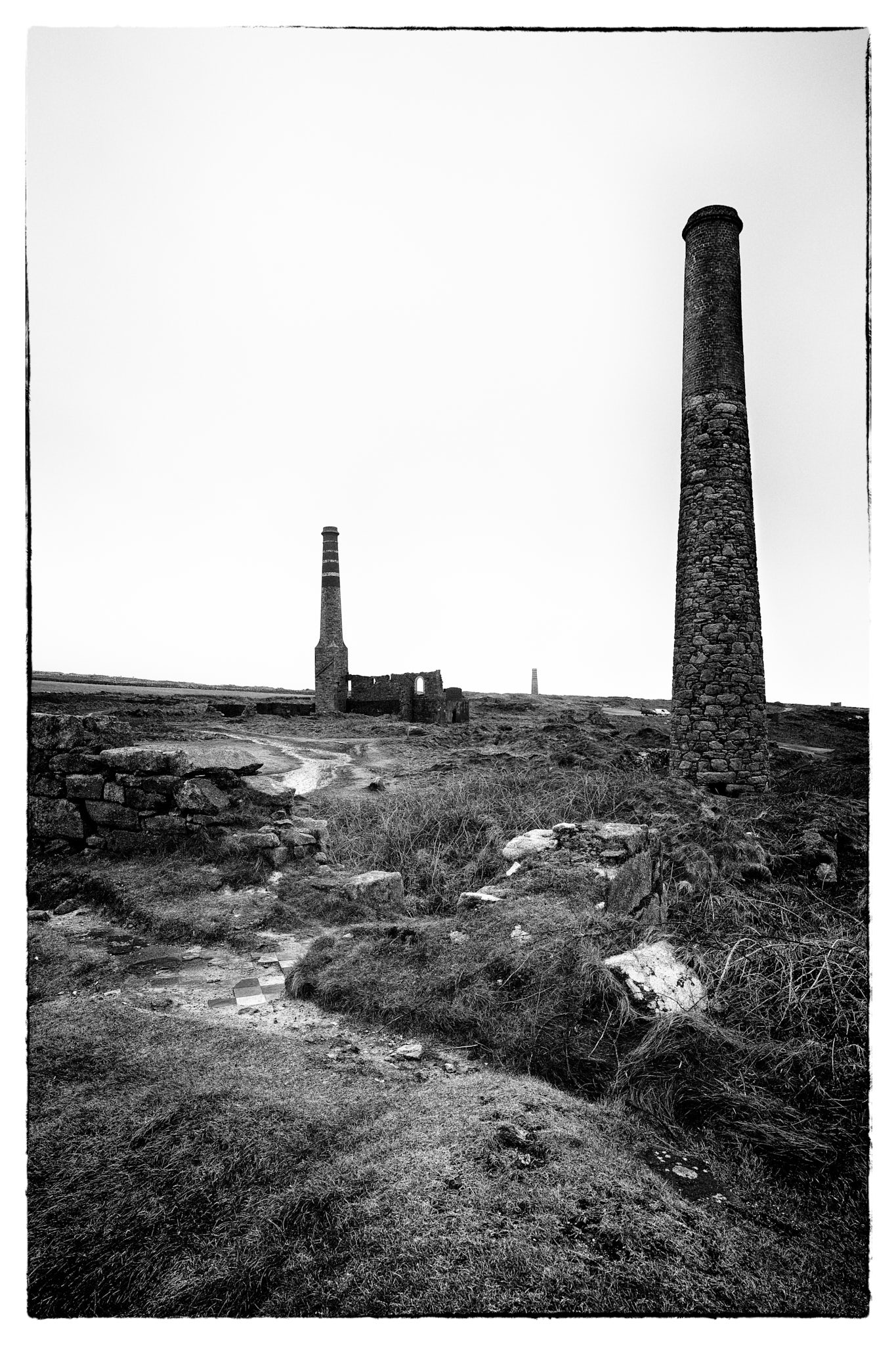
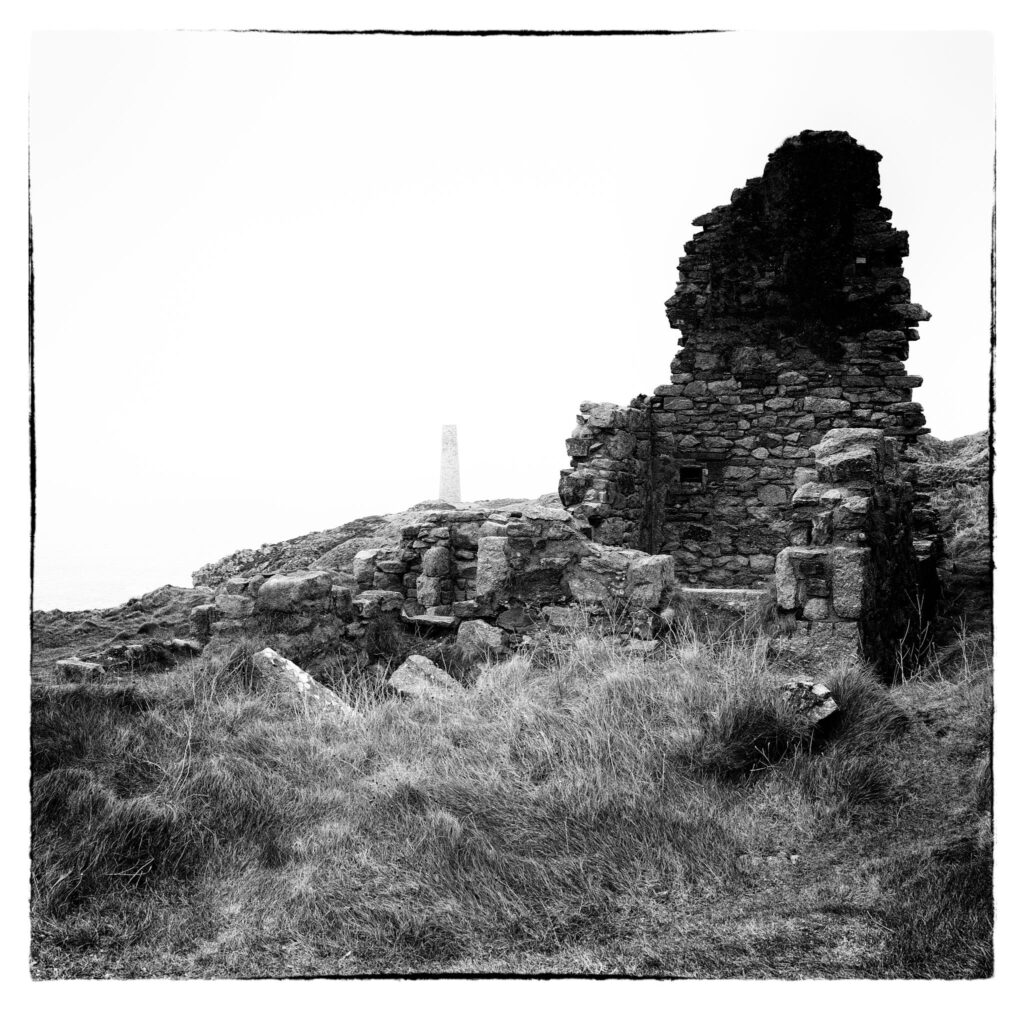
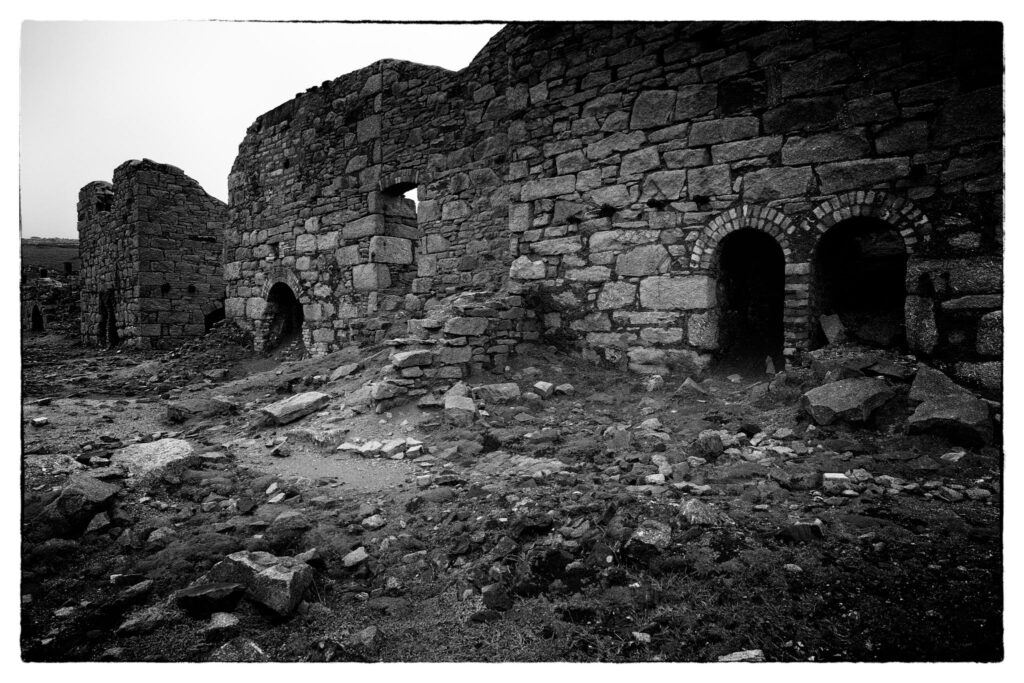
OK, so the weather wasn’t all bad. There were a couple of nice mornings, evenings and good light at other times. In fact there were a couple of days when the sun got under the clouds and provided the most dramatic of sights. But that’s a teaser for the next post! Herein I thought I’d share four photographs from the Levant tin mine, or what’s left of it, as it’s long since derelict. I’ve chosen a Film Noir styling to add that dark, grungy feel to the photographs.
My first visit was in an afternoon. I’d given up on photography in the morning and retreated to St. Ives to stay warm, dry and explore a little; it was Boxing day 2019. Parked just above the world’s only Cornish beam engine still operated by steam at its original site I sat in my truck buffeted by wind and rain hatching a plan for some dark, moody black and white photographs of the old mine structures. When the rain stopped it was about a half hour before sunset, the sky was blanketed in thick cloud and it was getting dark fast. I explored several different compositions but afterwards only one was acceptably sharp due to the blustery wind. But it was enough to give me hope that the idea was worthwhile and a return visit.
Levant tin. No. 2
The next morning I was back in better conditions! Not quite so windy but still completely grey with a sea fog hanging over the land and obscuring distant structures. Believe me, it was better! Keeping the Lee filters clean was still a challenge; the sea fog condensed on everything but the game was on!
Photographing chimneys without a tilt and shift lens was interesting and some post capture work has been necessary to reduce converging verticals. For the most part this has worked but I’d recommend a tilt and shift lens for anyone thinking about doing something like this 😉
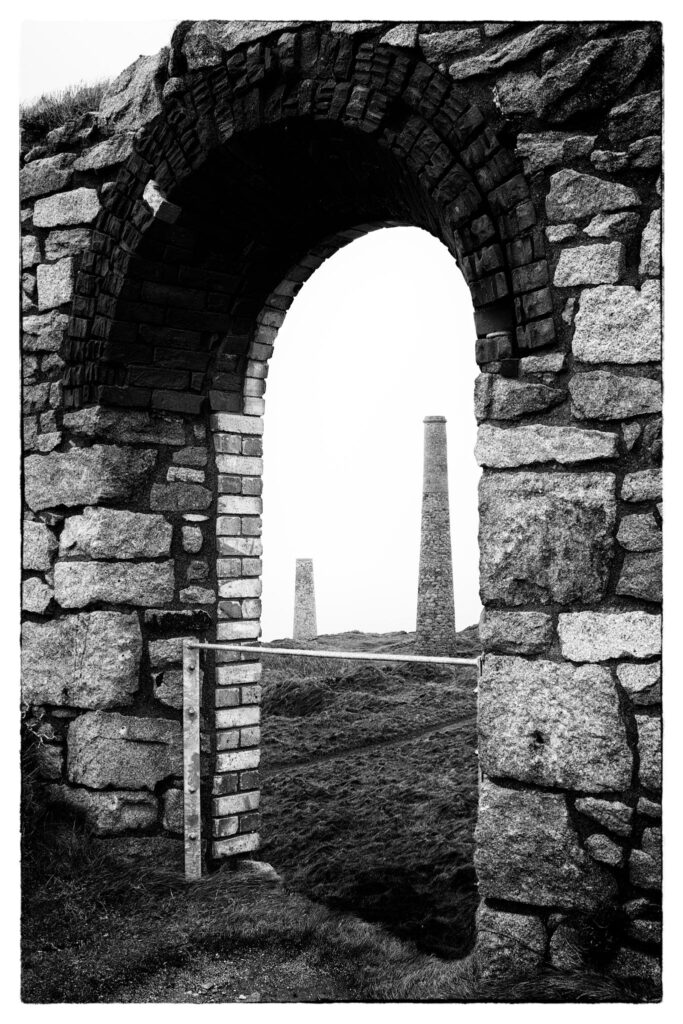
The photograph above is of a large doorway and, today, on its far side is a 15-foot drop to the ground below. Some safety minded person has decided to erect a modern steel bar across the doorway to stop people stepping through and falling to the ground below! In an edit of this image I removed the bar in post but, in the end, decided it’s retention helped emphasise the drop!
Apart from the buildings that house the Cornish Beam engine which is maintained by the National Trust, there isn’t much left on the surface of the mine today. I’ guess many of the old tunnels that extended significant distance out under the sea are probably now flooded and/or collapsed. It’s was an interesting site to explore and something that I think works best on moody days when the weather is not good for much else!
Andy
All images are Copyright Andy Gawthrope Photography
In 1996, work brought me to Bristol or Brizzle as it sounds in the local dialect known as Bristolian. Listen here. Over the years I’ve really grown to like the place. It is not too big nor is it too small and it has history. It can be linked to many significant events such as the discovery of North America in 1497 by John Cabot, the construction of technologically advanced ships including the Great Western in 1837 and the SS Great Britain that launched in 1843, blue glass production (known as Bristol Blue) and many nautical phrases such as Shipshape and Bristol fashion whose origin is rapidly fading into the mist of time.
Bristol sits on the Western side of England close to Wales. It has always had a sea port and to this day has strong trading links across the world. Bristol is perhaps most well known for its links with the America’s, tobacco, slaves and pirates with Edward Teach aka Blackbeard being the best known.
In the 23 years I’ve lived in Bristol it has evolved and mostly for the better. Take for example the harbour area which has almost completely been regenerated. The derelict buildings that were a legacy of a time when trading ships laden with goods used to sail/steam/motor directly into/from the city are gone, replaced with a vibrant area filled with restaurants, pubs and public spaces. Somehow, a few old cobbled streets and buildings have survived though and these help connect modern Bristol with itself through time for us all to appreciate. Modern Bristol is a mix of buildings from all ages; the very old, through Victorian terraces, tower blocks and the very latest designs of stone and glass.
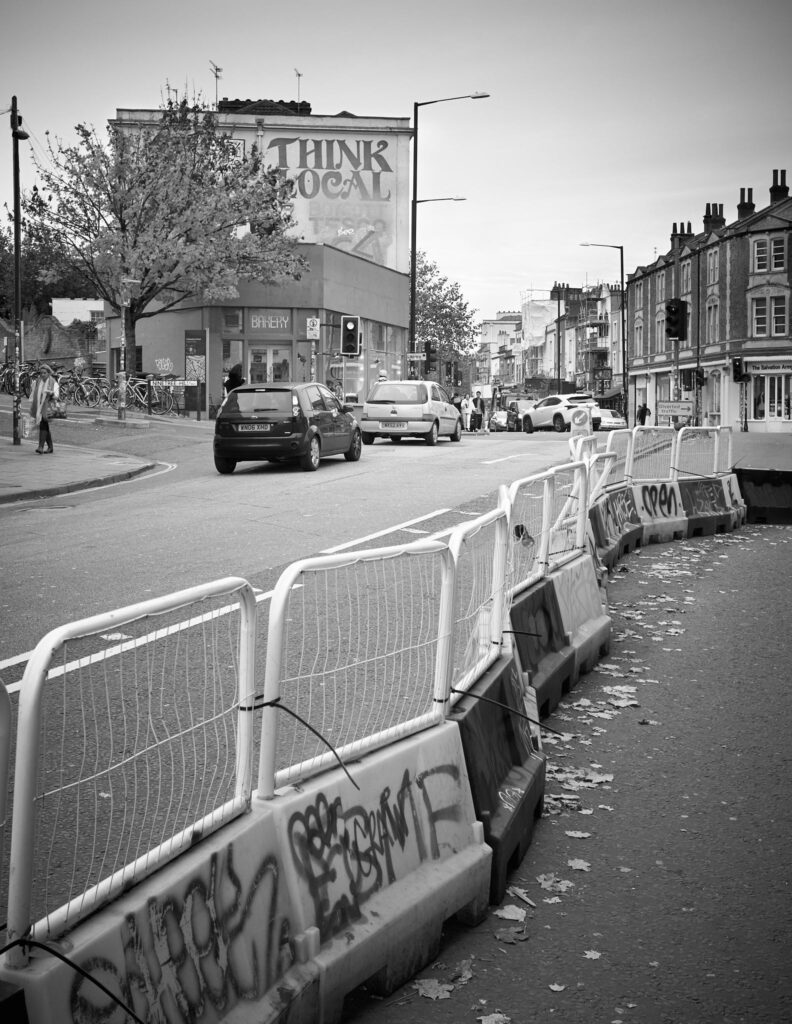
Like all cities Bristol has had its troubles and darker times too. More recently, St Paul’s had riots in 1980 and 1987, Hartcliffe in 1992 and Stokes Croft in 2011. Time has, for the most part, healed those wounds but some signs especially of the 2011 trouble remain. An example is the ‘Think Local’ and fading ‘Tesco’ on the side of a building close to the Tesco site and the centre for the 2011 unrest.
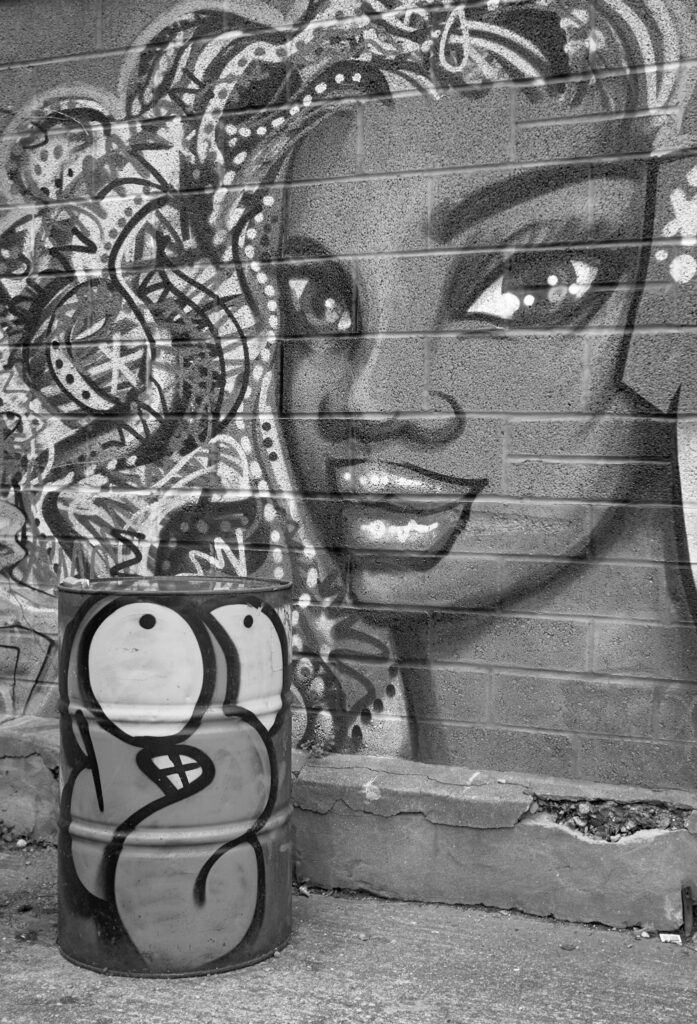
The majority of the photography in this post comes from the Stokes Croft area. Today, it’s a wonderfully bohemian area filled with independent, free thinking people who are not adversed to doing things differently. The area still seems to ‘Think Local’ and has many independent restaurants, clubs and shops. It has been described as Bristol’s cultural quarter, conservation area and outdoor gallery. I particularly like the idea of the latter.
Bristol street art
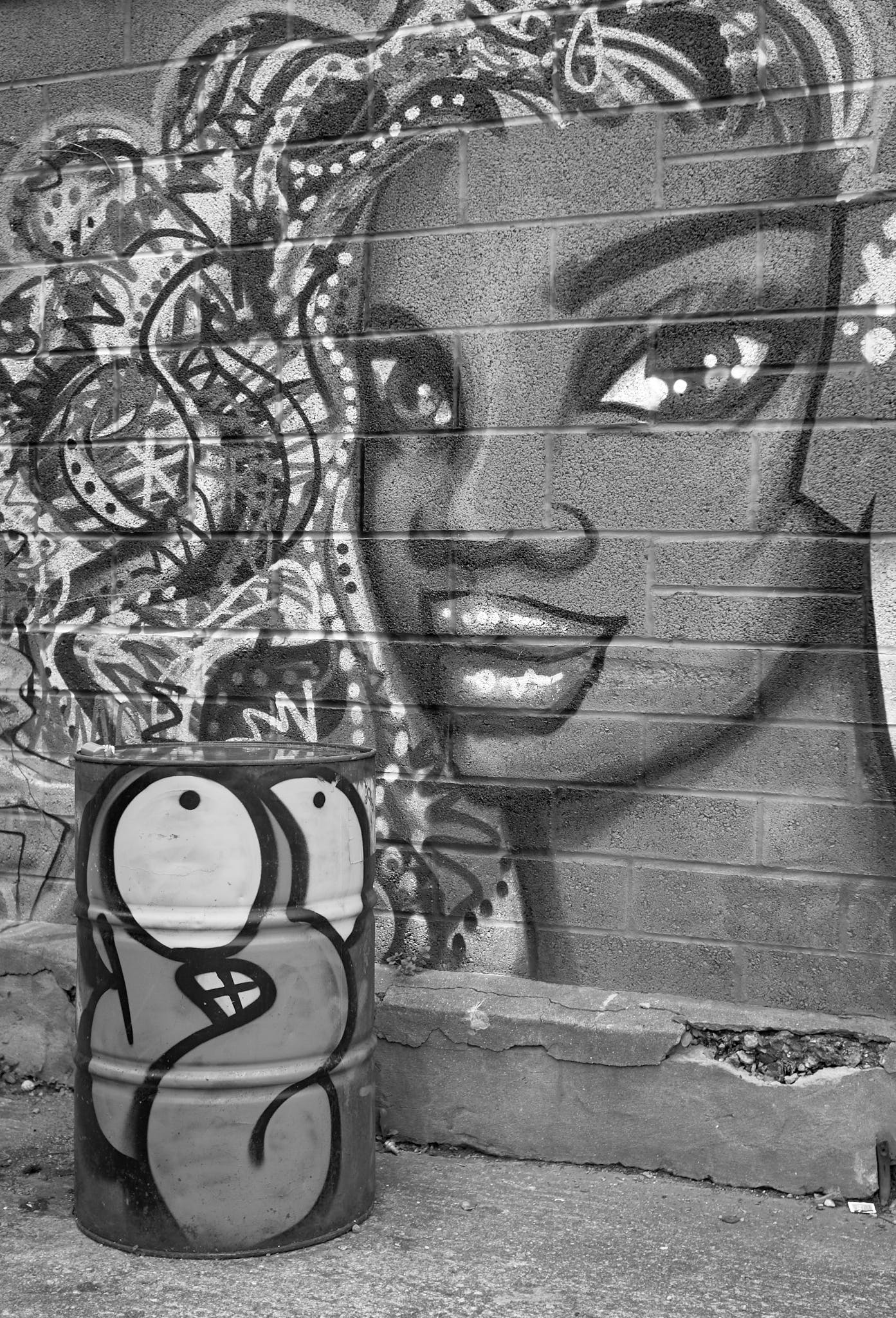
In recent years Bristol has become known for its street art thanks, in part, to the artist known as Banksy. Banksy has placed many now famous paintings on city buildings. Some think all such painting vandalism. However, as you will see in this post and subsequent posts in the series, much of the painting is artistically strong, colourful and brings a vibrance and character to the area’s in which it exists. Visitors come specifically each year to walk the city looking at the artwork. It is a tourist attraction and an attraction that is forever changing as new work is placed over old.
Some of the paintings are huge covering a large proportion of a tower block, others are quite small. Strangely, whether small or large its easy to miss many unless you happen to be some distance away, perhaps on the other side of a street. Whilst walking you need to keep looking around as often they may be directly above you!
I hope you enjoyed part 1. In part 2 I write about Bristol’s famous Lakota club and Full Moon club which both sit on the Southern boundary of Stokes Croft.
Andy
All images are Copyright Andy Gawthrope Photography.